My 4-Year-Old Daughter Suddenly Passed Away at Daycare – Then Her Teacher Called and Said, ‘I Sent You the Security Footage. Your Husband Is Lying’
Jul 12, 2026

My 4-Year-Old Daughter Suddenly Passed Away at Daycare – Then Her Teacher Called and Said, ‘I Sent You the Security Footage. Your Husband Is Lying’

A few days after my daughter’s funeral, her daycare teacher sent me a video that changed everything. What I saw shattered my trust in my husband and revealed a truth I never imagined.

189

The morning my four-year-old daughter, Ava, fell ill seemed completely ordinary. She sat at the kitchen counter in her pink pajamas, chatting through her favorite stuffed rabbit while I rushed to prepare for work.

I had planned to take her to daycare, but an unexpected meeting forced me to leave early. My husband, Mark, offered to handle the drop-off.

“Don’t worry,” he said with a smile. “I’ve got it.”

I kissed Ava goodbye, promising we’d stop for chicken nuggets after daycare.

It was the last promise I ever made to her.

A few hours later, I received a frantic call from her teacher. Ava had suddenly become seriously ill, and an ambulance had taken her to the hospital.

By the time Mark and I arrived, doctors were already fighting to save her.

They couldn’t.

The doctor explained that Ava had suffered a severe allergic reaction.

Nothing made sense.

She had been perfectly healthy that morning.

The days that followed blurred together. Flowers filled our home. Friends and family came and went. I barely slept, barely ate, and barely spoke.

Mark handled everything—the funeral arrangements, paperwork, and conversations with relatives. Whenever questions came up, he answered them before I could.

At the time, I believed he was helping me through the worst moment of my life.

I didn’t realize he was hiding something.

Five days after the funeral, Ava’s teacher, Miss Greenwood, called again.

She sounded nervous.

While reviewing security footage from the daycare, she had noticed something concerning and felt I needed to see it.

Minutes later, the video arrived.

At first, nothing seemed unusual.

Mark walked Ava toward the daycare entrance.

Then a woman appeared beside them.

She handed Ava a bottled drink and spoke to her warmly.

The woman wasn’t a stranger.

It was Lauren, one of Mark’s coworkers.

I recognized her immediately.

The footage showed Lauren touching Mark’s arm affectionately before the two of them walked away together.

My heart dropped.

Suddenly, months of strange behavior came rushing back.

The late-night texts.

The locked phone.

The endless “work dinners.”

The excuses.

I called Miss Greenwood, who admitted that Ava seemed unusually comfortable around Lauren.

That bothered me even more.

It suggested they had met before.

Part 2:
When Mark came home that evening, I confronted him.

The moment I mentioned Lauren, his expression changed.

After several painful minutes, he finally admitted the truth.

He and Lauren had been having an affair for six months.

The confession felt like another funeral.

Then he revealed something even worse.

On the morning Ava died, he had picked Lauren up before taking Ava to daycare.

Lauren had brought drinks from a nearby café—coffee for Mark and a smoothie for Ava.

“What kind of smoothie?” I asked.

“Strawberry banana,” he replied.

My stomach tightened.

Ava had a serious dairy allergy.

Everyone close to us knew that.

Lauren didn’t.

Mark had never told her.

The smoothie contained dairy products.

In that moment, everything became clear.

Ava’s death wasn’t caused by some mysterious medical event.

It happened because my husband was distracted by his affair and failed to protect our daughter.

He had handed her a drink without checking it.

A drink that triggered the allergic reaction that took her life.

Even worse, instead of telling me the truth immediately, he had tried to keep everything hidden.

The funeral arrangements.

The rushed explanations.

The repeated attempts to stop me from asking questions.

He wasn’t protecting me.

He was protecting himself.

The next day, I visited the café shown in the footage.

An employee confirmed that the smoothie contained yogurt and whole milk and that allergy information was clearly displayed.

That was all the confirmation I needed.

Later, Lauren asked to meet me.

She arrived in tears.

She insisted she had never known about Ava’s allergy.

For the first time, I believed her.

Lauren had made a terrible mistake, but she hadn’t acted with malice.

The real betrayal belonged to Mark.

He had brought another woman into our daughter’s life without my knowledge and ignored responsibilities he should never have forgotten.

When I returned home, Mark sat waiting for me.

He looked exhausted.

Part 3:
Broken.

“I loved Ava,” he whispered.

I looked at him for a long time before answering.

“I think you loved being seen as a good father more than you loved paying attention.”

He broke down crying.

But by then, I felt strangely calm.

The mystery that had haunted me for days was gone.

What remained was a painful truth built on deception, selfishness, and negligence.

Our marriage ended long before that conversation.

I simply hadn’t known it yet.

Now, my focus is no longer on Mark, Lauren, or their choices.

My focus is learning how to live with the loss of my daughter and finding a way to move forward, one day at a time

More Details
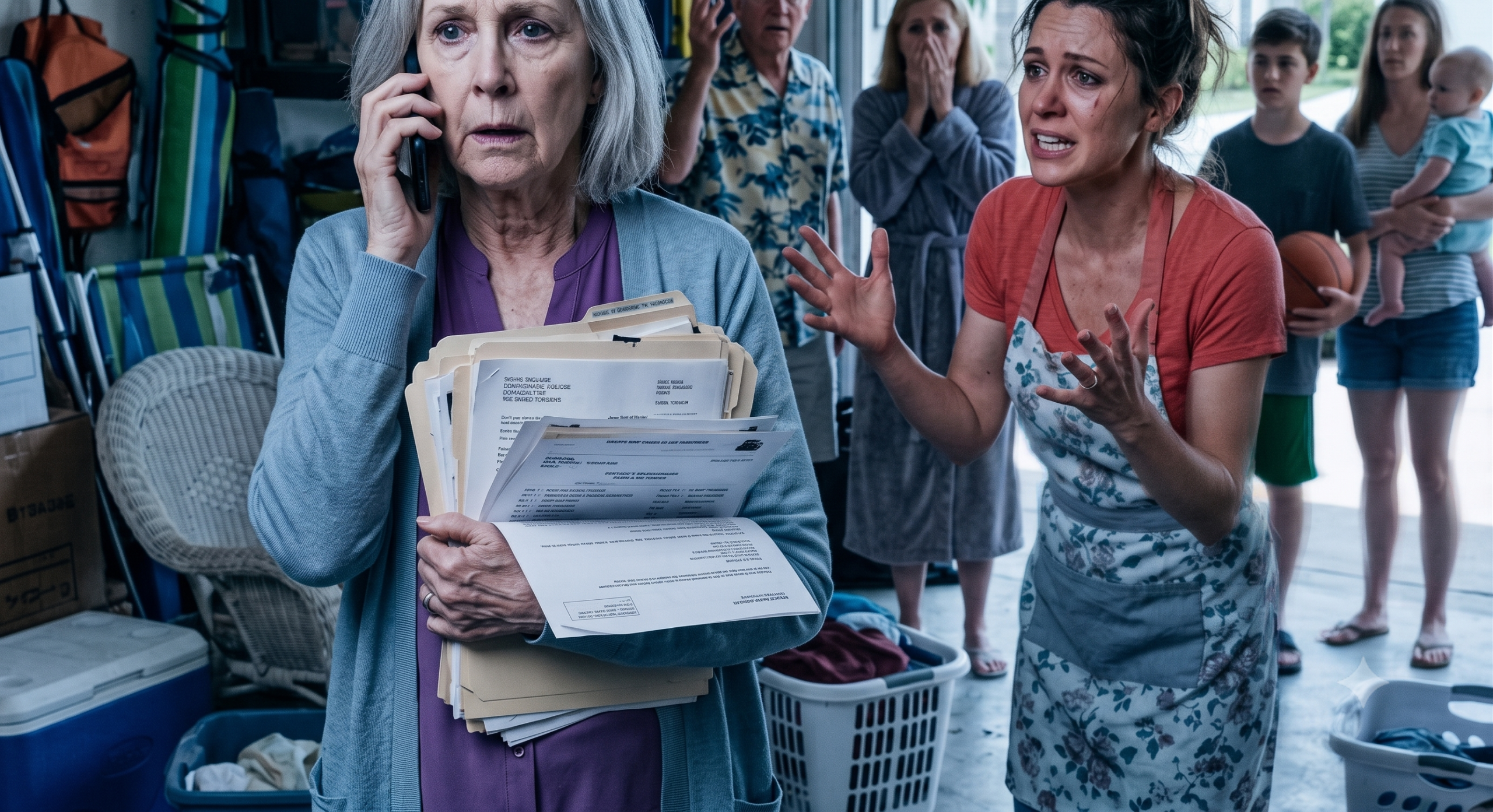
I went to my quiet Malibu beach house at 70, hoping to rest, but found my daughter-in-law already inside with her entire family as if it were a vacation rental. When she looked at me with pure contempt and said, “What is this old parasite doing here—there’s no room for you,” I only smiled… because she had no idea she had just started a war she could never win.
Jul 12, 2026

I went to my quiet Malibu beach house at 70, hoping to rest, but found my daughter-in-law already inside with her entire family as if it were a vacation rental. When she looked at me with pure contempt and said, “What is this old parasite doing here—there’s no room for you,” I only smiled… because she had no idea she had just started a war she could never win.

The day my daughter-in-law called me an old parasite while standing in the doorway of the beach house I had paid for with forty years of bent fingers and aching shoulders, I did not scream.

That was what frightened her most, I think.

Not at first. At first, Jessica believed my silence was weakness. She believed my thin gray hair, my careful shoes, and my old leather handbag meant I was the kind of woman who could be pushed to the edge of her own life and told to make room for younger, louder people. She believed the house behind her belonged to her because she had slept there a few weekends, because she had learned where I kept the good plates, because she had married my son and assumed that marriage was a set of keys to everything his mother had ever built.

She was wrong.

My name is Eleanor Vance. I was seventy years old when this happened, though I did not feel seventy until that morning. Before then, age had simply been a number attached to my driver’s license, a list of vitamins in my kitchen cabinet, and the small stiffness in my knees when I climbed stairs too quickly. I still drove myself from Chicago to California twice a year when I wanted the long road and flew when I wanted to be sensible. I still gardened. I still hemmed my own dresses. I still kept receipts in labeled envelopes because a woman who grows up poor learns that paper can protect her when people will not.

The Malibu house was never meant to impress anyone.

That was what Jessica never understood.

To her, it was a view, a location, a weekend destination, a place to take pictures on the terrace with the Pacific behind her and tell her friends she was “escaping to the coast.” To me, it was proof. Proof that I had survived widowhood. Proof that a woman could lose the man she loved and still build something beautiful with hands that shook from grief. Proof that every late night at a sewing machine, every skipped vacation, every repaired coat, every wedding dress altered for another woman’s daughter had not disappeared into thin air.

I had not bought that house because I had money.

I bought it because my grief needed somewhere to breathe.

When my husband, Thomas, died, I was fifty years old. Too young, people said, though grief does not care whether the age sounds fair. He had spent thirty years promising me we would retire somewhere near the ocean. “Not Florida,” he used to say, because Thomas had opinions about humidity. “Somewhere with cliffs. Somewhere where the water looks dramatic.”

We lived in Chicago then, in a narrow house with a small yard and radiators that hissed through winter. I sewed for a living, first in a bridal shop, then for private clients after my hands became known among women who cared about seams and patience. I could take in a gown without changing its soul. I could rebuild a bodice overnight. I could turn a thrifted suit into something elegant if the woman wearing it stood still long enough.

Thomas worked for the city. He fixed things. Pipes, meters, budgets, neighbors’ lawn mowers when they asked nicely. He was a good man in the quiet ways that never make headlines. He loved our son, Robert, with a gentleness Robert did not fully appreciate until he was a man himself.

Then Thomas’s heart failed one Wednesday morning while he was trimming the hedge.

He was gone before the ambulance arrived.

For months afterward, I existed in the house like a ghost who still paid bills. Robert was twenty-five then, newly working, newly proud, still calling me when his check engine light came on. He came by often at first, standing in the kitchen awkwardly because neither of us knew how to speak around Thomas’s absence.

One night, while sorting through a drawer, I found a folder Thomas had labeled “Ocean Someday.” Inside were magazine clippings, handwritten notes, and an old listing for a small, neglected beach property above Malibu. It had been far beyond our reach when he saved it. The house was in poor condition, the lot overgrown, the roof questionable, the retaining wall needing work.

I should have thrown it away.

Instead, I flew to California.

I stood on that overgrown lot with weeds scratching my ankles and the Pacific rolling below like a living thing, and for the first time since Thomas died, I felt something inside me move toward tomorrow.

The realtor warned me it needed too much work. The inspector listed problems with a kind of professional pity. Robert told me gently that maybe grief was making me romantic.

Maybe it was.

But grief is not always foolish. Sometimes it sees the thing your ordinary life was too practical to imagine.

I bought the house.

Not easily. Not dramatically. With savings, insurance money, the sale of a small parcel Thomas and I had inherited, and a modest loan I attacked with the same discipline I brought to every seam I ever stitched. I did not renovate it all at once. I could not afford that. I did what I could, one project at a time. New roof first. Electrical next. Plumbing after that. Tiles for the kitchen bought on sale and carried home in the trunk of a rental car. Plants from nurseries, tucked into the soil by my own hands. Wicker chairs for the terrace after the first summer I could sit outside without looking at unfinished walls.

Every piece mattered because every piece had cost me something.

Robert understood that once.

The first summer the porch was finished, he helped me carry two wicker chairs out to face the ocean. He was thirty by then, broad-shouldered like his father, with the same habit of rubbing the back of his neck when emotions came too close.

He set the second chair down and looked at the house glowing in late sunlight.

“Mom,” he said softly, “this place is a miracle.”

“No,” I told him. “It’s a mortgage.”

He laughed, then kissed my cheek. “It’s your miracle.”

For years, that was what he called it.

Mom’s miracle.

When Robert married Jessica, I tried to welcome her into it.

I truly did.

Jessica was pretty in a sharp, polished way, with blond hair always arranged as if she expected a camera and a smile that appeared quickly but rarely reached her eyes. She came from a family that valued appearances the way some people value honesty. Her mother, Celeste, wore pearls to breakfast and corrected waiters with a sweetness more insulting than anger. Her sister, Veronica, moved through life as if every inconvenience were a personal attack.

Still, Jessica made Robert happy at first. Or he looked happy beside her, which I mistook for the same thing.

I invited them to Malibu for birthdays. I cooked dinners. I showed Jessica where I kept fresh towels, sunscreen, extra blankets, and the good white plates with the blue edge. I let her use my kitchen. I let her borrow my sunhat. I let her stay in the guest room and wake to the ocean because I wanted her to feel she had gained a mother, not an opponent.

That was my first mistake.

Entitlement rarely enters through a broken window.

It walks in through a door opened with love, compliments the view, and begins deciding what belongs to it.

Over time, little things shifted. Jessica stopped asking if she could open wine from the cabinet and simply opened it. She invited friends for “just the afternoon,” then stayed overnight. She rearranged my pantry because my system “made no sense.” She posted photos from my terrace with captions like “Our little coastal escape,” and when I gently corrected her, she laughed.

“Oh, Eleanor, it’s just social media.”

Robert heard these things and looked uncomfortable, which is to say he did nothing.

I should have changed the locks earlier. I know that now. But mothers are slow to protect themselves from their children because we remember them small. We remember fevered foreheads, lost teeth, first heartbreaks. We remember the boy who called a beach house a miracle, and we hesitate to treat the man like someone who might let that miracle be used against us.

I had given Robert a spare key years earlier for emergencies. The agreement was written because I have always believed love and paperwork can live under the same roof. He teased me about it when he signed.

“Mom, you make everything official.”

“And you will thank me one day,” I said.

The agreement was simple. The key was for emergency access, repairs, and visits I approved in advance. No overnight guests without permission. No parties. No transferring the key. No removal of my personal belongings.

Robert kissed my forehead. “You think I’m going to rob you?”

“No,” I said. “I think people forget boundaries when they are not written down.”

He laughed.

Years later, nobody was laughing.

That Friday morning, I drove up the coastal road expecting quiet.

It was late October, one of those California mornings that feels almost indecently beautiful. The sky was clear and blue, the ocean polished by sunlight, the air scented with salt, eucalyptus, and the faint dry sweetness of chaparral. I had come to Malibu for a long weekend to review tax papers, prune the geraniums, and sit with coffee on the terrace where Thomas should have sat beside me.

Robert had texted the night before.

Mom, Jessica may stop by tomorrow afternoon to pick up a few things we left last time. Is that okay?

I had replied: She may stop by between noon and three. No overnight guests. I will arrive Friday afternoon.

He sent back: Understood. Thanks, Mom.

Understood.

A useful word when people mean it.

I turned into my driveway just after ten and saw six unfamiliar cars.

Not one.

Six.

Two crowded into the garage. One parked across the front walkway. A black SUV half on my lawn. Another car near the side gate. Music thudded from inside the house, bass rattling through the walls I had paid to restore. Beer cans lay scattered across the grass. A beach ball rolled lazily across the path. My red geraniums—the ones I had trimmed by hand every visit—had been knocked over, soil spilled across the terrace.

For several seconds, I sat in the car with my keys in my hand.

The mind is merciful at first. It searches for innocent explanations. Maybe Robert was there. Maybe there had been an emergency. Maybe Jessica had misunderstood. Maybe the cars belonged to workers, though workers rarely arrived with coolers, towels, and children shrieking across a patio.

Then I saw a teenage boy run past the window carrying one of my decorative pillows under his arm.

Something inside me went still.

I got out of the car.

The closer I came, the worse it became. Wet towels lay over my wicker chairs. Cigarette ash dotted the porch rail. Someone had dragged a cooler across the mosaic tiles and left a scratch behind. A toddler held one of my seashell bookends in both hands. Through the open door, I could see strangers moving through my kitchen.

Then Jessica appeared in the doorway wearing my apron.

Not just any apron.

My embroidered linen apron, the one I had made ten years earlier during the winter after Robert moved into his first apartment. Cream fabric, blue stitching, tiny flowers along the pocket. It was not valuable to anyone else. It was valuable to me because I had sewn it while teaching myself how to live alone without collapsing.

Jessica had tied it carelessly at her waist, a glass of white wine in one hand.

She looked at me, and annoyance crossed her face before surprise did.

“Eleanor,” she said. “What are you doing here?”

I looked past her into my own house. Celeste sat in my living room with her feet on the coffee table. Veronica stood near the fireplace scrolling on her phone. Two teenage boys hovered by the destroyed geraniums, suddenly aware they had been caught. A man in a Hawaiian shirt held a cooler against his hip. A young woman bounced a baby near the hallway.

“This is my house,” I said.

Jessica laughed.

Not loudly. Not nervously. Dismissively.

“What is this old parasite doing here?” she called over her shoulder. “There’s no place for you.”

The terrace went quiet.

That was the moment I learned exactly what kind of people she had brought into my home.

Because no one corrected her.

No one said, Jessica, stop.

No one said, This is Eleanor’s house.

No one looked ashamed except Veronica, and even she looked more afraid of inconvenience than injustice.

Celeste gave me a slow look from inside, her eyes traveling over my linen pants, my sensible shoes, my old handbag. “Perhaps Eleanor forgot there was a family gathering this weekend.”

Family gathering.

In my house.

Without me.

The teenage boys snickered softly.

Quiet cruelty can cut deeper than shouting because it assumes you will help by shrinking.

I did not shrink.

“Jessica,” I said, “where is Robert?”

“Working,” she said. “As usual. Some people have responsibilities.”

The insult was lazy, but the confidence behind it was not. She believed she had power here. Not legal power. Social power. The kind younger women sometimes think they have over older women because they are married to someone’s son and everyone is too uncomfortable to challenge them.

“I gave permission for you to stop by this afternoon,” I said. “Not to move your family into my house.”

She rolled her eyes. “Oh, don’t be dramatic. It’s the weekend. The house is empty most of the time anyway.”

“It is not empty. It is mine.”

“Robert is your son.”

“Yes.”

“So what’s yours is his. And what’s his is mine. That’s how normal families work.”

I felt my key bite into my palm.

A younger version of me might have shouted. A grieving version of me might have cried. A lonely version of me might have tried to reason with her.

But I was seventy years old, and I had spent enough years sewing silk for wealthy women to know that bad seams must be cut cleanly. Pull gently and the whole garment warps.

“I need to go to my bedroom,” I said.

Jessica stepped slightly to block the doorway.

“The bedrooms are occupied.”

I stared at her.

She lifted her chin. “Look, Eleanor, there’s no room for you here. The kitchen is being used. The kids are settled. Your presence is only going to create tension.”

“My presence,” I repeated.

“In the nicest possible way, yes.”

One teenage boy, emboldened by her tone, muttered, “She could just get a hotel.”

Jessica smiled.

And that was when I smiled too.

Not warmly.

Not kindly.

“All right, dear,” I said. “I understand the situation perfectly.”

Jessica mistook that smile for surrender.

That was her first mistake.

I drove to the Pacific View Inn and paid $285 for a room I never should have needed. The woman at the desk asked if I was in town for the weekend. I nearly told her the truth just to see what her face would do.

Yes, I am visiting because strangers are sleeping in the bed I bought.

Instead, I said, “Something like that.”

The room was clean and beige, with a balcony facing the water. From there, I could see the warm glow of my house in the distance. It looked peaceful. Welcoming. As if it had not just watched me be turned away.

That offended me more than Jessica’s insult.

At 9:17 p.m., I opened the notebook I kept in my travel bag.

I wrote everything down.

Six cars. Broken geranium pots. Beer cans on lawn. Cigarette ash on porch rail. Wet towels on wicker chairs. Jessica wearing embroidered apron. Exact words: “old parasite,” “no place for you,” “your presence will create tension.” Approximate number of guests: sixteen. Possible minors present: four.

Then I opened the property folder I always carried during tax season. Deed. Mortgage payoff papers. Utility bills. Insurance policy. Los Angeles County property tax records. Emergency access agreement signed by Robert. Recent text message exchange printed from my phone at the hotel business center.

Paper remembers what people try to bully out of existence.

I slept little.

At eight the next morning, I returned.

The front door was locked.

My own front door.

I rang the bell.

Veronica opened it in pajamas, hair tangled, face already irritated.

“What do you want now?”

I looked at her for a long moment. “Good morning. I need to gather personal belongings and speak with Jessica.”

“She’s asleep.”

“Wake her.”

Veronica crossed her arms. “Your stuff’s in the garage.”

“My stuff?”

“Jessica had us move it so it wouldn’t be in the way.”

In the way.

My clothes. My photographs. My linens. My records. The life that had paid for the roof over her head.

I walked past her.

She protested, but weakly. People are often bold only when they think you will obey.

The garage door was open. Inside, near the storage shelves, I found black garbage bags.

One had split. My cardigan sleeve hung out. Another held framed photographs wrapped in a damp towel. My wedding picture leaned crookedly against a plastic bin. My old sewing ledger from Chicago—the one where I had recorded years of clients, payments, fabric costs, and dreams—had one corner bent. The embroidered pillowcases I made after Thomas died were crushed beneath beach toys.

For a moment, I could not move.

Then I took out my phone and began photographing everything.

The garbage bags.

The split seam.

The bent ledger.

The wedding photo.

The broken pots outside.

The cigarette burn on the wicker chair.

The ash on the railing.

The beer cans under the bougainvillea.

Jessica entered while I was photographing the apron still hanging from her neck.

“What are you doing?” she snapped.

“Documenting.”

Her eyes went to the folder in my hand. “What are those papers?”

Before I answered, my phone rang.

Robert.

I put him on speaker.

“Mom?” His voice sounded tense. “Jessica said you showed up and upset everyone.”

I looked directly at Jessica. “Did she?”

Jessica’s face tightened.

“Mom, what’s going on?”

“Your wife moved her family into my Malibu house without permission, packed my belongings into garbage bags, damaged my garden and furniture, wore my personal things, and told me there was no place for me in my own home.”

Silence.

Then Robert said, “What?”

Jessica stepped forward. “Eleanor is exaggerating. We came for one weekend. She’s being territorial.”

I held up the printed text message even though Robert could not see it. “You asked if Jessica could stop by for an afternoon. I replied no overnight guests and told you I would be arriving Friday. Do you remember that?”

A pause.

“Yes,” he said.

Veronica, standing near the door now, went pale. “Jess, you said she knew.”

Jessica’s eyes flashed. “Stay out of it.”

Celeste appeared behind her, wrapped in one of my guest towels as if this were a resort. “This is absurd. Eleanor, you are creating a spectacle over a family weekend.”

“No,” I said. “Jessica created the weekend. I am creating the record.”

Robert’s voice cut through the speaker. “Jessica, tell me you didn’t throw my mother out of her own house.”

Jessica looked around. The audience she had gathered for my humiliation was now watching her carefully.

“She had somewhere else to go,” Jessica said.

The silence after that was colder than any answer.

I heard Robert inhale sharply.

“Mom,” he said, voice low, “I’m coming.”

He arrived in less than an hour.

I know because I timed it.

He came into the garage without his work jacket, hair still damp from a rushed shower, face pale in a way I had not seen since Thomas’s funeral. For one second, I saw my son as a little boy again, looking at something broken and hoping I could fix it.

Then he saw the garbage bags.

His face changed.

“Mom,” he whispered.

I did not comfort him.

Mothers spend too much of their lives absorbing the consequences of their children’s cowardice. I had no intention of absorbing this.

Jessica began speaking quickly. “Robert, before you overreact, your mother is making this sound horrible. We moved a few things carefully. The house was empty. My family needed a place for the weekend. You said we could use it.”

“I said you could stop by.”

“You always say your mother won’t mind.”

Robert looked at her. “I never said you could throw her things in the garage.”

“They were in the way!”

The words rang out.

There it was again.

In the way.

Robert looked at me. Then at the bags. Then at the apron tied around Jessica’s waist.

His voice changed.

“Take it off.”

Jessica blinked. “What?”

“My mother’s apron. Take it off.”

She laughed nervously. “Are you serious?”

“Now.”

That was the first time Jessica looked frightened.

Not because of the apron, but because she finally realized Robert was not automatically standing between her and the consequences.

Slowly, angrily, she untied it and tossed it onto a storage box.

I picked it up, folded it once, and laid it beside my folder.

Then I opened the emergency access agreement and placed it on top of the bin.

“Robert,” I said, “do you remember signing this?”

He looked at it and swallowed. “Yes.”

“It says your key is for emergencies, repairs, and approved visits only. It does not permit overnight guests, parties, transfer of access, or removal of my belongings.”

Celeste made a scoffing sound. “Good heavens. You made your own son sign a contract?”

I looked at her. “And today I am grateful I did.”

Nobody had anything clever to say to that.

I gave them until noon to leave.

Jessica exploded.

She accused me of humiliating her. She said I was selfish. She said I was ruining the children’s weekend. She said I was punishing Robert because I could not handle sharing. She said old people became possessive when their lives got small.

I let her speak.

Then I said, “If everyone is not gone by noon, I will call the sheriff and my attorney. I will file a trespass report, submit a damage claim, and provide photographs, signed agreements, and text messages. I will also formally revoke all access to this property.”

Jessica’s mother stepped forward. “You would do that to family?”

“No,” I said. “I would do that to trespassers.”

The packing began at once.

It was not graceful. Children cried. Veronica muttered that she had told Jessica this was a bad idea. Celeste snapped at everyone while carrying designer luggage she had apparently unpacked in my guest room. The man in the Hawaiian shirt took three trips to load the cooler and avoided looking at me entirely. The teenage boys were assigned to pick up beer cans under Robert’s supervision.

By noon, the cars were gone.

All of them.

The silence left behind felt bruised.

The house smelled of spilled beer, sunscreen, smoke, and entitlement. Sand covered the hallway. The kitchen counter was sticky. Someone had cracked one of the blue-edged plates. My white quilt was bunched on the floor of the guest room. A damp swimsuit had been left in the sink.

Robert stood in the living room with a trash bag in his hand, looking devastated.

“I’m sorry,” he said.

“I know.”

“I should have stopped this before.”

“Yes.”

“I didn’t think she would—”

“Do not finish that sentence,” I said.

He looked at me.

“Do not tell me you didn’t think your wife would mistreat me when she has been testing how far she could go for years. You saw it. You excused it. That is why she thought she could do this.”

His eyes filled.

“I didn’t want to choose sides.”

“She counted on that.”

He sat down slowly on the edge of the couch.

“I’ve been a coward,” he said.

That was the first useful thing he had said all day.

I let the words sit between us.

Then I handed him a broom.

“Start with the terrace.”

He swept dirt from the tile while I called a locksmith. Then my attorney. Then my insurance agent. I sent photographs. I sent copies of the agreement. I sent the hotel receipt. I sent the printed text exchange. I changed the alarm code while Robert stood beside me and watched his access disappear from the system.

That hurt him.

Good.

Some pain is corrective.

By evening, the locks were changed. Robert had loaded my garbage-bagged belongings back into the proper rooms. When he found the bent sewing ledger, he cried. Not loudly. Just one hand over his eyes, shoulders shaking once.

I wanted to go to him.

I did not.

Love without consequence becomes permission.

Within one week, Robert reimbursed me for the hotel, the cleaning, the locksmith, the broken pots, the damaged wicker chair, and the cracked plate. I did not ask whether the money came from him or Jessica. I deposited the check after it cleared.

Jessica called once.

I let it go to voicemail.

At first, she was angry. She said I had embarrassed her, damaged her marriage, and made her family feel unwelcome. Then her tone changed. She said things had gotten out of hand. She said maybe she had been stressed. She said she hoped “we could all move forward.”

She never said, “I called you a parasite in your own home.”

She never said, “I packed your life into garbage bags.”

She never said, “I was wrong.”

I saved the voicemail.

People who rewrite history should never be left alone with the only copy.

Two weeks later, Robert came to Chicago.

He brought my repaired wedding frame wrapped carefully in brown paper. We sat at my small kitchen table, the same table where he had once done homework while Thomas read the newspaper.

“I’m not asking you to forgive Jessica,” he said.

“That is wise.”

He gave a sad smile. “We’re in counseling.”

“I hope it helps.”

“I don’t know if it will.”

I did not answer.

He looked down at his hands. “She thought I would always smooth things over. She thought if she pushed far enough, I’d make you accept it.”

“And would you have?”

His face twisted.

“Before that weekend,” he said quietly, “maybe.”

That honesty hurt more than a lie.

I looked out the kitchen window at the alley behind my building, at the brick walls and gray sky and laundry line strung between neighbors’ porches. Chicago was not Malibu. It did not pretend to be soft. I had always liked that about it.

“I love you, Robert,” I said. “You are my son. Nothing changes that.”

His shoulders loosened slightly.

“But love is not a spare key.”

He closed his eyes.

“The Malibu house remains mine. There will be no unsupervised access. No spare key. No casual weekends. Any visit will be requested in advance and confirmed by me in writing. If Jessica comes, she comes as a guest who understands she is a guest. If she cannot do that, she does not come.”

He nodded.

“I understand.”

“Do you?”

“Yes.”

I believed he wanted to.

That was not the same as trusting him yet.

The next month, I returned to Malibu alone.

I did not invite Robert. I did not tell Jessica. I did not announce anything to anyone.

I simply went home.

The house felt different at first, not ruined, but handled. Every room held traces I did not want. I cleaned slowly. I washed the apron twice and folded it into a drawer. I replanted the geraniums in heavier pots. I replaced the cracked plate, then changed my mind and kept the broken one wrapped in paper at the back of a cabinet as a reminder that beautiful things can survive damage without pretending it never happened.

The terrace took longest.

I scrubbed the cigarette burn. I sanded and refinished the arm of the wicker chair. I swept the tiles at sunrise and again at dusk. Each task steadied me. Women of my generation were taught to tidy away pain before guests saw it. This time, cleaning was not hiding. It was reclamation.

On the fourth evening, I sat on the terrace with coffee and opened my old sewing ledger.

Inside the front cover, written years earlier in Robert’s blue ink, were the words: Mom’s miracle.

I traced them with my thumb.

I thought about Thomas. About Chicago winters. About the first roof repair. About Robert carrying chairs. About Jessica in my apron. About my own voice saying, “I understand the situation perfectly,” while something fierce and ancient woke up inside me.

A gull cried overhead. The waves struck the rocks below. The wind moved through the curtains as if the house were exhaling.

For the first time since that Friday morning, the house sounded like itself again.

Six months later, Robert and Jessica separated.

He told me over the phone. His voice was tired but clear.

“She still thinks the problem was that you embarrassed her,” he said. “Not what she did.”

“And what do you think?”

“I think I almost let my wife steal my mother’s peace because I was afraid of conflict.”

I sat quietly.

“I’m sorry,” he said. “Not because I want the key back. Not because I want anything. I’m just sorry.”

That apology reached me because it did not ask to be rewarded.

“I hear you,” I said.

Sometimes that is all forgiveness can honestly begin as.

I did not celebrate their separation. Marriage is complicated, and other people’s broken vows are not a party. But I did feel relief. Not because Jessica was gone from Robert’s life completely—I had learned not to assume anything—but because he had finally noticed the difference between keeping peace and enabling disrespect.

The following summer, he visited Malibu with written permission, though I teased him for sending the request like a nervous tenant.

He arrived alone.

We sat on the terrace in the two wicker chairs he had carried out years before. The geraniums bloomed red between us. The sun dropped toward the Pacific. For a long time, neither of us spoke.

Then Robert said, “Dad would have hated what happened.”

“Yes.”

“He would have told me I was being weak.”

“Yes.”

“I miss him.”

“So do I.”

His eyes filled, but he did not look away.

“I forgot what this place was,” he said.

I looked at the ocean.

“No,” I said gently. “You forgot whose it was.”

He nodded.

That was enough for the day.

Age teaches you that not every wound needs a speech. Some truths do their work quietly if people are finally willing to sit still with them.

I am seventy-one now.

The house is still mine.

The spare key hangs on a hook inside my Chicago apartment, labeled Emergency Only, which makes me smile because there is no one left who receives it without understanding what those words mean. The Malibu property is in my trust now, with clear instructions, legal protections, and conditions that would make any entitled daughter-in-law break out in hives. Robert knows this. He helped drive me to the attorney’s office.

He did not complain.

That was progress.

Sometimes, when I sit on the terrace at dusk, I think about that morning in the driveway. The cars. The music. The wet towels. Jessica’s voice calling me a parasite while standing under my roof. I used to wonder whether I should have shouted. Whether I should have defended myself more dramatically. Whether a louder woman would have seemed stronger.

Now I know better.

Strength is not always loud.

Sometimes strength is a notebook opened in a cheap hotel room.

Sometimes it is a deed laid flat on a storage bin.

Sometimes it is a mother telling her grown son, “Love does not unlock the door again.”

And sometimes it is an older woman sitting peacefully in the house she built, listening to the waves, knowing nobody will ever again mistake her kindness for permission.

A home is not protected by blood.

It is protected by boundaries.

It is protected by memory, evidence, courage, and the woman who finally understands that everything she built with her own hands belongs first to her.

THE END.

More Details
My Son Stole Everything and Disappeared for 25 Years Until His Daughter Arrived With a Key and a Message
Jul 12, 2026

My Son Stole Everything and Disappeared for 25 Years Until His Daughter Arrived With a Key and a Message

The doorbell rang on a Thursday morning and I almost did not answer it.

At sixty-seven, I had learned that unexpected knocks rarely brought anything good. But the bell rang again. Not impatient. Just certain. I wiped my hands on a dish towel and looked through the narrow window beside the door.

A young woman stood on the walkway outside my apartment in San Diego, one strap of a worn backpack over her shoulder. She looked like she was in her early twenties, with dark hair pulled back and the tired posture of someone who had traveled farther than she expected. She was not dressed like a salesperson. No badge, no brochure, no practiced cheerfulness.

She looked nervous.

I opened the door halfway.

“Can I help you?”

She stared at me for a moment, then swallowed.

“Are you Rosa Delgado?”

Something about her face made my hand tighten on the knob. It was not recognition exactly. More like an old photograph trying to come into focus.

“Who’s asking?” I said.

She took a breath.

“My name is Sophia. Sophia Delgado.”

I felt the hallway go quiet around us.

“I’m Daniel’s daughter.”

My son’s name landed between us like something pulled from a grave.

I had not spoken it in years. Not to neighbors, not to the women at church, not to the pharmacy clerk who once asked whether I had children. I had buried the name because every time it surfaced it carried the same image: my husband on the floor, the safe hanging open behind him, twenty-five years of savings gone. Daniel gone with it.

Antonio had died three days later. Heart attack, the doctor said. Catastrophic damage. Clean, medical words that could not explain how a family breaks in one morning and never reassembles.

For over twenty years, my son had not called, not written, not come back. He had vanished as if he had never existed.

And now his daughter was at my door.

She had Antonio’s eyes.

That was the part that made me step back.

“Come inside,” I heard myself say.

Sophia followed me into my small apartment. One bedroom, neat but worn at the edges, the kind of place where nothing matched but everything had been cleaned and repaired until it could be cleaned and repaired no further. We ended up at the kitchen table without discussing it. I offered coffee because I needed something to do with my hands.

She wrapped both hands around her mug like she was cold, though the morning sun was already warming the window.

“He died last month,” she said.

I waited.

“Cancer. Pancreatic. He was sick almost a year.”

The news landed flat. I had already mourned Daniel. Done it in pieces for more than two decades. The first grief had been sharp, the kind that made me look toward every door when a bell rang. Then came the heavier grief, settled into my bones through the years. After that, anger moved in and made a home where sorrow used to live.

“What kind of things did he tell you?” I asked, when she said he had told her things before he died.

“About you. About San Diego. About what happened.”

“What happened,” I said flatly, “is that he emptied our safe and disappeared.”

She flinched but did not look away.

She reached into her backpack and set a small silver key on the table between my calculator and red pen. A storage-unit key. The number 247 stamped into the metal.

“He made me promise to find you,” she said. “He said everything is there. What he took. Why he left. All of it.”

I picked up the key. Cold in my palm, lighter than it should have been for carrying what it represented.

“I haven’t seen my son in over twenty years,” I said. “I didn’t know if he was alive or dead or if he ever thought about me at all.”

“He thought about you,” she said. “All the time.”

I almost laughed. Not because it was funny, but because the words reached a place I thought had gone numb.

The truth about why I had believed what I believed required going back to the restaurant. La Cocina de Antonio on University Avenue. Twenty tables, red vinyl booths, a bell above the front door, and framed photographs of Guadalajara on the walls. Antonio had done all the cooking. I managed the front of the house and kept the books. Daniel had started working there after high school and never left.

We were a family.

Antonio kept cash in a safe in the back office, an old habit from growing up poor in Guadalajara where his family had lost everything when a bank failed. Two hundred and fifty thousand dollars by the time it ended, organized in labeled envelopes, carefully added to each week. The building fund was the biggest one. Our landlord had promised to sell the property when we saved enough. Antonio dreamed of owning it outright. No one able to take it from us.

When Daniel turned twenty-one, Antonio taught him the combination.

“In case something happens to me,” he had said, “you need to be able to take care of your mother.”

Daniel memorized the numbers, tore the paper into pieces, and threw them away. Just as his father had instructed.

The morning the world changed had started like any other. Antonio went to the office early for cash before a supplier delivery. I was prepping onions and peppers in the kitchen, the radio playing norteño music low. Then I heard a heavy thud from the back.

I found Antonio on the floor. His face was gray, his hand at his chest. Behind him, the safe door hung open. Empty. Completely empty.

They kept him on machines for three days and used careful words. Catastrophic. Irreversible. I did not understand at first that those words were preparation for what came next. Antonio died without waking up. On the third day. The same day the police finished asking their questions about who knew the safe combination.

Only three people had known.

Daniel never answered his phone.

I went to his apartment on the second day. His landlord let me in. Everything was there, clothes in the closet, dishes in the sink, bed unmade. But Daniel was gone. His car was gone from the parking spot.

I went back to the kitchen table and looked at Sophia across from me.

“So whatever is in that storage unit,” I said, “you think it explains all of it.”

“I think it does,” she said quietly. “I just know there’s more to the story.”

We drove to the facility off Marina Boulevard in my aging Honda. A chain-link fence, rows of orange roll-up doors, a small office with faded blinds. Unit 247 was at the far end, tucked into the corner.

I stopped in front of it.

My palm was sweating around the key.

I fitted it into the lock. It clicked. I pulled the door up and the metal screamed on its rails.

Against the back wall sat a dark green safe.

Medium-sized. The exact same kind as the one Antonio had kept in the restaurant office.

For a moment I could not breathe right.

He had stolen from a safe and spent decades keeping everything inside another one.

A piece of paper was taped to the top. Numbers in Daniel’s handwriting. His birthday. July 15, 1978. Numbers I would know anywhere.

My hands shook, but I needed to do it myself.

Right to 07. Left past zero to 15. Right to 78.

The handle gave. The door swung open with a familiar metallic groan I had not heard in decades.

Stacks of cash. Rubber-banded, organized by denomination, each stack wrapped with a paper band marked by year in black ink. The first stacks were from the early years after he left. Then the years marched forward through the 2000s and 2010s. The most recent stack was from only months before.

“Count with me,” I said.

Sophia opened the calculator on her phone.

Stack after stack. Year after year.

Finally she looked at the screen.

“Three hundred fifty-six thousand dollars.”

I sat down hard on the concrete.

More than he had taken. More than two hundred and fifty thousand. He had added to it. Saved more. Year after year, for over two decades.

I started crying before I understood I was going to. Not the managed grief I had practiced for years, the quiet kind that knew its place. Real crying, from somewhere deep and ugly and old. Hot tears that were angry and confused and something else I did not have a name for.

Sophia sat beside me on the concrete. She did not touch me. She just stayed.

When I could breathe again, I looked back at the safe. Three cardboard boxes sat behind where the money had been.

All three were labeled Sophia.

The first held photographs. Hundreds of them. Sophia as a newborn, as a toddler with a gap-toothed smile, in school pictures spanning every year. I picked up one showing her at about seven, standing in front of a birthday cake with Daniel behind her, his hands on her shoulders. Both of them smiling, but his eyes looked sad even then. I turned it over.

His handwriting on the back.

Her seventh birthday. She asked about you today. I didn’t know what to say.

Another photo. Sophia in a pink dress, Daniel in a suit.

Her quinceañera. She’s fifteen. She looks like you when she smiles.

Nearly every photograph had his handwriting on the back. First steps today. Lost her first tooth. Honor roll again. You would be proud.

Sophia was crying too, seeing herself through her father’s eyes.

The second box held folders labeled by year. The third contained something wrapped in a blanket. We lifted it together and found a small wooden box, old and worn at the corners. Inside was a men’s watch, silver and hand-wound, its face scratched, the band worn smooth, frozen at some long-ago time.

I turned it over.

An inscription on the back: To Daniel. Graduate 1996. Love, Dad.

Antonio had given that watch to Daniel the day he graduated high school. I remembered it. Antonio had saved for months.

Beneath the watch was a photograph of the three of us in front of the restaurant. I was younger. Antonio had his arm around my waist. Daniel stood between us, grinning at the camera.

We had looked happy.

A folded note lay at the bottom of the box.

The watch was mine. Dad gave it to me when I graduated. I wore it every day, even after it stopped working. The photo was in my wallet. It’s all I had left of you both.

He had carried it with him into exile. A broken watch and a family photograph. His only connection to the father who died and the mother he had left behind.

At the bottom of the safe, beneath all the stacked money, was a sealed envelope.

Thick with pages.

Rosa, written across the front.

Sophia watched me pick it up.

“He wrote it the week before he died,” she said. “He said everything you need to know is in there.”

We drove back separately. I dropped Sophia at her hostel and sat in my parked car for a while with Daniel’s watch in the wooden box on my lap and the letter on the passenger seat.

By the time I got home the sun was setting, painting my kitchen window orange. I made tea I did not want, sat down, and opened the envelope.

Six sheets of paper, written front and back. The handwriting was shaky in places, unsteady in a way I recognized as a body near its limit.

Mom, it began.

I don’t know how to start this. I’ve written it in my head a thousand times and never found the right words. I still haven’t. But I’m dying, and I’m running out of time to be a coward.

You think I stole from you and Dad. You’re right. I did. But not for the reason you think.

That spring, Carlos Ruiz came to me with a job. You remember Carlos. We’d been friends since high school. He said he had side work. Deliveries. Paid cash. Two thousand dollars for one night. I wanted a car. I wanted to buy it myself, not ask you both for help, because you had already worked so hard for everything.

Carlos said it was easy. Just packages from San Diego to Tijuana. I should have asked what was in the packages. I should have asked why anyone would pay two thousand dollars for one night of driving.

But I was twenty-two, and stupid, and proud.

We picked up the package on a Wednesday night. A heavy box, taped shut. We stopped at a gas station off the 805 and I went inside for water. When I came back, Carlos was panicking. The car window was smashed. The package was gone.

That was when he told me what was inside.

Cocaine. Five kilos. Worth two hundred and fifty thousand dollars.

Less than two hours later, they found us. Three men pulled up while we were still at the gas station. Carlos knew them. They were not police. They took us to a house in Chula Vista and explained that we owed two hundred and fifty thousand dollars. We had forty-eight hours to bring it to Tijuana in cash.

If we didn’t, they would kill us both. Then they would visit our families.

They said your name, Mom. They knew the restaurant address. They described Dad. They told us not to go to the police and said they would know if we did.

I believed them.

I told myself I was protecting you. I told myself if I didn’t pay them, they would kill all of us. I told myself I would pay it back somehow, even if it took the rest of my life.

That night I went to the restaurant. I let myself in through the back. I opened the safe. All those envelopes were there. Years of saving. Dad’s careful handwriting on each one. I took all of it. I tried to close the safe, but my hands were shaking so badly I couldn’t. I left it hanging open.

The next day, Carlos and I drove to Tijuana. We met them at a warehouse. We handed over the cash.

Then they told us we were staying in Mexico.

They said if we crossed back, they would assume we had talked to police. That our families would become problems.

We were trapped.

That afternoon I tried calling the restaurant to explain. The line was busy. I tried again. Busy. The third time, a stranger answered and said there was an emergency and the restaurant was closed.

I found out two days later that Dad had found the empty safe.

Heart attack.

I killed him, Mom.

I emptied that safe and his heart couldn’t take it. He died thinking I had betrayed him. He died thinking I stole from my own family and ran.

How do you come back from that? How do you call your mother and say I’m sorry I killed Dad, but I had a reason?

I couldn’t. I was a coward. I stayed in Tijuana. Got construction work. Lived cheap. Saved everything. I opened a safe of my own and started filling it every week.

I labeled each stack with the year.

Then I met Sophia’s mother. We had Sophia. She left when Sophia was three and I raised her alone.

Every time I had a chance to save, I saved. Every time I thought about buying something nice or making my life easier, I saw Dad on that floor.

Sometimes I crossed the border and came to San Diego. I watched from a distance, making sure you were okay. When I saw you needed help, I helped the only way I could. Anonymously. So you would never know it was me.

The safe filled up. Years passed. Sophia grew.

I kept thinking I would come back one day. Face you. But every year that passed made it harder.

Then I got sick.

The money in the safe is yours. All of it. It was always yours. I know it doesn’t fix anything. It doesn’t bring Dad back. It doesn’t give you back all those years.

But it is all I have.

I spent my whole life trying to pay back one terrible night.

I am sorry, Mom.

Sorry I took the money. Sorry I ran. Sorry I was too afraid to face you. Sorry you had to lose your husband and your son in the same week.

I love you. I always did.

I wish I could have told Dad.

I’m sorry.

Daniel.

I set the pages down with my hands still shaking.

The tea sat untouched beside me. The streetlight came through the kitchen window, making everything look cold. I had been sitting in that kitchen for over twenty years telling myself one story about my son.

Now I had another one.

Understanding did not erase the pain. It changed it. Made it heavier in some places and softer in others.

I remembered the eviction notice three days after I lost my job at the retail store, when the hours had been cut and I could not make rent. The landlord had called, confused, and said someone had paid the balance plus late fees. He would not say who. I had thought it was an accounting error. A miracle.

It was Daniel.

The appendectomy I had one February with no insurance, the bill more than eight thousand dollars. I had cried looking at it. Then a nurse told me it had been covered by an anonymous donation to the hospital’s charity account, specifically designated for my bill.

It was Daniel.

The transmission repair one winter when my car died. The mechanic called and said someone had already paid. I had cried in that parking lot, thinking I had finally gotten lucky.

It was Daniel.

Anonymous envelopes in my mailbox over the years with no return address, just enough to cover small emergencies.

All of it, Daniel.

He had been crossing the border and watching my life from a distance and seeing when I struggled and sending what he could. All the times I had survived alone through my own determination, he had been there beside me in secret, trying to fix what he had broken.

He had stolen everything.

But he paid it back.

He disappeared.

But he never really left.

Both things were true at the same time. There was no clean way to resolve that. Some truths do not resolve into something comfortable. They only become true in a more complete way.

The next morning, Sophia and I met at a small café near downtown. She was already there when I arrived. Two coffees on the table. Outside, ordinary traffic moved in the ordinary way of a city that has nothing invested in your interior weather.

We sat in a booth and neither of us knew how to start.

“Do you believe him?” she asked eventually.

I thought about it, actually thought.

“I believe it happened the way he said,” I answered. “I believe he was terrified. I believe he thought he was protecting us.”

“But?”

“But I am still angry he didn’t trust us enough to tell the truth. We could have run together. Faced it together. He made the decision for all of us and we paid for it.”

Sophia nodded slowly.

“He said the same thing in the hospital. That his biggest mistake was thinking he had to handle it alone.”

“What were his last days like?” I asked.

The question came out softer than I intended.

She told me. The hospice room, the morphine. Most of the time he had not been fully present. Then one night at two in the morning he had woken up completely lucid and grabbed her hand so hard it hurt. He had started talking about San Diego, about the restaurant, about Antonio and about me. He had cried while he talked, she said. He kept saying I killed him. I killed my own father. Then his machines alarmed and the nurses rushed in and she was pushed into the hallway. Two hours later a doctor came out and said his heart had given out.

Heart attack, she said.

Like Antonio.

The parallel sat between us, cruel and precise.

Father and son dying with the same wound at the center of the story. One from discovering the betrayal. One from finally confessing it.

Sophia asked the question I had known was coming.

“Can you forgive him?”

I looked out the window.

“I don’t know if forgiveness is the right word,” I said after a while. “What I can say is that I understand why he did it. And I accept that he tried to make it right.”

“Is that enough?”

I looked at her face. Antonio’s eyes looking back at me across three generations.

“It has to be,” I said. “He’s gone. I can’t forgive him to his face. I can’t yell at him or hug him or tell him what those years cost me. All I can do is decide how I move forward.”

She asked if she could still visit.

“You’re not him,” I said. “You’re you.” I touched her hand briefly across the table. “Yes. You can visit.”

Over the weeks that followed, we met regularly. Sometimes at my apartment, sometimes at coffee shops, once at a park where we walked for an hour without saying much but found it sufficient. We traded stories. She told me about Daniel teaching her to ride a bike, the Sunday breakfasts he cooked using recipes he had learned from Antonio, the way he came to every parent-teacher meeting even when he came home from work covered in construction dust. I told her about Daniel as a boy, how he loved standing on a stool beside Antonio to watch him cook, how his laugh used to fill the restaurant, how he was always gentle with the stray cats that gathered near the back door.

We were building something. Not what had been lost, but something new.

I moved the money from the safe into a bank account. For the first time in my life, those numbers appeared after my name on an official statement. I quit one bookkeeping client, then another. I stopped doing math in my head at the grocery store. I fixed the broken faucet, the cabinet door, the window screen I had been patching with tape for two years. I bought a reliable used car. I bought good coffee.

Then I used most of the rest for a down payment on a small house. Two bedrooms. A yard. A neighborhood where people waved from porches in the evenings.

Nothing fancy.

But mine.

One bedroom for me. One for when Sophia visited.

I set up an account for her as well. She was in nursing school and working part-time. The money would help her build a life without carrying every burden alone, without having to be as stubborn and exhausted as I had been. I wanted her to have the option of not surviving on the edge of things.

One weekend, Sophia drove us to Tijuana. We crossed the border together, something I had not done in decades. She drove through streets I did not recognize, past shops and food carts and apartment buildings with laundry on the balconies. Daniel was buried in a small cemetery at the edge of the city.

His headstone was simple.

Daniel Delgado. Beloved father.

Sophia stayed back and gave me space.

I stood at the grave alone. I had not prepared what to say. But the words came anyway, quietly, with no one else to hear.

“I read your letter,” I said. “I know what happened now.”

A bird sang somewhere in the trees beyond the wall.

“I understand you were scared,” I said. “But you should have told us. We could have faced it together. You didn’t have to carry it alone.”

The stone gave no answer.

“You carried it alone your whole life,” I continued. “That was your choice. I spent just as long being angry. That was mine.”

I knelt and brushed dirt from the base of the stone.

“You raised a good daughter,” I said. “She is smart and kind and strong. You did that right.”

My voice broke slightly on the last sentence.

“Antonio would have loved her. He would have been proud.”

I paused.

“Maybe he would have been proud of you too. For that part.”

I placed the flowers I had brought beside the grave. A simple bouquet in bright colors against the gray stone.

Sophia drove us home in the quiet.

Some things do not need words. Some understanding happens at a level below language, in the body rather than the mind, and you know it has occurred not by anything you say but by the way the weight redistributes itself afterward.

Back in my house, I hung photographs on the living room wall.

One of Daniel at around twenty, before everything fell apart, smiling in the restaurant with an apron and a tray.

Beside it, Sophia’s nursing school graduation photo. Cap and gown. Diploma in hand.

Same smile.

Family, continuing.

Different than before, but continuing.

Sophia started coming every few weeks. We cooked together. I taught her how to make tamales the way Antonio had taught me, showing her how to spread the masa, how to fold the corn husks just right, how to feel the texture instead of measuring by eye.

She took notes on her phone and asked questions and learned quickly.

One evening we were in the kitchen, music playing softly, the garden outside the window showing early green from the seeds I had planted in the spring. Sophia was working on her corn husks with the focused expression that reminded me of Daniel learning to chop vegetables beside his father.

I watched her and thought about Daniel at twenty-two, making a desperate decision in a moment of terror. About Antonio dying without knowing the truth. About myself, surviving alone for twenty-five years, not as alone as I had believed.

Daniel broke our family.

Then he spent the rest of his life trying to place something back into the space he had emptied.

He paid back every penny.

He watched over me when I did not know.

He raised his daughter to be kind, and then he sent her to find me.

That has to count for something.

Sophia looked up.

“Like this?” she asked, holding up a neatly folded tamale.

I checked it and smiled.

“Perfect,” I said. “You’re a natural.”

She smiled back.

Three generations of smiles moving through the same face.

Outside my window, the garden was coming up green and deliberate, reaching toward the light in the ordinary determined way that things grow when someone has finally decided to tend them.

We kept working side by side, hands moving together, making something from everything that had broken

More Details
He Took $56M After The Funeral, But One Hidden Clause Exposed Him-iwachan
Jul 12, 2026

He Took $56M After The Funeral, But One Hidden Clause Exposed Him-iwachan

The rain had followed us from the cemetery to the lawyer’s office
It clung to my black dress, darkened the hem with mud, and made every car outside Harold Jenkins’s conference room hiss against the wet street like it was trying not to interrupt.
My father did not look wet.
Thomas Stewart never did.
He looked pressed, polished, and faintly impatient, as if my grandfather’s funeral had been an appointment that ran longer than expected.
I sat across from him with both hands wrapped around the old brass key Grandpa William had given me when I was eight years old.
The key had a tag on it.
HOME.
Grandpa had written it in black marker himself.
He had put it in my palm after my mother died and told me I would always have a door that opened for me.
My father had never liked that story.
He had never liked anything that made Grandpa look like the parent he had refused to be.
Harold Jenkins sat at the head of the glass table with a thick folder in front of him.
He was the kind of lawyer who looked older than he probably was because he carried other people’s worst days for a living.
His glasses kept sliding down his nose.

Every time he pushed them back up, his eyes flicked toward me.
Not long enough for my father to notice.
Long enough for me to feel seen.
A small American flag stood beside a framed courthouse photo on the credenza behind him.
It was the sort of office detail I had never paid attention to before that morning.
That day, everything looked official enough to hurt.
“We are here to read the last will and testament of William Arthur Stewart,” Harold said.
My father laughed under his breath.
“Skip the ceremony, Harold. We all know why we’re here.”

I looked at him then.

Really looked.

At the graveside, he had accepted condolences with the right slow nod, the right lowered voice, the right hand placed briefly over his chest.

But while the priest was still speaking, he had leaned close enough for me to smell his cologne and whispered, “The estate needs to be cleared out.”

Not mourned.

Not protected.

Cleared out.

“I live there,” I had whispered back.

“For now,” he said.

That was my father.

He could stand beside a casket and discuss locks.

He could shake hands with old friends of his father and already be thinking about listing prices.

He could make grief look like bad business.

Harold opened the folder and began to read.

The Oak Lane house came first.

The house where I had learned to ride a bike in the driveway.

The house where my mother’s photo still sat on the hallway table because Grandpa said love did not get packed away just because it hurt.

Then came the investment accounts.

Then the controlling interest in Stewart and Sons Construction.

Then the full value of the estate.

Fifty-six million dollars.

All of it passed to Thomas Stewart.

My father leaned back as if a throne had appeared under him.

“Excellent,” he said.

The word did not echo.

It landed.

I stared at the folder, waiting for my name.

I did not want a mansion.

I did not want a company.

I wanted one line.

One sentence that said Grandpa had remembered the girl who sat beside him during chemo appointments, who learned how to make his oatmeal the way he liked it, who kept his pill organizer filled when my father was too busy to answer the phone.

Harold turned a page.

My father stood before he could read another word.

“Send the transfer documents to my office by noon,” Dad said. “I want the house empty today. Stagers are coming Monday.”

Harold’s hand stopped on the paper.

“Thomas,” he said, “Sophia has lived in that house for most of her life.”

“Sophia is twenty-four,” my father said. “She has a degree. She can find an apartment. My father was sentimental. I am not.”

He said it with the smoothness of a man who had practiced sounding reasonable while doing cruel things.

I swallowed.

“Dad, I just buried the man who raised me.”

“You buried my father,” he said. “Do not confuse affection with ownership.”

There are moments when a family sentence becomes a diagnosis.

That one did.

My father did not hate me in the dramatic way people imagine hatred.

He simply considered me unnecessary.

He walked around the table until he stood over me.

“You have two hours,” he said.

“For what?”

“To remove your personal effects.”

The phrase made me feel like a box in storage.

“My mother’s photo is there,” I said. “Grandpa’s books are there. My whole life is there.”

“Then pack quickly.”

Harold’s jaw tightened.

He looked like a man holding back a sentence he was not yet allowed to say.

That was the first moment I understood something was wrong.

Not wrong with the will.

Wrong with my father’s confidence.

“Please,” I said.

I hated the word before it finished leaving my mouth.

“Give me a week.”

Dad checked his watch.

“You are useless to me now, Sophia.”

He did not shout.

He did not spit.

He did not lose control.

He filed me away.

Harold closed his eyes for half a second.

My father picked up his briefcase.

“At noon,” he said, “anything left in the house becomes mine. If you take anything of value, I will treat it as theft.”

Then he walked out.

No hug.

No apology.

No backward glance.

I drove to Oak Lane with my funeral shoes still damp.

The house looked the same from the road, which felt like betrayal.

The oaks leaned over the driveway.

The mailbox still had one corner dented from the winter Grandpa backed into it with his old pickup.

The porch light was on even though it was almost noon, because Grandpa had believed a lit porch made a house look kinder.

But there was already a locksmith’s van in the driveway.

Two security men stood near the front steps.

My father pointed at the door.

“Exterior locks first,” he said. “Then the gate code.”

I ran past him.

In my room, I opened my suitcase on the bed and began throwing clothes inside.

Jeans.

A sweater.

A hoodie.

My laptop charger.

The stuffed bear Grandpa had won for me at a county fair when I was ten.

My hands were shaking so badly I dropped the framed photo of my mother, and the glass struck the carpet with a soft thud.

It did not break.

I remember thinking that was the only mercy the room gave me.

At 11:31 a.m., I tried to enter Grandpa’s bedroom.

My father blocked the doorway.

“Nothing from here,” he said.

“I just want his watch.”

“It’s worth ten grand.”

“He was my grandfather.”

“And now he is an asset.”

Something inside me went quiet.

Not peaceful.

Quiet in the way a courtroom goes quiet before the verdict is read.

I looked past his shoulder at the room.

Grandpa’s cardigan was still hanging over the chair.

His reading glasses were on the nightstand.

The book he had been too tired to finish lay facedown beside the lamp.

The room still smelled faintly of cedar, coffee, and the peppermint candies he kept in his pocket.

A family can train you to beg for warmth from a closed door.

The day you stop knocking, they call it disrespect.

“You’re going to regret this,” I said.

My father laughed.

“Threats from a homeless girl. How dramatic.”

That was when I remembered what Grandpa had told me two months earlier.

We had been sitting at the kitchen table while rain hit the windows.

He had asked me to bring him his blue folder from the office.

When I did, he covered my hand with his and said, “Sophia, when people show you who they are, don’t argue with the evidence.”

I thought he meant my father’s absence.

I thought he meant the missed birthdays, the unanswered calls, the way Dad only came to dinner when investors were visiting and he wanted the family table to look warm.

I did not know he meant evidence literally.

So I stopped begging.

I packed only what belonged to me.

I photographed every room.

I recorded the locksmith’s van in the driveway, the real estate agent’s SUV parked behind my father’s car, and the security guard taking the brass key from my hand.

My phone stamped the final video at 11:46 a.m.

In the foyer, Dad smiled.

“Good girl,” he said.

I walked out with one suitcase, one framed photo, and the stuffed bear tucked under my arm like I was eight years old again.

That night, I slept in my car under the harsh white lights of a grocery store parking lot.

The store was open twenty-four hours, and every few minutes someone pushed a cart across the pavement.

The wheels rattled.

The automatic doors sighed.

A teenage employee in a red vest came outside to collect carts and pretended not to notice me wiping my face with my sleeve.

I did not cry loudly.

I did not want strangers to hear the sound my father had managed to pull out of me.

I kept my mother’s photo wrapped in Grandpa’s sweater on the passenger seat.

At 9:00 the next morning, my phone rang.

Harold Jenkins.

“Sophia,” he said, “where are you?”

“In my car.”

Silence.

Then he exhaled.

“Come back to Oak Lane.”

I sat up so quickly my neck hurt.

“Why?”

“Do not call your father. Do not warn him. Bring nothing except yourself.”

“Harold, what is going on?”

His voice changed then.

It became careful.

Almost kind.

“Your grandfather trusted you more than he trusted anyone. I need you to remember that before we walk in.”

One hour later, Harold and I stood on the porch together.

The new lock was halfway installed.

A small cardboard box of hardware sat by the door.

Inside, my father’s voice carried from the foyer.

“We’ll tear out the built-ins,” he was saying. “Buyers don’t want dark wood. They want clean lines.”

I stopped walking.

Grandpa’s library had been the heart of the house.

He had built those shelves himself when my mother was pregnant with me.

He had measured every board, sanded every edge, and told me that books deserved a proper home because people often did not get one.

Harold looked at me.

“Ready?” he asked.

No.

But I nodded.

We stepped inside.

My father was standing beside a real estate agent with a tape measure in her hand.

The locksmith was near the staircase.

One security guard stood by the door, looking bored until he saw Harold.

Dad turned red the instant he saw me.

“I told you to get lost.”

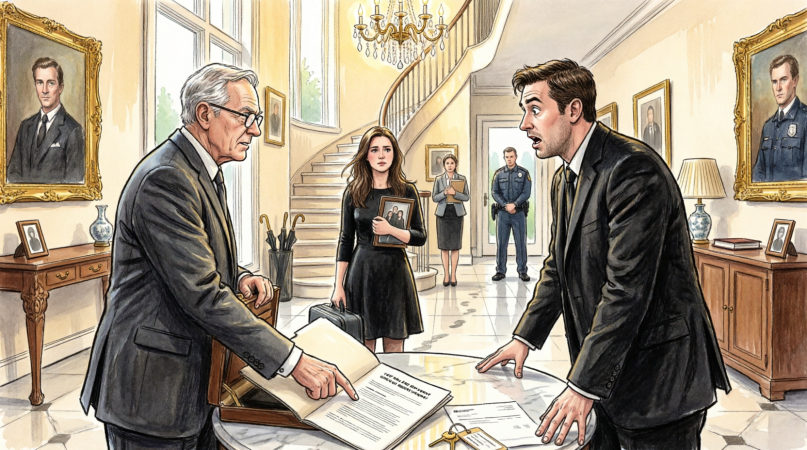
Harold set his briefcase on Grandpa’s entry table.

For the first time since the funeral, he smiled.

“Thomas,” he said, “did you actually read the whole will?”

Dad’s mouth tightened.

“I read enough.”

“No,” Harold said. “You read the part your ego wanted.”

The real estate agent lowered the tape measure.

The locksmith stopped moving.

Harold opened the briefcase and removed a sealed section from behind the probate filing.

It was clipped separately.

The paper looked ordinary.

That made it more terrifying.

My father stared at it.

“What is that?”

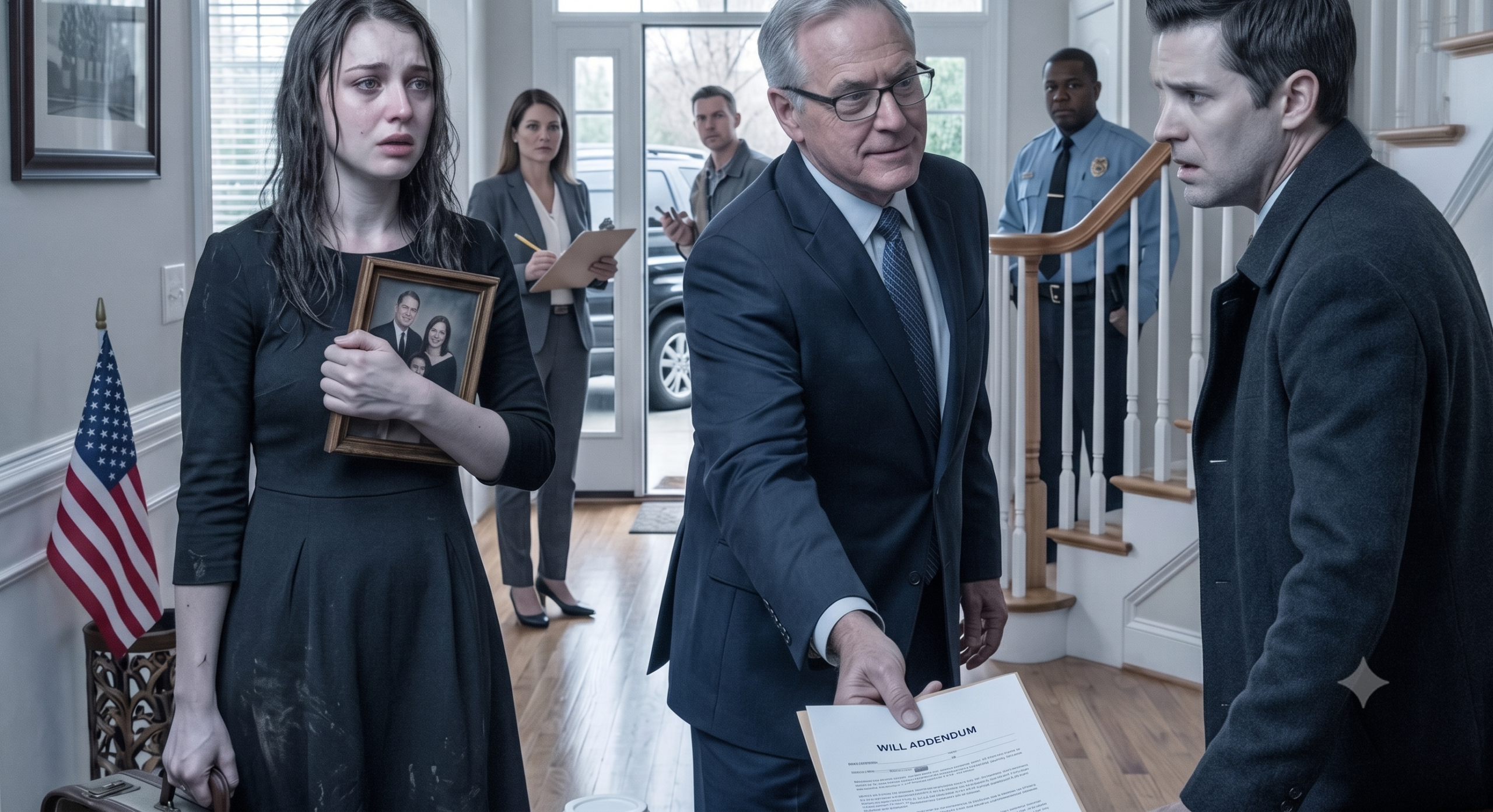
“Your father’s conditional transfer addendum,” Harold said.

Dad laughed once.

It was a bad laugh.

Too short.

Too dry.

“That’s not enforceable.”

“You may argue that later,” Harold said. “But you will not argue it while attempting to remove property or alter the residence.”

He laid the first page on the table.

My name was there.

Sophia Elaine Stewart.

My knees nearly gave out.

Harold kept one hand on the document.

“William left temporary control of the estate to you for twenty-four hours, Thomas, with one specific test attached. If you used that control to preserve the family home and provide Sophia access, the transfer would continue under supervision.”

Dad’s face changed.

Not fully.

Not yet.

But the smugness cracked.

Harold continued.

“If you attempted to remove Sophia, change locks, liquidate the residence, destroy the library, or interfere with her personal property before final certification, your control terminated immediately.”

The foyer froze.

The real estate agent whispered, “Oh my God.”

My father reached for the page.

Harold moved it away.

“I would advise against touching it.”

Dad’s voice dropped.

“You set me up.”

“No,” Harold said. “Your father gave you a choice.”

That sentence did what shouting could not.

It made my father look small.

Harold opened a thin envelope I had never seen before.

My name was written on it in Grandpa’s crooked black ink.

Sophia — only open this if your father forgets what family means.

For a second, I was back at the kitchen table with Grandpa’s warm hand over mine.

I could hear the rain on the windows.

I could smell his coffee.

I could see him trying not to look tired.

My father saw the envelope too.

All the color drained from his face.

“Harold,” he said. “Don’t.”

The word sounded nothing like the man who had called me useless.

It sounded like fear.

Harold slid the envelope toward me.

“Your grandfather asked me to give this to you if the condition was triggered.”

My fingers trembled as I broke the seal.

Inside was a letter and one notarized page.

The letter began with my name.

My dear Sophia.

I had to stop reading for a moment because the handwriting blurred.

Harold waited.

Nobody else moved.

Even the locksmith seemed to understand he had walked into something larger than a lock job.

I read the first paragraph silently.

Then the second.

Then I looked at my father.

He would not meet my eyes.

Harold took the notarized page and read aloud.

“Upon breach of conditional stewardship by Thomas Stewart, full residential ownership of the Oak Lane property transfers to Sophia Elaine Stewart, along with the William Stewart Family Preservation Trust established for maintenance, taxes, and protection of the residence.”

The real estate agent covered her mouth.

My father gripped the edge of the table.

Harold kept reading.

“Additionally, Thomas Stewart shall be removed from controlling authority over Stewart and Sons Construction pending board review, due to demonstrated conflict of interest and failure to comply with fiduciary conditions.”

Dad looked like he had been slapped by air.

“The company?” he said.

Harold nodded.

“The board received notice this morning.”

At 9:42 a.m., Harold told him, the certification packet had been filed.

At 9:57 a.m., the conditional breach notice had been delivered to the company’s registered office.

At 10:12 a.m., the first board member called Harold back.

Every time Harold named a time, my father flinched.

Not because the times were dramatic.

Because they were documented.

People like my father can dismiss tears.

They struggle with timestamps.

“You can’t do this,” Dad said.

“I am not doing it,” Harold replied. “William did.”

Then he looked at me.

“Sophia, the house is yours.”

I did not smile.

I thought I would.

I thought if the day ever came when my father was forced to face the cost of his cruelty, I would feel triumphant.

Instead, I felt the terrible weight of being loved by a dead man more carefully than I had been loved by a living father.

I picked up the old brass key from the table.

The guard had returned it when Harold demanded it.

The tag still said HOME.

Dad looked at the key like it had betrayed him.

“You think this makes you important?” he said.

I looked at him for a long moment.

“No,” I said. “It means Grandpa knew exactly who you were.”

The real estate agent quietly gathered her clipboard.

“I’m leaving,” she said.

The locksmith packed up his tools without being asked.

The security guard stepped aside.

My father did not move.

For the first time in my life, he was standing in a room where his money, his name, and his tone did not open the door.

Harold handed him a copy of the notice.

“You have until five p.m. to remove yourself from the property,” he said. “Anything belonging to the estate or the residence stays here.”

Dad stared at him.

Then he stared at me.

I remembered the conference room.

I remembered the cemetery mud.

I remembered sleeping under grocery store lights with my mother’s photo beside me.

I remembered his voice saying, “You are useless to me now, Sophia.”

That sentence had felt like an ending when he said it.

It was not.

It was evidence.

By sunset, my father was gone from Oak Lane.

He left in silence.

No apology.

No explanation.

No dramatic final speech.

Just a man carrying a briefcase down the porch steps of a house he had tried to sell before the grief inside it had cooled.

I stood in the doorway and watched him pass the mailbox Grandpa had dented with his old pickup.

The porch light clicked on behind me.

For the first time in twenty-four hours, the house did not feel like something being taken.

It felt like something keeping its promise.

Later that night, I went into Grandpa’s room.

His watch was still on the dresser.

I did not put it on.

I sat beside it and read his letter again.

He wrote that he was sorry he had not protected me sooner.

He wrote that he knew Thomas would mistake inheritance for permission.

He wrote that blood did not make someone family if all they knew how to do was calculate your value.

Then he wrote the line that finally broke me.

You were never useless, Sophia. You were the reason this house stayed warm.

I cried then.

Not loudly.

Not prettily.

I cried the way people cry when their body finally believes it is safe.

The next morning, I made coffee too strong and toast too dark.

I set one cup at Grandpa’s place at the kitchen table, not because he was coming back, but because love sometimes needs a ritual before it can become memory.

Then I took the old brass key, locked the front door from the inside, and stood there listening to the quiet house breathe.

My father had called me useless because he could not use me anymore.

Grandpa had called me home because he knew the difference.

And that difference changed everything.

More Details
BILLIONAIRE HUSBAND CAME HOME AT 4:17 A.M
Jul 12, 2026

BILLIONAIRE HUSBAND CAME HOME AT 4:17 A.M

By 5:03 in the morning, I was standing in the middle of my son’s empty nursery with blood on my hand, glass in my shoes, and my entire life folded into a cream-colored note.
For a long time, I did not move.
The house was so quiet I could hear the heating system ticking inside the walls. Somewhere downstairs, cold wind slipped through the broken kitchen door and moved across the empty rooms like a stranger.
I stared at the photograph on my phone.
My signature.
My perfect, practiced signature.
Daniel R. Whitman.
It sat at the bottom of a document I had never seen, beneath language that made my stomach twist.
Voluntary transfer of marital residence.
Acknowledgment of separate asset restructuring.
Consent to temporary custody arrangement.
My eyes kept snagging on those last words.
Temporary custody arrangement.
Custody.
Noah.
I called Hannah again. Voicemail.
Again. Voicemail.
Again.
This time, I left a message.

“Hannah, call me. Whatever this is, call me right now. You can be angry. You can take the house. You can take the money. But do not keep my son from me.”

My voice broke on the last word, and I hated myself for it.

Then I called my attorney.

Not the family lawyer. Not the smiling man who handled prenups and charity trusts and quiet settlements.

I called Richard Vale.

Richard answered on the fourth ring, his voice thick with sleep.

“Daniel?”

“My wife is gone.”

A pause.

“What do you mean, gone?”

“I mean the house is empty. Sold. She took Noah. There are divorce papers at my office. And someone sent me a photo of my signature on a custody document I never signed.”

The sleep left his voice immediately.

“Where are you?”

“At the house.”

“Do not touch anything else.”

“I already broke in.”

Another pause.

“Of course you did.”

“She locked me out of my own house.”

“Daniel, listen carefully. Is there a sold sign in the yard?”

“Yes.”

“Then it may not be your house anymore.”

That sentence hit harder than it should have.

I looked around the nursery, at the pale rectangular marks where Noah’s shelves used to be. There had been a tiny stuffed elephant on one of them, gray with floppy ears. Hannah bought it before we even knew he was a boy. She used to press it against her stomach and say, “He kicks when he hears your voice.”

I had laughed at her then.

I had been answering emails.

“Daniel,” Richard said. “Go to your office. Do not call Hannah again. Do not contact this Olivia woman. Do not speak to police unless I am present.”

“Police?”

“You smashed a door in a house that may no longer belong to you.”

I closed my eyes.

“I need to find my wife.”

“No,” Richard said. “You need to find out how much of your life she legally dismantled before you noticed.”

I hung up without answering.

Outside, dawn was beginning to gray the windows. Westport looked peaceful. Rich people liked peaceful things. Quiet streets, trimmed hedges, expensive lies.

I walked through the empty house one last time.

In the dining room, I saw a scratch in the floor from when Hannah and I had dragged the table ourselves because she said delivery men never understood angles. In the hallway, I saw where Noah’s swing had once stood, playing soft music at three in the morning while Hannah bounced barefoot beside it, exhausted but smiling.

In the primary bedroom, I saw nothing.

That was worst of all.

Nothing.

She had not left perfume bottles behind in fury. She had not ripped clothes from hangers. She had not shattered wedding photos.

Hannah had left with the precision of a surgeon.

No noise.

No mess.

No mistake.

When I stepped outside, a black sedan was idling by the curb.

For one wild moment, I thought it was hers.

But the rear window lowered, and my father looked out at me.

Charles Whitman wore a navy overcoat over his pajamas. His silver hair was combed. His face was carved from the same cold stone he used on bankers and senators.

“Get in,” he said.

I did not ask how he knew.

Men like my father always knew.

The driver opened the door. I slid into the back seat, and the car pulled away from the house I no longer owned.

My father did not look at me.

“I received a call twenty minutes ago,” he said.

“From who?”

“Board counsel.”

My throat tightened. “Why?”

“Because your wife’s attorney delivered a package to Whitman Capital at 4:45 this morning.”

I stared at him.

“That’s impossible.”

“Apparently not.”

“What package?”

He finally turned his head.

“Financial records. Emails. Internal transfers. Expense reimbursements. Private calendar entries. Enough to make several people extremely nervous.”

My pulse started pounding.

“Hannah doesn’t understand those documents.”

My father’s eyes narrowed.

“That is the first stupid thing you have said today, and I suspect it will not be the last.”

I looked away.

Hannah had a degree in art history. She loved museums and old churches and books with cracked spines. She cried during documentaries. She wrote thank-you notes by hand.

She did not belong in rooms with corporate counsel.

She did not belong near knives.

But then I remembered the note.

You were so busy hiding your life from me that you never noticed I was packing mine.

“How much does she have?” I asked.

“Enough.”

“That’s not an answer.”

“It is the only one you deserve at the moment.”

The car carried us toward Greenwich, toward the glass tower where Whitman Capital occupied the top four floors. My phone buzzed again.

Olivia.

Daniel? Are you okay? Your wife just called me.

I sat upright.

“What?” I whispered.

My father glanced over.

I opened the message thread.

She knows everything. She said if I contact you again, my deposition will be under oath.

A second message followed.

Daniel, what did you tell her about me?

I almost laughed.

What had I told Hannah about Olivia?

Nothing.

That was the point.

Olivia Bennett was not supposed to exist outside hotel rooms and late dinners and false calendar blocks. She was vice president of investor relations at one of our portfolio companies, sharp, beautiful, ambitious, and careless in the way people are careless when they believe powerful men protect them.

I had protected her.

Or thought I had.

I typed nothing back.

At 5:52, we arrived at Whitman Capital.

The lobby guard would not meet my eyes.

That was when I understood the disaster was not private anymore.

Upstairs, the lights were already on.

Richard Vale stood in the conference room with two other attorneys, three sealed folders, and a look on his face that made me colder than the empty nursery had.

On the table lay a stack of documents.

On top was a petition for dissolution of marriage.

Beneath it sat a custody filing.

And beneath that was a photograph of me entering the Boston hotel with Olivia.

I picked up the petition.

My hands felt numb.

Hannah Whitman v. Daniel Robert Whitman.

She had used my full name.

Not Dan.

Not Daniel.

Not husband.

Daniel Robert Whitman.

As if I were already a stranger.

Richard took the paper gently from my hand.

“She filed at 12:01 a.m.,” he said. “Emergency protective custody, temporary financial restraining order, preservation order for corporate records, and notice of intent to subpoena.”

“For what?” I asked.

His silence answered before his mouth did.

My father removed his gloves finger by finger.

“Tell him.”

Richard exhaled.

“Hannah’s team alleges marital waste, concealment of assets, misuse of corporate funds, fraudulent expense reporting, and exposure of family assets to personal liability.”

I stared at him.

“That’s insane.”

“Did you buy Olivia Bennett a diamond bracelet through an executive discretionary account?”

My mouth opened.

No sound came out.

Richard nodded once.

“Did you categorize hotel stays as client entertainment?”

“Everyone does that.”

My father’s hand struck the table.

Not hard.

Just once.

The room went silent.

“Children say everyone does it,” he said. “Men who inherit billion-dollar institutions do not.”

Heat climbed my neck.

“She had no right to take Noah.”

Richard’s expression changed.

“That is where this becomes worse.”

He opened the custody filing and slid a page toward me.

There it was again.

My signature.

My signature beneath a statement consenting to Hannah’s temporary relocation with Noah due to “ongoing marital instability and father’s erratic absence from home.”

“I did not sign that,” I said.

“We will challenge it.”

“I did not sign it.”

“I heard you.”

“No, you don’t understand. I didn’t sign anything like that.”

Richard looked at me carefully.

“Daniel, there is a notarization.”

I grabbed the page.

A notary seal. A date. Two weeks earlier.

Two weeks earlier, I had been in Chicago.

No.

Not Chicago.

Boston.

With Olivia.

My stomach dropped.

My father leaned forward.

“Where were you on March 14?”

I knew before I checked the calendar.

“The Four Seasons,” I said.

Richard’s jaw tightened.

“With Ms. Bennett?”

I said nothing.

My father closed his eyes for one brief second, as if the sight of me had become physically tiring.

Richard tapped the page.

“The document says it was signed at your home at 8:30 p.m. Hannah’s attorney claims there is video evidence.”

“That’s impossible.”

“Then we need to prove it.”

The conference room door opened.

My assistant, Mara, stepped inside.

She was usually immaculate. That morning, her blouse was slightly wrinkled, and her face looked pale.

“Daniel,” she said softly. “There’s someone here to see you.”

“Not now.”

“She says she is here on behalf of Mrs. Whitman.”

Richard straightened.

“Who?”

Mara swallowed.

“Eleanor Price.”

My father looked toward the door.

For the first time all morning, something like surprise passed across his face.

I knew the name.

Everyone with money and secrets in Connecticut knew the name.

Eleanor Price did not lose.

She was the attorney wives hired when they did not want revenge to look messy. She smiled in court. She wore pearls. She used words like “stability” and “best interests” while quietly removing a man’s skin.

“Send her in,” Richard said.

Eleanor entered alone.

She was in her sixties, small, silver-haired, wearing a cream suit and carrying a leather folder. She looked around the room, smiled politely at my father, and then looked at me.

“Daniel.”

I hated the way she said my name.

Like she already owned the ending.

“Where is my wife?” I asked.

“Safe.”

“Where is my son?”

“With his mother.”

“You can’t do this.”

She placed the folder on the table.

“Mr. Whitman, I did not do anything. Hannah did.”

The use of Mr. Whitman cut deeper than expected.

“We will be contesting every document,” Richard said.

“I assumed so.” Eleanor opened the folder. “That is why I brought copies of the security footage, notarized recordings, bank authorizations, property transfer documents, and communications confirming Mr. Whitman’s consent.”

Richard’s eyes sharpened.

“Communications?”

Eleanor removed a printed sheet and slid it across the table.

It was an email.

From me.

To Hannah.

Subject: Do what you need to do.

Hannah,

I know I have been absent. If leaving Westport for a while makes you feel safer with Noah, I won’t stop you. Sell the house if you want. I don’t care anymore.

D.

I stared at it.

My skin prickled.

“I never wrote that.”

“It came from your personal email,” Eleanor said.

“I never wrote that.”

She folded her hands.

“Then perhaps you should ask who had access to your accounts.”

The room shifted.

Because someone did.

Someone had access to my email. My calendar. My travel records. My passwords.

Not Hannah.

Not unless—

I stopped breathing.

Mara.

I turned slowly.

My assistant stood near the door, white as paper.

“Mara,” I said.

Her eyes filled instantly.

“I’m sorry.”

The words were barely audible.

My father stood.

Richard said, “Do not speak without counsel.”

But I was already moving toward her.

“What did you do?”

Mara stepped back.

“I didn’t know at first.”

“What did you do?”

“She came to me last year,” Mara whispered. “After Noah was born.”

“Hannah?”

Mara nodded.

“She asked if you were really in Chicago as often as you said. I told her I couldn’t discuss your schedule. She didn’t yell. She didn’t threaten me. She just looked so tired.”

My hands curled.

“So you betrayed me?”

Her face changed then. Something sad hardened into something almost angry.

“You asked me to send flowers to your wife and jewelry to your mistress on the same afternoon.”

The sentence landed like a slap.

No one spoke.

Mara wiped at her cheek.

“You forgot Hannah’s birthday, Daniel. You told me to pick something tasteful and sign your name. Then ten minutes later, you asked me to book Olivia a suite in Boston with a view.”

“I paid you very well.”

“Yes,” she said. “You did. That was what made it worse.”

My father made a low sound of disgust.

Eleanor lifted one hand.

“Ms. Keene cooperated voluntarily. She did not forge Mr. Whitman’s signature.”

“Then who did?” Richard asked.

Eleanor looked at me.

“We believe Mr. Whitman did.”

I laughed once.

“You’re insane.”

“We have video.”

She removed a tablet and tapped the screen.

The footage showed our Westport kitchen.

Date stamp: March 14.

Time: 8:27 p.m.

Hannah sat at the kitchen island, wearing a gray sweater, her hair tied back. Noah’s baby monitor glowed beside her.

A man entered the frame.

My height.

My build.

My dark suit.

My face.

He sat beside her.

Hannah slid the papers forward.

He picked up a pen.

He signed.

My signature.

My blood went cold.

“That is not me,” I said.

But my voice had lost force.

The man looked exactly like me.

Not similar.

Exactly.

Richard took the tablet, watched the clip twice, and went pale.

“Daniel,” he said quietly. “Where were you at this exact time?”

I knew the answer would bury me.

Because at 8:27 p.m. on March 14, I was not in Chicago.

I was not in a meeting.

I was in a hotel room in Boston with Olivia Bennett, where no one except the hotel staff and Olivia could prove I existed.

Eleanor closed the tablet.

“Hannah is prepared to offer supervised visitation pending forensic review. She is also willing to delay public filing of certain corporate allegations if Mr. Whitman complies with all temporary orders.”

My father laughed, but there was no humor in it.

“She is blackmailing him.”

“No,” Eleanor said gently. “She is surviving him.”

I wanted to hate her for that.

Instead, I thought of Hannah in the nursery at midnight, folding Noah’s tiny clothes into boxes while I texted another woman beneath a hotel sheet.

The anger in me flickered.

Fear took its place.

“Let me speak to her,” I said.

Eleanor shook her head.

“No.”

“She is my wife.”

“Not in the ways that matter.”

I stepped forward.

Richard caught my arm.

“Daniel.”

I shook him off.

“Tell her I want to see Noah.”

“I will tell her,” Eleanor said.

“Tell her I’ll give her anything.”

At that, Eleanor’s eyes changed.

“Daniel, that is what you never understood. She stopped wanting what you could give.”

She picked up her folder.

At the door, she turned back.

“One more thing. Hannah asked me to deliver a message.”

The room held its breath.

Eleanor looked directly at me.

“She said, ‘Check the blue safe.’”

Then she left.

The blue safe.

No one spoke for several seconds.

My father broke the silence.

“What blue safe?”

I looked at him.

There was a safe in my private office behind a framed photograph of my grandfather shaking hands with a president. Blue enamel dial. Old-fashioned. Sentimental.

Hannah used to joke that it was the only ugly thing in the entire building.

I had not opened it in months.

We moved down the hallway in silence.

Mara did not follow.

Inside my office, the city was turning silver beyond the glass. I pulled the photograph from the wall and revealed the safe.

My hands shook as I turned the dial.

Left. Right. Left.

It opened.

Inside, there was no cash.

No certificates.

No passport.

Only a small white box and a folded letter.

I opened the box first.

Inside lay my wedding ring.

Not mine.

Hannah’s.

The platinum band I had slid onto her finger under a canopy of white roses while three hundred people watched and my father congratulated me for choosing well.

Beneath the ring was a tiny hospital bracelet.

Noah Whitman.

My throat closed.

Richard looked away.

I unfolded the letter.

Daniel,

You always kept trophies in safes.

So I left you the only things you ever truly owned and never valued.

My ring.

Your son’s name.

Everything else was borrowed.

I wanted you to know something before the lawyers teach you how to sound innocent.

I know about Boston.

I know about Olivia.

I know about the accounts.

I know about the signatures.

But there is one thing I do not know.

I do not know whether the man in that kitchen was you.

And that should terrify you more than it terrifies me.

H.

I read the last line again.

I do not know whether the man in that kitchen was you.

The room tilted.

Richard stepped closer.

“Daniel?”

I handed him the letter.

He read it. Then he read it again.

My father took it from him, and for once, he did not have a lecture ready.

“What does she mean?” he asked.

I looked at the open safe.

At Hannah’s ring.

At Noah’s hospital bracelet.

At the empty space where I used to keep documents that could move markets.

“I don’t know,” I said.

But a memory had already surfaced.

A dinner party two months ago.

Hannah standing in the garden beside a man I had assumed was a donor from the museum board. Tall. Dark-haired. Similar build. His back to me.

When I approached, Hannah had turned.

Too quickly.

The man had smiled.

Only briefly.

Only before my phone rang and I stepped away.

I had forgotten his face.

Now I could not remember it at all.

At 7:12 a.m., Richard’s forensic team arrived.

At 7:40, my father called an emergency board meeting.

At 8:05, Olivia Bennett stopped answering her phone.

At 8:19, the police arrived at my office.

Not for the broken door.

For me.

Two detectives stepped out of the elevator with badges in hand and expressions that told me they already knew my name.

“Daniel Whitman?” one asked.

“Yes.”

“I’m Detective Harris. This is Detective Lane. We need to ask you some questions regarding the disappearance of Ethan Cole.”

Richard immediately stepped in.

“My client will not answer questions without—”

I raised a hand.

“Who is Ethan Cole?”

The detectives exchanged a glance.

Detective Lane opened a folder and removed a photograph.

A man smiled up from the page.

Tall.

Dark hair.

My build.

Not my face.

But close enough in the wrong light.

Close enough from behind.

Close enough on a security camera if he wanted to be.

My mouth went dry.

Detective Harris watched me carefully.

“You know him?”

“No.”

But I had seen him.

In my garden.

With my wife.

Detective Lane slid another photo onto the desk.

This one showed Ethan Cole entering the lobby of the Boston hotel.

March 14.

8:11 p.m.

My heart stopped.

He was wearing my suit.

My suit.

The one I had sent out for tailoring after a wine stain and never picked up myself.

Detective Harris said, “Mr. Cole was a private investigator. He was hired six months ago by your wife.”

Richard’s voice went sharp.

“Detective, what exactly is this about?”

Harris looked at me.

“Ethan Cole vanished three days ago. His last known meeting was with Olivia Bennett.”

The name entered the room like smoke.

I grabbed the edge of the desk.

“That’s impossible.”

“Why?”

“Because Olivia doesn’t know him.”

Detective Lane’s face did not move.

“We have evidence suggesting otherwise.”

My father spoke at last.

“What kind of evidence?”

Detective Harris placed one final photograph on the desk.

It showed Olivia Bennett outside a parking garage at night.

She was speaking to Ethan Cole.

Her face was tense.

His was calm.

Between them, she held a small blue flash drive.

I felt the world narrow to a single point.

The blue safe.

The blue flash drive.

Hannah’s letter.

Olivia’s messages.

The fake signature.

The man in the kitchen.

None of it was separate.

It had never been separate.

Detective Harris leaned forward.

“Mr. Whitman, when was the last time you saw Olivia Bennett?”

I heard Richard say my name.

I heard my father curse softly.

I heard my own heartbeat.

And then my phone buzzed.

Unknown number.

A video message.

Everyone in the room saw it arrive.

Richard said, “Do not open that.”

But I already had.

The screen filled with darkness. Then a light clicked on.

Olivia Bennett sat in a chair, mascara streaked down her face, wrists bound with silver duct tape. Behind her was a concrete wall.

She looked terrified.

“Daniel,” she whispered. “I’m sorry. I thought she only wanted proof. I didn’t know what he was going to do.”

A man stepped into frame behind her.

Only his torso was visible.

Dark suit.

My suit.

Then he leaned down beside Olivia’s face.

For one sick second, I thought I was looking in a mirror.

But the smile was wrong.

Too calm.

Too familiar.

He looked into the camera and said, in a voice almost identical to mine, “Your wife is smarter than both of us, Daniel. But she still doesn’t know the best part.”

The video cut to black.

A second message appeared.

Ask your father about the first Daniel Whitman.

My father went completely still.

Not pale.

Not shocked.

Still.

Like a man who had just heard a dead person knock from inside a wall.

I turned toward him.

“What does that mean?”

He did not answer.

For the first time in my life, Charles Whitman looked afraid.

The House I Came Home To Was Already Gone

PART 3

She had mentioned his name in the letter like a fact, not an explanation. Like I was supposed to already know what she had done with him.
My son.
My chest tightened.
I ran back downstairs, skipping steps, nearly falling into the stripped living room. I grabbed my laptop from the kitchen counter out of instinct, then remembered—there was no counter. Just bare marble and emptiness.
So I went to the car.
Slammed the door shut. Hands trembling. Turned the ignition.
Nothing mattered except answers now.
I drove through Westport half-blind, red lights flashing past me like accusations. Olivia’s messages kept lighting up my phone in the cupholder, but I didn’t touch them anymore.
I went straight to my office building downtown.
The glass tower still glowed like nothing in my life had just collapsed.
Security nodded as I walked in at 5:02 a.m., suit wrinkled, eyes wild.
“Morning, Mr. Whitman.”
I didn’t answer.
My office was on the 41st floor. Corner suite. Entire glass wall overlooking the harbor.
I used my keycard.
Green light.
Door opened.
And that’s when I saw them.
Two federal agents standing inside my office like they had been waiting for me all night.
One of them held a folder.
The other didn’t move at all.
“Daniel Whitman?” the first asked.
My mouth went dry again. “Yes.”
He flipped the folder open.
“We need to ask you about fraudulent asset transfers, tax evasion, and misuse of corporate funds across multiple accounts registered under Whitman Holdings.”
I laughed once.
A short, broken sound.
“You’ve got the wrong person.”
The second agent finally spoke.
“Your wife disagrees.”

The room tilted slightly.

“My… wife?”

The first agent slid a document across my desk.

“It was all filed legally. Signed. Witnessed. And submitted two days ago. Everything tied to you has already been frozen pending investigation.”

My eyes scanned the paper.

My company.

My accounts.

My offshore holdings.

My private investment group.

All of it… exposed.

But the signature at the bottom wasn’t mine.

It was hers.

Hannah Whitman.

Neat. Clean. Certain.

I leaned forward, gripping the edge of the desk.

“No,” I said again, but weaker this time. “She wouldn’t even know how to—”

The agent cut me off.

“She brought a full forensic audit team with her. And documentation. Very thorough documentation.”

My throat tightened.

“Where is she?”

The agents exchanged a look.

Then the first one answered.

“We don’t know. She didn’t stay after filing.”

They turned to leave.

Then paused.

“Oh,” he added casually, like it was nothing. “She also requested sole custody. Emergency relocation approval. Approved last night.”

My knees nearly gave out again.

“Relocation?” I repeated. “To where?”

But they were already walking out.

And just before the door closed, the second agent said something that made everything inside me go still.

“She said if you tried to find her… you’d only find what you deserve.”

The door shut.

And I was alone in my own office.

For the first time in my life, I wasn’t the one controlling the outcome.

I grabbed my phone again.

Called Olivia.

This time she answered immediately.

“Hey—”

“Did you know?” I snapped.

A pause.

“…Know what?”

“About Hannah. About any of this.”

Silence again.

Then a soft exhale.

“Daniel,” she said carefully, “I think you should stop calling me.”

My grip tightened.

“You told her, didn’t you?”

Another pause.

Then her voice changed. Less soft now.

“She didn’t need me to tell her. She already knew everything. She just needed proof.”

Click.

She hung up.

I stood there staring at my reflection in the glass wall.

And for the first time, I didn’t see a powerful man.

I saw someone who had been watched for a very long time.

Someone who had mistaken silence for ignorance.

My phone buzzed one more time.

Unknown number again.

A single message:

You taught me how to wait.

Now you’ll learn what waiting feels like.

And beneath it… a bank notification.

A transaction alert.

Every personal account I had was now at zero.

Not frozen.

Not pending.

Empty.

I sank into my chair.

The city lights outside kept shining like nothing had changed.

But everything already had.

And somewhere out there, Hannah wasn’t running.

She was finishing what she had started.

PART 4

I stayed in that chair until the sky outside the glass turned from black to a dull, lifeless gray.

At some point, my tie loosened on its own. My collar felt too tight, like the building itself was pressing down on me.

Every system I tried to access—accounts, internal company servers, legal dashboards—refused me. Not because of technical failure.

Because I no longer had permission.

It was like I had been erased from my own empire.

Then the office door opened again.

Not security this time.

My chief financial officer, Mark Ellison.

He looked like he hadn’t slept either. Suit disheveled. Eyes sharp but uneasy.

“You need to see this,” he said immediately.

He didn’t wait for permission. He placed his tablet on my desk.

A news headline filled the screen:

“Whitman Holdings Under Federal Investigation Following Internal Whistleblower Audit”

Below it… my face.

My company logo.

And beneath that, another name I didn’t expect to see attached to any of this:

Hannah Whitman — Lead Source of Documentation.

My throat tightened.

“That’s impossible,” I said quietly.

Mark didn’t respond right away. Instead, he swiped.

Financial charts. Transaction maps. Offshore transfers. Internal memos.

All tied together like a web.

And at the center of it…

me.

“I’ve been with you eight years,” Mark said finally. “I’ve never seen records this complete. Whoever built this… didn’t guess. She mapped everything.”

I leaned forward slowly.

“She’s not a forensic accountant,” I muttered. “She’s a schoolteacher. She stayed home with our son.”

Mark looked at me for a long moment.

“Then you underestimated her.”

The words hit harder than they should have.

Because deep down, I already knew that wasn’t the real story anymore.

I stood up.

“I need to find her.”

Mark hesitated. “Daniel—federal investigators are already—”

“I don’t care,” I snapped.

I grabbed my coat and left the office before he could finish.

I didn’t go home.

There was nothing left there except silence and consequences.

Instead, I drove to the only place I could still think clearly: the hospital where Noah was born.

Yale New Haven.

The parking lot was almost empty. Morning shift change. Nurses moving like ghosts behind glass doors.

I sat in the car for a full minute before going in.

The maternity wing smelled the same as I remembered—sterile air, disinfectant, something faintly like milk and exhaustion.

At the front desk, I gave Noah’s full name.

The receptionist typed slowly.

Then frowned.

“I’m sorry,” she said. “That record has been restricted.”

“Restricted?” I repeated. “By who?”

She checked again.

“Maternal authority override. Legal guardian designation updated.”

My stomach dropped.

“Hannah Whitman,” I said immediately.

The receptionist nodded. “Yes.”

My hands curled into fists.

“Where did she take him?”

The woman looked uncomfortable now. “Sir, I’m not authorized to—”

I slammed my hand on the counter.

“Where. Is. My. Son.”

A nurse nearby turned.

The receptionist finally spoke, quieter.

“I’m sorry… but they were discharged under emergency relocation order. Yesterday afternoon.”

Yesterday.

While I was still pretending my life was normal.

I stepped back slowly.

“Who approved it?” I asked, voice low now.

She hesitated.

“Court order was already in place. Everything was pre-filed.”

Pre-filed.

That word again.

Like none of this had happened overnight.

Like it had been built piece by piece… while I was busy lying to myself.

Back in the car, my phone rang.

Unknown number.

I answered immediately.

Silence at first.

Then her voice.

Calm. Familiar. Controlled.

“Hannah,” I said.

“No,” she replied softly. “Not anymore.”

My chest tightened. “Where is my son?”

A pause.

Then: “Safe.”

“That’s not an answer.”

“It is the only one you get right now.”

I swallowed hard.

“What do you want from me?”

For the first time, she hesitated.

Not long. Just enough for me to hear something behind the silence.

Tiredness.

Or maybe disappointment.

“You already gave me everything I wanted,” she said.

I shook my head even though she couldn’t see me.

“I don’t understand.”

A quiet breath.

“Yes, you do.”

Then she continued.

“You just never thought I would use it.”

My grip tightened on the steering wheel.

“What are you talking about?”

Another pause.

Then her final words came through, steady and cold.

“The life you built wasn’t just yours, Daniel. You made sure I had access to every part of it. Every account. Every signature. Every system. You taught me how everything worked… because you never thought I would ever look.”

My throat went dry.

“That doesn’t explain—”

“It does,” she interrupted.

A sharper edge now.

“You just never paid attention when I started learning.”

Silence again.

Then a final sentence, quieter than the rest:

“You will hear from me when it’s time.”

The line went dead.

I sat there staring at the dashboard for a long time.

Then my phone lit up again.

But this time, it wasn’t a message.

It was an email.

Subject line:

“Phase Two Executed.”

No sender name.

Just a single attachment.

I hesitated.

Then opened it.

It was a list.

Names.

Companies.

Accounts.

People I trusted.

And next to each one… a status update.

FROZEN. EXPOSED. TERMINATED. UNDER INVESTIGATION.

At the very bottom of the list, one final line:

Subject: Daniel Whitman — Pending Final Action.

My blood went cold.

Because this wasn’t just divorce anymore.

This was execution.

Not of my life.

Of everything I thought I controlled.

And somewhere behind it all…

Hannah was still one step ahead.

PART 5

I stared at that email until the screen dimmed, my reflection faintly appearing over the list of names like a ghost hovering over its own crimes.

“Pending Final Action.”

Those three words wouldn’t leave my mind.

I started the car without thinking and drove.

No destination. Just motion.

The city blurred past—morning traffic, coffee shops opening, people living normal lives that suddenly felt unreal. I kept checking my mirrors like someone might be following me, though I couldn’t say who anymore.

Hannah? The government? Or just the consequences finally catching up?

My phone rang again.

This time, I almost didn’t answer.

Unknown number.

I pressed accept.

A man’s voice this time.

Calm. Professional.

“Mr. Whitman.”

I straightened slightly. “Who is this?”

“Legal counsel assigned to the emergency custody and corporate seizure proceedings.”

My jaw tightened. “Where is my son?”

A pause.

“Your son is safe. That is the only detail authorized for release.”

I laughed once, bitter. “Everyone keeps saying that like it means something.”

Silence.

Then: “Your wife anticipated that reaction.”

My grip tightened on the wheel.

“Stop calling her that,” I said sharply. “She’s not—”

“She is the petitioner,” the man interrupted. “And at this stage, she holds full legal authority over the trust structures tied to your family assets.”

I swallowed hard.

“That’s not possible. I would’ve seen it.”

“You did,” he said. “You just didn’t recognize it.”

That sentence hit harder than I expected.

Because something about it felt true.

Not legally.

Emotionally.

Like I had been walking through my own downfall and mistaking it for success the entire time.

I ended up at the marina without remembering the drive.

Westport Harbor.

The same place I used to take investors on weekends. The same dock where I once stood with Hannah, her hand in mine, watching the water like it meant something permanent.

Now the boats rocked gently in the wind like nothing had ever broken.

I got out of the car.

Cold air hit my face.

For the first time since this started, I wasn’t running.

I was standing still.

My phone buzzed again.

A message.

Unknown number.

No words this time.

Just a location pin.

Attached text:

If you want answers, come alone.

My pulse slowed instead of speeding up.

That should’ve scared me more.

But it didn’t.

Because something in me—something desperate and cornered—was done waiting.

I got back in the car and followed the pin.

It led me outside the city.

To a quiet stretch of road I barely recognized.

Then a private property gate.

Unmarked.

Open.

I hesitated only once.

Then drove in.

The road curved through trees until I saw the house.

Smaller than mine.

Older.

Hidden in a way my house never was.

And parked outside it…

was a familiar car.

Hannah’s.

My breath caught.

I stepped out slowly, every instinct screaming that this was wrong.

But I kept walking.

The front door was already open.

Inside, the house was warm. Lived-in. Not erased like mine had been.

And in the center of the living room stood Hannah.

No longer the version of her I remembered.

No soft hesitation. No warmth waiting for permission.

Just stillness.

Control.

And in her arms—

Noah.

My son.

He was asleep.

Breathing softly.

Safe, like everyone had said.

My voice broke before I could stop it.

“Hannah…”

She didn’t correct me this time.

She just looked at me.

Not with anger.

Not with love.

With something far more final.

Understanding.

“You came,” she said quietly.

I took a step forward. “Give him to me.”

She didn’t move.

Instead, she shifted slightly, holding him closer.

And said something I wasn’t prepared for.

“He doesn’t know you.”

The words didn’t make sense at first.

Then they did.

Slowly.

Painfully.

My throat tightened. “That’s not true.”

Hannah studied me for a long moment.

Then she walked to the couch and sat down with him, still holding him like the world couldn’t take him unless she allowed it.

“You weren’t there,” she said simply.

My chest tightened. “I provided for him.”

She looked up at me then.

And there it was.

Not accusation.

Fact.

“You were absent,” she corrected. “There’s a difference.”

Silence filled the room.

Then she reached beside her and picked up a folder.

Placed it on the table.

“Everything you lost,” she said, “you already signed away.”

I stared at her.

“No,” I whispered. “You did this behind my back.”

Her expression didn’t change.

“I did it in front of you,” she said. “You just never looked at me long enough to notice.”

A long silence followed.

Only Noah’s quiet breathing filled the space between us.

Then she added, softer:

“I didn’t destroy your life, Daniel.”

A pause.

“I just stopped protecting it.”

My phone buzzed in my pocket again.

Another message.

Same unknown number.

Final line:

Decision confirmed.

I looked at Hannah.

At my son.

At the life I no longer understood how to reach.

And for the first time…

I realized this wasn’t about losing everything.

It was about realizing I had never truly had it the way I believed.

Hannah stood up slowly.

Still holding Noah.

And said:

“This ends now.”

PART 6

Hannah stood there for a moment longer, holding Noah close, her eyes steady on me—not angry anymore, not even emotional in the way I expected.

Just finished.

The kind of calm that comes after a decision has already been made long before the conversation ever started.

“You don’t need to chase this anymore, Daniel,” she said quietly. “There’s nothing left for you to fix.”

My throat tightened. “That’s my son.”

For the first time, something flickered in her expression. Not doubt. Not softness.

History.

“You think fatherhood is a title you get to claim because of biology,” she said. “But Noah doesn’t know your voice. He doesn’t wake up looking for you. He doesn’t reach for you when he’s scared.”

Each word landed heavier than the last.

“I did that part,” she continued. “I stayed up when he cried. I held him when he was sick. I learned him while you were learning how to disappear.”

The room felt smaller.

Not because the walls changed—but because everything inside me was collapsing inward.

I took a step forward. “I can change.”

Hannah shook her head once.

“No,” she said simply. “You can only start over somewhere else. Not here.”

Silence.

Then she walked toward the door.

Slowly.

Deliberately.

Still carrying Noah like the final piece of something she had already rebuilt without me.

Before she stepped outside, she stopped.

Not looking back fully.

Just enough for me to hear her last words clearly.

“You didn’t lose your life tonight, Daniel.”

A pause.

“You lost the version of it that depended on no one ever noticing what you were doing.”

And then she was gone.

The door closed softly.

No dramatic slam. No final explosion.

Just an ending that felt too quiet for how much it destroyed.

I stood there for a long time in that empty living room.

The house around me was warm.

Alive.

But I wasn’t part of it anymore.

Eventually, I turned and walked out.

No destination.

No phone calls.

No more chasing voices that wouldn’t answer.

Outside, the air was cold and real.

For the first time in a long time, I wasn’t building anything.

I wasn’t escaping anything either.

I was just… left with the truth.

Some lives don’t end with revenge.

Some end with understanding arriving too late to matter.

And as I stood there watching the road Hannah had taken disappear into the trees, I finally understood the last thing she ever gave me.

Not punishment.

Not hatred.

Clarity.

And that was the part I couldn’t run from.

The end.

More Details
At my father’s graveside, the gravedigger gripped my arm and whispered, “Sir, your father paid me to bury an empty coffin.” Before I could even speak, he pushed a brass key into my hand. “Don’t go home,” he warned.
Jul 12, 2026

At my father’s graveside, the gravedigger gripped my arm and whispered, “Sir, your father paid me to bury an empty coffin.” Before I could even speak, he pushed a brass key into my hand. “Don’t go home,” he warned.

“No matter who calls, no matter what they say. Go to Unit 17 on Route 9. Right now.” Then my phone buzzed. A text from my mother appeared on the screen. Come home alone. My father had been buried less than five minutes earlier. Or so I believed.”

The final hymn still seemed to hang in the freezing New Jersey air. Relatives and neighbors moved slowly across the cemetery grass, speaking in soft voices, promising food, touching my shoulder, offering the kind of words people use when they know nothing can be fixed.

My mother stood near the black funeral car with one hand over her mouth.

My wife, Chloe, kept our two children close.

And I stood there trying to be the son everyone expected me to be.

Strong.

Helpful.

Still standing.

My father, Gideon Vance, was sixty-six. They said he had suffered a heart attack in his study and was gone before the ambulance arrived.

For three days, I had chosen flowers, signed documents, comforted my mother, and convinced myself grief was the only thing happening.

Then the gravedigger stopped me.

“Your father paid me,” he said.

I stared at him.

“Paid you for what?”

He looked over his shoulder before leaning closer.

“To bury an empty coffin.”

For a moment, my mind refused to accept the words.

“My father is dead,” I said. “I saw him.”

The man’s expression did not change.

“You saw what he wanted you to see.”

I almost stepped back.

Some sentences are so impossible that your mind rejects them before fear can even begin.

Then he pressed something cold into my palm.

A small brass key.

The number 17 was stamped on it.

“Don’t go home,” he repeated. “No matter who calls. No matter what they tell you. Go to Unit 17. Route 9 Storage. Your father left instructions.”

“My father died three days ago.”

That was when my phone buzzed.

I pulled it out automatically.

The message was from my mother.

Come home alone.

Three words.

No period.

No “honey.”

No explanation.

My mother never texted like that. She wrote long messages full of commas and called me sweetheart even when she only needed me to pick up milk.

But she was standing thirty yards away at her husband’s funeral, supposedly texting me like a stranger.

The gravedigger saw the screen.

His face lost color.

“Don’t,” he said. “Whatever you do, don’t go home yet.”

I looked at the grave.

Then at my mother.

Then at the key in my hand.

“What is happening?”

He reached into his coat and pulled out an old envelope.

My name was written across the front in my father’s handwriting.

Nathan.

“He gave me this twenty years ago,” the gravedigger said. “Told me I would know when to give it to you.”

Twenty years.

My father had planned something before I was even old enough to understand why anyone would need a plan like this.

Then the gravedigger turned and walked away between the headstones like a man who had finally completed a promise he never wanted to keep.

I did not go home.

I sat in my car at the edge of the cemetery parking lot and opened the envelope with shaking hands.

Inside was a short letter from my father.

No comfort.

No explanation.

Only one instruction.

Go to Unit 17. Trust the woman waiting there. Do not go home until you understand why.

By the time I reached Route 9 Storage, dusk had settled over the highway. The facility sat behind a chain-link fence, past a gas station, a closed diner, and a row of low warehouses with faded signs.

A small American flag snapped sharply beside the office.

Security cameras watched the gate.

And beneath the awning stood a woman in a dark coat, waiting as if she already recognized my car.

Before I could ask who she was, she raised a badge.

Federal Bureau of Investigation.

My stomach dropped.

“Mr. Vance,” she said, “your father told us you would come alone.”

I looked at the key.

Then at Unit 17.

The storage door was only twenty feet away, but suddenly that distance felt impossible.

“What’s inside?” I asked.

The agent’s face tightened.

“Enough to explain why your father needed an empty coffin.”

Then my phone began to ring.

My mother again.

The agent looked at the screen, then back at me.

“Do not answer that,” she said.

And behind her, inside Unit 17, something started to beep…

Part 2

My hands shook so badly I dropped the key twice, the metallic clatter echoing unnaturally loud against the concrete floor.

The FBI agent stood perfectly still, her hand resting near the lapel of her coat, eyes scanning the perimeter of the dark facility.

When I finally rammed the key into the padlock, snapped it open, and threw up the heavy rolling metal door, I froze.

Inside, there was no furniture. No boxes of old family memories. No holiday decorations.

The concrete room contained only a single folding chair, an LED camping lantern casting a harsh white glow, three large jugs of water, a heavy steel legal file box, and a piece of personal property that made my breath catch violently in my throat.

It was my mother’s navy leather handbag. The gold clasp caught the lantern light.

It was the exact same handbag the local police told me had been found inside my father’s study, sitting on his desk right next to his collapsed body.

An envelope was taped to the leather strap. My name was written across the front in her neat, precise cursive.

For Nathan. If you’re reading this, they lied to you first.

My chest tightened until it felt like my ribs would snap. They lied to you first. Who was “they”? My father? The police? My mother herself, who was supposedly waiting for me at home right now?

The rhythmic, electronic beeping behind the file box grew sharper, louder.

“Mr. Vance,” the agent whispered, her voice laced with sudden urgency as she stepped into the unit beside me. “Grab the file box. We need to leave. Now.”

Before my fingers could even touch the metal handles, the sharp crunch of tires over gravel erupted from the entrance of the storage facility. High-beam headlights cut through the gathering dusk, blinding us as a dark SUV tore down the narrow alleyway and skidded to a halt directly behind my car.

The engine revved, blocking our only exit.

PART 3

The blinding glare of the high beams washed over Unit 17, casting long, frantic shadows against the concrete walls.

The FBI agent reacted instantly. She drew her weapon, stepping in front of me to shield the open unit. “Federal agent! Turn off the engine and step out of the vehicle with your hands visible!” she roared.

The SUV’s doors flew open. Two men stepped out, but they weren’t dressed like federal agents, and they certainly weren’t local police. They wore matching tactical jackets, their faces obscured by low-profile caps. One of them raised a compact, silenced firearm.

Thwip. Thwip.

Two muffled cracks shattered the silence. The brick wall right beside my head erupted in a shower of red dust.

“Down!” the agent yelled, firing two deafening rounds back at the vehicle.

I dove into the unit, my shoulder slamming against the concrete floor as I grabbed my mother’s navy handbag and wrestled the heavy steel file box into my arms. The electronic beeping inside the box was faster now, a frantic, rhythmic countdown that made my blood run cold.

The agent backed into the unit, her gun still raised as she slammed her hand against the rolling door’s handle and dragged it down with a deafening screech. She threw the latch forward just as a hail of bullets peppered the outside of the metal door like lethal hailstones.

“We have about thirty seconds before they pull that door open with a crowbar,” she panted, her face slick with sweat in the lantern light. She looked at the steel box in my arms. “The beeping. It’s a proximity tracker. Your phone—it tripped a geofence the moment you arrived. They knew you didn’t go home.”

My phone vibrated violently in my pocket. I pulled it out with trembling hands.

It was another text from my mother.

 know you’re at Route 9, Nathan. They are coming. Do not trust the badge.

I stared at the screen, my mind spinning into freefall. The agent was telling me to run, but my mother’s text told me the agent was the threat.

“Mr. Vance, listen to me,” the agent said, picking up the LED lantern and pointing it toward the very back of the unit. The light revealed a small, square maintenance hatch cut into the drywall, held together by a simple latch. “Your father didn’t build this to store papers. He built it as an escape hatch. It leads directly to the drainage ditch behind the highway. We go now, or we die in this box.”

Heavy metal scraped against the outside of the rolling door. They were prying it open.

I didn’t have time to think. I threw the strap of my mother’s handbag over my shoulder, gripped the heavy file box against my chest, and scrambled through the narrow maintenance hatch behind the agent.

We tumbled out into the freezing, muddy ditch just as a loud boom echoed from inside Unit 17—the sound of the front door being breached.

Final Part

We ran through the dense woods bordering Route 9, the thorns tearing at my funeral suit, until we reached a non-descript sedan parked half a mile down the highway. The agent threw open the doors, shoved me into the passenger seat, and slammed her foot on the gas, tearing into the dark New Jersey night.

It wasn’t until the highway lights blurred past us in a steady hum that she finally spoke.

“My name is Agent Miller,” she said, her eyes fixed on the rearview mirror. “Twenty years ago, your father, Gideon Vance, uncovered a massive asset-laundering ring within the very corporate firm he managed. The people behind it weren’t just criminals; they were ghosts buried deep inside local government, the police department, and yes, even certain rogue factions of federal intelligence.”

“And my mother?” I choked out, clutching the file box. “She’s at home. She texted me.”

“That isn’t your mother texting you, Nathan,” Agent Miller said softly, her voice heavy with grim finality. “Your mother has been in a secure federal protection facility in Vermont for the last forty-eight hours. Your father faked his own heart attack—and her disappearance—because the syndicates found out he was finally getting ready to hand the physical evidence over to the legitimate side of the Bureau.”

My trembling fingers ripped open the envelope taped to my mother’s handbag. Inside, the letter in her handwriting read:

Nathan, if you are reading this, they lied to you first. They told you your father died of a heart attack to keep you compliant and quiet. The people monitoring our house are waiting for you to return so they can eliminate the last of the Vance bloodline. Trust Agent Miller. She is the only one who knows where we are truly hidden. Come to us.

The pieces of the impossible puzzle finally crashed together. The empty coffin. The cold text messages with no periods or affection. The men at the storage facility.

My father hadn’t died. He had staged a masterpiece of a disappearance to save our lives.

“Open the box, Nathan,” Miller said.

I used the small brass key the gravedigger had given me, fitting it into the heavy steel lock of the file box. It turned with a satisfying click.

Inside lay thick stacks of ledgers, encrypted flash drives, and the original corporate charters detailing a multi-billion-dollar shadow network. But resting right on top was a smaller, handwritten note in my father’s bold, unmistakable script.

Nathan, I’m sorry I had to make you mourn me, even for a few days. It was the only way to make the funeral look real enough to fool them. You have the truth in your hands now. Deliver it to Miller, and then come join us. The gravedigger has your coordinates. — Dad

I looked down at the documents, the electronic tracker finally falling silent as Agent Miller pulled out a signal-jamming device and flipped the switch. The frantic, terrifying world I had lived in for the last three days suddenly felt clear.

I wasn’t a grieving son attending a tragic funeral anymore. I was the final piece of my father’s twenty-year-old plan.

“Where are we going?” I asked, my voice steadying as I closed the box.

Agent Miller smiled faintly, turning the sedan north toward the interstate, away from the shadows of New Jersey and toward the safe, quiet hills of Vermont.

“To see your parents, Mr. Vance,” she said. “Let’s go finish what your father started.”

FINAL PART

The sedan cut through the dark, winding roads of upstate New York, heading toward the Vermont border. The steady hum of the tires against the asphalt was the only sound competing with the fierce racing of my pulse.

In the backseat lay the steel file box—the heavy, tangible proof of a twenty-year shadow war my father had fought in absolute secret. In my lap, I clutched my mother’s navy handbag, a comforting anchor to reality in a world that had completely inverted itself in less than an hour.

“We’re crossing into Vermont in ten minutes,” Agent Miller said, her eyes shifting from the road to the rearview mirror. “My team has already intercepted the local authorities back in New Jersey. The men who attacked you at the storage unit are being picked up as we speak. The grid is locking down.”

“And the phone?” I asked, looking at the black screen of my cell, which now sat dead inside Miller’s signal-blocking pouch. “The texts from my ‘mother’?”

“A spoofed clone of her device, routed through a proxy server inside your childhood home,” Miller explained, her voice steady and clinical. “The syndicate kept a tight watch on your family. They knew your mother’s texting habits, but they didn’t know your father had spent two decades preparing you for the day the trap would spring. They expected you to run home to comfort a grieving widow. Instead, you followed the gravedigger.”

A low, exhausted laugh escaped my throat. My father, Gideon Vance, had always been a meticulous man. He measured twice, cut once, and never left anything to chance. I used to think it was just a stubborn quirk of his engineering background. Now, I realized it was the only reason we were still breathing.

By 3:00 AM, the sedan pulled off the highway and onto a gravel road lined with towering pines. We traveled deep into the woods until the headlights caught the silhouette of a secluded, snow-dusted cabin. The windows were dark, but as the car came to a halt, a single porch light flickered on.

“We’re here,” Miller said, turning off the ignition. “Go on, Nathan. I’ll secure the evidence.”

My legs felt heavy, entirely drained of adrenaline, as I stepped out into the biting Vermont air. I carried my mother’s handbag in one hand and the letter from my father in the other. I walked up the wooden steps of the porch, my breath pluming in the freezing dark.

Before I could even reach for the brass doorknob, the door swung open.

There stood my mother. She wasn’t wearing the black funeral veil or the hollow, broken expression she had worn at the cemetery. She wore a thick wool sweater, her eyes wide, bright, and instantly filling with tears as she looked at me.

“Nathan,” she choked out, throwing her arms around my neck. She smelled like home—like vanilla and the familiar detergent she had used for as long as I could remember.

“Mom,” I whispered, holding her tight, the final remnants of the terror erasing itself from my chest. “You’re okay. You’re really okay.”

“I am,” she said, pulling back to look at my face, her hands warm against my cold cheeks. “I’m so sorry we had to put you through this. We had to make sure they believed it.”

“I know,” I said. “I know.”

“He’s inside,” she added, nodding toward the warm glow of the living room.

I stepped past her into the cabin. Sitting by a roaring stone fireplace, holding a mug of coffee with hands that bore the familiar calluses of a lifetime of hard work, was my father. Gideon Vance.

He looked tired, the stress of the operation etched deep into the lines of his face, but his eyes were sharp, alert, and entirely alive. He stood up slowly as I walked into the room.

For a moment, neither of us said anything. The absurdity of having stood over his empty coffin just hours prior clashed violently with the reality of him standing six feet away from me.

“You found Unit 17,” my father said, his voice deep, gravelly, and entirely solid.

“The gravedigger kept his promise, Dad,” I replied, a small smile finally breaking through my exhaustion. “And you dropped your key twice.”

A rare, genuine grin broke across his face, and he closed the distance between us, pulling me into a fierce, crushing embrace. “You did well, Nathan. You trusted the right people. You kept your head down.”

“We have the ledgers, Gideon,” Agent Miller said, entering the cabin and placing the steel file box firmly on the wooden dining table. “The encrypted drives are already being uploaded to the main Bureau servers in D.C. The arrests are happening right now. It’s over.”

My father let out a long, slow breath, a weight leaving his shoulders that he had carried for twenty long years. He looked at the file box, then at my mother, and finally back at me.

The world I knew had changed forever. The house in New Jersey was gone, the life we had lived there was a memory, and the road ahead would involve courtrooms, new identities, and rebuilding from scratch. But as the fire crackled in the hearth, warming the cabin against the bitter northern night, I realized the only thing that truly mattered was sitting right here in this room.

The coffin was empty, but our family was entirely whole.

More Details
My daughter-in-law sent my wife a 14-dish Thanksgiving list for 25 guests and wrote, “The kitchen is yours. Start at 5 a.m. if you want dinner ready on time.” Meanwhile, my son didn’t say a word. So instead of arguing, I quietly booked two flights to Florida for my wife and me. That morning, Melissa walked into a cold, silent kitchen — and the moment she saw the four-word note I had left, she started calling everyone in a panic…
Jul 12, 2026

My daughter-in-law sent my wife a 14-dish Thanksgiving list for 25 guests and wrote, “The kitchen is yours. Start at 5 a.m. if you want dinner ready on time.” Meanwhile, my son didn’t say a word. So instead of arguing, I quietly booked two flights to Florida for my wife and me. That morning, Melissa walked into a cold, silent kitchen — and the moment she saw the four-word note I had left, she started calling everyone in a panic…

My name is Harold Foster. I am sixty-one years old. I spent thirty-two years in construction management, and the one thing I have always known how to do is read a structure.

Which walls are load-bearing.

Which ones are only there for show.

And which ones are about to come down.

I did not expect to need that skill at my own son’s Thanksgiving table.

Three weeks before the holiday, my daughter-in-law sent my wife a list.

Fourteen dishes. Twenty-five guests. A start time of five in the morning.

I read it over Karen’s shoulder at our kitchen counter in Ohio, the evening news murmuring from the living room, the smell of coffee still hanging in the air from the pot I had forgotten to turn off. I want to tell you, I have been on job sites where grown men were asked to do less with more warning.

Karen and I have been married thirty-four years. Before I tell you what happened, you need to understand who she is.

She taught second grade for twenty-eight years at Millbrook Elementary. Same school. Same grade. Same classroom for most of it. She knew every child’s name by the second day. Years later, she still remembered them. What they struggled with. What made them light up. Who needed patience. Who needed a challenge. Who needed somebody to notice they had not eaten breakfast before the school bell rang.

She is the most capable person I have ever known.

She is also, and I say this with full awareness of what it cost her, someone who spent most of her life making things easier for other people.

Our son, Derek, is thirty-four. He grew up steady and careful, a structural engineer, which suits him. He measures twice. He builds things meant to last. I am proud of him in the way a father is proud when a son turns out to be a genuinely decent man.

Derek met Melissa three years ago and married her a year after that. Small wedding. Their backyard. White roses. Folding chairs lined up on the grass. A rented tent in case the Ohio weather changed its mind. Karen stayed up two nights that week hemming the linen tablecloths Melissa had ordered online and then decided were too long.

I offered to help.

Karen said she had it.

That was Karen.

I liked Melissa well enough at the start. She was sharp, organized, had opinions about everything, and was not shy about sharing them. Those are not bad qualities. A person can have a spine and still have a heart.

The problem, and it took me longer than it should have to name it, was that Melissa’s opinions about things frequently included opinions about what Karen should be doing. And the way she voiced those opinions left no room for the answer to be anything other than yes.

I noticed it.

I said something to Karen once early on.

She told me I was being protective.

She was not wrong.

But I was not wrong either.

The pattern started small. They always do.

Melissa’s birthday dinner, fourteen months into the marriage. A Wednesday text to Karen.

“Hey, Mom. Derek and I are thinking low-key birthday dinner Saturday. His family, maybe twelve people. Your pot roast would be so perfect for it.”

No question in that sentence. No “Would you be willing?” No “Only if you have time.” Just the assumption, already dressed and waiting at the door.

Karen made the pot roast.

She also made scalloped potatoes, a green salad, and a chocolate layer cake from scratch because she had heard Melissa mention once, months earlier, that chocolate cake was her favorite.

That was Karen.

She listened. She acted. And she did not make a production of it.

Nobody said thank you after dinner.

Melissa posted photos of the table on Instagram. The white plates. The candles. The flowers. The little place cards she had written in gold ink.

The pot roast did not appear in any of them.

Four months after that, Derek and Melissa went to Cancun for ten days. Derek texted me on a Thursday.

“Hey, Dad. Is it okay if Rufus stays with you and Mom while we’re gone starting Sunday?”

I said of course. We liked Rufus, a spoiled golden retriever with soft eyes and no sense of personal space.

But I also noticed it was Thursday, they were leaving Sunday, and this was the first we had heard of it.

I brought it up with Karen that night.

She shrugged and said, “It’s fine.”

I said, “It’s not about whether it’s fine. It’s about how she asks.”

Karen looked at me the way she sometimes did, patient and a little tired, the look that meant, I know, Harold, but let’s not make it a thing.

I let it go.

I should not have let it go.

Looking back, that was the moment to say something to Derek, to Melissa, to someone. Instead, I folded the same way I was criticizing Karen for folding.

That is on me.

Three weeks before Thanksgiving, on a Tuesday evening, I was watching the news in the living room when Karen came in from the kitchen holding her phone. She did not say anything. She just held it out.

I read it.

Two turkeys, combined weight over twenty pounds.

Stuffing from scratch.

Eight pounds of mashed potatoes.

Green bean casserole.

Sweet potatoes with brown sugar pecan topping.

Fresh cranberry sauce. Not canned.

Homemade dinner rolls.

Gravy.

Corn pudding.

Brussels sprouts.

Pecan pie.

Pumpkin pie.

Apple crisp.

A cheeseboard for arrivals.

Fourteen items.

Below the list, Melissa had written:

“Twenty-five guests confirmed. Start time 5:00 a.m. Kitchen is yours.”

I set the phone down on the coffee table. Then I picked it up and read the last line one more time.

Kitchen is yours.

Not “our kitchen.” Not “would you mind.” Just kitchen is yours.

Like a work order.

Like someone had put in a request and was confirming the vendor.

I looked at Karen. She stood in the doorway with her arms crossed. Not angry. Not yet. Just very still in the way she got when she was deciding whether something was as bad as it looked.

It was as bad as it looked.

“I’ll call Derek,” I said.

“No,” she said.

Quietly, but clearly.

“Let me handle it first.”

She picked up her phone and typed back.

“That’s a lot for one person. Maybe we can split some dishes.”

Melissa’s reply came in under two minutes.

“Oh, Mom, you’ve done it before. You’re so much better at this than any of us. We’ll be running around getting everything else set up.”

Karen read it, then set the phone face down.

I sat there in the living room and made myself stay quiet, but I was already thinking.

Two Sundays before Thanksgiving, Derek had the family over for a casual dinner. Pizza, bagged salad, and paper napkins. Nothing Melissa had cooked. I will give her this: she never pretended to be something she was not in the kitchen.

The pretending was reserved for other areas.

After dinner, while Jenna, Melissa’s younger sister, was telling a story about someone at her office, Karen found a pause and turned to Melissa.

“I’ve been thinking about Thanksgiving,” Karen said. “Maybe Jenna could handle a couple of the sides. Or we could order the pies from Baker’s Mill. They do a wonderful pecan.”

Melissa laughed.

It was a particular kind of laugh. Warm on the surface. Decided underneath.

“Mom,” she said, reaching over to pat Karen’s hand. “That’s literally what you’re good at. Don’t overthink it. It’s always so beautiful when you do it.”

Jenna nodded without much thought. Paul, Jenna’s boyfriend, looked down at his phone.

Derek looked at his pizza.

I watched my son look at his pizza and say nothing.

Not one word.

I had taught that boy to speak up when something was wrong. I had taught him that silence in the face of something unfair was its own kind of answer.

He had apparently left that lesson somewhere between his twenties and now.

I kept my face neutral. I had learned over many years on job sites and in project meetings that showing anger before you have decided what to do with it is a waste of anger.

On the drive home, I said to Karen, “That’s not happening.”

She looked out the window.

“Harold.”

“Twenty-five people alone? Five in the morning? No.”

She was quiet for a moment.

Then she said, “I know.”

And then, “I already have a plan.”

I looked at her. She was almost smiling.

“Tell me,” I said.

That night, Karen called Pat Callaway.

Pat had been Karen’s closest friend since their first year teaching together at Millbrook. Twenty-two years of knowing each other the way people do when they have shared a faculty lounge, a profession, and more difficult parent conferences than either of them could count.

Pat had retired to Sarasota four years earlier. Karen talked to her every Thursday morning over FaceTime.

I sat in the kitchen while Karen was on the phone in the bedroom. When she came out twenty minutes later, her expression was different. Settled. Like she had made a decision and that decision had already taken hold.

She sat down across from me at the kitchen table and put her hands flat on the surface.

“Pat invited us for Thanksgiving,” she said. “Her back porch. Her grandmother’s roast chicken with lemon and garlic. Just the three of us.”

“I’m in,” I said.

She looked at me.

“Just like that?”

“Karen,” I said, folding my hands. “Our daughter-in-law sent you a work order. Our son watched her do it and said nothing. Pat is offering you a back porch in Florida.” I paused. “What exactly is the decision here?”

She exhaled, long and slow, like something had been held in for weeks.

Then she pulled a yellow legal pad across the table and picked up a pen.

She wrote a few lines, folded the paper, and set it beside her coffee cup.

Then she opened her laptop.

I watched her pull up the airline website. I watched her find the 6:05 a.m. departure out of Columbus on Thanksgiving morning.

Two tickets.

Tampa.

She looked up at me.

I nodded once.

She pressed confirm.

The texts kept coming all week.

Monday:

“Just a reminder, rolls have to be homemade. Store-bought always tastes like cardboard lol.”

Wednesday:

“Hey, Mom. Scratch pie crust, please. The frozen kind gets soggy. I found a great tutorial if you need it.”

Friday:

“One more thing. Fresh cranberry sauce, please. Not the can. Greg and Sandra are foodies and I want everything elevated.”

Greg and Sandra.

First time those names appeared.

I asked Karen who they were.

“Derek’s boss and his wife,” she said.

I sat with that for a moment.

This Thanksgiving, the one with the fourteen-item list and the five-in-the-morning start time, was not a family dinner.

It was a professional showcase.

Melissa wanted to impress Derek’s employer, and she had decided that Karen’s hands would be the instrument she used to do it.

Each text arrived with no please and total certainty.

Karen replied to each one with a single word.

“Okay.”

I asked her once if that was wise.

She said, “I’m not stringing her along. I’m just not arguing with someone who isn’t listening.”

I had been married to this woman for thirty-four years. I knew her particular quality of calm when she had committed fully to a course of action. It was the same calm she had with a difficult parent at school. Patient. Clear-eyed. Done negotiating.

The boarding passes were printed and sitting in the dish on my nightstand next to my wallet and my phone.

Two passes.

Seats 14A and 14B.

6:05 in the morning.

Ten days before Thanksgiving, we were already gone in every way that mattered.

The only thing left to resolve was the timing.

Eight days before Thanksgiving, Karen drove over to Derek’s house to return a spare key that no longer fit their new locks. She came home thirty minutes later and sat down at the kitchen table without taking her coat off.

I knew that look.

“What happened?” I said.

She told me.

The door had been unlocked. She stepped inside to leave the key. She heard Melissa on the phone upstairs.

“Greg is definitely coming. Him and Sandra, the Petersons, a few people from Derek’s firm. I just need it to look amazing. Mom’s handling all the food, so that part is covered.”

Mom’s handling all the food.

That part is covered.

I sat back in my chair.

There is a term in construction for a wall that looks structural but is not. A partition put up to define a space without actually holding anything up. You do not know it is false until you start pulling it apart and the ceiling does not move.

That was what this was.

Melissa had built a Thanksgiving that looked like a family gathering but was actually a professional event. A staged impression designed for Derek’s boss. And the element she decided was load-bearing, the thing she had counted on without asking, was my wife.

Karen finally took off her coat, hung it on the back of the chair, and looked at me.

“She doesn’t think we’ll actually do it,” she said. “She thinks I’ll show up at five in the morning because I always have.”

“Then Thanksgiving is going to be very educational for her,” I said.

Karen almost smiled.

I got up and put the kettle on.

Six days before Thanksgiving, I called Derek myself.

Karen had asked me not to. She had already spoken to him directly, and it had not moved anything. But I am his father, and there are things a man needs to hear from his father, especially when he does not want to.

Derek picked up on the second ring.

I kept it short.

“Derek, your mother has been handed a fourteen-dish list for twenty-five people with no help and a five-in-the-morning start time. She told you it was too much. You told her to do it anyway. I need you to fix that.”

A pause.

“Dad, I know, but Mel’s already got everything—”

“Derek.”

Another pause.

“It’s just this one time,” he said.

I had been on enough job sites to know when a man was repeating words that were not his own. Those were Melissa’s words, preloaded and waiting.

“I’m telling you clearly,” I said. “Your mother is not going to be the catering staff for your wife’s networking dinner. Figure it out.”

“Dad, I really think you’re—”

“I love you,” I said. “Good night.”

Then I hung up.

Karen was at the kitchen table when I came back in. She looked up and read my face.

“Well?” she said.

“He’s not ready to hear it yet.”

“He will be,” she said.

She nodded slowly, then stood, went to the hall closet, reached up to the top shelf, and came back carrying her suitcase.

She set it on the bed and looked at it.

Then she started to pack.

I want to tell you about an apron.

It was a navy canvas one, heavy-duty, from a kitchen supply store in Columbus we had visited on a day trip years earlier. I bought it because I liked the weight of it and the deep pockets. I wore it every Saturday morning when I made my Dutch apple pancakes. Derek still talked about those pancakes, which I took a certain satisfaction in.

The apron hung inside the pantry door. There was a smear of dried flour near the pocket that I had never gotten around to washing off.

The night before Thanksgiving, while Karen was packing, I went to the kitchen. I am not sure what I was looking for. Something to do with my hands, maybe.

I took the apron down and held it for a moment.

I thought about all the Thanksgivings I had stood at that stove with Karen. More than thirty years of them. She ran the operation. I was support staff, and I accepted that division cheerfully because I knew my limits. I could not chop an onion to any standard she would recognize. But I could stand next to her for six hours and hand her things and make her laugh and make sure she was not alone.

That was the thing Melissa had missed entirely.

Not just the labor.

The company.

I folded the apron along its old creases and put it back on the hook.

It did not need to come to Florida.

It belonged here.

But it would not be used this Thanksgiving.

I turned off the kitchen light and went back to the bedroom.

Karen had set my suitcase on the bed, open, already half-filled with my things. She knew me well enough to start without me.

Later that night, after I finished packing, I came back to the kitchen and found Karen sitting at the table. The yellow legal pad was in front of her.

She had written on it days ago. Four sentences, folded once, left sitting on the table like something that had already made up its mind.

She unfolded it now and smoothed it flat with her palm.

I read it over her shoulder.

Derek,

I love you. That hasn’t changed and it won’t. But I am not able to cook Thanksgiving dinner for twenty-five people alone. I said so, and no one heard me. We’re going to see Pat. We’ll be back Sunday.

The kitchen is yours.

Mom and Dad.

She had added “and Dad” at the bottom in different ink.

I had not asked her to.

She set the note in the center of the table, reached up to the cabinet above the sink, and took down the small glass she used every morning for orange juice. Plain. Nothing special. She placed it over the note as a weight.

We stood there in the kitchen together for a moment.

The light was on.

The house was quiet.

“We’re going to hear about this,” I said.

“Yes,” she said.

“Derek’s going to be upset.”

“Yes.”

I looked at her. Thirty-four years of marriage and she still had a way of looking back at me that said more than most people could fit into a paragraph.

“You ready?” I said.

“I’ve been ready for about two weeks,” she said.

I turned off the kitchen light.

She carried her suitcase to the door. I carried mine.

We called an Uber together, standing side by side in the hallway. The driver did not ask where we were going at four in the morning, which suited us fine. He had a low radio station playing, the heat turned up, and Karen sat next to me in the back seat with her hands in her lap and the stillness of a person who had made her decision and was now simply letting it happen.

The Columbus airport at 4:30 in the morning has a specific quality. Not empty, but suspended. Like it is holding its breath between one day and the next.

I bought us both coffees from a vending machine that were aggressively bad.

We drank them anyway.

Karen’s phone had three unread messages from Melissa sent the night before. Reminders. Roll instructions. An emoji.

Neither of us opened them.

At 5:40, they called our boarding group. We stood in line, and I thought, Right now, twenty-five people think there is a Thanksgiving dinner being prepared for them. In a few hours, someone is going to walk into a kitchen and find a note under a juice glass.

My phone buzzed as we stepped into the jetway.

Derek.

“Hey, Dad. Swinging by to get you and Mom around 7. Mel wants her there by 8 to start. See you soon.”

He did not know yet.

I put the phone in my jacket pocket.

We found our seats, 14A and 14B. Karen took the window.

The plane pushed back at 6:09, four minutes late, which felt entirely appropriate.

When the wheels left the ground, Karen reached over and put her hand on mine.

We did not say anything.

We did not need to.

Pat Callaway was waiting at Tampa arrivals with two paper cups of real coffee and no dramatic reaction whatsoever, which is exactly what you want from a friend of twenty-two years.

She hugged Karen first. Then she looked at me.

“Harold, you came.”

“Did you think I wouldn’t?”

“I thought Karen might talk you out of it on the way.”

“She tried,” I said.

Karen looked at me once.

“A little,” I added.

We drove to Sarasota with the windows cracked. The air was warm in a way that November in Ohio makes you forget is possible. Salt, green, something flowering I could not name. After more than thirty years in the Midwest, it felt like a different planet with better weather.

Pat’s house was small and white, with bougainvillea climbing the mailbox post. Deep pink, almost aggressive about it. A gray cat named Murray acknowledged our arrival from the couch and returned to his nap.

We took our coffees to the back porch. It faced a small inlet catching the morning light in long, flat pieces. A pelican sat on a dock post across the water, doing nothing at all with complete authority.

Karen’s phone lit up on the table.

Derek.

Melissa.

Then Jenna’s number.

I turned it face down.

Pat looked at me.

“You know it won’t stop.”

“It’ll stop when it stops,” I said.

She handed me more coffee.

I sat back and looked at the water and thought: Somewhere in Ohio right now, there is a kitchen with a note in it and no turkey. And here I am on a warm porch with my wife watching a pelican sit on a dock post, going absolutely nowhere.

Some problems solve themselves.

Derek told us what happened after, in pieces.

I will tell you what I know.

At 7:58 in the morning, Melissa came downstairs in her new linen apron. Striped. Artisan-looking. Bought specifically for the morning prep photo she had planned.

She had a vision for the content. Golden kitchen light. Flour on the counter. The start of something spectacular.

The kitchen was dark and cold.

No Karen.

No Harold.

No turkey on the counter.

No prep work.

No smell of anything.

Just the table, and on it, a glass. Under the glass, a folded piece of yellow paper.

Melissa picked it up and read it.

Derek came downstairs two minutes later and found her standing there still holding the note, not moving.

He read it.

He told us later he stood for thirty seconds without saying anything.

Then he called me.

I did not answer.

He called Karen.

No answer.

He called my cell again, then texted, then tried the house line on the off chance we had left our phones behind and were sitting home in the dark.

Then he called Jenna.

Jenna arrived at 8:15, still in her coat.

“Melissa, can you cook a turkey?”

“Jenna, I’ve never cooked a turkey in my life.”

Paul, Jenna’s boyfriend, offered to look it up on YouTube.

Nobody took him up on it.

Meanwhile, twenty-five people had confirmed. The centerpiece flowers had been delivered the day before. Greg and Sandra Whitman had RSVP’d within twenty minutes of receiving the invitation.

In Sarasota, I was watching a pelican.

The clock in Derek’s kitchen read 8:32.

Six and a half hours to dinner.

By nine in the morning, Melissa had called four restaurants. The first said they had stopped taking Thanksgiving orders in October. The second had a packaged turkey dinner, but required seventy-two hours’ advance notice. The third did not answer. The fourth, a place called Harrington’s that she had bookmarked from a food magazine, was fully booked for dining in, with no takeout available on the holiday.

She hung up on the fourth one without saying goodbye.

Derek drove to Kroger at 9:30.

The Thanksgiving turkey section, a full aisle two weeks earlier, was down to three frozen birds. The largest was eighteen pounds and needed three to four days of refrigerator thawing to be safe.

He stood in the freezer aisle with a shopping cart and no good options.

He came home with four rotisserie chickens from the deli counter, two boxes of instant mashed potato flakes, a bag of frozen dinner rolls, a pecan pie in a plastic clamshell, a pumpkin pie from the bakery case with a small dent in the box, a wedge of brie, and crackers.

He had remembered at the last moment that Melissa had mentioned a cheeseboard.

Jenna tried to make the green bean casserole from a recipe on her phone. She got a call and forgot to set a timer. The kitchen smelled like burned onions for the rest of the afternoon.

At 1:30, guests started arriving.

Greg Whitman and his wife, Sandra, came in at 1:45, precisely on time. The punctuality of people attending a work-adjacent event who have calculated exactly how long they intend to stay.

Greg wore a blazer. Sandra brought a bottle of wine and handed it to Melissa at the door with a smile that gave nothing away.

The table looked beautiful.

Melissa had a real eye for arrangement. The linen cloth. The white and amber centerpiece. The taper candles at every setting. She had put genuine care into how it looked.

Then the food came out.

Four rotisserie chickens on her good china platters.

Instant mashed potatoes with a slight gray tint in the candlelight.

Frozen rolls, cool in the middle.

The pecan pie on a cake stand, the plastic clamshell nowhere to be seen, but its impression still faintly visible in the crust.

Sandra Whitman looked at the spread, set her wine glass down carefully, and said nothing.

Melissa smiled at the table.

“We had a last-minute change of plans,” she said. “My in-laws weren’t feeling well.”

Greg nodded.

“That’s too bad.”

In the kitchen, Derek stood at the counter with his back to the room.

He had asked his mother to cook for twenty-five people alone. She had told him plainly it was too much. He had said, Can you just do this one thing?

Standing there looking at four Kroger chickens on his wife’s good china, Derek understood.

In his body, the way things land when they finally stop bouncing off the surface, he understood what one thing had actually meant.

Pat’s grandmother’s roast chicken with lemon and garlic was everything she had promised. Crisp skin, deeply fragrant, cooked with the kind of attention that makes simple food taste like a decision.

We had it with real mashed potatoes, buttered and lumpy in the good way, a salad from Pat’s garden, and a white wine that turned out better than its price had any right to suggest.

We ate outside on the back porch.

The afternoon light on the inlet had shifted from sharp morning brightness to something amber and low, the sun easing toward the palms on the far bank. Murray had migrated from inside to the doorway, occupying the threshold with the self-possession of a cat who considered all boundaries advisory.

I was telling Pat about a bridge repair project I had retired off of the spring before. Licking County. Straightforward job. Terrible weather for six weeks straight.

Then Karen’s phone rang on the table between us.

Melissa.

Karen looked at the phone, then at me, then at Pat.

Pat looked at her chicken.

Karen picked up.

“Mom.” Melissa’s voice was a register higher than usual, tight at the edges. “Where are you? Do you know what’s happening here right now? Do you have any idea? Greg is here. Derek’s boss is sitting at our table and there is nothing ready. You could have at least called.”

Karen set her fork down and looked out at the water.

“Melissa,” she said, in the same voice she used with an upset parent in a school hallway. Clear. Unhurried. Finished negotiating. “I told you I couldn’t do it alone. I said it two weeks before Thanksgiving. I said it again at Sunday dinner. Harold called Derek directly. No one heard us.”

A pause.

“So we thought about ourselves instead.”

Silence on the line.

“That is so selfish.”

“We’ll be home Sunday,” Karen said. “I hope the rest of your evening goes well.”

She hung up.

Pat refilled her wine without being asked.

Twenty seconds later, my phone rang.

Derek.

I answered.

He did not speak right away. I could hear him outside. The muffled noise of the party behind a closed door, then just the backyard and the wind.

“Dad.”

His voice had changed. The defensive edge was gone. What was left was quieter. The sound of a man who had stopped performing and started feeling.

“I don’t know what to say,” he said. “I knew it was too much. I kept telling myself it would be fine. That you’d both just…”

He stopped.

“And I didn’t say anything when I should have.”

Another pause.

“I’m sorry, Dad. Tell Mom I’m sorry.”

I believed him.

Derek had never been dishonest with me. He had chosen the easier path. Kept quiet to avoid conflict. Let things slide because confrontation felt costly.

But that was a failure of courage, not character.

There is a difference.

And I had made the same failure myself earlier in this story. He came by it honestly.

“I know,” I said. “We’ll talk when we’re home Sunday. Go take care of your guests.”

“Is the food good?” he asked.

I looked at the plate in front of me. The crisp chicken, the buttered potatoes, the warm porch, and my wife across the table from me, finally relaxed for the first time in three weeks with the amber Florida light behind her.

“It’s wonderful,” I said. “Pat made her grandmother’s chicken.”

A pause.

“Good,” he said. I could hear him almost steady himself. “Good, Dad.”

“Go,” I said. “Sunday.”

After I set the phone down, Karen looked at me across the table.

I picked up my fork.

“Roast chicken?” she said.

“Yes,” I said. “Please.”

Derek told us the rest of it over the next few days.

Greg Whitman stayed two hours. He was the kind of man who was always polite in proportion to how well a situation was going. Not cold when things went wrong, just measured, giving somewhat less of himself.

He ate one of the rotisserie chickens without complaint. He complimented the centerpiece, which genuinely deserved it.

At some point, Sandra said to Derek quietly, “Your parents usually cook, don’t they? Are they all right?”

Derek said we had a prior commitment we could not move, which was true.

Melissa, from across the table, said there had been a last-minute change of plans.

Also true, depending on your definition of last-minute.

The two explanations did not line up by about forty-five degrees, the way improvised stories do not when two people are solving the same problem from different angles and have not compared notes.

Jenna had given up on the green bean casserole and was sitting at the end of the table next to Paul. At one point, she looked down at Melissa and said quietly but clearly, “Mel, you should have asked them properly.”

“Jenna, I said don’t start.”

Jenna did not start. But she held the look for a moment, steady and level, the expression of a younger sister who had finally run out of the benefit of the doubt.

Then she went back to her dinner.

Guests left by five, earlier than a holiday dinner usually ends. Earlier than it would have ended with a real turkey in a kitchen that had been running since early morning and the warmth that builds in a house when someone has been cooking in it all day.

After everyone left, Derek did the dishes.

He told me that was the first time he had washed up after a large family meal.

That surprised me until I thought about it.

Then it did not.

Karen had always done it. I had helped sometimes, but she had always done it.

Standing at the sink, Melissa came in and told him he should have called us more.

He turned off the water.

“I did call them,” he said. “They told me it was too much.”

A pause.

“You knew?” she said.

“Yeah,” Derek said. “I knew.”

Then he turned the water back on.

Melissa left the kitchen.

She did not post any photos to Instagram that evening. Not the centerpiece. Not the table before the food came out. She had taken several earlier in the day, but they stayed in her camera roll.

Greg Whitman’s next email to Derek was a routine Monday note about a project timeline. He did not mention Thanksgiving.

That was all.

We flew home Sunday afternoon.

Columbus was gray and drizzling, the particular November gray Ohio specializes in. Not dramatic enough to be interesting, just a low ceiling of cloud that makes you appreciate having been somewhere with bougainvillea and pelicans for four days.

The rideshare pulled into our driveway, and Derek was sitting on the front steps.

Not his house.

Ours.

He had driven forty minutes to sit on our steps without calling ahead. That told me he had thought about it long enough to know a phone call was not sufficient.

He stood when I came up the walk.

We looked at each other.

He looked tired in the way people do when they have been honest with themselves about something for the first time and it cost them sleep.

“Melissa didn’t come,” he said.

“Okay,” I said.

We went inside.

Karen had arrived a few minutes ahead of me, and the kettle was already on.

The three of us sat at the kitchen table, the same table where the note had been four days earlier, the same seats we had used for thirty years.

Derek said, “I knew it was too much, and I said nothing. I kept telling myself it wasn’t worth a fight. I let Mel treat you both like you’d just be there, and I convinced myself that was okay.”

He stopped.

“It wasn’t.”

“No,” I said. “It wasn’t.”

He looked at me. He had expected more scaffolding around the truth. Maybe I did not have any to offer him.

Karen put her hand over his on the table.

“We love you,” she said. “That’s not in question. But we will not be made invisible for someone else’s convenience. Not even for yours.”

“I hear you,” Derek said.

“Good,” Karen said.

Then she poured the tea.

We sat there for a while without filling the silence.

It was the kind of quiet that only comes after something true has been said and actually received. The quiet on the other side of a real conversation. When everyone in the room has stopped performing.

It was the best thirty minutes we had had together in two years.

Derek sitting on our front steps without calling ahead stayed with me. That moment when someone stops explaining and just shows up.

Melissa called on Monday.

I answered.

“I want you to know,” she said, “that what you did was really hurtful.”

“Melissa,” I said, “I understand it felt that way. And I’d like you to understand that when you send someone a fourteen-item list and call it a family invitation, that is hurtful too. We can talk about this honestly, or we can leave it here. Your choice.”

Silence.

Then she hung up.

She called back two days later.

This time she talked less and listened more. She asked how the trip was. Said Sarasota sounded nice. Said she had been thinking.

She did not apologize in those words.

But she asked questions for the first time in two years instead of only issuing instructions. And I recognized that as the closest thing to an opening we were going to get.

Karen took the second call. They talked for eleven minutes, longer than they had ever talked, Karen told me afterward, without Melissa giving her a task.

There was no grand resolution.

No moment where everyone wept and understood each other perfectly and pledged to become different people.

That is not how it works.

What changed was more functional than that.

An assumption had been removed.

The assumption that our time, our labor, and our willingness were simply available indefinitely on demand.

That was gone.

Without it, things had to be negotiated. Which meant they had to be talked about. Which meant everyone had to act like people with actual choices.

That was enough.

Derek started calling more. Asking questions instead of updating us on decisions already made. Small things that added up.

Karen signed up for a container gardening class at the community center on Tuesdays from ten to noon. She had been wanting to for a year and kept putting it off because there was always something someone else needed first.

We booked Sarasota again for March. Pat was already planning which botanical garden we would visit.

One Saturday morning, I put on my navy apron and made Dutch apple pancakes from scratch, just for the two of us. Karen poured coffee and sat at the counter, and we did not talk about Melissa or Derek or Thanksgiving or any of it.

We just had breakfast.

I stood at the stove in that apron with the old flour smear on the pocket and thought, This is what it was always supposed to be. The two of us in this kitchen on a Saturday morning with nowhere to be.

This right here.

About a week after we got back from Florida, Karen was reorganizing the hall closet and pulled down a shoebox from the top shelf. My handwriting was on the lid.

Photos. Miscellaneous.

We brought it to the kitchen table and opened it together.

The usual archaeology of a shared life.

Birthday parties from the nineties.

Derek at age nine, holding up a fish with the pride of a man who had achieved something permanent.

A church picnic neither of us could date.

Near the bottom, Karen held up a photograph.

It was from Thanksgiving eight or nine years earlier, based on how the kitchen looked before we repainted. She was at the stove. I was standing behind her, arms loose around her shoulders, my cheek tilted toward her hair.

We were both laughing.

I do not know at what.

The timer was probably going. The turkey was in the oven. One of us had said something that landed right.

I did not remember being photographed, but I remembered the feeling of being there.

Not watching from a comfortable distance.

Not stepping in only for the moments that required me and retreating for the rest.

Just in it for all of it.

Because that was where I wanted to be.

Because she should not be alone in that kitchen.

Because she had never asked me to be there, which made it more important, not less.

That was the thing Melissa had never understood, and the thing Derek had forgotten somewhere along the way and had to relearn the hard way.

You do not send someone you love a work order.

You show up.

Karen put the photograph in a small frame and set it on the kitchen shelf next to the orange juice glass.

We stood looking at it for a moment.

“We should have gone to Florida years ago,” she said.

“We were exactly where we should have been,” I said. “Until we weren’t.”

She looked at me.

“That’s very philosophical for a Tuesday.”

“I’m a deep man, Karen.”

She laughed.

And I thought that was what the thirty-four years were for.

Not to produce Thanksgiving dinners for networking events.

To produce this.

The two of us in our kitchen on a Tuesday afternoon, laughing at something small, with nowhere we had to be.

If you have ever been handed a list instead of an invitation, you know exactly what I mean.

You do not have to explain your absence to people who never noticed your presence.

More Details
Jul 12, 2026

At our daughter’s baptism party, my husband quietly pushed the $4,500 bill toward me and whispered, “Can you pay it with your card?” I looked at him, looked at the bill, and said nothing. Because he had no idea I already knew this party was never really for our daughter.

When the party was over and I didn’t pay the bill, my husband’s face went deathly pale with panic. I just sat there calmly and dropped one line: “It’s not my child, so why should I pay?”

“You pay the bill. It’s not my child’s party after all.” As the celebration for our daughter’s baptism wound down, my husband tried to push the check onto me, but I remained perfectly still seated. A look of panic crossed Daniel’s face as he fumbled for words.

The eyes of everyone, his parents, our relatives, even his colleagues from work all turned to me. But there was one thing they didn’t know.

I already knew everything. I knew my husband was having an affair with his first love.

I knew he had secretly funneled tens of thousands of dollars from our baby’s savings account to pay for that woman’s hospital bills. And today, this lavishly decorated party wasn’t a celebration for my daughter, Lily.

It was the stage for my cold revenge, a platform to rip the hypocritical mask from my husband’s face in front of everyone he cared about.

A splitting headache had been pounding against my skull all afternoon, making it impossible to focus on the reports piled on my desk. After getting permission from my boss, I left work early, hailing a cab through the torrential downpour.

When I arrived home, the familiar silence enveloped me. Daniel, a project manager at a real estate development firm, would never be home at this hour.

I dragged my exhausted body inside, dropped my keys on the entryway table, and kicked off my work heels. I was heading straight for the bedroom to rest when I paused in front of Daniel’s home office.

The door was slightly ajar. On his desk sat a cold mug of coffee and an ashtray overflowing with cigarette butts.

Strangely, the desktop computer screen was brightly lit. Daniel was so meticulous, almost obsessive about the electricity bill, that he almost never forgot to shut down his computer before leaving.

I stepped inside, intending to press the power button, but my eyes caught something in the bottom right corner of the screen. The Facebook Messenger icon was active.

Normally, I never checked my husband’s phone or computer. I believed that trust was the foundation of a marriage.

But today was different. A small lock symbol hovered over the Messenger icon, indicating a new message in a secret conversation.

The woman’s intuition that had been dormant inside me, now six months pregnant, began to stir violently. I pulled out the chair, sat down, and placed my hand on the mouse, clicking the lock icon.

The system prompted for a pin. I hesitated for a moment, then remembered Daniel’s habit of creating codes using family birthdays.

I entered his birth. Incorrect.

Our wedding anniversary. Incorrect again.

On the third try, I recalled his particularly close relationship with his mother. I combined his mother’s birth year with his own, and the screen flashed, opening the secret chat window before my eyes.

A single short name appeared. Chloe.

The last message, which had arrived just ten minutes ago, hit me like a physical blow.

“Daniel, thank you so much for taking the day off to come to the hospital with me. The doctor said the baby is growing strong and healthy. It was so amazing in the car when I felt him kick.”

Below it was Daniel’s reply.

“Glad to hear the baby’s healthy. Get some rest. Something urgent came up at work, so I have to stop by the office. I’ll call you tonight.”

I sat frozen in the chair. The sound of the rain outside vanished, replaced by a dull ringing in my ears.

My husband had gone to an OB/GYN appointment with another woman. The baby in her womb had kicked.

In that instant, my own stomach fluttered as my six-month baby moved. Two lives, two women, and one man.

The truth was so brutal and stark that it left no room for denial. My hands grew cold, but my mind became unnervingly clear.

I scrolled the mouse wheel, going back through their entire conversation history. It had started three months ago, when I was in my first trimester, suffering from severe morning sickness.

Reading line by line, I pieced the story together. Chloe wasn’t a stranger.

She was Daniel’s college girlfriend, his first love. He had once mentioned her in passing, calling it a young romance that ended over personality differences, but they had never truly cut ties.

Three months ago, Chloe had contacted him complaining about her miserable life. She had just finalized a messy divorce and, to make matters worse, discovered she was pregnant.

Her ex-husband denied the child was his and threw her out. And in her loneliest moment, my husband had extended a helping hand.

The first few messages were just words of comfort and encouragement. But soon, the tone of their conversation shifted dramatically.

Daniel wrote, “Don’t worry, Chloe. I won’t let you and the baby suffer. I’ll take care of you. You just focus on staying healthy, and I’ll handle the rest.”

Chloe replied, “I feel so guilty about your wife, Jennifer. I don’t want to ruin your family. I’m so scared.”

My husband quickly reassured her.

“Our marriage has been on the rocks for a long time. Jennifer is a workaholic, a cold person. The most important person in my life is you, Chloe. When the baby is born, I promise I’ll make you and our child officially mine.”

The most important person in my life is you.

Reading that line, a wave of violent nausea rose from the pit of my stomach. I clapped a hand over my mouth, barely holding it back.

At the very same time, I was hunched over a toilet, throwing up everything I ate, losing sleep to protect our child. My husband was using the cruelest words to belittle me while winning the heart of his mistress.

He was willing to raise another man’s child while viewing his own wife carrying his own blood as a mere obstacle to be removed. But it didn’t end there.

I examined the screenshots of bank transactions they had sent each other. Daniel had a separate savings account at a different bank where his bonuses were deposited.

I knew of its existence, but since I was financially independent myself and believed a man needed his own space, I had never pried. But that private money was flowing directly to a third party.

In March, Daniel sent Chloe $1,000 with the message, “For your health. Get yourself something good to eat.”

In April, he sent $2,500. “Find a studio apartment in a secure building. I’ll worry about the rent.”

In May, another $1,500 came with a note for maternity clothes and other essentials.

I did a quick calculation in my head. In just three months, my husband had sent his first love a total of $15,000.

A lump of sorrow formed in my throat, choking me. Just last week, Daniel and I had withdrawn $4,000 from our joint savings account to buy newborn essentials and discuss getting a good stroller.

I had also brought up the idea of hiring a night nurse for the first couple of weeks to help while I recovered. At the time, Daniel had frowned, his tone calculating.

“The economy is tough right now. Let’s just get the basics. A night nurse is a luxury we can’t afford. Our parents’ generation handled it all themselves. We can get a used stroller from my brother’s kids. We’re about to be parents. We need to learn to save.”

I had agreed without a word of complaint, thinking he was being a responsible, forward-thinking husband. But that same responsible husband was throwing around $15,000 for his mistress without batting an eye.

In a conversation from the previous day, Chloe asked, feigning concern, “Your baby’s due date is getting close. What are you going to do about Jennifer?”

Daniel’s reply was cold. “I have a plan to handle that side of things. I’m just looking for an excuse to move out. You don’t need to worry about her.”

Her.

A single dismissive word. His legal wife, pregnant with his child, was just a problem to be handled.

I scrambled to the bathroom and threw up everything in my stomach. Once I had emptied even the lunch I’d had at work, tears streamed down my face and my throat burned.

I washed my face and stared at the haggard woman in the mirror. Puffy eyes, disheveled hair, and a six-month baby bump.

I wept silently, mourning my own naivety and foolish devotion over our three-year marriage. I had given my all, my emotions, my youth, to a hypocrite and a piece of trash.

But strangely, that feeling of despair lasted for exactly 15 minutes. As I looked down at my belly and felt the gentle stirrings of my child, my mind became incredibly calm.

I wiped my face and returned to the office. I didn’t scream or call him or pull anyone’s hair.

That’s what women who want to save their marriage do. For me, the moment the boundaries of respect had been so brutally violated, this marriage was no longer worth saving.

I took out my phone and opened the camera. One by one, I meticulously photographed every conversation and every transaction record.

When I was done, to prevent him from claiming they were doctored images, I recorded a continuous video scrolling from the very beginning of the chat to the end.

Next, I opened an incognito browser tab, logged into my personal email, and sent all the evidence I had just collected to a separate private email address only I knew.

After finishing, I carefully closed the Messenger window, deleted the browser history, and returned the computer screen to the exact state it was in when I first walked in.

I turned off the office light, went to the bedroom, changed into my pajamas, and lay down in bed. I closed my eyes.

Tomorrow, a new performance would begin.

I would play the part of the happiest wife in the world until I could end this tragedy on my own terms.

A month passed since that fateful rainy day. Now seven months pregnant, my body felt heavy and unwieldy.

Daniel continued to play the role of the perfect husband to a T. Every day after work, he’d bring home food said to be good for pregnant women or a bag of fresh fruit.

As soon as he walked in the door, he would tenderly ask about my well-being and the baby.

“Jennifer, I brought you some clam chowder. Eat it while it’s warm. Should I heat it up for you?”

I would smile, take the container from his hand, and try my best to keep my voice steady.

“Thank you, honey. Are things busy at work?”

Daniel would sigh, rubbing his shoulders, and launch into a story about a difficult contract or a demanding client.

His performance was so convincing that if I hadn’t seen those messages with my own eyes, I would have firmly believed my husband was sacrificing himself for our family.

I spooned the chowder into my mouth, looking him straight in the eye and nodding sympathetically. The food was tasteless, but I forced myself to swallow to provide enough nutrients for the baby inside me.

The next morning, taking advantage of some time off, I visited the office of a lawyer, Miss Davis. She specialized in divorce and asset division.

As soon as I entered her office, I placed a neatly printed stack of documents on her desk. Inside were the Messenger screenshots, the video of me opening the secret chat, and a complete bank statement showing the $15,000 flowing from Daniel’s bonus account to Chloe’s.

Miss Davis flipped through the pages, her eyes widening with surprise.

“I’ve been doing this for 15 years,” she said, looking at me. “I’ve seen plenty of wives break down in this office after discovering their husband’s affair. But you are the first to come in so calm and with such systematically collected evidence. What are your terms for the divorce?”

I folded my hands on the desk and answered clearly.

“I want full custody of our child, no exceptions. Regarding assets, our condo is in both our names, so I demand half. I want our joint savings account frozen immediately so he can’t touch it. And for the $15,000 he sent his mistress, since that was marital property, I want to legally compel him to return my half, which is $7,500, to me.”

Miss Davis nodded in agreement. She advised me on the process of filing the lawsuit and how to protect my legal rights during the proceedings.

She particularly stressed that I should not rock the boat and should maintain my daily routine as usual, so as not to tip him off or give him a chance to hide assets.

Leaving the lawyer’s office, I felt a weight lift from my shoulders. The legal process was in the hands of an expert.

My job now was to protect my health and prepare to shatter the final illusion of those two who were currently reveling in the dark.

That weekend, Daniel said he had a late meeting with an important client out of town. I knew exactly who that client was.

Lying in bed, I found the phone number for Chloe that I had secretly jotted down from Daniel’s phone and added her as a contact. Then I sent her a friend request on Facebook.

It was accepted almost immediately. She must have been curious why her lover’s wife was looking for her.

I had no intention of making her wait. I sent the first message, polite but direct.

“Hello, Chloe. I’m Daniel’s legal wife, Jennifer. I think it’s time the three of us had an honest conversation.”

Not even five seconds later, the indicator showed she was typing. She replied at a frantic pace, as if she had a script prepared for this very situation.

“Hi, Jennifer. I’m not sure what you’re talking about. I think there’s been a misunderstanding. Daniel and I are just old college friends. There’s nothing going on, and we haven’t done anything to wrong you.”

I let out a dry laugh in the empty room. Women who steal other people’s husbands always love to wrap themselves in the noble guise of old college friends.

I had no intention of arguing or slinging mud. A smart woman doesn’t waste her time on such meaningless endeavors.

I opened my photo gallery and selected the screenshot of the $2,500 bank transfer from Daniel to Chloe. The sender and receiver’s names were clearly visible.

I pressed send and added a short message.

“That’s a very expensive friendship. Is it normal for friends to support each other with rent and medical bills every month? $15,000 in three months. That’s some deep friendship you two have.”

After that message, my phone screen went completely silent. The read receipt appeared clearly below the photo, but no reply came.

Her silence was the most obvious proof of the humiliation she felt, her true face now exposed. She never would have dreamed that the wife she thought was a fool had tracked every single dollar of their transactions.

I locked my phone and tossed it aside. The first silent confrontation was over in an instant, but its effect was absolute.

I had completely shattered her hypocritical piety. I didn’t care if she ran to Daniel tonight crying and complaining.

The final act of this play had already been written by my hand. All that was left for them to do was to slowly savor the bitter fruit they had sown.

The next morning, I woke up feeling surprisingly refreshed. I checked my phone and saw a new text message from an unknown number.

My Messenger was set to block messages from strangers, so Chloe had resorted to a standard text message to continue her performance. It seemed she couldn’t bear being caught with no excuse.

I opened the message. The long, rambling text was a desperate attempt to paint herself as a pitiful victim.

“Jennifer, I’m truly sorry if my actions have caused you pain, but I didn’t know Daniel was still living with you. He told me your relationship was over long ago and that you were getting a divorce soon. He said you didn’t have any feelings for him anymore.”

Reading the first text, I just scoffed at the classic lies of a cheating husband and the unbelievably foolish excuses of the other woman.

The second text was a lament about her difficult situation.

“I just got divorced and things were so hard. The baby in my belly was abandoned by its father and I was kicked out onto the street. Then Daniel appeared and helped me and my baby. I’m just a vulnerable woman who needed someone to lean on. I thought of that money as a loan from him. I plan to pay it back when I get on my feet. I really didn’t want to ruin your family.”

The third text was an appeal to pity.

“Jennifer, you’re pregnant, too, so I hope you can understand my situation as a soon-to-be mother. Please don’t make this a big deal. What did the baby in my womb do wrong? Once the baby is born, I’ll quietly step away and give Daniel back to you.”

After reading all three messages, I found the woman pathetic. She had the courage to commit the act, but not to take responsibility.

She was using her unborn child as a shield to hide her greed, blaming everything on my husband’s lies, and conveniently ignoring her own calculated actions and selfishness.

Instead of getting angry, calling her to scream, or sending a long rebuttal, I chose complete silence, and I deleted all three messages from my phone.

A pregnant woman didn’t need to trouble her mind with such garbage. Her apology couldn’t change reality, and whether she stepped away or gave my husband back was no longer my concern.

I never take back things that other people have used.

My sole focus now was on building a stable future for the daughter who would soon be born. All my efforts were now directed only toward myself and the child growing inside me every day.

I was nine months pregnant with my due date just a week away. My body felt like it had reached its limit.

My legs were swollen, and even walking was a struggle. I had taken maternity leave from work and was resting at home.

I prepared everything for the baby’s arrival by myself. Daniel, using the excuse of a busy year-end at work and the need to care for his mistress who was also nearing her due date, was barely home.

I ordered diapers online, washed baby clothes, and neatly folded them into a pink basket. As I sat on the sofa folding the tiny palm-sized outfits, I suddenly remembered the day we first met.

Four years ago, I met Daniel through a mutual friend. At our first meeting in a small coffee shop, he wore a crisp white shirt and spoke in a calm, gentle manner.

I remember his hands were particularly clean and neat. Throughout our conversation, he was incredibly considerate.

He pulled out my chair, poured my water, and asked kindly about my work and hobbies. He once told me, “Taking care of people is just a habit for me. When I see the people I love happy, it puts my mind at ease.”

I, who had always dreamed of a normal family, fell head over heels for that false warmth and sense of security. And I nodded when he proposed.

On our wedding day, the look in his eyes as he watched me at the altar seemed filled with sincerity. I thought I had found the most solid pillar of support in my life.

But time was the cruelest solvent. It stripped away the glamorous exterior and laid bare a person’s selfish nature.

The hands that once poured my water were now using our family’s money to support another woman. And the eyes that once looked at me with love were now filled with cold calculation.

A sharp kick in my side brought me back to the present. My daughter was reacting to the outside world.

I placed a hand on my belly, gently stroking it to soothe her. As the momentary pain passed, a steely resolve settled in my heart.

Marrying him was a mistake, but this child was a precious gift that I wouldn’t trade for anything. I made a promise to myself.

No matter what difficulties lay ahead, even if I lost money, I would protect this child to the very end. From this moment on, I was no longer Daniel’s submissive wife.

I was a strong mother, ready to reclaim a peaceful life for my child.

The contraction started early on a Wednesday morning during my 39th week of pregnancy. My abdomen tightened like a rock, and waves of pain radiated from my back to my lower belly.

I gritted my teeth, reached out to turn on the bedside lamp, and woke Daniel. He stumbled out of bed, half asleep, grabbed the pink hospital bag I had prepared, and clumsily helped me into a taxi to the hospital.

The labor and delivery waiting area was filled with the groans of other expectant mothers. I gripped the cold metal railing of the hospital bed, my clothes soaked with sweat.

Daniel stood by my side, holding my hand and whispering, “You can do this, honey. I’m right here with you.”

Looking at his worried face, I thought that the me of three months ago might have shed tears of gratitude, but the me of today could only manage a bitter scoff.

He was such a good actor. It was no wonder both Chloe and I had fallen for him so easily.

At 7:00 a.m., our daughter’s first cry echoed through the delivery room. The doctor wrapped the tiny red baby in a white swaddle and placed her on my chest.

Feeling the warmth of that small life, my heart felt like it was melting, and all my exhaustion seemed to vanish. I named her Lily.

It was a simple name, but it held my hope for her life to be peaceful. It was also a vow: no matter what storms came our way, this mother would bear it all to give her child a tranquil life.

A nurse pushed a wheelchair to take me and the baby out, and Daniel rushed over. His eyes welled with tears as he took my hand, kissed my forehead, and repeatedly thanked me.

A few families in the neighboring rooms whispered with envy. They praised me for being blessed with a husband who doted on his wife and child.

I simply responded with a smile. Lying in the wheelchair, I watched him perform the final scene of the exemplary father.

He played his part brilliantly, but I, his sole audience member, already knew the ending to the next act.

Two days later, I was discharged. My mother, who lived in a small town upstate, took a bus down to help me with my postpartum recovery.

Seeing her arrive with bags full of homemade chicken pot roast and vegetables from her own garden brought tears to my eyes.

My mother bustled around, cleaning the room, cooking, and washing her granddaughter’s diapers. Holding Lily, she told me, “A new mother’s body is weak, so you need to take good care of yourself. Seeing how Daniel looks after you and the baby puts my mind at ease. Your dad can manage the house, so I can stay here for a few months. Don’t worry about anything. Just focus on recovering.”

At night, my mother took care of Lily, allowing me to get some much-needed sleep. Daniel was on his best behavior, too.

He would come home from work, roll up his sleeves, and help my mother in the kitchen. Many times, watching my elderly mother work so hard for me late into the night, I wanted to lean on his shoulder and sob.

I wanted to tell her the ugly truth about the son-in-law she praised so highly, but I gritted my teeth and held back.

My mother had high blood pressure and had spent her life wishing for her daughter to have a peaceful family. If she learned the truth now during my recovery, she would surely collapse.

I couldn’t burden her with this. The plan for divorce remained my secret alone.

I quietly waited for the right moment.

Time flew by, and with Lily now three months old, it was time to plan her baptism.

One Saturday evening after dinner, Daniel, who was watching TV in the living room, suddenly suggested we throw a party. He grabbed a piece of paper and excitedly started planning.

He insisted it had to be a grand affair, saying he would reserve three large tables at the most upscale hotel banquet hall in town. The guest list would include both our parents, relatives, his work colleagues, and even some important clients.

Hearing this, I frowned and objected. I said the baby was only three months old and could easily get sick in a noisy, crowded place.

Besides, a party at a big hotel would cost a fortune, and with diapers and formula to buy, we couldn’t afford to be wasteful. Hearing my words, Daniel immediately waved his hand, dismissing my opinion.

“This is our daughter’s baptism, a once-in-a-lifetime event. We can’t just do something small. All my colleagues throw big parties. If we do something shabby, people will look down on us. Plus, this is a chance to invite clients and strengthen relationships. This isn’t just a party for our daughter. It’s about my reputation. You just stay home and take care of Lily. I’ll handle all the reservations. Don’t worry about the money.”

His excessive enthusiasm gave me a bad feeling. Why would a man who used to count every penny when we went grocery shopping suddenly want to throw a party at a luxury hotel?

That night, when Daniel was snoring beside me, I quietly took his phone, unlocked it with his password, and checked his banking app.

What I saw ignited a furious rage within me. Our joint savings account, the $12,000 we had saved for the baby’s delivery costs and emergencies, had been completely withdrawn three days prior.

I quickly checked the transaction history. $5,000 had been directly transferred to Chloe’s account with a clear message: “First payment for delivery costs. Use this for the hospital bill for now.”

A significant portion of the remaining money was used as a deposit for the hotel ballroom. The rest he had likely spent as pocket money.

I clenched my jaw, my nails digging into my palms. He truly was the worst kind of man.

He had used the money his wife had painstakingly saved to pay for his mistress’s delivery costs and then used the rest to plan a lavish party to show off his own hollow image.

I quietly took screenshots of all the transactions and sent them to my secret email. Everything was clear now.

The upcoming party wasn’t for Lily. It was the perfect pretext for Daniel to pre-celebrate the birth of the child he was having with his mistress.

It was a blatant insult to me and my daughter. But Daniel had misjudged me.

He thought I was a docile wife who would just stay quiet and care for the baby. He had no idea that this ostentatious party he was so carefully preparing would become the perfect stage for me to expose everything about his disgusting charade.

I placed his phone back where it was and gently tucked Lily in. I decided to give him a party he would never forget.

The day of the party finally arrived. Early in the morning, my mother was busy getting her granddaughter ready.

She dressed Lily in a beautiful pink dress. I didn’t want to show up looking haggard after childbirth either.

I opened my closet and pulled out the most striking red dress I owned, one I had bought before my pregnancy. The form-fitting dress accentuated my fair skin and cleverly concealed my still-recovering figure.

I sat at my vanity, applied a light layer of foundation, and painted my lips with a vivid red lipstick. I swept my hair up into a neat bun, revealing a bright, determined face.

When I came out of the room, my mother looked at me with a mixture of surprise and pride, complimenting me on how I looked even more beautiful after having a baby.

Daniel, who was busy in the living room checking the guest list, was speechless for a few seconds when he saw me. He came over, wrapped an arm around my waist, and showered me with compliments.

I accepted his false flattery with the calmest demeanor.

At exactly 11:00 a.m., our family arrived at the hotel. The ballroom was spectacularly decorated with balloons, fresh flowers, and a large banner that read, “God bless Lily on her baptism day.”

Guests began to arrive, and soon the three large tables were filled with relatives from both sides. Laughter and the clinking of glasses created a lively atmosphere.

My in-laws greeted guests with beaming faces. My mother-in-law held Lily in her arms, proudly showing her off as she moved from table to table.

Daniel’s aunt came over, stroking Lily’s head and laughing heartily.

“Oh, look at that nose and mouth. She looks just like Daniel, and she’s so plump. Jennifer has done a wonderful job. You grandparents must be so happy to have such a beautiful granddaughter.”

The congratulations were endless. Everyone praised Daniel for being a capable man who had prepared such a wonderful party for his wife and child.

They said I was blessed to have a husband who was a good provider and a family man. I sat at the center table picking at my food, though I couldn’t taste a thing.

My surroundings felt like a perfectly staged play. From my duplicitous husband laughing and chatting outside to the relatives praising this false happiness, no one knew the ugly truth hidden behind the smiles.

I took a sip of water and scanned the entire room. The atmosphere was loud, but my mind was incredibly calm.

It was the absolute serenity of someone who held the entire situation in the palm of her hand.

A thick folder of evidence sat safely in the handbag on my lap. Every document, every photo, every statement was ready.

Today, right here, under these bright lights, with both families and all his friends gathered, I would tear off the mask of the model husband with my own hands.

I would make everyone witness the true face of a man who embezzled from a joint savings account to support his mistress. My composure was the brief calm before a massive storm.

Halfway through the party, people had finished their meals and were starting to chat and make toasts. Suddenly, Daniel stood up.

He picked up his wine glass and lightly tapped it with a spoon to get everyone’s attention. The noise subsided, and all eyes turned to him at the center of the room.

Daniel cleared his throat and began his well-rehearsed speech. His voice was low and smooth.

He thanked the relatives from both sides for taking time out of their busy schedules to attend. He spoke of the hardships of work and the long nights he spent providing for his family.

Then he turned to me with an affectionate gaze and said in a moving voice, “To all our relatives, friends, and colleagues, the person I want to thank the most today is my wife Jennifer. For ten long months, she carried our child and gave birth to a healthy, beautiful daughter. I will always carry the weight of her sacrifice deep in my heart. As an ordinary office worker, to have a stable job and a warm family like this, I believe it’s a blessing on our entire family. This party is not only to celebrate my daughter’s milestone, but also to show my gratitude to my wonderful wife.”

A thunderous round of applause erupted. My in-laws sitting beside me nodded with satisfaction, and some guests smiled with envy.

Daniel raised his wine glass high, made a toast to good health, and downed the glass amidst cheers. The performance had reached its perfect climax, the image of a responsible family man.

If I didn’t know the truth, I would have fallen for it, too.

After emptying his glass, Daniel slowly sat down next to me. In stark contrast to his confident demeanor just moments ago, he leaned in and whispered, his voice low enough for only the two of us to hear.

“Jennifer, when the party’s over, can you pay the bill with your card? My company’s finances are a bit tight at the beginning of the month, so all my cards are maxed out. I used most of my cash on the decorations and tipping the staff. It doesn’t matter who pays between us, right? Please.”

Hearing those words, I managed a faint smile. It was a smile skillfully concealed but filled with contempt.

I turned to him, my gaze serene, and nodded. “Okay, I’ll take care of it. You go and mingle with the guests.”

My easy agreement made Daniel let out a sigh of relief. He patted the back of my hand lightly, then got up again and moved to another table, clinking glasses and laughing loudly with people.

As I watched his back disappear into the crowd, the contempt inside me reached its peak. What a despicable scheme.

He had drained our joint account, sent $2,000 to his mistress for her delivery, and used the rest as a deposit for a party to boost his own ego.

And at the last minute, he planned to dump the remaining balance on me, forcing me to pay for his charade with my own modest salary.

Everything was going according to his plan. But he had miscalculated one thing.

My salary was for my daughter’s formula, not for propping up a traitor’s fragile pride. I quietly unzipped my handbag and placed my hand on the folder of documents inside.

The bill would arrive soon, and the time to end this vulgar play was drawing near.

Around 1:00 p.m., the party was winding down. Guests had put down their forks and were eating fruit.

The chatter continued, but it wasn’t as loud as before. Just then, a young staff member in a white shirt entered from the entrance holding a black bill folder.

He walked straight to the main table where I sat with my in-laws.

He said, “Excuse me, ma’am, sir. I hope you enjoyed your meal. Here is the final bill for the banquet room and catering. After the deposit, the remaining balance is $4,500. Please review and settle the payment.”

The staff member placed the billholder squarely in the middle of the table between me and Daniel.

My in-laws stopped their conversation and looked at their son. Daniel acted nonchalantly, nudging my side with his elbow and winking at me repeatedly.

He gestured with his chin, signaling for me to open my purse and take out my card, but I didn’t move an inch. I sat upright in my chair, my hands clasped on the table, my expression utterly placid.

As I hesitated, Daniel started to get anxious. People were watching.

He leaned close to me, hissing through clenched teeth.

“What are you doing? Hurry up. Everyone’s looking. Just swipe the card. I’ll transfer you the money when we get home.”

I slowly turned my head and looked him straight in the eye. My gaze no longer held patience or submission, but extreme contempt.

I pushed the billholder towards Daniel. Then I stood up straight, cleared my throat, and declared in a voice so clear and sharp that everyone in the room turned to look.

“You pay the bill. It’s not my child’s party after all.”

In an instant, a suffocating silence fell over the banquet hall. The clatter of cutlery stopped immediately.

My in-laws stared at me, dumbfounded. The relatives from both sides began to whisper.

Everyone knew that the baby sleeping peacefully in the bassinet was the child I had given birth to, the child my own mother had cared for since she left the hospital.

And now I was boldly proclaiming that she wasn’t my child.

Daniel’s jaw dropped, the color draining from his face, leaving it deathly pale. He grabbed my arm, trying to pull me back down, stammering as he tried to salvage the situation.

“Jennifer, have you been drinking? If you’re drunk, stop making a scene. Our Lily is right there. Have you lost your mind? Everyone, I’m so sorry. My wife is just tired today and isn’t making any sense.”

I violently shook his hand off me.

“I’m not crazy, and I’m not drunk.”

Under everyone’s horrified gaze, I began to turn the tables. I pointed directly at the face of the model husband and spat out each word, clear and deliberate.

“Lily is my daughter. No one can deny that. But this party isn’t for her. This elaborate party is a cover, isn’t it? A party to celebrate the baby that’s about to be born between you and your first love, paid for with the delivery fund you stole from me. Just a few days ago, you sent that woman $5,000 for her hospital bills. You threw an $8,000 party to hide your own filth. And now you’re trying to force me to pay your remaining balance. That illegitimate child is not mine, so I have no obligation to pay this bill.”

Every word I spoke landed like a hammer blow on the table. The bustling banquet hall had transformed into a tense family courtroom.

The play was officially over, and all the ugly truths were laid bare.

The room was thick with shock. The air was so heavy you could hear people breathing.

My father-in-law slammed his hand on the table, rattling the glasses. He glared at Daniel and yelled, “Daniel, what is your wife talking about? What is all this? You’ve been cheating, and you have another child on the way?”

My mother-in-law, at a complete loss, gripped the edge of the table with trembling hands. She looked at me with pleading eyes, trying to salvage a last shred of dignity.

“Jennifer, dear, calm down. This must be a misunderstanding from something you heard. Daniel works so hard for his family. Where would he find the time to cheat? You can’t just accuse your husband like that without proof.”

I understood her reaction. No mother wants to believe her son is a despicable human being.

But I had prepared too thoroughly for this moment. I opened the handbag on my lap and took out the thick, neatly organized folder of documents.

I threw it hard onto the center of the banquet table. The thud of the paper hitting the glass was dry and final.

“The proof you wanted to see, Mother, I’ve printed it all out right here. From the messages about their OB/GYN appointments to the screenshots of the bank transfers, it’s all here.”

I turned to the crowd and began to explain every detail, my voice steady so that all the relatives could hear.

“For the past three months, while I was at home suffering from morning sickness, your son got back together with a woman named Chloe, his first love. This woman was divorced, pregnant with another man’s child, and had been kicked out of her home. And then your son swooped in, promising to raise the child and take responsibility for them.”

I flipped to the second page.

“Here are the bank records. In just three months, he secretly sent her a total of $15,000. That money is our family’s blood-and-sweat money I scrimped and saved for my own child.”

I pointed a finger at a page with a brightly colored printout of a message.

“On page five, you’ll see where he calls his mistress the most important person in his life. He said I was just an obstacle that needed to be cleared for their union. And the grand finale was three days ago, when he emptied our joint savings to pay for that woman’s delivery costs and booked this restaurant to play the part of a loving husband.”

My father-in-law picked up the documents with a trembling hand. His eyes scanned the cruel messages and the undeniable transfer records.

His face turned crimson with rage. He grabbed a glass from the table and smashed it on the floor.

Pointing at Daniel’s face, he unleashed a torrent of curses.

“You worthless piece of filth. I have no son like you. How dare you bring such shame upon this family?”

My mother-in-law completely broke down. She buried her head in her arms on the table and began to sob, unable to believe that the son she had praised so highly was such a cruel fraud.

The relatives started murmuring amongst themselves. The same people who had been praising Daniel moments before now shot him looks of contempt and whispered to each other.

My own father, who had been sitting quietly at a side table, slowly stood up. The old man’s face was filled with pity for his daughter, but his expression was firm.

He walked over to me gently, patted my shoulder, and then looked my father-in-law straight in the eye. My father’s voice was low and gravelly, but resolute.

“Sir, you know the whole situation now. My daughter did not marry into this family to be subjected to this kind of humiliation. Since things have come to this, I’m taking my daughter home, and we will be filing for divorce. We will take our granddaughter and raise her well.”

I looked at my father, my eyes burning, but I refused to cry. I had done the most important thing.

The truth was out, and the party had officially imploded amidst the chaos and humiliation of my in-laws. My mother quickly gathered our things and took Lily in her arms.

My father led the way, clearing a path for us. I picked up my handbag and followed my parents resolutely, leaving Daniel to the mess he had created.

As we exited the restaurant, I heard frantic footsteps behind us. Daniel came running out into the lobby.

His face, drenched in sweat, was pale with terror. He blocked our path and tried to grab my hand, but my father swatted his hand away.

“Get out of the way. Don’t you dare block my daughter’s path. Get lost before I call security.”

Daniel ignored my father’s shouts and dropped to his knees in the middle of the lobby. The polished man from 15 minutes ago was gone, replaced by a pathetic, tear-streaked wreck.

He clasped his hands together and begged in a trembling voice.

“Jennifer, please hit me. Curse me. I don’t care. Just please don’t divorce me. I was wrong. I was a complete fool. I was tricked by that woman. I wasn’t thinking straight. I’ll cut off all contact. I promise. I’ll be completely devoted to our family. For the sake of our three years of marriage, please just give me one more chance. Please.”

I stopped and looked down at the man kneeling at my feet. I felt no pity, no hatred.

My heart was just empty and cold. I stepped closer to him and replied, my voice devoid of emotion.

“A chance? What right do you have to ask for a chance? Your biggest mistake wasn’t cheating or spending money on another man’s child. Your biggest mistake was treating me like a tool without feelings. You used me as a shield to hide your affair. You fed your mistress with my money, and you used my sacrifice as a stepping stone to decorate your own facade of a happy family. You never once respected me. The only person you’ve ever loved is yourself.”

Daniel looked up, about to make another excuse, but I held up a hand to stop him.

“The show is over, Daniel. I’m filing for divorce tomorrow. You’d better get ready to deal with the asset division and returning the $15,000 you sent that woman. Goodbye.”

I turned my back on him resolutely and walked towards the taxi my father was hailing. I opened the car door and got into the back seat with my mother and Lily.

As the car started to move, the image of the man crumpled in the hotel lobby grew smaller and smaller until it disappeared completely. I let out a long sigh of relief.

It felt as if I had just set down a massive burden. The road ahead might be difficult, but at least I no longer had to live with a liar.

The car took me to my parents’ single-story house with its red tiled roof a little outside the city. Stepping through the familiar iron gate and smelling the faint scent of the wood pile in the yard, I finally felt safe.

My father carried my things to my old room while my mother bustled around preparing a bottle for her granddaughter. The unconditional care of my family felt like it was melting away the fatigue that had built up all day.

The first few days passed peacefully, filled with the busyness of child care. But when night came and darkness enveloped the small room, I had to face reality.

I had been resolute when I tore off my husband’s mask, but I was still human, made of flesh and blood. When I was left alone with my tiny sleeping child, a sense of emptiness washed over me, squeezing my heart.

Sleepless nights followed. I would stare blankly at the ceiling, replaying the past over and over.

The moments we cooked dinner together. The memory of choosing dishes for our new apartment.

All my hopes for a normal family had been brutally crushed. I didn’t cry.

It felt as though all my tears had dried up the day I discovered that secret chat. But my body reacted with extreme fatigue.

I lost my appetite. Even at the dinner table my mother had so lovingly prepared, I would push food around my plate after a few bites.

In just two weeks, I lost 10 lbs. Seeing my gaunt face and the dark circles under my eyes, my parents were heartbroken.

My mother would secretly cry on the porch at night, but in front of me, she always put on a brave face to encourage me.

One early morning, I got up to make a bottle for the baby and saw my father in the corner of the yard fixing an old chicken coop. He turned to me and said in a calm but firm voice, “Jennifer, you have to get back up where you fell. Losing one bad husband isn’t the end of the world. Look at Lily over there. That child needs a healthy, happy mother. Your mom and I won’t force you to forget, but you have to take care of yourself first.”

Hearing my father’s words and seeing Lily’s bright smile in my mother’s arms, something inside me clicked. My father was right.

I couldn’t let the past ruin the future for me and my child. Emptiness couldn’t be filled with resentment or self-pity.

It could only be mended by taking care of myself.

From that day on, I decided to change. I established a routine.

Early in the morning, I would leave the baby with my mother, change into my workout clothes, and go for a run along the trail near our house.

As I sweated, it felt like the depressing thoughts were being washed away. I bought a journal and started writing, clearing my head.

The act of writing helped to offload the sludge from my mind. I bought a coloring book and colored whenever I had a spare moment.

Focusing on the vibrant colors brought a sense of peace to my mind.

Overcoming grief didn’t happen overnight. There were days when the feelings of injustice resurfaced, but I no longer allowed myself to wallow in them.

I treated them as a lesson and faced them head-on. Thanks to my parents’ love and my daughter’s smile, I knew I was slowly pulling myself out of the mire and getting ready to officially end this toxic relationship.

Miss Davis handled things swiftly. Exactly two weeks after I filed, all the divorce papers were ready.

Thanks to the irrefutable evidence I provided, Daniel’s side couldn’t offer any counterarguments in court. He had no grounds to fight for custody of Lily.

As for the assets, we agreed to sell the condo and split the proceeds. The $15,000 he had secretly sent to his mistress was recognized as an improper disposal of marital assets, and the court ordered him to return my half, $7,500, to me.

On a Wednesday morning, I received a call from my lawyer’s office to come in and sign the final papers before the court issued the final decree.

I ironed a sea green blouse and put on a pair of neat black slacks. On my way out, the autumn sky was exceptionally clear and blue, a stark contrast to the dreary rain on the day I discovered his secret.

When I opened the door to the lawyer’s office, Daniel was already sitting on the sofa waiting. In less than two months, his polished appearance had completely crumbled.

He was gaunt, his eyes were hollow, and a dark stubble covered his chin. The shirt he wore was wrinkled.

Seeing him, I felt a fleeting sense of pity rather than satisfaction. A man who had used every means to acquire a glamorous shell had ultimately destroyed everything himself because of his own greed.

Daniel jumped to his feet when he saw me enter. He awkwardly clasped his hands.

“You’re here. How have you and Lily been?”

“Lily is good, and so am I.”

I pulled a chair from across the room and sat down, maintaining a deliberate distance. I nodded and replied curtly.

“We’re doing fine. You don’t need to worry.”

Miss Davis came in with a file and placed it on the glass table. She asked both of us to carefully read the sections on asset division, child support, and visitation rights one last time before signing.

The only sound in the office was the quiet rustling of paper. I read every line, not missing a single detail.

Everything was as I had demanded. I took a pen from my bag and signed my name firmly at the bottom of the page.

My handwriting was sharp and steady. When it was Daniel’s turn, his hand trembled.

He hesitated for a long time, looking at me, his eyes filled with regret and powerlessness. But faced with my cold expression, he seemed to realize that any effort was futile.

He slowly bowed his head and heavily wrote his name on the paper. Once the procedure was finished, Miss Davis collected the documents.

Before I left, Daniel looked up at me and asked in an earnest voice, “Jennifer, the court granted me the right to pay child support and see her. Can I come see Lily on Sunday afternoons? I’m still her father after all.”

I paused at the doorway and looked back at the man who was once my husband. Vengeance was not how I wanted to raise my child.

I answered honestly.

“I agree. You can come see her on Sunday afternoons, but please be on time and let me know in advance. I don’t want our routine to be disrupted.”

With those words, I opened the door and walked out. The warm autumn sunlight poured down on my face.

The glass door closing behind me put a final permanent end to my three years of a mistaken marriage. All the paperwork was done.

From this moment on, I was officially a free woman and a mother ready to face the long journey ahead.

The time after the legal proceedings was a series of busy but strangely peaceful days. With the money from the sale of the condo and the funds returned from Daniel, I had a decent nest egg.

I put half of it into a college fund for Lily and used the rest for living expenses. As my maternity leave was ending, I contacted my company, explained my situation, and requested to work from home.

Fortunately, thanks to my years of experience and proven capabilities, they agreed on the condition that I come into the office only on Monday mornings for meetings.

This decision allowed me to maintain a stable career while being present for my daughter’s growth. Life as a single mom demanded a high level of self-discipline.

Every day, I woke up at 5:00 a.m. while Lily was still sound asleep. I’d put on my running shoes and jog for 30 minutes on the country roads near my parents’ house.

The fresh morning air and the chirping of birds in the bamboo groves washed away the previous day’s fatigue. Back home, I’d shower, drink a glass of warm water, then turn on my computer and start working.

Around 7:00 a.m., my daughter would wake up, and the house would fill with the sound of her laughter. My parents would take turns looking after her, feeding her porridge, and helping me focus on my work.

I felt a bond of family I had never experienced living in that sterile, closed-off condo with Daniel.

On weekend afternoons when I had free time, I would sit on the porch and paint. I painted the flowers blooming in the yard, the sunset-streaked sky, my father’s wrinkled smile as he chopped firewood.

With every brush stroke, not only did color fill the paper, but the wounds in my heart also began to slowly heal. I realized that losing one terrible husband didn’t mean losing everything.

My life was still vast and colorful, filled with small joys as long as I was open to receiving them. My diligent work ethic paid off.

At the end of that year, I was recognized for successfully completing a major project for my department and was promoted to team leader along with a hefty year-end bonus.

The day I held the salary increase notice in my hand, I treated myself to a nice meal and bought a few new outfits. The reflection in the mirror was that of a neat, confident woman in her 30s.

The shadow of my past self was nowhere to be found. I had completely shed that dark period and had rebuilt a new, proud life with my own two hands.

Life flowed on peacefully.

Then one winter night, I had just put Lily to sleep and was about to sip a cup of hot tea and watch a show when my phone buzzed with a new Messenger notification.

After the divorce, I had blocked all contact from my former in-laws, leaving only Daniel’s number unblocked for communication about our daughter. I picked up the phone and saw it was a message from an unsaved, unfamiliar number.

But as soon as I read the first line, I knew exactly who it was.

“Jennifer, hello. How are you? It’s Chloe. I know you blocked my number, so I’m contacting you from someone else’s phone. Please don’t delete this message right away. I’m having a really hard time. The son I gave birth to is a few months old now. And Daniel abandoned us. He blamed me for everything, saying he lost his home, his family, and his job because of me. He’s a truly disgusting person. He just packed his things and disappeared without a trace, leaving me and my son in a tiny studio apartment with no money for living expenses. I regret everything so much. I guess this is karma.”

I read the words on the screen one by one. The mistress’s desperate plea didn’t move my heart in the slightest.

Maybe two years ago, when I had just discovered the truth, I might have felt a bit of satisfaction seeing the person who destroyed my family get her comeuppance.

But now, with my heart completely at peace, I regarded her words as nothing more than trivial street gossip. I took a sip of my warm tea.

The saying, “What goes around comes around,” was true. Daniel was a greedy transactional person who treated women as pawns for his own benefit.

The man who abandoned his devoted wife for a mistress was the same man who could ruthlessly discard that mistress the moment she became a liability.

Chloe had chosen the path of living off a married man’s money. And in the end, she was tripped up by her own dependency.

Their fight now was just a selfish game of shifting blame. Who was right? Who was wrong?

Who was the victim? And who was the fraud?

None of it had anything to do with my life anymore. I had no intention of replying, scolding, or lecturing.

The most painful punishment for traitors is not curses, but indifference. To treat them as strangers, not even worth a thought.

I pressed the delete button, erasing the message from my phone forever. And I immediately added the unfamiliar number to my block list.

I put my phone down on the desk, tucked Lily’s blanket back in, and stretched. Outside, the cold winter wind howled, but inside the small room, it was perfectly warm.

I had completely cleansed those awful people from my mind. Life is short.

I have no time to spare watching the miserable endings of others. My only mission was to live the rest of my life wonderfully for myself.

Time truly flies. Two years had passed since I walked out of the courthouse with my divorce papers.

This spring brought me a great joy. Thanks to my frugal living and performance bonuses, I was finally able to buy a small, sunny condo near my daughter’s preschool.

The two-bedroom home was painted a bright cream color. And on the balcony, I placed a few pots of my favorite moss roses.

This home was entirely in my name, a secure sanctuary I had built for me and my daughter with my own two hands.

Lily was now two years old, running around the house and learning to speak in babbling sentences. My parents would take the bus up to see their granddaughter whenever they had time, their hands full of vegetables and meat from their small farm.

The small apartment was always filled with laughter.

At 3:00 p.m. sharp on a Sunday afternoon, the doorbell rang. I wiped my hands on a towel and opened the door.

Standing there was Daniel holding a wooden toy box. For two years, he had consistently come to see our daughter once a week as agreed.

Time seemed to leave different marks on people. While I had gained some healthy weight and my complexion had improved, Daniel had aged noticeably.

There were streaks of gray at his temples, and his attire was no longer the neatly ironed shirts and suits of the past, but a faded, worn-out jacket. I had heard that due to his past scandals, his career wasn’t going well.

I opened the door wide and politely invited him in.

“Come in. Lily’s playing with her blocks in the living room.”

Daniel entered meekly, wiping his boots on the welcome mat before stepping inside. He walked over to Lily, crouched down on the floor, and took out the new toys he had brought.

Lily, not at all shy, happily took the wooden blocks and started building a house. Daniel watched his daughter with a gaze full of deep regret.

He turned to me as I was pouring him a glass of water and said hesitantly, “Jennifer, your new place is really nice. Thank you so much for the past two years. After all the terrible things I did, you could have stopped me from seeing Lily. You could have taught her to hate me, but you didn’t. You let me keep seeing her. I’m so grateful for your generosity.”

I placed the glass of water on the table and replied calmly.

“It’s not because I’m generous. I just did what was right for my child to have a normal upbringing. The child is innocent. She has the right to be loved by both her father and mother. I didn’t want her to learn hatred because of adult mistakes. As long as you pay your child support on time and still love your daughter, I will respect that right. But what was between us ended a long time ago.”

Daniel lowered his head and said nothing more. He played with his daughter for about an hour and then left looking desolate.

As his figure disappeared behind the elevator doors, I quietly closed and locked my door. Returning to the living room, I swept Lily into my arms.

She wrapped her arms around my neck and kissed my cheek with her small lips. The warm afternoon sun of early spring streamed through the balcony window, illuminating the room.

I held my daughter and looked out at the bustling streetscape below. Remembering the difficult days and the tears of the past, a smile of contentment spread across my face.

I had realized that a happy family does not necessarily require the presence of a husband. Happiness was in the courage to decisively cut off the things that cause pain and in the ability to stand on one’s own two feet and take responsibility for one’s own life.

The past half of my life felt like a long dream. Now I was awake and I was living days that were free, proud, and more peaceful than…

If you came here from Facebook because of this story, please go back to the Facebook post, tap Like, and comment exactly “Respect” to support the storyteller. That small action means a lot and gives the writer more motivation to keep bringing you stories like this.

More Details

Jul 12, 2026

My eight-year-old adopted granddaughter called me at 1:58 a.m. and whispered, “Grandpa, I feel so hot.” Her parents had taken her brother to Florida for his birthday, but one note left on the kitchen counter proved this was not an accident.

PART 1

At 1:58 a.m., Harlan Mercer woke up to the glow of his phone on the nightstand.

The house was silent. For a moment, he thought it was only an alert.

Then he saw the name.

Sadie.

Not his son Wesley. Not his daughter-in-law Maren.

Sadie, his eight-year-old adopted granddaughter, who almost never called anyone without permission.

He answered immediately.

“Sadie, sweetheart? What’s wrong?”

At first, he heard only small, uneven breaths.

Then her weak whisper came through.

“Grandpa Harlan.”

Something inside him tightened.

Harlan had spent nearly thirty years as a court-appointed family advocate in Oregon. He knew children often told the truth carefully. They did not always say, I’m scared. Sometimes they said, I’m sorry.

“I feel so hot,” Sadie whispered. “And when I close my eyes, the room moves.”

Harlan sat up fast.

“Where’s your dad? Where’s Maren?”

Sadie went quiet.

“They went to Florida,” she finally said. “For Carter’s birthday.”

“With Carter?”

“Yes.”

Harlan closed his eyes, forcing his anger down where Sadie could not hear it.

“Are you alone in the house?”

“They left medicine on the counter,” she said quickly. “And Mom wrote me a note.”

That sentence made him go still.

“What does the note say?”

“I don’t know all of it. The words started moving.”

Harlan pulled on his clothes.

“Listen to me. Don’t stand up. Don’t go downstairs. Keep me on the phone.”

“I’m sorry,” she whispered. “I didn’t mean to bother you.”

“You did the right thing,” Harlan said. “You called the right person.”

PART 2

The drive to Wesley’s neighborhood took less than fifteen minutes, but it felt much longer.

Harlan kept Sadie on speaker the whole way. Whenever her breathing faded, he asked simple questions.

“What color is your blanket?”

“Yellow.”

“The moon blanket?”

“Yeah.”

That was Sadie. She loved planets, stars, dinosaurs, and quiet little facts about space.

When Harlan reached the house, everything looked perfect from outside. Trimmed lawn. Porch lights. Clean driveway. A safe-looking home.

But he knew safe-looking houses could hide terrible things.

He used the spare key and stepped inside.

The air was too warm.

The thermostat was set to vacation mode.

A house prepared for people who were away.

Not for a sick child upstairs.

He took a photo.

Then he walked into the kitchen.

On the counter were children’s fever medicine, crackers, a dosing cup, and a folded pastel note.

Maren’s handwriting was neat and rounded.

The note told Sadie to take one dose before bed, stop making a scene, not call the neighbors unless it was a “real emergency,” and not make Carter feel guilty about his birthday trip.

Harlan read it twice.

The first time, he saw the cruelty.

The second time, he saw the planning.

This was not panic. This was not forgetfulness.

This was an instruction telling a sick child that needing help was an inconvenience.

Then he found the thermometer.

He pressed the memory button.

103.7.

They had checked.

They had known.

And they had left anyway.

Harlan photographed the note, the thermometer, and the thermostat.

Then Sadie whispered through the phone.

“Grandpa?”

“I’m coming up,” he said.

PART 3

Sadie’s room was hot and dim.

She lay curled beneath her yellow moon blanket, hair damp against her forehead, cheeks flushed, lips dry.

When she saw Harlan, she tried to move.

“No,” he said gently. “Stay still.”

“I’m sorry,” she whispered again.

He touched her forehead.

She was burning with fever.

Across the room, a cup of water sat on the dresser, full and untouched.

Too far away for her to reach.

“I tried to get it,” Sadie said. “But the floor moved when I stood up.”

Harlan looked at the cup, then thought of the medicine downstairs and the note in his pocket.

Everything was clear.

Medicine she could not safely reach.

Water too far from the bed.

A note telling her not to ask for help.

Then Sadie asked, “Did I ruin Carter’s trip?”

That question hurt more than anger ever could.

“No, sweetheart,” Harlan said. “You didn’t ruin anything.”

He helped her drink slowly, then wrapped her in the yellow blanket.

“We’re going to get you help.”

“Will Mom be mad?”

“I’ll handle your mom.”

Sadie’s eyes fluttered.

“Dad said Mom handled it.”

There it was.

Wesley had not written the note.

But Wesley had left too.

Harlan lifted Sadie carefully. She felt too hot and too light in his arms.

Before leaving, he photographed the room—the cup, the bed, the phone still counting the call from 1:58 a.m.

Not because he wanted memories.

Because evidence mattered.

Then he carried Sadie downstairs, past the warm thermostat, past the clean kitchen, past the note that no longer needed explaining.

Outside, the porch lights still glowed.

The neighborhood still looked perfect.

But Harlan knew the truth.

A house can shine from the street and still fail the child inside.

More Details
Jul 12, 2026

My husband left me for a younger woman and took the whole family abroad for his wedding. At 2:13 a.m. he texted me: “Disappear before we get back. I hate old things. I deserve a new life.” But when they returned laughing, they found only empty dirt where our house used to be… and the color drained from their faces.

PART 1

“Disappear before we get back. I hate old things, and I work too hard not to deserve a new life.”

Promoted Content

267
67
89

The message arrived at 2:13 a.m., illuminating Alexandra’s nightstand as if someone had turned on a lamp inside her chest.

Below it, almost immediately, another text appeared.

“Don’t cause drama. The kids are coming with us.”

Alexandra sat perfectly still on the bed, her phone trembling between her fingers. Outside, in the gated community of Oak Brook, all she could hear was the distant hum of a motorcycle and the sprinklers hitting the grass. Everything seemed normal. Everything was still in its place. But those two sentences had finally shattered something that had been cracking for years.

Richard Stone, her husband of 19 years, had always possessed a talent for making cruelty sound like an office directive. Short sentences. No explanation. No room for debate.

Three weeks earlier, he had announced he was marrying Valerie, a 27-year-old woman who worked at his advertising agency and who, according to him, “made him feel alive again.”

He told her in the kitchen, while Alexandra was brewing coffee and cutting fruit for their children, Dylan and Chloe. Richard was leaning against the granite counter, wearing a freshly ironed white shirt, his phone placed face down.

“I’m starting over,” he said.

Alexandra didn’t answer.

He continued, as if he were presenting a business plan.

“The wedding will be in Maui. My parents are going. My cousins too. The kids need to see me happy.”

“Our kids?” she asked, feeling her voice begin to break.

“Don’t turn them against me, Alex. Playing the victim doesn’t suit you.”

That night, Alexandra cried in the bathroom with the shower running so no one would hear. But in front of Richard, she didn’t shed a single tear. She didn’t beg. She didn’t ask if he still loved her. She already knew the answer. Perhaps she had known it for years.

For almost two decades, she had been the one who remembered vaccines, school meetings, medications, birthdays, bills, uniforms, and family dinners. Richard was the successful one. The provider. The man who came home late and expected a hot meal because “his day had been much harder.”

And now, after using that house as if it were his throne, he was asking her to disappear.

At 6:41 a.m., an email was mistakenly sent to their shared account. It was the travel itinerary. Departure flight. Hotel. Return flight. The exact time of arrival back in Chicago.

Alexandra read it three times.

Richard wasn’t just cruel. He was careless.

At 7:20 a.m., she went down to the laundry room and pulled out a plastic storage bin where she kept her father’s old papers. Deeds. Receipts. Contracts. Yellowed copies that smelled of dampness.

Her father, Arthur Reed, had left her that plot of land before he died.

“The house might fall down, sweetheart,” he told her one afternoon, sitting on the porch. “But you never give the land to someone who confuses your love with obedience.”

Richard had always mocked that.

“Your dad and his paranoia,” he would say. “As if I wanted to steal a patch of dirt from you.”

Alexandra opened the folder and found the deed. Then, she logged into the County Recorder’s Office portal.

The name appeared clear, cold, and impossible to argue with.

Owner: Alexandra Reed.

Not Richard Stone.

Not Richard and Alexandra.

Just her.

For the first time in days, Alexandra smiled.

It wasn’t a happy smile. It was a tired, hardened smile—the kind that is born when a woman realizes she still holds a card no one else saw.

Two days later, she walked into a small office in a strip mall, sandwiched between a salon and a stationery store. Attorney Gloria Miller read Richard’s texts without interrupting. Then, she reviewed the deed, the itinerary, and the bank statements.

“He thinks you’re going to leave quietly,” Gloria said.

“He does.”

“What do you want to do?”

Alexandra looked out the window. In the parking lot, a woman was loading groceries into her trunk while a child sat on the curb eating chips. Life went on. But hers could no longer go on the same way.

“I want him to come back and understand exactly what he threw away.”

Gloria set the paper down on the desk.

“Then let’s do it right. No yelling. No threats. Just paperwork.”

That very same day, Alexandra filed for divorce. She changed passwords. She froze credit lines. She opened a new bank account. She printed every text message, every email, and every receipt.

But the most drastic decision came 48 hours later, when an engineer specializing in prefabricated homes walked through the living room, tapped the light steel columns, inspected the supports, and told her:

“It can be dismantled and moved. It’s not easy, but it can be done. Do you want the lot completely cleared?”

Alexandra looked at the kitchen where she had served thousands of dinners, the hallway where her children had run barefoot, the window where she had waited for Richard so many nights.

Then, she remembered the text from 2:13 a.m.

“Yes,” she replied. “When he gets back, I want him to find absolutely nothing.”

And while Richard toasted to his new life in front of the ocean, the house he thought was his began to quietly lift off the ground without making a sound.

PART 2

The first truck arrived before dawn.

Alexandra stood in the driveway, her hair tied back, a thermos of coffee in her hand, and a folder under her arm. She didn’t look like an abandoned woman. She looked like an owner waiting for an order to be executed.

The crew worked with an almost terrifying precision. They cut off the utilities. Separated the modules. Numbered the walls. Removed doors, windows, frames, and built-in furniture. Every single piece was photographed and logged.

Attorney Gloria Miller had insisted on that.

“Everything with an invoice. Everything with a permit. Everything insured. Let him scream all he wants, but make sure he can’t prove a thing.”

Alexandra obeyed.

The lot was hers. The house, although built during their marriage, had been largely financed with money inherited from her father, well documented in old bank transfers. Richard never wanted to review those papers because he always believed Alexandra wouldn’t dare use them.

That was his mistake.

Meanwhile, in Maui, Richard was posting photos.

Valerie in white by the ocean.

Richard raising a glass.

Lucille, his mother, hugging the young bride as if Alexandra had never existed.

The cousins smiling.

Alexandra’s children in the background, looking serious and uncomfortable, dressed in beige linen.

Chloe wasn’t smiling in any of the pictures.

Neither was Dylan.

At 11:38 p.m., Alexandra received a text from her daughter.

Mom, are you okay?

Alexandra pressed her phone to her chest before replying.

Yes, my love. You and your brother will always have a home with me. Never forget that.

It took Chloe several minutes to reply.

Dad said you were going to live with Aunt Rose because you didn’t want to see us.

Alexandra closed her eyes.

There was the poison.

Richard hadn’t just abandoned her. He had also tried to turn her silence into guilt.

She didn’t reply with hatred. She couldn’t put her children in the middle of a war they hadn’t asked for.

She just wrote:

That is not true. When you get back, we will talk calmly.

The next day, the court granted a temporary injunction: Alexandra would have exclusive use of the property while the divorce proceeded, and Richard could not enter or dispose of the lot without judicial authorization.

The notification was scheduled for the day of his return.

Gloria was clear.

“Don’t confront him alone.”

“I want to be there.”

“You can be. But don’t get too close. He is going to want to provoke you.”

Alexandra nodded.

The last module of the house left the lot on a Thursday afternoon. Neighbors watched from their windows. Nobody asked anything. In gated communities, people pretend not to see, but they always know.

Mrs. Higgins, who lived across the street, came over with a bag of pastries.

“Honey,” she said quietly, “I don’t know what’s going on, but if that man made you cry, I’m glad he’s finally getting what’s coming to him.”

Alexandra almost broke down right then and there.

She packed the last memories in boxes: school photos, crooked mugs made in elementary school, a piece of the hallway doorframe where Dylan and Chloe’s heights had been marked since they were toddlers.

She didn’t leave that behind.

She took it with her.

The house was moved to a temporary lot outside of Chicago, owned by a friend of her father’s, while its final installation was arranged. It wasn’t perfect. It wasn’t comfortable. But it was hers. And for the first time in years, Alexandra could breathe inside her own walls.

On the day of their return, she parked her car under an oak tree, half a block from the empty lot. In the passenger seat sat the folder with the deed, the temporary injunction, the relocation contract, the invoices, and a printout of Richard’s message.

At 12:06 p.m., the black SUV turned the corner.

They were laughing.

Richard was driving. Valerie was next to him, wearing oversized sunglasses with a wilted bouquet on her lap. Lucille and Ernest were in the back. Dylan and Chloe got out last.

The laughter died before they even closed the car doors.

Where the house used to be, there was only scraped dirt, tire tracks, and open sky.

Richard took three steps forward, deathly pale.

“Where is my house?” he whispered.

Valerie took off her sunglasses.

“Richard… you told me it was yours.”

And right at that moment, Alexandra opened her car door.

PART 3

Everyone turned around at the same time.

Alexandra crossed the street slowly, clutching the folder to her chest. She wasn’t wearing heavy makeup. She didn’t have on an elegant dress or revenge heels. She wore jeans, a white blouse, and the sneakers she had worn all week packing up pieces of her life.

But Richard looked at her as if he didn’t know her.

Perhaps it was the first time he was truly seeing her.

“Alexandra,” he said, with that low voice he used to use to scare her without ever raising a hand.

She stopped in front of the lot.

“You told me to disappear before you got back.”

Richard swallowed hard.

“Don’t do this here.”

“You also said you hated old things.”

Chloe looked down. Dylan clenched his fists.

Valerie, still holding the bouquet, looked from Alexandra to Richard as if she were watching a movie she suddenly didn’t want to star in anymore.

“What does this mean?” Valerie asked.

Alexandra opened the folder and pulled out the first page.

“It means the lot never belonged to Richard.”

She handed the copy to Gloria Miller, who had just stepped out of another car parked a few yards back. The lawyer walked toward them calmly, looking impeccable, as if she were walking into a courtroom.

“Mr. Stone,” she said. “I am attorney Gloria Miller, legal representative for Mrs. Alexandra Reed.”

Richard looked around. Several curtains twitched in the neighboring houses. Mrs. Higgins was in her front yard, pretending to water a hydrangea bush that had already been soaked for ten minutes.

“This is ridiculous,” Richard said. “That house is mine. I worked for it.”

Gloria raised an eyebrow.

“The property is registered exclusively in my client’s name. Furthermore, there is a temporary injunction granting her exclusive use of the property and prohibiting you from accessing or disposing of it while the proceedings move forward.”

“What property?” he spat, pointing at the dirt. “There’s nothing there!”

“The property is the land, Mr. Stone.”

The sentence dropped like a stone.

Ernest, Richard’s father, sat down on a suitcase. He took off his glasses and covered his mouth with his hand. Lucille, who had always defended her son with the fury of someone who refuses to admit what they raised, looked at Alexandra with disdain.

“This is a low blow,” she said. “After everything Richard gave you.”

Alexandra turned to her.

“What he gave me? I washed your tablecloths on Christmas, I watched your grandchildren when he went on trips, I hosted your guests, I put up with your comments, and I smiled so this family wouldn’t break apart in front of the kids. Your son sent me a text at 2:13 in the morning telling me to disappear because he hated old things. Don’t talk to me about low blows.”

Lucille opened her mouth but said nothing.

Gloria pulled out another piece of paper.

“You are also hereby notified of the commencement of divorce proceedings. A process server will look for you at your office, but an electronic copy was sent to you this morning.”

Richard looked at Alexandra.

“Did you plan this while we were at my wedding?”

“No,” she replied. “You planned it when you thought you could humiliate me and still come back to sleep under the same roof.”

Valerie let out a nervous laugh.

“Richard, tell me you didn’t text her that.”

Alexandra didn’t wait. She pulled out the printed message and showed it to her.

The black letters seemed even crueler under the sun.

Disappear before we get back. I hate old things. I work too hard, so I deserve a new life.

Valerie read it in silence. Her expression shifted. The confidence of a triumphant bride slowly faded away.

“You told me she was crazy,” she whispered. “That she wouldn’t accept the divorce. That the house was yours.”

Dylan let out a dry laugh.

“Dad always says whatever is convenient for him.”

Richard snapped his head toward his son.

“Shut up.”

It was just two words, but it was enough.

Alexandra took a step forward.

“You do not speak to him like that.”

For the first time, Richard didn’t answer immediately.

Chloe walked over to her mother, eyes full of tears.

“Mom… Dad said you didn’t want us to come back to you.”

Alexandra felt all the strength she had built up over the week buckle inside her. Revenge could hold her up against Richard, but her children’s pain was different. That pierced right through her.

She took Chloe’s hands.

“That was never true. You and your brother always have a place with me. Always.”

Dylan stepped closer too, trying to look strong but with red rimmed eyes.

“What about our stuff?”

“The important things are with me,” she said. “Your photos, your memory boxes, your books, the height marks from the hallway. I didn’t leave them behind.”

Chloe burst into tears and hugged her mother.

Richard watched the scene with anger, but also with fear. Because the lies weren’t working anymore. Because his children were looking at him differently. Not as the father who “deserved a new life,” but as the man who used them to punish their mother.

Valerie dropped the bouquet on the dirt.

“I didn’t get married to live in a hotel with your parents and a lawsuit hanging over us,” she said.

“Valerie, don’t start,” Richard muttered.

“No. You don’t start. You promised me a house, stability, a supportive family. And it turns out you didn’t even know who owned the land.”

Lucille tried to intervene.

“Sweetheart, don’t listen to her. This will get sorted out.”

Valerie looked at her with a newfound coldness.

“Ma’am, you came back laughing too.”

The silence was brutal.

Alexandra didn’t smile in that moment. Not anymore. The first smile, the one in the car, had been about survival. But now, seeing her children crying over an empty lot, she understood that justice doesn’t always feel sweet. Sometimes it just feels necessary.

Gloria approached Richard and handed him the official copy.

“You cannot stay here. If you attempt to enter the premises or intimidate my client, we will call the authorities.”

“And where am I supposed to go?” Richard asked, his voice cracking.

Alexandra looked at him calmly.

“You should have thought about that before telling me to disappear.”

He lowered his eyes.

For a second, he looked like an ordinary man. Not the brilliant boss, not the arrogant husband, not the rejuvenated groom by the ocean. Just a man standing on someone else’s land, surrounded by suitcases, realizing too late that the power he boasted about never belonged to him.

The following months were not easy.

Richard fought in court. He said Alexandra had acted in bad faith. That she was bitter. That she wanted to destroy him. Gloria responded with documents: the deed, invoices, permits, texts, itineraries, moving receipts, and the temporary injunction.

Richard had anger.

Alexandra had paperwork.

Valerie left before the first month was over. Word was she moved back to Los Angeles and deleted all the wedding photos. Lucille left several voicemails—first insulting, then crying, then asking to see her grandkids as if nothing had happened.

Alexandra didn’t respond to the insults.

Nor did she celebrate Richard’s downfall in front of her children.

When Dylan asked if his dad was a bad person, she took a deep breath before answering.

“Your dad made bad decisions. Very bad ones. But you two don’t have to carry that.”

The house was reassembled months later on a different lot—smaller, quieter, near a road lined with maple trees. It wasn’t the same life. It was better, because it was no longer built on fear.

The doorframe with the height marks was reinstalled in the hallway. Chloe’s chipped mug sat on a shelf. Dylan’s books returned to his room. The porch light, the same one that flickered when they dismantled the house, turned on again one rainy night.

Alexandra stood on the sidewalk, looking at it.

She thought about her father.

She thought about the text at 2:13 a.m.

She thought about all the times she had confused enduring with loving.

Some time later, she drove past the old lot. There were no more tire tracks. The grass was growing wild, as if the earth were learning to cover up the shame of others.

At first glance, it looked like an empty lot.

But Alexandra knew the truth.

That lot wasn’t empty.

Buried there was Richard’s arrogance. Broken there was the lie her children had almost believed. There, a woman who had been called old, useless, and replaceable remembered that she was not just a piece of furniture inside a house.

She was the owner of her own life.

And whenever someone asked if she regretted moving the house, Alexandra thought of Richard stepping out of his SUV with his new wife, looking for a door that no longer existed.

Then, she would answer without raising her voice:

“I don’t regret moving it. I regret taking so many years to remember that it was always mine.”

More Details