I buried my husband, and nobody knew that that very same week, I bought a ticket for a one-year cruise.
Jul 3, 2026

I buried my husband, and nobody knew that that very same week, I bought a ticket for a one-year cruise.

I buried my husband, and nobody knew that that very same week, I bought a ticket for a one-year cruise. When my son left three cages in my living room as if I were his maid, I knew my mourning was over. My daughter-in-law didn’t even greet me. She just pushed the cages onto my rug and said, “There are your instructions.” I smiled. By dawn, when the ship set sail from Miami, my absence was going to completely ruin their lives.The photo arrived blurry, but I could still see Austin’s face. 

Pale. His mouth wide open. Holding my note in one hand and that second folder in the other—the one I had left on the table with bold black letters: “AUSTIN.”
Behind him, Chloe was looking toward the hallway, as if she still expected to find the parakeets, the rabbit, and the cat. She had surely opened every door, checked under the couch, and yelled my name like someone calling for a maid who was taking too long.


She found nothing. No pets. No food. No mother.

My phone started vibrating again. Austin. Chloe. Austin. Chloe.
Then Tyler, my other son, who had been living in Charlotte for years and only called me on Christmas or when he wanted to ask what size shirt his dad used to wear.

I didn’t answer.

In front of me, the cruise ship lit up like a white city ready to lift off from the sea. The Port of Miami smelled of salt, diesel, coffee, and early morning. In the distance, the outline of Fort Jefferson stood dark against the water, like an old witness that had watched ships, wars, promises, and goodbyes come and go.
I was saying goodbye too. But not to my dead. To my chains.

I walked up the gangway with my blue suitcase in one hand and my passport in the other. A young man in uniform smiled at me.
“Welcome on board, Mrs. Theresa.”
The word “welcome” pierced right through me. It had been years since anyone had said that to me without asking for something right after.
When I entered my cabin, I set the suitcase by the bed and pulled back the curtain. Through the window, I could see the pier, the harbor cranes, the lights along Ocean Drive, and a few taxis idling like yellow fireflies. I thought of Ernest, of his white linen shirt, of his thin hands during his final months.

“Forgive me for leaving so soon,” I whispered.

But I didn’t feel any guilt. I felt that he, wherever he was, was smiling.

The phone vibrated again. This time it was a voice note from Austin. I didn’t want to hear it. Then one came from Chloe. No, thank you. Then a text message appeared from my son:

“Mom, what is this? What does this lawsuit mean? Why does it say we have to evict? Where are my animals?”

My animals. He didn’t ask if I was okay. He didn’t ask if I had arrived safely. He only asked about his own comfort.

I sat on the bed, opened my purse, and pulled out a copy of the very folder he was holding in his hands. I had put it together with Claire Montgomery, a white-haired attorney with a calm voice who had been friends with Ernest since high school.

Claire was the one who opened my eyes. Not with advice, but with documents.

Three months before Ernest died, Austin had taken his father to the bank “to help him with some signatures.” Ernest was weak, confused by his medication, but he still understood far more than anyone realized. That night, when he came back, he took my hand and said:

“Theresa, don’t give him the house. Not while you’re still breathing.”

I thought it was just the fever talking. It wasn’t a fever. It was a warning.

After the funeral, when Austin asked about the house with the cemetery dirt still on his shoes, I looked through Ernest’s papers. There, I found copies of promissory notes, an attempted power of attorney, personal loans in my husband’s name, and an application to use our house as collateral for a debt of Austin’s.

My son didn’t want to know what I was going to do with the house. He wanted to know how soon he could strip it away from me.

Claire reviewed everything at her downtown office, near the plazas, where you can still hear live music in the afternoons and servers walk past with Cuban espressos as if they were carrying ceremonial cups.

“Theresa,” she told me, “your husband managed to protect you.”

Ernest had updated his will a year prior. The house was left entirely to me, complete, with no strings attached. He also left a clear clause: as long as I lived, no one could occupy, sell, rent, or use it as collateral without my explicit, written consent.

And Austin had already tried. Not once. Three times.

The first folder, the one I left next to the keys, was the formal notification from Claire: a lawsuit for signature forgery, the cancellation of any power of attorney, and a request for an injunction to prevent Austin from entering my property without authorization.

The second folder was worse. The second one contained copies of bank transfers, receipts, messages, and a log of every single dollar I had given him over the years. Not because I wanted to collect it all back. A mother doesn’t keep a ledger to charge for love.

But when a son calls his mother a “maid” with his hands full of cages, those ledgers become a shield.

Austin called again. This time, I answered. I didn’t say hello. I just listened.

“What did you do?” he screamed. “Where are you?”

Behind him, Chloe was shrieking something about the cat, the rabbit, and the parakeets.

“Good morning, Austin.”

“Don’t you dare talk to me like that! There’s a court server here. She says we can’t stay. She says if we don’t leave, she’s calling the police!”

“Correct.”

“This is my house!”

I looked out the window. The sky over the ocean was beginning to brighten.

“No, son. It’s my house.”

There was a silence. Not of remorse. Of calculation.

“Mom, you’re hysterical. You just became a widow. Chloe and I are worried about you. Tell us where you are, and we’ll come pick you up.”

I almost laughed.

“I am exactly where I should have been many years ago.”

“What does that mean?”

Just then, the ship’s speakers announced our imminent departure. Several people were walking along the deck with coffee in paper cups, sun hats, and that pure excitement of someone who still believes the world can be kind.

I took a deep breath.

“It means I am not going to take care of your pets, or your debt, or your marriage, or your hunger, or your pride.”

“Mom…”

“The animals are safe. Mrs. Mary took them to her nephew, at the shelter that handles responsible adoptions. I left them food, vaccines, and a donation. The cat is finally out of that horrible carrier.”

Chloe snatched the phone. “You crazy old woman! That cat was incredibly expensive!”

Hearing that, something clicked inside me. I didn’t cry because of the insult. I cried because for years, things that had no teeth had made me hurt.

“Chloe,” I said, “I also left a folder for you in the entryway drawer.”

She went silent. “What folder?”

“The one containing the text messages where you said that when I ‘get a little older,’ you both were going to put me in a cheap nursing home so you could take over the house. Claire already has copies.”

Chloe gasped as if she had swallowed a splinter. Austin came back on the line.

“Mom, don’t do this. We’re family.”

Family. That word some people use to demand your blood without ever offering you a drop of water.

“That is precisely why I did it,” I replied. “Because you are still my son, and I didn’t want to wait until I hated you.”

I hung up.

The ship let out a massive, deep horn blast. I felt the vibration beneath my feet. The city began to slide away slowly behind the glass, or perhaps it was me finally moving away.

I walked up to the deck. The ocean breeze hit my face. Ocean Drive slipped past on one side, with its art deco buildings, its benches, and the early morning vendors setting up their shops. Further away, I imagined the Versailles Restaurant waking up, the little espresso cups waiting for the rush, that Miami ritual where the coffee pours strong like a dark promise.

I hadn’t eaten breakfast. For the first time in my life, it didn’t matter. I didn’t have to serve coffee to anyone.

A woman around my age leaned against the railing next to me. She wore an enormous sun hat and bright red lipstick.

“First cruise?”

“First escape,” I said without thinking.

She looked at me for a second and smiled. “Then I’ll toast to that.”

She offered me a small thermos. “Coffee with a dash of cinnamon. I’m from Tallahassee. A woman never travels without decent coffee.”

I took a sip. It was hot, sweet, and strong.

“My name is Sarah,” she said.

“Theresa.”

“Traveling alone?”

I looked out at the ocean. “For the first time, yes.”

I didn’t explain further. She didn’t ask either. There are women who understand when an answer carries far too many decades behind it.

The ship left Miami slowly. The coastline faded back, firm and dark, enduring years of humidity and memory. I thought about how I, too, had been a fortress—but the kind where everyone entered to dump their belongings, and no one ever stopped to ask if the walls were aching.

The phone vibrated again. This time, it was Tyler. I answered because, unlike Austin, he didn’t scream. He just disappeared.

“Mom,” he said. “Austin called me. He says you’ve lost your mind.”

“Of course.”

“Is it true about the house?”

“Yes.”

He sighed. “And the cruise?”

“That too.”

There was a long silence. “Why didn’t you tell me?”

I looked at my hands. They had age spots, protruding veins, and short nails from so much washing, so much cooking, so much caretaking. Those hands had held Tyler when he had a fever, had sewn school uniforms, had pushed wheelchairs, and had split Ernest’s pills into exact halves.

“Because when your father got sick, I called you three times and you didn’t come,” I told him. “Because when I needed help, you said you were too busy. Because I didn’t want to ask for permission to live.”

Tyler didn’t answer. Then he said quietly:

“I’m sorry, Mom.”

The word hurt. Not because it was enough. But because it arrived so late.

“Save it,” I told him. “Use it when I come back, if you still want to get to know me as a person and not just as an available mother.”

“Are you coming back?”

The ocean opened up wide in front of the ship, massive.

“In a year.”

“A year?”

“A year.”

I could almost picture him sitting down, calculating everything he had never had to calculate before: birthdays without my cakes, Thanksgiving without my southern collard greens, illnesses without my homemade soup, guilt without my silence.

“And what if something happens?”

“Call an adult,” I said. “You all are adults now.”

I hung up gently. Not with anger. With a clean, light exhaustion.

I spent the first morning walking around the deck. People were taking photos, children were running, and a couple was arguing over a lost suitcase. I walked into the dining room and served myself fruit, toast, eggs, and a coffee that wasn’t as good as the one from the café, but it tasted like freedom.

As I raised the first spoonful to my mouth, I paused. For forty years, I had eaten last. First Ernest, then the children, then the grandchildren, then the guests, then the dishes. My plate always sat waiting, cold, right next to the sink. This morning, I ate my food hot.

And I cried. Not a lot. Just enough.

At noon, another message arrived from Austin. “Let’s just calm down. Chloe is crying. The baby is asking for you. Don’t do this to us.”

The baby. My granddaughter, Lily. At that, my chest tightened. Lily wasn’t to blame for her parents’ faults. I happily made her favorite sweet treats because she would hug me without ever demanding a thing. I would miss her.

I opened the chat link to my granddaughter’s tablet, which she sometimes used to send me voice notes. There was a new one.

“Grandma, Daddy says you left because you don’t love us anymore. Is that true?”

I sat down on a deck bench. The wind whipped my hair around. I recorded a message.

“My sweet girl, Grandma loves you very much. So much. But loving people doesn’t mean letting them treat you poorly. As soon as it’s possible, you and I will talk. And I’m going to send you postcards from every single place I go. This adventure is also to teach you something, my baby: no woman was born to be anyone’s doormat.”

I sent it. Then, I blocked Austin and Chloe for a few hours. Not forever. Just enough to breathe.

That afternoon, as the ship advanced across the Gulf, I went down to the lounge where they were hosting a seminar for long-term travelers. There were widows, retirees, couples, a retired teacher from Charleston, a man from Nashville who said he was going to write his memoirs, and a couple from Memphis celebrating fifty years together.

I was the only one who seemed to still carry the funeral on her shoulders.

Sarah sat down beside me. “It looks like you left a war back on land.”

“I left my son in my living room with a legal folder.”

“Then you left a bomb, not a war.”

I smiled. She was right. But the bomb wasn’t meant to destroy out of malice. It was to blow open a door that had been sealed shut with abuse.

At nightfall, the ocean turned pitch black and gleaming. On deck, they played live jazz to bid farewell to the coastline. A young musician sang a classic tune, and several couples got up to dance. I thought of Ernest, who had two left feet but would still drag me out to dance at local neighborhood gatherings anyway.

“I don’t know how to dance alone,” I murmured.

Sarah overheard me. “Nobody dances alone out here, Theresa.”

She took me by the hand and pulled me into the center of the floor.

I danced poorly. I danced with embarrassment. I danced while crying and laughing all at once. I danced for Ernest, for the young girl I used to be, for the woman who had been buried beneath aprons, debts, and prescription bottles. I danced until my knees ached and my chest opened up wide like a window.

When I returned to my cabin, I unblocked my phone. There were thirty messages. I only opened the one from Claire, my attorney.

“Everything is handled. Austin handed over the keys after making a scene. The court officer recorded the transition. Chloe threatened to report animal abandonment; I have already forwarded the shelter drop-off logs, veterinary receipts, and authorization forms. We also received the court summons for the signature forgery hearing. Enjoy your trip, Theresa.”

Enjoy. The word felt massive.

Beneath it was another message. From Mrs. Mary. “The parakeets are already singing, the rabbit ate some hay, and the cat scratched my nephew, but he says that’s a good sign. Rest easy, my friend. Ernest would be giving you a standing ovation right now.”

I laughed out loud to myself. Then I cried again.

I imagined Ernest sitting in our kitchen with his coffee, saying that the cat had character and that Austin had needed to learn how to wash his own dishes since 1998.

Guilt tried to creep in around 3:00 AM. It always knows how to find the cracks. I woke up thinking about my empty house, about Ernest’s photo, about the extinguished candles. I thought about Austin as a little boy, sleeping off a fever against my chest. I thought about Chloe insulting me. I thought about Lily.

For a split second, I wanted to get off the ship. But there was no port left. Only the ocean.

Then I understood that sometimes, a woman needs there to be no road back just so she won’t betray herself all over again.

On the third day, an email arrived from Austin. He couldn’t call me, so he wrote from an old account.

“Mom, I messed up. But you can’t do this to me. I’m your son.”

I read it several times. Then I typed my response:

“Yes, you are my son. That is why I gave you so many chances. Now, I am giving you a consequence. Talk to Claire. Find a job. Pay your debts. Take care of your daughter. And when you can speak to me without demanding anything from me, maybe we can start over.”

He took a long time to reply. “And if I can’t?”

I looked out at the horizon. “Then learn.”

That afternoon, the ship organized an activity where we could write letters to our future selves. They handed out heavy paper and envelopes. Some people wrote down goals. Others wrote the names of their grandchildren. I wrote a letter to myself.

“Theresa: do not return small. Do not ever open the door again to anyone who only comes to drop off cages. Remember the Port of Miami, the wind, and the coastline fading behind you. Remember that you ate your food hot. Remember that your mourning ended the moment you stopped burying yourself alongside Ernest.”

I tucked the letter deep inside my blue suitcase.

Months from now, there would be other ports. There would be Cartagena, Havana seen from a distance, islands with impossibly clear water, dinners with strangers, and sunrises where the sun seemed to rise solely for me. There would be days of profound sadness and nights where I would miss Ernest’s voice the way one misses a demolished home. There would be calls from Lily, growing happier each time, telling me that her dad was now making burnt eggs for breakfast and that her mom had learned how to clean the cat litter.

There would also be a court hearing. Austin, his voice cracking, would admit that he forged signatures driven by debt and by the absurd certainty that everything belonging to me already belonged to him. Claire would tell me the story without sugarcoating it. I wouldn’t celebrate. A mother doesn’t celebrate seeing her son fall.

But she doesn’t lie down underneath him to cushion the blow either.

That first night, however, none of that existed yet. There was only me. My cabin. The gentle lapping of the sea.

And a new message from Lily: “Grandma, send me a photo of the ship. I love you. You are not a doormat.”

I clamped a hand over my mouth to stifle a sob. I sent her a photo of the moon reflecting across the Gulf. Then, I turned off my phone.

I put on the perfume Ernest had bought me, opened the cabin window, and let the salty air wind-whip my hair.

Behind me lay the empty cages. The clean living room. The note. The folder. The son who would have to learn how to live without bleeding me dry.

In front of me was the black water—vast, immense, and entirely free.

And for the very first time since I buried my husband, I didn’t feel like a widow. I felt alive.

More Details
My 4-Year-Old Daughter Suddenly Passed Away at Daycare – Then Her Teacher Called and Said, ‘I Sent You the Security Footage. Your Husband Is Lying’
Jul 3, 2026

My 4-Year-Old Daughter Suddenly Passed Away at Daycare – Then Her Teacher Called and Said, ‘I Sent You the Security Footage. Your Husband Is Lying’

A few days after my daughter’s funeral, her daycare teacher sent me a video that changed everything. What I saw shattered my trust in my husband and revealed a truth I never imagined.


The morning my four-year-old daughter, Ava, fell ill seemed completely ordinary. She sat at the kitchen counter in her pink pajamas, chatting through her favorite stuffed rabbit while I rushed to prepare for work.

I had planned to take her to daycare, but an unexpected meeting forced me to leave early. My husband, Mark, offered to handle the drop-off.

“Don’t worry,” he said with a smile. “I’ve got it.”

I kissed Ava goodbye, promising we’d stop for chicken nuggets after daycare.

It was the last promise I ever made to her.

A few hours later, I received a frantic call from her teacher. Ava had suddenly become seriously ill, and an ambulance had taken her to the hospital.

By the time Mark and I arrived, doctors were already fighting to save her.

They couldn’t.

The doctor explained that Ava had suffered a severe allergic reaction.

Nothing made sense.

She had been perfectly healthy that morning.

The days that followed blurred together. Flowers filled our home. Friends and family came and went. I barely slept, barely ate, and barely spoke.

Mark handled everything—the funeral arrangements, paperwork, and conversations with relatives. Whenever questions came up, he answered them before I could.

At the time, I believed he was helping me through the worst moment of my life.

I didn’t realize he was hiding something.

Five days after the funeral, Ava’s teacher, Miss Greenwood, called again.

She sounded nervous.

While reviewing security footage from the daycare, she had noticed something concerning and felt I needed to see it.

Minutes later, the video arrived.

At first, nothing seemed unusual.

Mark walked Ava toward the daycare entrance.

Then a woman appeared beside them.

She handed Ava a bottled drink and spoke to her warmly.

The woman wasn’t a stranger.

It was Lauren, one of Mark’s coworkers.

I recognized her immediately.

The footage showed Lauren touching Mark’s arm affectionately before the two of them walked away together.

My heart dropped.

Suddenly, months of strange behavior came rushing back.

The late-night texts.

The locked phone.

The endless “work dinners.”

The excuses.

I called Miss Greenwood, who admitted that Ava seemed unusually comfortable around Lauren.

That bothered me even more.

It suggested they had met before.

Part 2:
When Mark came home that evening, I confronted him.

The moment I mentioned Lauren, his expression changed.

After several painful minutes, he finally admitted the truth.

He and Lauren had been having an affair for six months.

The confession felt like another funeral.

Then he revealed something even worse.

On the morning Ava died, he had picked Lauren up before taking Ava to daycare.

Lauren had brought drinks from a nearby café—coffee for Mark and a smoothie for Ava.

“What kind of smoothie?” I asked.

“Strawberry banana,” he replied.

My stomach tightened.

Ava had a serious dairy allergy.

Everyone close to us knew that.

Lauren didn’t.

Mark had never told her.

The smoothie contained dairy products.

In that moment, everything became clear.

Ava’s death wasn’t caused by some mysterious medical event.

It happened because my husband was distracted by his affair and failed to protect our daughter.

He had handed her a drink without checking it.

A drink that triggered the allergic reaction that took her life.

Even worse, instead of telling me the truth immediately, he had tried to keep everything hidden.

The funeral arrangements.

The rushed explanations.

The repeated attempts to stop me from asking questions.

He wasn’t protecting me.

He was protecting himself.

The next day, I visited the café shown in the footage.

An employee confirmed that the smoothie contained yogurt and whole milk and that allergy information was clearly displayed.

That was all the confirmation I needed.

Later, Lauren asked to meet me.

She arrived in tears.

She insisted she had never known about Ava’s allergy.

For the first time, I believed her.

Lauren had made a terrible mistake, but she hadn’t acted with malice.

The real betrayal belonged to Mark.

He had brought another woman into our daughter’s life without my knowledge and ignored responsibilities he should never have forgotten.

When I returned home, Mark sat waiting for me.

He looked exhausted.

Part 3:
Broken.

“I loved Ava,” he whispered.

I looked at him for a long time before answering.

“I think you loved being seen as a good father more than you loved paying attention.”

He broke down crying.

But by then, I felt strangely calm.

The mystery that had haunted me for days was gone.

What remained was a painful truth built on deception, selfishness, and negligence.

Our marriage ended long before that conversation.

I simply hadn’t known it yet.

Now, my focus is no longer on Mark, Lauren, or their choices.

My focus is learning how to live with the loss of my daughter and finding a way to move forward, one day at a time.

More Details
A cruel household took my compliance entirely for granted during my recovery, facing total eviction by the weekend.
Jul 3, 2026

A cruel household took my compliance entirely for granted during my recovery, facing total eviction by the weekend.

The front door flashed red the second I entered my own passcode.
Three days after giving birth, still sore, exhausted, and holding my newborn daughter against my chest, I stood outside the house I had paid for and realized my husband had locked me out.
Rain ran down the glass door. My hospital bag sat beside my swollen feet. I called Daniel again and again.
On the third call, he finally answered.
Laughter echoed behind him.
“Daniel,” I whispered. “The code isn’t working.”
Then I heard his mother in the background.
“Oh, she’s outside?”
Daniel sighed. “I changed it.”
My chest tightened. “You changed the passcode while I was in the hospital?”
“You needed boundaries, Claire,” he said coldly. “Mom thinks you’ve been acting too comfortable, like this place belongs to you.”
I looked up at the glowing windows, the balcony, the nursery I had decorated myself.
“It does belong to me,” I said.
He laughed. “You’re emotional. You just had a baby.”
Then I heard music. Waves. His sister shouting, “Tell her we’re already at the resort!”
“You went on vacation?” I asked.
“Mom needed a break from your drama,” Daniel replied. “We’re in Cabo for ten days. Go stay with your sister.”
“Our daughter is three days old.”

“Then be a mother and figure it out.”

Then he hung up.

For a moment, I just stood there in the rain, holding my baby close.

I wanted to cry. I wanted to scream.

But instead, I wiped my face.

Because Daniel had forgotten one very important thing.

Before I was his wife, before I was a mother, I had been a real estate attorney.

And that house had never belonged to him.

Not the walls.

Not the locks.

Not even the grass.

So I called my assistant.

“Vivian,” I said, staring at the red keypad. “Pull the deed. Call Marcus Lee. Ask if his cash buyer is still interested.”

She went quiet.

“The Hillcrest house?” she asked.

“Yes,” I said. “I’m selling it.”

PART 2

By the next morning, I was in a quiet hotel suite with my daughter sleeping beside me.

My body hurt. I was barely able to move. But my hands were steady as I opened my laptop.

Vivian sent everything: the deed, title report, tax records, purchase history.

My name was the only one on every document.

Claire Elise Monroe.

Sole owner.

Purchased before marriage.

Protected by a prenuptial agreement Daniel had signed without reading because he thought prenups only protected rich men from desperate women.

He never realized I was the one with more to protect.

At 9:12 a.m., Daniel texted me a photo from the resort.

His mother sat under a white umbrella, wearing my diamond bracelet.

The message said:

“Hope you found somewhere to stay. Maybe next time, show respect.”

Then his sister added me to a family group chat.

His mother wrote that a woman who could not keep peace after childbirth could not keep a home.

His sister joked that Daniel should put the house in their mother’s name before I ruined everything.

Daniel replied:

“Already handling things when we get back.”

I said nothing.

Silence makes arrogant people careless.

By noon, Marcus Lee arrived at my hotel with a folder. His buyer was a private medical group that had wanted the property months earlier.

Back then, I had refused.

Now, I accepted.

“All cash,” Marcus said. “Fast closing. They’ll take it furnished.”

“Good,” I replied.

He looked at my sleeping baby. “Are you sure?”

I looked at my daughter’s tiny hand curled against her blanket.

“Daniel locked a postpartum mother and a newborn outside in the rain,” I said. “His family is wearing my jewelry on vacation. Yes, Marcus. I’m sure.”

Over the next few days, everything moved quickly.

I signed papers. Approved wires. Hired movers.

I sent my personal belongings, nursery furniture, legal files, family photos, and my grandmother’s piano to a townhouse I had quietly bought months earlier.

Everything else stayed behind.

The sofas his mother loved.

The dining table Daniel bragged about.

The guest room his sister treated like a free hotel.

Let them think they still had their castle.

On the sixth day, Marcus called.

“Funds cleared,” he said. “Closing is complete.”

I closed my eyes.

“The house is sold?”

“The house is sold.”

That night, Daniel called.

“Claire,” he said coldly, “when I get home, we’re going to have a serious conversation.”

“Yes,” I said softly. “You are.”

PART 3

They came home tanned, laughing, and dragging designer suitcases up the driveway like they were returning to a palace.

I watched from across the street inside Marcus’s car. My daughter slept safely beside me.

Daniel reached the keypad first.

He typed the code.

Red light.

He tried again.

Red light.

His mother pushed him aside.

“You probably forgot it.”

She entered the code slowly.

Red light.

Then the front door opened.

A security guard stepped out, followed by a woman in a gray suit holding a clipboard.

“Can I help you?” she asked.

Daniel frowned. “You can get out of my house.”

The woman checked her clipboard.

“This property has belonged to Hillcrest Medical Housing Group since last Friday.”

His mother went pale.

Daniel stared at her. “That’s impossible.”

That was when I stepped out of the car.

The laughter stopped.

“Claire,” Daniel said, his voice low.

I walked toward them slowly, still healing, still tired, but calmer than I had ever been.

Daniel pointed at the house.

“What did you do?”

I smiled.

“I sold my house.”

His mother gasped. “Your house?”

“Yes,” I said. “Mine. Purchased before marriage. Sole title. Protected by the prenup Daniel signed without reading.”

Daniel’s jaw tightened. “You had no right.”

“I had every right,” I replied. “You had no right to lock your wife and newborn outside in the rain.”

His sister snapped, “We live here!”

“No,” I said. “You visited between shopping trips.”

The property manager turned to them.

“You have fifteen minutes to leave the premises.”

His mother’s eyes widened.

“My dining table!”

“Mine,” I said.

“My bedroom set!”

“Mine.”

Daniel stepped closer. “Claire, don’t play with me.”

Marcus got out of the car, holding a folder.

“Mr. Reeves,” he said calmly, “I advise you not to threaten my client. We have the sale documents, screenshots of your messages, proof of the lockout, and photos of your mother wearing Claire’s insured jewelry without permission.”

Daniel’s sister quickly covered her wrist.

The bracelet was still there.

A police cruiser pulled up moments later.

Daniel’s mother whispered, “You called the police?”

“No,” I said. “The new owner did. I simply told the truth.”

For the first time, they had no door to slam. No room to hide in. No house to control.

Their luggage sat on the curb.

Daniel looked at me desperately.

“Claire, come on. We have a baby.”

I held his gaze.

“No,” I said. “I have a baby. You have consequences.”

Three months later, my daughter and I lived in a bright townhouse with white curtains, warm floors, and a nursery no one could take from us.

My divorce was moving forward.

Daniel was staying in a weekly motel. His mother’s credit cards were maxed out. His sister was selling designer bags online.

His mother told relatives I destroyed the family.

Maybe I did.

But some families are only cages with chandeliers.

And the day Daniel changed that passcode, he thought he had locked me out.

He never realized he had set me free.

More Details
My ten-year-old daughter always rushed to the bathroom as soon as she came home from school.
Jul 3, 2026

My ten-year-old daughter always rushed to the bathroom as soon as she came home from school.

At first, I brushed it off as a phase. Kids get sweaty. Maybe she didn’t like feeling grimy after recess. But it happened so often that it started to feel… rehearsed. No snack. No TV. Sometimes not even a greeting—just “Bathroom!” followed by the sound of the lock turning.

One night, I finally asked her softly, “Why do you always take a bath right away?”

Sophie flashed a smile that was just a little too practiced and said, “I just like to be clean.”

That answer should have eased my mind. Instead, it left a tight knot in my stomach. Sophie was usually messy, blunt, forgetful. “I just like to be clean” sounded like something she’d been coached to say.

About a week later, that knot turned into something much heavier.

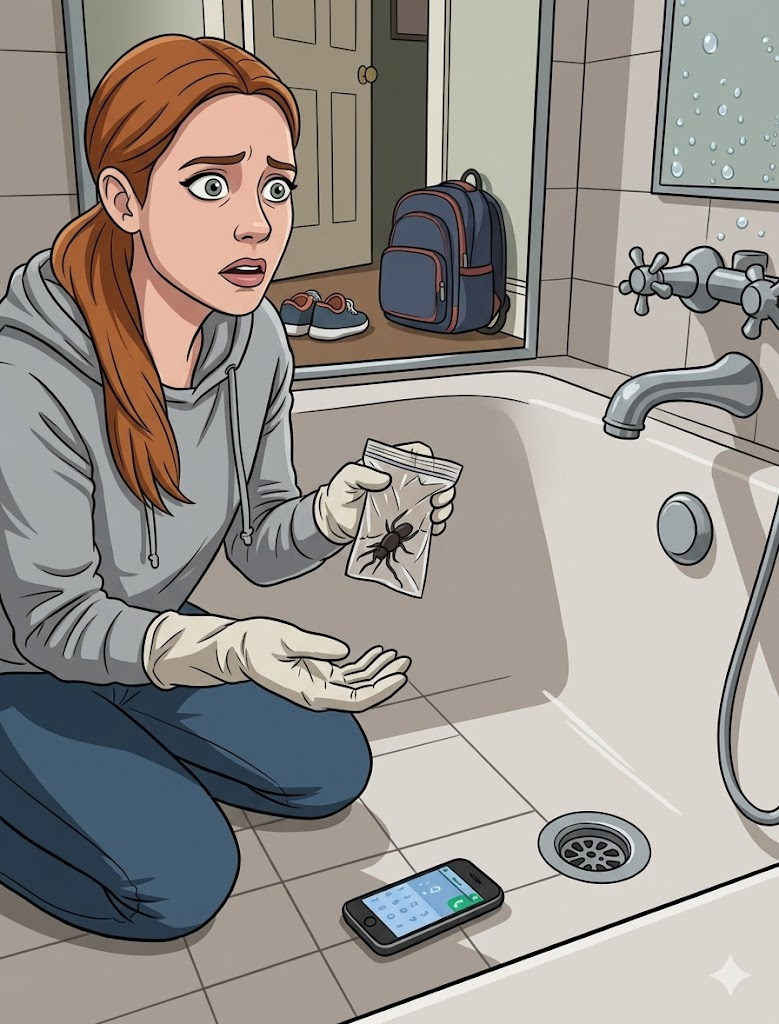
The bathtub had started draining slowly, leaving a gray ring at the bottom, so I decided to clean out the drain. I pulled on gloves, unscrewed the cover, and slid a plastic drain snake inside.

It snagged on something soft.

I tugged, expecting clumps of hair.

Instead, I pulled up a wet mass of dark strands tangled with something else—thin, stringy fibers that didn’t look like hair at all. As more came free, my stomach dropped.

There, mixed with the hair, was a small piece of fabric, folded and stuck together with soap residue.

It wasn’t random lint.

It was a torn piece of clothing.

I rinsed it under the faucet, and as the grime washed away, the pattern became clear: pale blue plaid—the exact fabric of Sophie’s school uniform skirt.

My hands went numb. Uniform fabric doesn’t end up in a drain from normal bathing. It ends up there when someone is scrubbing, tearing, trying desperately to remove something.

I flipped the fabric over and saw what made my entire body start shaking.

A brownish stain clung to the fibers—faded now, diluted by water, but unmistakable.

It wasn’t dirt.

It looked like dried blood.

My heart slammed so loudly I could hear it. I didn’t realize I was stepping backward until my heel hit the cabinet.

Sophie was still at school. The house was silent.

My mind raced for innocent explanations—nosebleed, scraped knee, a ripped hem—but the way Sophie rushed to bathe every single day suddenly felt like a warning I had ignored.

My hands shook as I grabbed my phone.

The moment I saw that fabric, I didn’t “wait to ask her later.”

I did the only thing that made sense.

I called the school.

When the secretary answered, I forced my voice to stay steady as I asked, “Has Sophie been having any accidents? Any injuries? Anything happening after school?”

There was a pause—too long.

Then she said quietly, “Mrs. Hart… can you come in right now?”

My throat tightened. “Why?”

Her next words made my blood go cold.

“Because you’re not the first parent to call about a child bathing the moment they get home.”

I drove to the school with the torn fabric sealed in a sandwich bag on the passenger seat, like evidence from a crime I didn’t want to name. My hands wouldn’t stop shaking on the steering wheel. Every red light felt unbearable.

At the front office, there was no small talk. The secretary led me straight to the principal’s office, where Principal Dana Morris and the school counselor, Ms. Chloe Reyes, were waiting. Both looked exhausted—the kind of tired that comes from holding secrets that weigh too much.

Principal Morris glanced at the bag in my hand. “You found something in the drain,” she said gently.

I swallowed. “This came from Sophie’s uniform. And there’s… there’s a stain.”

Ms. Reyes nodded, as if she had been expecting exactly that. “Mrs. Hart,” she said carefully, “we’ve had reports that several students are being encouraged to ‘wash up immediately’ after school. Some were told it was part of a ‘cleanliness program.’”

My chest tightened. “Encouraged by who?”

Principal Morris hesitated, then said, “A staff member. Not a teacher. Someone assigned to the after-school pickup area.”

My stomach twisted. “You mean an adult has been telling kids to bathe?”

Ms. Reyes leaned forward, her voice calm and gentle. “We need to ask something difficult. Has Sophie mentioned a ‘health check’? Being told her clothes were dirty, being given wipes, or being asked not to tell parents?”

My mind jumped to Sophie’s rehearsed smile. “I just like to be clean.”

“No,” I whispered. “She hasn’t said anything. She barely talks lately.”

Principal Morris slid a folder across the desk. Inside were anonymized notes—stories that were horrifyingly similar. Children describing a man with a staff badge telling them they had “stains” or “smelled,” guiding them to a side bathroom near the gym, handing them paper towels, sometimes tugging at their clothes “to check.” He warned them, “If your parents find out, you’ll get in trouble.”

I felt sick. “That’s grooming,” I said, my voice shaking.

Ms. Reyes nodded. “We believe so.”

I forced myself to breathe. “Why wasn’t this stopped sooner?”

Principal Morris’s eyes filled. “We suspended him yesterday while investigating. But we didn’t have physical evidence. The kids were scared. Some parents assumed it was about hygiene. We needed something concrete.”

I looked down at the fabric again, my throat burning. “So Sophie was trying to wash it away.”

Ms. Reyes spoke softly. “Children often bathe immediately after something invasive because they feel contaminated. It’s not about being dirty. It’s about trying to regain control.”

Tears spilled before I could stop them. “What do you need from me?”

Principal Morris replied, “We want to speak with Sophie today, with you present, somewhere safe. Law enforcement has already been contacted.”

My hands clenched. “Where is she right now?”

“In class,” Ms. Reyes said. “We’ll bring her here. But please—don’t interrogate her. Let her speak in her own time. Safety comes first.”

When Sophie entered the office, she looked so small in her uniform, her hair still slightly damp from her morning shower. She saw me and immediately looked down, as if she already understood.

I took her hand. “Sweetheart,” I whispered, “you’re not in trouble. I just need you to tell me the truth.”

Her lip trembled. She nodded once.

Then she whispered the sentence that silenced the room:

“He said if I didn’t wash, you would smell it on me.”

My heart shattered and hardened all at once.

“Sophie,” I said gently, “who said that?”

She squeezed my fingers painfully tight. “Mr. Keaton,” she whispered. “The man by the side door.”

Ms. Reyes kept her voice calm. “What did he mean by ‘smell it’?”

Sophie’s eyes filled with tears. “He… he touched my skirt,” she said. “He said there was a stain. He took me to the bathroom by the gym. He came in after. He said it was a ‘check.’” Her voice cracked. “He told me I was dirty.”

I pulled her into my arms, shaking. “You are not dirty,” I said fiercely. “You did nothing wrong.”

Detective Marina Shaw arrived within the hour. She didn’t rush Sophie or push for details—just confirmed the basics and explained, in simple terms, that adults are never allowed to do what Mr. Keaton did. Sophie listened carefully, like she was deciding whether the world was safe again.

The detective took the bag with the torn fabric as evidence. Sophie’s uniform from that day was collected, photographed, and security footage from the side entrance and gym corridor was requested. The principal explained that Mr. Keaton had no legitimate reason to be near student bathrooms and that his access had already been revoked.

That night, even after spending the entire day with me, Sophie still tried to head straight for the bath when we got home.

I knelt and held her shoulders. “You don’t have to wash to be okay,” I told her. “You’re already okay. And I’m here.”

She looked up with red, tired eyes. “Will he come back?”

“No,” I said—and this time, I meant it. “He can’t.”

The case moved quickly after that. One parent came forward. Then another. The pattern became undeniable: the “cleanliness” excuse, the threats, the isolation. Mr. Keaton was arrested for inappropriate contact and coercion. The school introduced new supervision rules, bathroom escort policies, and mandatory reporting training—measures that should have existed before, but at least existed now.

Sophie began therapy. Some days were easier. Some were raw. She drew pictures of herself standing behind a locked door with a huge lock labeled “MOM.” I keep that drawing on my nightstand as a reminder of what my job truly is.

And I’ll be honest—I still think about that drain. About how close I came to ignoring a pattern because it was easier to accept “I just like to be clean.” Sometimes danger doesn’t arrive loudly. Sometimes it repeats quietly.

So if you’re reading this, I want to ask you gently: what small change in a child’s behavior would make you pause and look closer—without panic, but without brushing it off either?

Share your thoughts. Conversations like this help adults notice patterns sooner—and sometimes, noticing is what keeps a child safe.

**Part Ending**

Months passed, but the weight of that day never fully lifted—it simply changed shape.

Sophie turned eleven in a quiet backyard party with just family and her two closest friends. No big crowds, no unfamiliar adults. She blew out the candles on a simple chocolate cake and, for the first time in a long while, her smile reached her eyes. When I hugged her afterward, she whispered, “I didn’t wash today, Mom. And I’m okay.” I held her tighter than I probably should have, swallowing the lump in my throat.

Mr. Keaton—his real name now public in the court documents—pleaded guilty to multiple counts of child endangerment and sexual abuse of a minor. More families came forward once the first charges were filed. The evidence from Sophie’s uniform, the security footage showing him leading her toward the side bathroom, and the testimonies of other children painted a clear, damning picture. He received a lengthy prison sentence. The school district settled quietly with the affected families, implemented stricter protocols, and the after-school area now has two staff members on duty at all times with visible cameras.

But justice, even when it arrives, doesn’t erase the scar.

Sophie still has hard days. Some nights she wakes up convinced she smells “dirty” again, even after a normal day of school and play. On those nights we sit together in the bathroom while she takes a shower—not because she has to, but because she chooses to. I wait outside the door, humming the silly songs we used to sing when she was little. She knows now that the door doesn’t have to be locked. She knows I’m there.

Therapy helped her find words for the shame he tried to plant inside her. She learned that his words were weapons, not truths. One session, she drew a new picture: herself standing in an open field, no locked doors, with me beside her holding a big key. She titled it “Free.” I framed that one too.

I changed as well. The knot in my stomach never fully disappeared, but it became something useful—sharper instincts, quicker questions, less willingness to accept easy answers. I started volunteering with a local child safety organization, speaking to parent groups about noticing the quiet changes: the sudden obsession with cleanliness, the rehearsed phrases, the emotional distance. I always end with the same line:

“Trust your unease. A child’s silence can be louder than you think.”

Sophie is healing. She laughs more freely now. She leaves her backpack by the door and sometimes even forgets to head straight for the bath. She tracks mud into the house again like a normal kid. And when she does rush to clean up after soccer practice, I no longer feel that old dread. I just call out, “Don’t use all the hot water, messy girl!”

One evening, as we were folding laundry together, she paused over her school uniform skirt—the new one, without any torn pieces or hidden stains.

“Mom?” she asked softly.

“Yeah, baby?”

“I’m really glad you cleaned the drain that day.”

I set the shirt down and looked at her. “Me too.”

She nodded once, satisfied, and went back to folding. In that small moment, I saw it: the beginning of trust returning, the slow rebuilding of safety in her own skin.

The house still has that gray ring sometimes in the tub. I leave it now and then as a reminder. Not of fear, but of vigilance. Of how love sometimes means digging through the mess instead of pretending it isn’t there.

And if you’re a parent reading this—keep noticing. Keep asking the gentle questions. Keep being the adult who refuses to look away.

Because sometimes, the thing that saves a child is as simple, and as hard, as cleaning out a drain.

More Details
For 13 years, I hid my success to make my sister feel big
Jul 2, 2026

For 13 years, I hid my success to make my sister feel big

My name is Elena Martinez. I am forty-two years old. My sister, Victoria, is forty-five.

Growing up in Northern Virginia, Victoria was the golden child. She was straight A’s, debate team captain, full scholarship to Georgetown, perfect hair, perfect posture, perfect answers at every dinner table where adults were watching.

I was the quiet one.

I spent more time in the library than at country club luncheons. I liked books, silence, old courthouses, and questions people could not answer quickly. My parents owned a successful accounting firm in Northern Virginia. We were upper middle class, comfortable, polished, and very aware of the right zip code.

Victoria understood that world perfectly.

She married her college boyfriend, Bradley, a corporate attorney with a family that looked good in Christmas cards. They bought the McMansion, the luxury SUV, the expensive patio furniture, and the carefully curated life that seemed built more for photos than for peace.

I went to law school, but not Georgetown.

Victoria made sure I knew what she thought of that.

“You would embarrass yourself there,” she said once, as if she were saving me from a public mistake.

So I went to a state school. I took out loans. I worked nights as a paralegal and studied in the margins of my own exhaustion. Victoria told relatives I “couldn’t hack it at a real law school.”

After graduation, I clerked for a federal district court judge.

Victoria laughed when she heard.

“A clerk?” she said. “That’s basically a secretary. Elena, I thought you wanted to be a real lawyer.”

I did not correct her.

That became a pattern long before I understood how dangerous patterns can be. Victoria needed to win. She needed to stand taller by making someone else seem smaller. Correcting her only made her sharper, colder, more determined to prove the correction did not matter.

So I let her believe what she wanted.

What Victoria did not know, and what none of my family knew, was that the judge I clerked for was Frank Davidson.

Judge Frank Davidson.

Five years later, he became Attorney General of the United States.

After my clerkship, I worked as a federal prosecutor. I handled serious federal cases, public corruption matters, and organized investigations that demanded long hours, calm judgment, and a stomach for pressure. I won cases. A lot of them.

Victoria told people I was “doing okay for a government employee.”

At twenty-nine, I was recommended for a federal judgeship, the youngest candidate in the circuit. The vetting process took eighteen months. Background checks, interviews, confirmation hearings, quiet scrutiny from people who knew how to find every weak seam in a life.

I told my family I was still working as a prosecutor.

Technically, I was still in federal criminal law.

Victoria was busy planning her second wedding.

She had divorced Bradley for what she called “lack of ambition” and married Richard, a pharmaceutical executive with a better house, better watch, and better vacation photos.

At their engagement party, she lifted a champagne glass and announced, “At least one Martinez sister married successfully.”

I was confirmed to the federal bench three months later.

I did not invite my family to the ceremony.

Judge Davidson, Attorney General Davidson by then, called personally to congratulate me.

“Elena,” he said, “you earned this. Don’t let anyone make you feel otherwise.”

For thirteen years, I sat on the federal bench. I presided over high-profile cases. I wrote opinions that appellate courts cited. I mentored young attorneys, spoke at conferences, served on judicial committees, and built a reputation for fairness, scholarship, and restraint.

My family thought I was a mid-level government lawyer making seventy-five thousand dollars a year.

Victoria thought I lived in a sad little apartment because I did not post my home on social media.

In reality, I owned a renovated townhouse in Old Town Alexandria, a three-story historic place with original crown molding, a garden courtyard, and quiet rooms filled with books. I bought it with careful savings, investments, and a life I built without needing applause.

Victoria thought I drove an embarrassing five-year-old Camry.

She did not know I also had a vintage Mercedes in my garage that I drove on weekends because I loved classic cars, not status symbols.

She thought I was single because “no successful man wants a workaholic government employee.”

She did not know about Michael, a fellow federal judge I had been seeing privately for four years. We kept our relationship quiet because our work required discretion and because I had learned to protect anything good from people who treated information like ammunition.

Victoria’s third marriage was falling apart when she met Mark Reynolds.

Mark was thirty-eight, a senior associate at a white-shoe law firm. Handsome, charming, polished, ambitious. Most importantly to Victoria, his father was Judge Thomas Reynolds, a United States Circuit Court Judge for the Fourth Circuit.

I knew Judge Reynolds.

I had argued before him twice when I was a prosecutor. After my confirmation, we served together on several judicial panels and committees. He was brilliant, principled, dryly funny, and impossible to flatter into foolishness.

Victoria found out about Judge Reynolds on her second date with Mark.

She called me immediately.

“Elena,” she said, breathless, “Mark’s father is a federal judge. Not some district court thing. A circuit court judge. Do you know what that means?”

“Yes,” I said quietly. “I know what that means.”

“Of course you don’t,” she replied. “It means he’s basically one step below the Supreme Court. It means Mark comes from a family that matters. Real influence. Real circles.”

“That’s wonderful, Victoria. I’m happy for you.”

“I need you to understand something.”

Her voice went cold in that familiar way.

“This is the most important relationship of my life. Mark’s family moves in circles you can’t even imagine. Federal judges, senators, CEOs. His mother went to Wellesley. They summer in Martha’s Vineyard.”

“I understand.”

“Do you?” she asked. “Because I can’t have you embarrassing me, Elena. I can’t have Mark’s family thinking the Martinez family is ordinary.”

I said nothing.

“You’re going to meet them eventually,” she continued. “When you do, don’t talk about your job too much. Don’t mention you work for the government. If anyone asks, say you’re in law. That’s technically true.”

“Okay, Victoria.”

“And for God’s sake, buy a decent outfit. None of your clearance rack blazers.”

For the next six months, I watched Victoria throw herself into becoming worthy of the Reynolds family.

She joined the boards of three charities. She attended gallery openings. She hired a personal stylist. Her Instagram turned into a museum of sophisticated dinner parties, book launches, cultural events, and carefully angled photographs beside people whose names she wanted others to recognize.

She called me once a month with updates.

“Mark’s mother mentioned they vacation in Nantucket. I’m learning about Nantucket. Did you know there’s a difference between Nantucket and the Hamptons, Elena? Of course you didn’t.”

Another time, “Mark’s father knows Senator Williams. They went to Yale together. Can you imagine? My future father-in-law knows senators personally.”

And later, “I met Mark’s sister Catherine. She’s a partner at a venture capital firm. A partner, Elena. She manages a four-hundred-million-dollar fund.”

I listened.

I said, “Congratulations.”

Then I went back to my life.

In March, I presided over a public corruption case that made national news. A state senator had accepted payments from developers, and the trial lasted three weeks. My rulings were covered by national newspapers and legal journals.

Victoria never mentioned it.

She did not read legal news.

In April, I was asked to speak at a Harvard Law Symposium on federal sentencing reform. Judge Reynolds was the keynote speaker. We had dinner with several other judges the night before.

Over coffee, Judge Reynolds looked at me and said, “Elena, I keep meaning to ask. Any relation to a Victoria Martinez in Arlington? My son Mark is engaged to a Victoria Martinez.”

“That’s my sister,” I said.

His eyebrows rose.

“Your sister? Mark never mentioned. Does she know you’re a judge?”

I smiled faintly.

“Complicated. I keep my private life very private.”

He studied me for a moment.

“Your family doesn’t know?”

“No, sir.”

“That must be difficult.”

I shrugged. “It’s easier this way. My sister needs certain things to be true about me. Letting her think I’m unsuccessful makes her happy. Everyone wins.”

Judge Reynolds frowned.

“That’s not winning, Elena. That’s hiding.”

“With respect, Your Honor,” I said, “it’s surviving.”

He did not push.

But I saw something in his expression. Concern, maybe. Understanding, too.

In May, Victoria got engaged. The proposal was elaborate. Mark rented a private room at the Four Seasons, hired a string quartet, and let Victoria post the whole thing online before dessert arrived.

She called me the next morning.

“It’s official. I’m going to be part of the Reynolds family. Mark is already talking about me joining his mother’s foundation board. Can you imagine me on a board with judges’ wives and senators’ wives?”

“That’s wonderful.”

“We’re having an engagement dinner next month. Small, intimate, immediate family.” She paused. “Which means I need you to come.”

“Of course.”

“But Elena, I need you to understand. This isn’t like our family dinners.”

“I know.”

“These are sophisticated people. Mark’s father clerked for the Supreme Court. His mother studied at Oxford. They’re not going to understand your lifestyle.”

“My lifestyle?”

“You know what I mean. The government job. The lack of success. Just please don’t talk about work. Don’t mention money. Don’t embarrass me.”

I could have told her then.

I should have, maybe.

Instead, I said, “I’ll be on my best behavior.”

The engagement dinner was scheduled for June 15 at The Ivy, an exclusive restaurant in Georgetown. Victoria texted me the dress code three times.

Cocktail attire.

Nice cocktail attire, Elena.

Not clearance rack.

I wore a navy silk dress from my closet, understated and elegant, with pearl earrings Michael had given me after a conference in Boston. I drove the Camry because I knew Victoria would be watching the parking lot.

I arrived exactly on time.

Victoria was already there in a white designer dress that probably cost three thousand dollars. She grabbed my arm the moment I walked in.

“You’re here. Good. Listen, Mark’s family isn’t here yet. When they arrive, let me do the talking. Don’t volunteer information about yourself. If anyone asks what you do, just say law and change the subject.”

“Understood.”

“And please, please don’t mention that apartment of yours or that car. Mark’s sister drives a Tesla. His mother has a Mercedes. They don’t need to know you’re struggling.”

I almost laughed.

I almost told her that my “sad little apartment” was a historic townhouse Catherine Reynolds herself had complimented during a judicial function the month before. I almost told her that my garage Mercedes was vintage, not new, because I preferred character over display.

Instead, I said, “I’ll be discreet.”

“Thank you.” Her shoulders softened. “This is important to me, Elena. This family is everything I’ve worked for.”

Our parents arrived next. Dad in his country club blazer, Mom in her pearls. They hugged Victoria first, nodded at me second.

The usual.

Mom lowered her voice.

“Elena, Victoria told us about Mark’s family. Very impressive. Please don’t mention your job too much. We don’t want them thinking we’re ordinary.”

“I understand,” I said.

Then Mark arrived with his family.

Judge Thomas Reynolds looked exactly as he did in court: tall, silver-haired, composed, with the kind of presence that did not need volume. His wife, Caroline, wore a classic cream suit. Catherine, Mark’s sister, wore a sharp black pantsuit and carried herself with the confidence of someone who had made her first million before thirty.

Mark introduced everyone.

“Mom, Dad, Catherine, this is Victoria’s family. Her parents, David and Marie. And her sister Elena.”

Victoria jumped in quickly.

“My younger sister. She works in law. Government law.”

She said it the way someone might say pest control or telemarketing.

Judge Reynolds extended his hand to my father.

“David, pleasure to meet you. Thomas Reynolds.”

Then he turned to me.

Our eyes met.

I saw the recognition. Saw him process the situation. Saw the question form.

I gave the slightest shake of my head.

Not here.

Not now.

He paused for less than a second.

“Elena,” he said smoothly. “Nice to meet you.”

“Your Honor,” I said quietly. “The pleasure is mine.”

Victoria shot me a look.

“Just Mr. Reynolds, Elena. Don’t be weird.”

We sat down at a large round table near the windows. Victoria positioned herself between Mark and Judge Reynolds. I was placed at the far end, between Catherine and my father.

The dinner began politely.

There was talk about wedding venues, dates, guest lists, flowers, and black-tie expectations. Victoria dominated the conversation, laughing too loudly and touching Mark’s arm constantly.

“We’re thinking September,” she said, “at the Ritz-Carlton in Tysons. Five hundred guests. Black tie.”

“That sounds lovely,” Caroline Reynolds said.

“Mark’s father will invite so many important people,” Victoria continued. “Won’t you, Judge Reynolds? I mean, you must know everyone in Washington legal circles.”

“I know a few people,” Judge Reynolds said carefully.

“A few?” Victoria laughed. “Mark says you have senators on speed dial and that you’ve argued before the Supreme Court. That’s incredible. I’ve always admired people in positions of real power.”

She glanced at me.

Judge Reynolds’ expression did not change, but I saw his jaw tighten slightly.

“Power is relative,” he said. “The most powerful people I know are often the ones working quietly, without recognition.”

Victoria missed the subtext entirely.

“Oh, absolutely. But there’s something to be said for achievement. For making something of yourself.”

Another glance at me.

“Not everyone has that drive.”

My mother nodded.

“Elena has always been content with less.”

“Less?” Catherine asked, turning to me with interest. “What do you do, Elena?”

Before I could answer, Victoria jumped in.

“She works for the government. Local courts. Nothing exciting. It’s fine for her. She’s never been ambitious.”

“Local courts,” Catherine repeated.

She was still looking at me.

“It’s a living,” I said quietly.

“Must be interesting, though,” Catherine pressed. “What kind of law?”

“Criminal,” I said. “Federal criminal law.”

“Federal,” Judge Reynolds said, his voice carefully neutral. “That’s not local courts.”

Victoria waved her hand.

“Same difference. Government legal work. Bureaucratic. Low-level. Elena is comfortable there.”

The table went quiet for a moment.

Then my father decided to help.

“The important thing is that one of our daughters is successful.” He smiled at Victoria. “We’re very proud of Victoria’s accomplishments. Her marriage to Mark, joining this family. It’s quite an achievement.”

“An achievement,” Judge Reynolds repeated softly.

“Well, yes,” Mom said. “The Reynolds family is so distinguished. Federal judges, important connections. It’s everything a parent hopes for.”

I watched Judge Reynolds’ face. I watched him realize what my life had been. I watched him understand why I had hidden.

Victoria beamed.

“I’ve worked hard to be worthy of Mark. To be someone his family can be proud of.”

“And Elena?” Caroline Reynolds asked quietly. “What about Elena?”

Victoria laughed that nervous, dismissive laugh I knew too well.

“Elena is fine with her life. She’s never wanted more.” She looked at me. “Have you, Elena?”

Everyone turned to me.

I could have ended it there. I could have told the truth.

Instead, I said, “I’m content.”

“Content,” Victoria repeated triumphantly. “See? Elena knows her limits. Not everyone needs to be successful. Some people are just ordinary, and that’s okay.”

She said it kindly, patronizingly, as if she were offering me mercy.

My father nodded.

“We’ve accepted that our daughters are very different. Victoria aims high. Elena aims realistically.”

Judge Reynolds set down his fork.

His voice was still polite, but there was steel underneath.

“What makes you think Elena isn’t successful?”

The question hung in the air.

Victoria laughed nervously.

“Well, I mean, she works a government job. She drives a Camry. She lives in an apartment. No offense to Elena, but success looks different for different people.”

“No offense taken,” I said quietly.

Catherine was staring at me now. Really staring.

“Wait,” she said. “Federal criminal law. How long have you been doing that?”

“A while.”

“And what’s your title?” she asked.

Victoria interrupted.

“Does it matter? Can we talk about the wedding? I want Catherine’s advice on venues.”

“What’s your title, Elena?” Judge Reynolds asked.

The table went silent.

I looked at Victoria. I looked at my parents, at their smug and comfortable certainty that I was the family disappointment.

Then I looked at Judge Reynolds.

He gave me the slightest nod.

“I’m a federal judge,” I said clearly. “United States District Court for the Eastern District of Virginia.”

The silence stretched.

Then Victoria laughed.

It was high-pitched and disbelieving.

“What? Elena, don’t. That’s not funny.”

“I’m not joking.”

“You’re a judge?” my mother asked. “Since when?”

“Thirteen years.”

My father shook his head.

“That’s impossible. You work in a court. You’ve told us.”

“I told you I work in federal criminal law. I do. I preside over federal criminal cases.”

Victoria’s face had gone red.

“You’re lying. You can’t be a federal judge. Federal judges are—”

“Appointed by the president,” Judge Reynolds said quietly. “Confirmed by the Senate. They serve lifetime appointments.” He turned to me. “Elena, when were you confirmed?”

“March 2011. President Obama. Senate vote was ninety-four to two.”

The color drained from Victoria’s face.

Catherine pulled out her phone and typed quickly. A moment later, she turned the screen toward the table.

There I was in judicial robes at a conference the previous year.

Judge Elena Martinez, U.S. District Court, Eastern District of Virginia.

My mother grabbed the phone.

“That’s you,” she whispered. “That’s you in judge robes.”

“Yes.”

“But you said you never…” She looked at Victoria. “Did you know?”

“Of course I didn’t know,” Victoria snapped. “She lied. She let us think she was nobody.”

“I never lied,” I said calmly. “I told you I worked in federal criminal law. I do. You assumed I was low-level. I didn’t correct you.”

“That’s lying by omission.”

“Is it?” I looked at her steadily. “You called me a secretary. Called my work nothing. Told me not to embarrass you. When exactly was I supposed to correct you?”

Judge Reynolds watched the exchange with an expression I recognized from court. It was the look he wore when a witness began damaging their own credibility without realizing it.

Mark looked from me to his father.

“You know each other?”

“Judge Martinez and I have served on several judicial panels together,” Judge Reynolds said. “She is one of the finest legal minds I’ve had the pleasure of working with.”

Victoria stood abruptly.

“This is insane. You’re all insane. Elena is not a federal judge. She can’t be. I would have known.”

“Would you?” I asked quietly. “When is the last time you asked about my work? When is the last time you asked about my life at all?”

“I—that’s not—” She turned to our parents. “Tell them. Tell them Elena is not a judge.”

My mother was still scrolling through search results on Catherine’s phone.

“There are articles,” she whispered. “So many articles. Judge Martinez presides over corruption trial. Judge Martinez opinion cited by Fourth Circuit.” She looked at me. “Elena, is this real?”

“Yes.”

My father was reading over her shoulder. His face had gone gray.

“You sentenced a state senator.”

“He had been convicted in a public corruption case. The evidence was overwhelming.”

“You’ve been a federal judge for thirteen years,” he said slowly. “Thirteen years. And you never told us.”

“You never asked. You assumed. I let you.”

Victoria slammed her hand on the table.

“Why? Why would you hide this? Do you know what this makes me look like? I’ve been telling Mark’s family that you’re nothing. That you’re ordinary. That I’m the successful one.”

“Yes,” I said. “You have.”

“You made me look like an idiot.”

“No, Victoria. You did that yourself.”

The words hung there.

Judge Reynolds cleared his throat.

“Perhaps we should—”

“No,” Victoria said, hands shaking. “No, I want to know. Why hide it, Elena? Why let everyone think you’re a failure?”

I looked at her.

Really looked at her.

“Because you needed me to be.”

“That’s not—”

“You built your entire identity on being better than me. Smarter. More successful. More accomplished. What would you have done if you’d known the truth thirteen years ago?”

She opened her mouth, then closed it.

“You would have made it about you,” I continued quietly. “Made it a competition. Told everyone I got the position through connections or luck. Anything to preserve your position as the successful sister.”

“That’s not true.”

“Isn’t it? You’re doing it right now. Your first response wasn’t congratulations or pride. It was anger that I made you look bad.”

My mother made a small sound.

My father stared down at his plate.

Mark was looking at Victoria like he had never seen her before.

“I think,” Judge Reynolds said carefully, “we should all take a breath. This is clearly a shock.”

“A shock?” Victoria’s voice rose. “My sister has been lying to our family for over a decade, making fools of us, and you think we should breathe?”

“I didn’t make a fool of you,” I said. “I lived my life. You made assumptions.”

“You let us. You played poor. You played unsuccessful. You—”

She stopped.

“Wait. The apartment. You said you couldn’t afford—”

“I never said that. You assumed.”

Catherine was still on her phone.

“Judge Martinez’s financial disclosures are public record,” she said. “She owns a townhouse in Old Town Alexandria worth approximately one point eight million.”

My mother gasped.

“Federal judges make over two hundred thousand annually,” Catherine continued. “And it looks like she has investment income. She has been very smart with her money.”

“You’re rich,” Victoria said.

“I’m comfortable.”

“You let me pay for your dinner last Christmas. You let me think you were struggling.”

“You insisted on paying. You said, and I quote, ‘I know money is tight for you.’ I said thank you.”

The waiter appeared with our entrees, took one look at the table, and disappeared without a word.

Judge Reynolds leaned back in his chair.

“Elena, I have to ask. Why reveal this now?”

“Because,” I said, looking at Victoria, “I’m tired.”

“Tired?” she repeated.

“Tired of being your villain. Your cautionary tale. The sister you pity in public and mock in private.”

“I don’t.”

“You do.”

I pulled out my phone, opened Instagram, and found Victoria’s post from the previous month.

I read aloud.

“So grateful for my journey. Some people settle for ordinary lives. I chose extraordinary. Family first.”

Victoria’s mouth tightened.

“That wasn’t about you.”

“It had a picture of us. You in designer clothes, me beside my Camry. You tagged me.”

Silence.

“Or this one,” I continued. “Thankful for sisters, even when we take very different paths. Some of us aim high.” I looked up. “A photo from Dad’s birthday where you’re with your husband, and I’m alone in the background.”

“I was just—”

“And the text you sent me last week.”

I scrolled and found it.

“Make sure you dress appropriately for dinner. Mark’s family is used to a certain level of sophistication. I know that’s not your world, but please try.”

I set the phone down.

“For thirteen years, I let you treat me like I was less than you. Like I was someone to be ashamed of. I let you because I thought it made your life easier. I thought if you could feel superior to me, maybe you would be happy.”

“I am happy.”

“Are you?” I asked. “You’ve had three marriages. You’ve changed careers four times. You’ve reinvented yourself over and over, chasing whatever you think success looks like. And every time, you defined it against me. At least I’m not like Elena.”

My mother was crying quietly now.

My father looked like he might be sick.

Mark had not said a word. He was watching Victoria with an expression I could not quite read.

“This isn’t fair,” Victoria whispered. “You lied to us. You made us look foolish.”

“No,” Judge Reynolds said firmly. “Elena lived her life privately. You made assumptions and never bothered to verify them. There’s a difference.”

Victoria turned to him desperately.

“But you understand, right? Your son is marrying into a family that has been lying.”

“My son,” Judge Reynolds interrupted, his voice cold now, “is marrying into a family where one daughter has served with distinction on the federal bench for more than a decade. Where one daughter has handled cases that shaped federal law and earned the respect of every judge she has worked with.”

He paused.

“And where one daughter has apparently spent those same years tearing that sister down. So no, Victoria. I don’t understand. I don’t understand at all.”

Victoria’s face crumpled.

Caroline Reynolds spoke for the first time in several minutes.

“Elena, forgive me for asking, but why tonight?”

I looked at Victoria.

“Because I realized something. No matter what I do, no matter how small I make myself, Victoria will always need someone beneath her. And I’m done being that person.”

“I never asked you to—” Victoria began.

“You didn’t have to ask. You demanded it. Every family dinner. Every holiday. Every conversation. Don’t embarrass me. Don’t talk about your job. Don’t make me look bad. As if my existence was something you had to manage.”

“That’s not—”

“It is.”

I stood.

“For thirteen years, I’ve watched you build an identity based on being better than me. I’ve watched you introduce me to friends, boyfriends, husbands, with that apologetic tone. This is my sister. She’s not as successful. I smiled through it. I accepted it.”

I looked at Judge Reynolds.

“But I can’t accept it anymore. Not when you’re joining a family that includes this man, someone I respect immensely, someone who represents everything I believe about justice and integrity. I won’t let Victoria’s version of me be the truth Mark’s family knows.”

“You’re doing this for revenge,” Victoria said bitterly.

“No. I’m doing this because I deserve better. Because I’ve earned better.”

I picked up my purse.

“I’m sorry, Judge Reynolds. Caroline. Catherine. I know this isn’t how you wanted to meet my family.”

“Don’t apologize,” Judge Reynolds said. “You have nothing to apologize for.”

“Elena, wait,” my father started.

“No, Dad. I’m done waiting. I’m done being quiet. I’m done making myself small so Victoria can feel big.”

I turned to my sister.

“I hope you find what you’re looking for. I hope Mark makes you happy. I hope you build a good life together. But I won’t be part of a family that requires me to pretend I’m someone I’m not.”

“You’re leaving?” my mother asked.

“Just like that?”

“Just like that.”

Catherine stood suddenly.

“Wait. Elena—Judge Martinez—can I walk you out?”

I nodded.

Outside, the Georgetown air felt warm and bright after the heavy quiet of the dining room. Catherine walked beside me to the parking lot and leaned against my Camry.

“So,” she said. “Federal judge.”

“So,” I replied. “Venture capital.”

She laughed softly.

“Your sister has been talking for months about how I needed to meet her whole family. About how she was so much more accomplished than her sister who was just getting by.”

“I know.”

“I Googled you two weeks ago,” Catherine said. “Found your judicial record. Recognized your name from cases I read in law school. I went to Columbia Law before I moved into finance. I knew you’d been on the bench. Knew you were brilliant.”

“You didn’t say anything.”

“I wanted to see if you would.” She paused. “I wanted to see if you were hiding, or if your family just couldn’t see you.”

“Both, probably.”

“For what it’s worth,” she said, “I think you’re extraordinary. And I think my brother just realized he may be marrying the wrong version of someone.”

I smiled faintly.

“He loves her. He’ll work through this.”

“Maybe.” Catherine hesitated. “But Elena, don’t disappear completely. My father respects you. My mother just spent ten minutes reading your opinions on her phone, and she’s already impressed. We’re not your family. We see you.”

Something in my chest loosened.

“Thank you.”

I drove home to my “sad little apartment,” my three-story historic townhouse with original crown molding and a garden courtyard.

I texted Michael.

Family dinner was interesting. I’ll tell you tomorrow.

He called immediately.

“Interesting good or interesting bad?”

“Interesting necessary.”

“You told them.”

“I told them.”

“How do you feel?”

I thought about it.

“Free.”

The text messages started around eleven that night.

Victoria: I can’t believe you did this.

Victoria: You ruined everything.

Victoria: Mark’s parents think I’m a horrible person.

Victoria: How could you embarrass me like this?

I did not respond.

Then my mother.

Elena, we need to talk.

Your father is very upset.

This isn’t how family handles things.

I turned off my phone.

The next morning, I had seventeen missed calls and four voicemails.

My father’s voice was tight with anger.

“Elena, this was inappropriate. You made us all look foolish. You need to call your sister and apologize.”

My mother was crying.

“I don’t understand why you kept this secret. We could have been so proud. Why would you hide this from us?”

Victoria was nearly hysterical.

“Mark is reconsidering. His parents want him to think carefully about marrying into our family. You’ve destroyed my life. I hope you’re happy.”

And then, surprisingly, Catherine Reynolds.

“Elena, it’s Catherine. I know you probably don’t want to hear from any of us, but I wanted you to know something. My parents aren’t reconsidering Mark and Victoria’s relationship because of you. They’re reconsidering because of how Victoria treated you. There’s a difference. Also, Dad wants to know if you’re free for lunch next week. Purely professional. There’s a judicial task force forming, and he wants your input. Call me.”

I called Catherine back.

“Hey,” she said. “You okay?”

“Getting there.”

“My family had breakfast this morning. Long conversation. Mark is processing.”

“What kind of processing?”

“He’s realizing there were red flags he ignored. The way Victoria talks about people. The way she measures worth. The way she treats service staff and anyone she considers beneath her.”

Catherine paused.

“She spent twenty minutes trying to convince Mark that you somehow tricked all of us, that you were manipulative, that everything you said was designed to make her look bad. Mark asked why she had spent years telling him you were a failure without ever actually asking about your career.”

“And?”

“She didn’t have a good answer.”

I felt a pang of sympathy for Mark.

“This isn’t his fault.”

“No,” Catherine said. “But it’s his problem now.”

A beat passed.

“Elena, can I ask you something?”

“Sure.”

“Why do you drive a Camry?”

I laughed.

“Because it’s reliable and I don’t care about cars as status symbols.”

“And the townhouse you hide?”

“I don’t hide it. I just don’t post it on social media. I’m a federal judge. My address is private for security reasons. My life is private because it needs to be.”

“That’s what I thought. But Victoria kept telling Mark you were ashamed of your life. That you lived small because you had to, not by choice.”

“Victoria believes what she needs to believe.”

“Yeah.” Catherine sighed. “I’ll be honest. I don’t know if Mark is going through with the wedding. He loves Victoria, but he’s realizing he doesn’t know her as well as he thought. The woman who spent months mocking her federal judge sister isn’t the woman he thought he proposed to.”

“He proposed to exactly that woman,” I said. “He just didn’t see it.”

“True.”

She paused.

“Are you going to reconcile with your family?”

“I don’t know. Right now, they’re angry that I embarrassed them. Not sorry they misjudged me. There’s a difference.”

“There is.” Another pause. “My father really does want lunch. He’s been on the phone all morning with colleagues, apparently telling everyone about the brilliant Judge Martinez who has been hiding in plain sight for years. You’ve got fans, Elena.”

“Tell him I’d be honored.”

After we hung up, I sat in my garden with coffee and thought about Victoria. About my parents. About thirteen years of being invisible.

My phone rang.

Judge Reynolds.

“Elena, I hope I’m not calling too early.”

“Not at all, Your Honor.”

“I wanted to apologize for last night. That dinner was uncomfortable.”

“You have nothing to apologize for.”

“Don’t I? I should have said something immediately. I should have introduced you properly. I let the situation unfold when I could have stopped it.”

“With respect, Your Honor, it needed to unfold. They needed to hear it from me.”

He was quiet for a moment.

“Catherine said you might be available for lunch next week.”

“I am.”

“Good. But Elena, I’m not calling about the task force. I’m calling as Mark’s father. My son is in love with your sister. He wants to marry her. But he has also discovered that the woman he loves has been cruel to someone I respect. He doesn’t know what to do with that information.”

“I don’t want to come between them.”

“You’re not. Victoria’s choices are coming between them. There’s a difference.”

He sighed.

“Mark asked me this morning if I think Victoria can change. If a woman who dismissed you for thirteen years can become someone different.”

“What did you tell him?”

“I told him that wasn’t my question to answer. But I also told him that anyone who spends years tearing down a federal judge to feel superior has serious self-reflection to do.”

“She’s not a bad person, Your Honor. She’s just insecure. Competitive. Cruel.”

His voice softened, but it remained firm.

“Elena, I know you want to excuse her. But what I witnessed last night wasn’t a moment of weakness. It was a pattern revealed. Your parents confirmed it. Every story they told about you was dismissive. Every comparison favored Victoria. That doesn’t happen by accident.”

“No,” I admitted. “It doesn’t.”

“Mark needs to decide if he can marry someone who needs others to be small so she can feel big. That is not your burden to carry.”

“Thank you, Your Honor.”

“Call me Tom. We’re colleagues. And Elena?”

“Yes?”

“I’m proud to be your colleague. What you’ve accomplished, the way you’ve conducted yourself—you’re a credit to the bench.”

After we hung up, I cried.

Not from sadness.

From relief.

Someone saw me. Really saw me.

Three weeks later, I was in chambers reviewing briefs when my clerk knocked.

“Judge Martinez, there’s a Victoria Martinez in the lobby. She says she’s your sister. She doesn’t have an appointment.”

I looked up.

“Send her in.”

Victoria looked terrible.

Her eyes were red-rimmed. She wore no makeup, jeans, and a Georgetown sweatshirt. I had never seen her dressed casually in any public setting.

“Elena,” she said.

“Victoria.”

“Can we talk?”

“Sit.”

She sat, looking around my chambers at the law books, the framed degrees, the photographs from judicial conferences.

“This is really your office.”

“Yes.”

“You’re really a federal judge.”

“Yes.”

She was quiet for a long moment.

“Mark ended our engagement.”

“I’m sorry.”

“Are you?”

I looked at her.

“Yes.”

“You got what you wanted,” she said. “You humiliated me. Destroyed my relationship. Made me look like a monster.”

“Is that what you think I wanted?”

“Wasn’t it?”

I leaned back in my chair.

“Victoria, I spent thirteen years making myself invisible so you could shine. If I wanted to humiliate you, I could have done it years ago.”

“Then why now?”

“Because you were about to marry into a family that includes someone I respect deeply. Because I couldn’t stand at your wedding and pretend to be your failure story anymore. Because I was tired of lying to myself about what our relationship actually was.”

“What is it?” she asked quietly.

“One-sided. Built on you needing me to be less than you are.”

She flinched.

“That’s not fair.”

“Isn’t it? When was the last time you asked about my life and actually listened to the answer? When was the last time you celebrated something I did? When was the last time we had a conversation where you didn’t compare us and find me wanting?”

Silence.

“I can’t remember either,” I said.

“I didn’t mean to.”

She stopped and started again.

“Mark said I was cruel. That I treated you like you were worthless. I didn’t think I was that bad.”

“You didn’t think you were bad at all. You thought you were honest. Realistic. You thought you were the successful sister dealing with the disappointing one.”

“But you were never disappointing,” she whispered. “You were extraordinary the whole time. And I was too self-absorbed to see it.”

“Yes.”

She looked at me.

Really looked at me.

“I don’t know how to fix this.”

“I don’t know if you can.”

“Do you want me to try?”

I thought about it.

“I want you to figure out who you are without me being your villain. Without needing someone else to be less than you. Until you do that, we don’t have anything to fix.”

“Mark said the same thing. He said he can’t marry someone who gets her self-worth from putting others down.”

“He’s right.”

“I love him, Elena.”

“I know. But love isn’t enough if you can’t see your partner clearly. If you need them to be your supporting actor instead of their own person.”

She nodded slowly.

“Mom and Dad are upset with me. They say I drove you away. That I ruined the family.”

“You didn’t ruin anything. You revealed what was already there.”

“Will you…” She hesitated. “Will you come to therapy with me? Family therapy? Mom wants to set it up. She thinks if we all talk—”

“No.”

Her face tightened.

“No?”

“Not yet. Victoria, you need individual therapy first. You need to figure out why you built your identity on being better than me. Why you need others to fail so you can succeed. Until you do that work, family therapy is just a performance.”

“That’s harsh.”

“It’s honest. I’ve been quiet for thirteen years. I’m done being quiet.”

She stood.

“I really did ruin everything, didn’t I?”

“You revealed everything. There’s a difference.”

At the door, she turned back.

“I know you probably don’t believe this, but I am proud of you. Federal judge. Thirteen years. That’s incredible.”

“Thank you.”

“I’m sorry I couldn’t see it before.”

“I know.”

After she left, I sat in my chambers and felt nothing dramatic. No satisfaction. No anger. Just a quiet sense of closure.

My phone buzzed.

Michael.

Dinner tonight? You’ve been quiet lately.

I smiled and typed back.

Yes. And I have stories.

That evening, over wine at my townhouse, I told Michael everything.

“So your family had no idea?” he asked.

“No idea.”

“For thirteen years?”

“Thirteen years.”

He shook his head.

“Elena, that’s impressive and depressing in equal measure.”

“I know.”

“Are you okay?”

I thought about it.

“I think so. It feels strange. Like I’ve been carrying something heavy for so long that I forgot what it felt like to put it down.”

“What happens now?”

“I live my life without apologizing for success or hiding to make other people comfortable.”

“Good.”

He raised his glass.

“To Judge Elena Martinez, who stopped hiding.”

“To being seen,” I corrected.

We clinked glasses.

Three months later, Judge Reynolds and I co-authored an article on federal sentencing reform. It was published in the Harvard Law Review.

My parents saw it on Facebook.

Someone from their country club shared it with a comment: Did you know David and Marie Martinez’s daughter is a federal judge?

My mother called.

“Elena, we saw the article. Your father wants to know if we can take you to dinner to celebrate.”

“Celebrate what?” I asked. “The article, or the fact that people from the club now know what I do?”

Silence.

“Mom, I love you. But until you can tell me you’re proud of me for me, not because of what other people think, we don’t have much to talk about.”

“That’s not fair.”

“It’s honest. I’ll talk to you when you’re ready to be honest, too.”

I hung up.

Six months after the engagement dinner, I received a wedding invitation.

Not Victoria’s.

She and Mark had ended things permanently. According to Catherine, Victoria was in therapy, working through what Catherine diplomatically called “identity issues.”

The invitation was from Catherine herself.

She was marrying her longtime partner in a small ceremony in Nantucket.

I know it’s forward to invite you, she wrote in a note enclosed with the invitation. But you’re the kind of person I want in my life. Someone who knows who they are and doesn’t apologize for it. Plus, Dad wants to corner you about that sentencing reform task force. Fair warning.

I went to the wedding.

I met Catherine’s brilliant partner, had long conversations with Judge Reynolds about judicial philosophy, and danced at the reception under soft lights while the Atlantic wind moved through the tent.

As I was leaving, Judge Reynolds pulled me aside.

“Mark asks about you sometimes,” he said. “How you’re doing.”

“Tell him I’m well.”

“He feels guilty about Victoria. About not seeing what was happening.”

“He shouldn’t. We see what we’re ready to see.”

“Wise words.”

He paused.

“Elena, I’m glad you stopped hiding. The legal community is better for seeing you clearly.”

“Thank you, Tom.”

“And for what it’s worth, I think your family may come around eventually. Some people need time to adjust their vision.”

“Maybe. But I’m not waiting for them anymore.”

“Good,” he said. “Don’t.”

I drove home to my townhouse. My not-so-secret life. My very real success.

I thought about Victoria. About my parents. About thirteen years of being invisible.

I thought about Judge Reynolds calling me “Your Honor” at that dinner. About the look on Victoria’s face. About the wine glass shattering.

I did not feel triumphant.

I did not feel vindicated.

I felt free.

My phone buzzed with a text from an unknown number.

This is Mark Reynolds. I got your number from Catherine. Hope that’s okay. I wanted to say thank you for showing me what I needed to see. Even though it cost me my engagement, I’m grateful. I hope you’re well.

I typed back.

I’m very well. Thank you for asking. I hope you find someone who sees you clearly. It makes all the difference.

He replied a few minutes later.

I hope Victoria does, too. She’s trying.

That’s something, I wrote.

It is, he answered.

I set my phone down and looked around my living room. My books. My old wood floors. My quiet garden beyond the window. My space. My life. My hard-earned peace.

For years, I thought hiding was the price of survival.

But when I finally stopped hiding, I realized being seen was worth everything I had once given up to stay invisible.

More Details
Part1: I Bought My Dream Home Until My Husband Tried to Move His Family In and Claim It as His
Jul 2, 2026

Part1: I Bought My Dream Home Until My Husband Tried to Move His Family In and Claim It as His

“Claire?”

The question went into the empty foyer and came back smaller than he had sent it. That is the particular cruelty of a house that has been emptied: it does not argue with you. It simply shows you the shape of what was there, outlined in absence, and lets you draw your own conclusions.

That morning he had left like a man who believed the world had organized itself around his convenience. He had come through the kitchen in the expensive watch I bought him for our anniversary, coffee in one hand and the unhurried confidence of someone who had already decided how the day was going to go. He told me he was picking up his parents and his recently divorced sister from the airport. He told me how many rooms they would need. He told me that I was not going to say a word about it. He said all of this the way a person states the weather: not negotiating, not explaining, simply reporting a condition that existed independent of anyone else’s opinion.

He did not ask whether his family could move in. He did not ask whether I had any feelings about sharing the house I had just bought without his contribution. He did not ask because asking would have implied I had standing to refuse, and in his understanding of our marriage I had long since stopped having that kind of standing. He simply told me how things were going to work, set his coffee cup in the sink, and walked out.

By the time he came back with his parents and his sister and their luggage, the house had learned a new language.

Let me go back further, because the moment Ethan opened that door is not where the story begins.

Ten years before I bought that house, I was sleeping next to a laptop in a one-bedroom apartment with a window that let in cold air through a crack I had been meaning to seal for eight months. The company was still small enough that every dollar that went out of my account was a dollar I felt personally, in the specific anxious way you feel money when you have built everything from exactly nothing and payroll is Tuesday and you are not entirely sure Tuesday is covered. There were months when I ate cereal for dinner because cereal was two dollars and did not require time I did not have. There were nights I fell asleep at my desk over attorney invoices and server contracts and the particular kind of email that requires diplomatic precision when you are furious but cannot afford to be. I did all of it without a co-founder, without inherited capital, without anyone’s name attached to mine in a way that would have made the doors open faster.

Ethan came later. He arrived after the company had a real office with a receptionist who answered the phone. He arrived after the clients were paying reliably and the product had been written about by people who got paid to have opinions about products. He arrived after the first article described me as a founder rather than a young woman with an interesting idea, which is a distinction that sounds small and is in practice enormous.

He was charming in the way that certain men are charming when they have not yet encountered serious resistance from anyone they wanted something from. He remembered names at parties. He offered to carry things when people were watching. He made a specific point of telling everyone he was proud of me, and I understood that to mean the same thing as respecting me, which was my mistake and one I had plenty of time later to understand clearly.

The first time he said “our company” in a room full of people, I corrected him without making much of it. The second time, I laughed and let it go because the room had moved on. By the tenth time, I had stopped correcting him because arguing over a pronoun in a crowd of people holding champagne made me look petty, and I did not want to look petty, and so the word passed without comment and became, over time, something he believed.

That is how it begins, sometimes. Not with a slammed door or a raised voice. With a word you do not correct because correcting it will make you seem difficult, and then another word, and then a version of reality constructed one unchallenged sentence at a time, until you are standing in your own kitchen wondering when you stopped being the subject of your own story.

When the company sold, Ethan told people we were blessed. When the wire cleared into my account, he told people we were finally secure. When I bought the house in Bel Air outright, with a closing statement that listed no mortgage, no co-borrower, no contribution from anyone other than the proceeds of my own work, he stood beside me at the title office and put his hand on my lower back and said, “We finally got our dream house.”

The woman behind the desk looked at the paperwork. Then she looked at me. She knew, the way anyone with a document in front of them knew. The deed was in my name. The wire confirmation mapped to my account. The closing statement, the insurance policy, the property tax enrollment, the homeowner’s file, all of it had a single origin point, and that point was me. But Ethan had spent years practicing the art of standing near things until people assumed they belonged to him too, and he was very good at it by then.

Two nights after we moved in, the marble floors were still cold under my bare feet and the pool filter hummed through the open glass doors in that soft, expensive rhythm that well-maintained houses produce. The place still smelled of lemon cleaner and new stone sealant. Ethan was in the kitchen with a beer and the relaxed ease of someone who had arrived at the destination he had been planning toward without being required to do much of the traveling.

That was the second night, and it was the night he stopped assuming and started declaring.

He told me his parents were moving in. He told me his sister Lily needed a fresh start after her divorce. He said there was more than enough space. He said all of this standing barefoot on my marble in a house I had paid for in full, and the specific way he said it, without a question mark anywhere, without a pause that suggested my response was relevant, was the clearest thing he had said to me in five years.

I felt bad for Lily. She had always been kind in the understated way of someone who does not have much surplus energy but extends what she has without being asked. Her divorce was a month old and I could imagine the particular exhaustion of that, the strange weight of a life that needs to be repacked and carried somewhere new. My sympathy for her was real. But sympathy is not the same thing as handing someone the keys to something that cost you a decade.

“You didn’t decide that with me,” I said.

That was when I saw what had been standing behind the curtain the entire time. Not a new side of him. The same side, finally no longer bothering with the curtain.

“Don’t start with your drama, Claire.”

“I’m asking why you made a decision about my house without talking to me.”

He laughed. Once, short, with something in it that was not humor. “Your house?”

“Yes,” I said. “My house.”

He stepped closer to me in the way people step closer when they want the size difference to do part of the work for them. “Claire,” he said. “This house is mine. You bought it after you married me. Everything you have is mine too. If you have a problem with my family moving in, you better get comfortable with it, because I am the one in charge here.”

There are sentences that do not detonate immediately. They sit down in the room with you. They make themselves at home. And then slowly, over the hours that follow, they make the room unlivable.

“I paid for it,” I said. “From my account. From the sale of my company.”

He shrugged. “Then prove it.”

The moment my love for him changed shape was not dramatic. It did not happen with tears or a slammed cabinet or anything a camera would want to capture. It happened in the gap between his shrug and my silence. Something that had been soft and warm for five years went cold and specific, like water freezing in a pipe. It did not vanish. I wish it had been that clean. It compressed into something harder and much less useful to him.

At one forty-three in the morning, I lay beside him listening to him sleep and replayed the five years before that kitchen. His hand on my lower back whenever a client praised my work, the hand that read as affection and functioned as a claim. His jokes about how I would forget to eat if he did not manage me, jokes I had laughed at because I did not yet understand what they were managing me toward. His habit of saying “we” whenever money was mentioned and “Claire’s work” whenever difficulty was involved. The way he told the story of my company at dinner parties, always with himself positioned near the center as the stabilizing force behind my ambition, the man who kept things grounded while I had my interesting ideas.

At four in the morning I locked myself in my office and opened the deed transfer folder. I downloaded the closing statement. I saved the wire receipt from the sale proceeds. I pulled the insurance policy, the property tax account, the homeowner’s file. I photographed every document on my desk, partly because I needed the images and partly because I needed to see my own evidence assembled in a single physical space, needed proof that I had not imagined my own life into existence in someone else’s version of it.

Then I opened the temporary moving account.

I had created it for practical expenses during the transition. Movers, storage fees, packing supplies, tips for the crew. I had given Ethan access to it without much thought because five years of marriage had trained me to treat access as an expression of trust rather than an operational decision with consequences.

The ledger loaded and three transfers looked back at me.

Twenty thousand dollars. Forty-three thousand dollars. Sixteen thousand dollars. The descriptions were plain and unhurried in the way of someone who had not expected anyone to question them: family support, emergency, help for Lily. I sat with those three lines for a long moment. My hand tightened on the edge of the desk until my knuckles ached. I did not scream. I did not wake him. I checked the dates.

One transfer had gone out before closing had even completed. Before he stood beside me at the title office. Before he told me his family was coming. Before he said “then prove it” in my kitchen as though the burden of demonstrating my own life was mine to perform for his benefit.

This was not confusion. This was not one ugly sentence spoken in the stress of an insecure marriage. This was paperwork and timing and access used as architecture. He had not simply declared the house his in the heat of a moment. He had been treating it as his before the ink dried.

At seven twelve the next morning, Ethan came into the kitchen wearing the anniversary watch and the expression of a man who had said difficult things the night before and expected the morning to have absorbed them. “I’m heading to the airport,” he said. “By the time I get back, you better have figured out how things are going to work.”

He expected me to fight. I think he may have wanted it, because anger has a shape he understood and could respond to. Anger would have given him something to hold onto, something to redirect, something to wait out.

I looked at the coffee cup in his hand, the one with my company logo printed on the side from the launch party where he had stood in a room full of people and told them all he was proud of what we had built together.

“Drive safe,” I said.

His eyes narrowed slightly. He knew something had shifted but could not locate where it had gone. That is the specific limitation of people who confuse control with intelligence: they can feel resistance, but they cannot always read its form.

The front door closed at seven nineteen.

By seven twenty-one I was moving.

I called the attorney whose card was in the closing file, the one who had prepared all the documents Ethan had shrugged at. I called the private moving coordinator whose number I had saved months before during the purchase, when I had been planning this move as a celebration and could not have imagined I would need it for something else. I called the bank and froze the temporary account, which required a phone call and two verification questions and the particular patience of a person who is working fast but cannot afford to make mistakes. Then I sent one email with the subject line reading urgent: unauthorized transfers and property access. I attached the deed packet, the wire ledger, the transfer confirmations, and the closing statement, and I sent it before I talked myself into waiting.

After that I walked through the house with my phone in my hand and documented every room methodically, the way the dispatcher in me had been trained to approach scenes before anything changed. My office first. The safe. The computers. The framed photograph from my first office, the one where you can see the cracked window in the background and a folding chair that I bought at a garage sale because I was not yet spending money on furniture that could not also function as a tax write-off. The furniture delivery receipts, still in a folder on my desk. The kitchen tools and appliances I had bought years before Ethan ever stood on that marble and described the counters to his friends with the proprietary warmth of a man who owned things by proximity.

I did not take what belonged to the house. I did not take what was genuinely his. I took what was mine, which required making distinctions quickly and cleanly and without sentiment, which is a thing I had become very good at over ten years of running a company where sentiment was a luxury and decisions had to be both right and fast.

There is a difference between leaving and disappearing, and the difference matters more than people think. Leaving is honest. You make a choice, you move in the direction of that choice, and you let the consequences land wherever they land. Disappearing is what people do when they want to avoid being held accountable for the footprints they leave behind. I was not disappearing. I was leaving, with documentation, with an attorney copied on every significant action, with a folder waiting on the kitchen island so that when Ethan came home there would be no ambiguity about what had happened and why.

By ten in the morning my movers were in the driveway. Not his movers. Mine, from the company I had researched and hired and paid for, and they worked with the efficiency of people who had been adequately compensated and given a clear scope of work. Rugs rolled. Boxes sealed. Hangers stripped from the closet in long smooth arcs. My office emptied first, because that room was the one he had always treated as a hobby space rather than the room that had generated the money that paid for everything he was now claiming as joint property.

The house changed with every box that left. At first it looked wounded, the way rooms do when they are in the middle of being reorganized and everything that usually gives them coherence is in transit. Then it looked clean. Then, by noon, it had a particular honesty to it that the furnished version had been missing. A couch he had chosen for the living room remained. Two barstools he had picked out stayed at the island. His golf clubs were still in the garage. Everything that had made the space feel like a home, which is to say everything I had brought to it from a decade of building a life, had been carried out through the front door into a truck that was now parked on a street in Bel Air waiting for my instruction.

At twelve thirty-eight Ethan texted: We’re on our way. Don’t embarrass me.

I read the message while the last box moved past me on a dolly. I did not respond. Some men interpret silence as obedience because they have never had to understand the difference between someone who has nothing to say and someone who has decided to stop saying it where he can hear.

At one in the afternoon I stood in the foyer for a few minutes and let the emptiness settle around me. Not comfortable with it, exactly, but not afraid of it either. The house echoed in the way that houses echo when there is nothing left to absorb the sound. I had a folder on the marble island, copies only, not originals. The deed. The closing statement. The wire confirmation. The frozen account notice. The three transfer records with their plain, insulting descriptions. I placed it where he would see it immediately and where no one could claim afterward that the information had not been made available.

Then I walked out.

A neighbor’s small flag moved in the warm afternoon air near the mailbox at the end of the driveway. The moving truck door closed with the particular finality of a mechanism designed to hold heavy things securely.

At one seventeen I watched from the back seat of the truck as Ethan’s SUV pulled into the driveway. He got out first, smiling, in the easy way of a man who has spent the morning at an airport being useful to people who needed him. His father followed carefully, the way older men navigate unfamiliar surfaces after long flights. His mother held her purse close to her chest. Lily came last, standing beside the car with two suitcases and the face of someone who has been promised something and is still deciding whether to believe the promise.

Lily was the one moment that hurt me outside the anger. She had not caused any of this. She had trusted her brother, which is a forgivable thing. She looked exhausted in the specific way of someone who has recently had their life reorganized against their preferences and is trying to find their footing again, and she deserved better than to arrive at a stranger’s home, luggage in hand, and discover that the shelter she had been offered had been taken from someone else without permission.

Ethan lifted his key.

He opened the front door.

His voice started with the volume of a man announcing a good thing. “Claire, we’re”

The empty foyer took the rest of the sentence and gave nothing back.

For several seconds no one moved. His mother looked at the bare walls. His father looked toward the living room where only the couch remained. Lily stepped inside slowly and the wheel of one suitcase caught on the threshold.

Ethan walked to the kitchen island because men like Ethan go for the object rather than the person when they feel threatened. He found the folder. He opened it. I was too far away to hear what he said when the first page registered, but I could read the shape of his body. The shoulders went tight. The head dropped. The hand on the pages went still and then moved faster.

Deed. Closing statement. Wire confirmation. Frozen account notice. Transfer records.

His father moved behind him and looked over his shoulder at the documents. His mother stayed near the entry with one hand pressed to her purse. Lily came to the island last, and when she saw her own name in the transfer description, help for Lily, she stopped moving in the visible way people stop when something reaches them a beat after it should have.

Her hand went to her mouth.

I did not know what Ethan had told her. Perhaps that I had agreed to the arrangement and was simply nervous about the adjustment. Perhaps that we had discussed it and I was coming around. Perhaps simply that Lily needed this and I would be fine and the details were being managed. Whatever version she had been given, the folder dissolved it.

Ethan’s phone buzzed. He looked at the screen and turned it toward his body too quickly, which is the gesture of someone receiving information they do not want witnessed. Lily saw the gesture. That small, instinctive motion, that single turn of the wrist away from the room, told her more about the situation than the folder had. She sat down on her suitcase. Not the graceful lowering of someone choosing to sit. The sudden sit of a person whose knees have received news before the rest of them.

My phone rang while I was still watching from the truck. The attorney from the closing file. I answered before the second ring.

“Claire,” she said, “I received everything this morning.” Her voice had the particular calm of a professional who has seen worse and knows exactly where to begin. “The temporary account is frozen. Do not speak to him directly about the transfers. Do not negotiate property access over text. Every communication goes through counsel from this point.”

I looked through the truck’s windshield at the house. Ethan was in the doorway now with the folder in one hand, scanning the street. He was looking for me. For the version of me who would step out of a car with tears on her face and start explaining herself. For the wife who would be so occupied defending her feelings that she forgot to defend her facts. That woman was not available.

“Understood,” I said.

“There is also a timing issue on one of the transfers,” she said. “It predates the final closing. We will want that reviewed separately, because it has implications beyond the property dispute.”

I closed my eyes for a moment. The kitchen came back to me. The marble. The pool light turning the wall blue. His voice saying then prove it with the confidence of a man who had not considered the possibility that I already had.

Now he had the proof too.

Evidence has a sound when it lands in the wrong man’s hands. It is quieter than you expect.

Ethan called nine times over the course of that afternoon. I forwarded each call notification to the attorney without answering. His texts moved through stages that I recognized as the predictable sequence of a person whose primary tools have stopped working: anger first, then confusion, then the particular false concern men reach for when fury has run its course. Where are you. This is insane. You embarrassed me in front of my family. We need to talk like adults. You cannot just empty our house.

Even then, even with the deed in his hand and the closing statement on the island showing a single name, a single account, a single origin for everything he had been calling ours, he still typed it.

I forwarded every message.

At three forty-two, Lily texted from her own phone. I did not know, she wrote. Then, a minute later: He said you offered.

I believed her. She had no reason to lie to me at this point and every reason not to. I also understood that believing her did not obligate me to absorb the cost of her brother’s choices on her behalf. I wrote back one sentence: I’m sorry he put you in this position. That was all I had available to give her that was honest without being useful to Ethan.

His parents did not move into the house that day. Lily did not either. The suitcases went back into the SUV, which must have had its own particular quality of silence on the drive to wherever they found to stay that night. The folder remained on the island. The security alerts on my phone showed Ethan moving through the house for three hours after I left, opening rooms, checking closets, standing in spaces that no longer held what he had told himself he owned.

He checked the office. Empty. The primary suite closet. Empty. The kitchen cabinets. Largely empty. The rooms gave him the same answer in slightly different forms: mine does not become ours because you say it loudly enough or often enough or with enough confidence that the people around you stop challenging it.

My attorney sent a formal letter to the property address that evening. It was not dramatic. It did not catalog my pain or explain my choices or give him the satisfaction of knowing how any of it had felt. It named the property. It named the account. It named the disputed transfers. It directed him not to remove, damage, or represent ownership he did not legally hold. I read it twice, not because it sounded like revenge but because it sounded like oxygen. For the first time in a longer stretch than I wanted to calculate, a sentence about my life did not have to navigate around someone else’s ego in order to get to the point.

I slept that night in a furnished temporary place with three suitcases, my laptop, my jewelry case, and the framed photo from my first office leaning against the wall. The room had a mini-fridge that hummed too loud and a lamp with a shade that sat slightly crooked on its base. The sheets smelled faintly of institutional laundry. I slept better there than I had slept beside Ethan in weeks.

People tend to believe the hard part is the leaving. In my experience the hard part is the period just before the leaving, when you understand what is happening clearly enough to act but have not yet acted, when clarity and inertia exist in the same body at the same time. The leaving itself, when it finally comes, tends to be quiet. The hard part is behind you by then.

The next morning Ethan sent one more message. It was shorter than the others and different in tone, without the anger or the performance. You made your point, it said.

I looked at those four words for a while. Then I forwarded them to the attorney along with everything else, because lessons have a way of requiring maintenance, and I was done translating my evidence into emotional language for a man who only understood power when it was removed from his reach.

The legal process moved through the weeks that followed with the unglamorous methodical rhythm of legal processes. The transfers were reviewed. The property remained in my name. The family Ethan had tried to install in my home learned from documents, rather than from me, that he had offered them something he did not have the authority to give. Lily sent one more message three days after everything, two words: I’m sorry. I wrote back: Me too. That was the extent of what I owed her, and it was genuine, and it was complete.

I did not owe Ethan’s parents an explanation for their son. I did not owe Ethan a final conversation in the kitchen where he could stand on my floor and perform his version of accountability on his own terms. Some people believe that closure requires a confrontation, a scene, a moment where everything is said out loud in a room where both parties can hear it. I have found that closure is more often a document than a conversation. A deed. A wire confirmation. A frozen account and an attorney who answers on the first ring.

Weeks later I went back to the house with my attorney’s instructions in a folder and a locksmith scheduled for the afternoon, and I stood in the kitchen where all of it had happened. The neighbor’s flag was still moving by the mailbox. The pool was still and clear. The marble was still cold in the way of good stone that holds its temperature.

The house felt different. Not lighter, exactly, which is the word people reach for in these situations. More accurate, maybe. More like itself. The life that had filled it for those brief weeks had been partly mine and partly a story Ethan was telling about his own importance, and with the story removed, what remained was the house I had actually bought: clean lines, good light, and the kind of quiet that is not emptiness but potential.

I stood where he had stood and said the words that were still somewhere in the air of the room. This house is mine.

He had been right that one time. He had simply been confused about which one of us he was talking about.

I walked through the rooms without inventory, without documentation, without anything more required of me than simply being present in a space that had always been mine and always would be. The echo was still there, but it sounded different now. Not like absence. Not like a question going unanswered. It sounded like a room waiting for the right person to fill it, which is perhaps the best thing a room can do.

I had spent ten years building something from nothing, through cracked windows and cereal dinners and the particular loneliness of being competent in a world that kept asking who was actually in charge. I had done all of it before Ethan arrived and I had continued doing it after he left, and the house, like the company before it, had exactly one name attached to its origin.

Mine.

Not as a correction. Not as a declaration that needed to be repeated until someone believed it. Simply as a fact that had always been true and that no amount of confident standing near it had ever changed.

I locked the front door behind me with my own key.

The afternoon was warm. The flag moved in the breeze. The pool filter hummed through the glass doors in the soft, expensive way of a house where everything was running exactly as it should.

I drove away without looking back, because there was nothing behind me that I had not already accounted for.

More Details
PART 4-A GRANDMOTHER’S REBELLION AGAINST FAMILY FREE LABOR: “WHEN THE VILLAGE QUITS” (ENDING)
Jul 2, 2026

PART 4-A GRANDMOTHER’S REBELLION AGAINST FAMILY FREE LABOR: “WHEN THE VILLAGE QUITS” (ENDING)

Still, I followed her into a room with a big table and about ten other people my age or older. Some couples. Some alone. One man in a wheelchair with a baseball cap pulled low.

Carla smiled at all of us. “We like to start with a simple question,” she said. “What brought you here today?”

I braced myself for the usual polite answers.

“Looking to downsize.”

“Curious.”

“My kids thought it would be a good idea.”

I wasn’t ready for how honest they were.

“My daughter lives three states away,” one woman with a braided bun said. “I don’t want her getting a call one day that I’ve fallen and nobody noticed for three days.”

A man with kind eyes cleared his throat. “My wife died two years ago. I’ve tried to make friends at the senior center, but I feel like a visitor in my own life. I want… neighbors. People who know if my porch light stays off too long.”

A woman in a denim jacket laughed softly, but there was no joy in it. “I raised my kids. Then I raised my grandkids. My body finally said no. I don’t want the next chapter of my life to be just an afterthought in someone else’s emergency plan.”

Heads nodded.

No one seemed shocked.

Those words sank into me like stones into a pond.

Then it was my turn.

I could have kept it vague.

“I’m just looking.”

“I’m exploring options.”

Instead, I heard myself say, “I retired as a nurse, and then I started working again without a paycheck.”

A couple of people glanced at me.

I continued, “I’ve been raising my grandsons while their parents chase jobs and bills. I love them. But I walked out of my grandson’s birthday party two weeks ago because I realized that in my family, love and free labor had gotten tangled up. And then the whole thing went online, and now I’m the villain or the hero depending on who you ask.”

I expected awkward silence.

Instead, someone said softly, “Oh, you’re her.”

Another woman added, “I read something like that. About ‘the grandma who quit.’ I didn’t know it was real.”

I huffed out a breath. “Trust me. It’s very real.”

Carla didn’t look alarmed.

She looked… compassionate.

“You don’t have to be anything here,” she said. “Not the hero. Not the villain. Just… a person who’s tired.”

That almost undid me.

Because under all the anger and online commentary and careful speeches, that’s what I was.

Tired.

Too tired to be everyone’s village without having a village of my own.

After the circle, Carla gave us a tour.

There was a shared kitchen with big pots hanging from hooks and a long table scarred with knife marks and coffee rings.

A laundry room with a sign-up sheet.

A small library with sagging shelves and a puzzle in progress on a card table.

We passed a bulletin board covered in handwritten notes.

“Tuesday: Soup Night. Bring a bowl, not a dish.”
“Need help changing a lightbulb in 3B. Knees not what they used to be.”
“Looking for someone to teach me how to use video chat so my grandson stops saying I’m ‘lagging in real life.’ Cookies offered as payment.”

I read that last one twice.

Because for the first time in a long time, the kind of “help” being asked for didn’t feel like a one-way street.

It felt… shared.

Mutual.

We stepped out into the community garden.

Raised beds, some tidy, some wild.

A few people in hats, weeding and gossiping.

A woman with dark skin and a floral scarf tied over her hair waved a trowel at me.

“You new?” she called.

“Just visiting,” I said.

She shook her head. “That’s what they all say. I’m Maryam.”

I walked over.

She handed me a pair of gloves without asking if I wanted them.

“Here. Grab a side of this stubborn thing,” she said, pointing at a weed with a root system like a secret.

We tugged together.

It came out with a satisfying pop.

“There,” she said. “Proof life still lets go if you pull evenly.”

I smiled. “How long have you lived here?”

“Two years,” she said. “Moved in after my third grandchild’s arrival. My daughter cried. Thought I was abandoning her.”

I swallowed. “Did you?”

“Abandon her?” She shook her head. “No. I just stopped letting her abandon herself.”

She stuck the weed into a bucket, wiped her forehead. “I raised four kids on one income,” she said. “Then I found myself raising my son’s kids when his marriage fell apart. One day I looked at my hands and realized they’d never stopped working for other people. I wanted to see what they felt like when they were just… mine.”

I looked down at my own hands.

The same hands that had delivered babies, held dying patients, tied little sneakers, scrubbed toilets that weren’t mine, knitted blankets that were called boring.

“They still come?” I asked. “Your kids. Your grandkids.”

“Oh yes,” she said. “Sometimes too much.” She laughed. “But it’s different. They come here. To my space. To my life. I’m not just background in theirs anymore.”

A lump rose in my throat.

Before I could answer, a small voice carried across the garden.

“Grandma!”

I turned.

Noah was barreling down the path, Liam right behind him, with Jessica and Mark walking more slowly, taking everything in like they weren’t sure they’d entered the right story.

I blinked. “What are you doing here?”

Jessica lifted a hand, a little sheepish. “We asked for the address,” she said. “We wanted to… see. If that’s okay.”

It was more than okay.

It was terrifying.

The boys skidded to a stop in front of me.

Noah looked around, eyes wide. “This is like… a tiny town,” he said. “Do you get your own house?”

“An apartment,” Carla said, appearing behind me with her ever-present clipboard. “But it feels like a house when you shut the door.”

Liam tugged my sleeve. “Is there a game room?” he whispered.

Carla grinned. “We have a common room with board games and a very opinionated Scrabble club. That count?”

He nodded solemnly.

Jessica scanned the garden, the walking aids, the gray hair, the shared spaces.

“This isn’t… a nursing home,” she said slowly.

“No,” I replied. “It’s what happens when people your age realize they don’t have a plan and people my age get tired of pretending that’s okay.”

She winced, but she didn’t argue.

Instead, she asked, “Can we… walk with you?”

So we did.

We walked the path together.

I watched my grandsons peer into the library, poke their heads into the common kitchen, wave awkwardly at older residents who waved back like they’d been waiting for them.

Mark touched the bulletin board notes. “This is… kind of brilliant,” he admitted. “Everyone asking for help. Everyone helping.”

I shrugged. “Radical concept, isn’t it?”

We ended up back in the garden.

Maryam had set aside a little patch of soil.

“Here,” she said, thrusting a small tomato plant into Noah’s hands. “Every new maybe-resident plants something. If you move in, you’ll see it grow. If you don’t, we’ll still eat it. That way we’re connected, either way.”

Liam clapped. “Can I help?”

“Of course,” she said. “Two workers, one plant, perfect ratio.”

We knelt together.

The boys dug, their small fingers scooping out the earth.

I pressed the plant in, covering the roots gently.

Noah patted the soil, serious. “What if you don’t move here?” he asked.

“Then this plant will still exist,” I said. “And you’ll know there’s a spot in the world where something is growing because we were here one morning.”

Jessica watched us, eyes shiny.

“It feels like…” She hesitated.

“Like letting go and holding on at the same time?” I offered.

She nodded.

Before we could say more, Mark’s phone buzzed.

He glanced at the screen, frowned.

“Sorry,” he murmured, stepping aside.

I turned back to the boys.

“Want to see the library?” I asked.

They nodded enthusiastically.

We were halfway to the door when I heard Mark say, “Mom? Calm down. Slow down. What happened?”

Something in his voice made my stomach drop.

I turned.

His face had gone pale.

“When?” he whispered into the phone. “Is she okay? Is she—”

A cold dread slithered into my chest.

He met my eyes.

“It’s my mom,” he said. “She collapsed in the lobby of her condo. The paramedics took her to the hospital.”

Sharon.

Gigi.

The woman with the tablets and the cruise brochures and the unlimited screens.

Liam burst into tears. “Is she gonna die?”

Mark knelt in front of him. “We don’t know yet,” he said honestly. “They said she’s awake. That’s good. But we need to go.”

Noah clenched his jaw, eyes wet. “Can we see her?”

“If they let us,” Jessica said, voice shaking.

Mark looked at me.

“Come,” he said. “Please.”

There was no decision to make.

Boundaries don’t mean you stop showing up when someone is lying in a hospital bed.

Boundaries mean you don’t carry everyone there on your back.

“I’ll drive behind you,” I said. “We don’t all need to pile into one car.”

On the way out, I caught Maryam’s eye.

She gave me a knowing nod.

“Go,” she said. “We’ll water your tomato.”


Hospitals smell the same no matter how they’re decorated.

Antiseptic, fear, stale coffee.

The emergency department was crowded.

We checked in at the desk.

“We’re here for Sharon Malone,” Mark said, his voice too loud.

The nurse on duty, a man with tired eyes and a badge that said “Luis,” nodded.

“She’s stable,” he said. “They think it’s a mild stroke. She’s asking for you.”

Liam gripped my hand so tightly my fingers ached.

We followed Luis down a corridor lined with curtained bays.

Machines beeped.

Voices drifted in and out—TVs, monitors, muffled sobs, the rustle of curtains.

When we reached Sharon’s room, I had a flash of her in that white linen suit at the birthday party, perfume and laughter filling the doorway.

Now, she lay on a narrow bed in a hospital gown, her hair flattened, face slack in a way I had never seen.

One side of her mouth drooped slightly.

Her right hand curled on the blanket like it was trying to remember how fingers worked.

For a moment, I didn’t see “Gigi.”

I saw a woman my age who had spent her retirement learning pickleball tournaments and learning how to pose for cruise photos while quietly ignoring the way her heart labored in the background.

“Mom,” Mark said, voice thick.

Her eyes flicked toward him.

Her speech was slurred, but her humor was intact.

“Don’t… sound… like I died,” she mumbled. “Not… yet.”

Liam sobbed.

Noah stepped closer to the bed, gripping the rail.

“Hi, Gigi,” he whispered.

She turned her head slightly, taking in the boys, then Jessica, then finally me.

A flicker of something crossed her face—guilt? Shame? Fear?

“Hey, Sharon,” I said softly. “Quite a way to get attention.”

Her good eyebrow twitched.

“You… got… online,” she slurred. “I had… to… upstage you.”

It was such a Sharon thing to say that I laughed.

The sound came out half-sob.

Mark swallowed. “They said you were lucky,” he said. “A neighbor found you fast. If you’d been alone in your condo—”

“I was… alone,” she said. “Lots of… alone.”

Her eyes filled.

It was the first time I’d ever seen her look small.

Not glamorous.

Not performative.

Just… human.

Jessica wiped her cheek. “You could have asked for help,” she whispered. “You didn’t even tell us you weren’t feeling well.”

Sharon’s eyes flashed with the old pride.

“Didn’t want to be… a burden,” she muttered.

Something in me snapped again.

Not in anger this time.

In recognition.

We were all afraid of the same thing, weren’t we?

Being a burden.

Being an appliance.

Being the person everyone resents needing.

I stepped closer.

“Sharon,” I said, “you showed up twice a year with gifts and jokes. You let us do the messy work and took the fun parts. But you’re not a burden now. You’re just… a woman who wanted to be loved without being needed for anything hard.”

Her eyes met mine.

For once, she didn’t roll them.

A tear slid down her temple.

“I was… jealous,” she forced out. “Of you. They had you every day. They look… at you like… like you’re theirs. I thought if I… bought the right things… I could… catch up.”

My breath caught.

“You were jealous of me?” I whispered.

Her good hand flexed weakly. “You had… the lifetime. I had… the highlights.”

The room went quiet.

No monitors beeping, no hallway noise.

Just the sound of two old women finally telling the truth.

“I was jealous of you,” I admitted, my voice shaking. “You kept your freedom. Your time. Your energy. You weren’t the one plunged into their sick days and tantrums. You got to be the hero. I got to be the infrastructure.”

We stared at each other across the thin hospital blanket.

Two sides of the same coin, finally seeing the tarnish.

“I think we both lost,” I said softly.

She sniffed. “Maybe… we can… both win?”

Noah sniffled. “How?”

Sharon’s smile was crooked now, but it was real.

“By… not… pretending your grandma is… magic,” she said. “Either of us.”

I swallowed past the lump in my throat.

Mark cleared his throat. “They want to keep Mom here a few days,” he said. “Then probably rehab. Then… we’ll figure out what’s next.”

Sharon rolled her eyes. “I am not… moving into… a sad room… with bingo.”

“You might move into a not-sad place with a garden and cranky neighbors,” I said.

She blinked. “Maple… Court?”

I stared. “You know it?”

She gave a weird little shrug. “I looked it up,” she slurred. “After the article. Thought… maybe… people like us… live there. Didn’t want to admit it.”

I shook my head, half amazed, half unsurprised.

Of course she’d looked.

Of course she’d pretended she hadn’t.

“We’re not dead yet,” I said. “We can rewrite some things.”

The boys edged closer.

Liam reached up carefully and touched Sharon’s hand.

“Gigi,” he said, voice wobbling, “you scared us.”

She squeezed his fingers weakly. “Scared… myself… too.”

Noah leaned into me.

I put an arm around him.

We stood there—a messy, flawed, frightened family—staring at one of its pillars and seeing, for the first time, the cracks that had always been there.


The weeks after the stroke were a blur of rehab appointments, school counselor meetings, therapy sessions, co-housing tours, and very tired adults trying to fake confidence for small eyes.

Sharon moved into a short-term rehab facility.

She hated the food.

She flirted with the physical therapist.

She made friends with the woman in the next bed.

Classic Sharon.

I visited her with the boys on Tuesdays.

On Thursdays, I went back to Maple Court.

Sometimes with Jessica.

Sometimes alone.

Sometimes, on brave days, with a small box of my things—photos, books, the mug I like best—to see how they looked on the shelves of a demo unit.

I didn’t say yes immediately.

I swung back and forth between desire and dread.

If I moved, was I abandoning my family?

If I didn’t, was I abandoning myself?

One evening, I sat at my kitchen table with a legal pad.

On one side, I wrote:

“Reasons to stay exactly where I am.”

On the other:

“Reasons to move.”

Under “stay,” I wrote:

  • Familiar.
  • Close to kids.
  • Fear. (I circled that one.)

Under “move,” I wrote:

  • People my age.
  • Shared responsibilities.
  • Safety.
  • My own life.

Then I added one more:

  • To show my grandsons what boundaries look like in real time, not just in speeches.

The next day, I called Carla.

“I’d like to put down a deposit,” I said.

She didn’t cheer.

She didn’t make it dramatic.

She just said, “Welcome home, Eleanor.”


Moving out of a house is like opening a time capsule you forgot you buried.

I found the tiny shoes Jessica wore home from the hospital.

Old birthday cards.

Notes from patients’ families.

The crayon drawing Noah did when he was three that said “GRAMA EL BEST CHEF” in letters that looked like they’d been blown in by the wind.

Jessica and Mark helped sort.

The boys helped pack.

“What’s this?” Liam asked, holding up a photo of me at 30, in my nurse’s uniform, hair dark, eyes tired but burning.

“That’s your grandma when she still thought she could fix the world by herself,” I said.

Noah smirked. “She’s still trying.”

“Not as much,” I replied. “Now she knows the world has to meet her halfway.”

We stacked boxes labeled “Keep,” “Donate,” “Maybe.”

I kept less than I thought I would.

It was strangely freeing.

One afternoon, as we were packing up my bedroom, Noah climbed onto the bed with the knitted blanket in his arms.

“The counselor asked me to write about something that makes me feel safe,” he said. “I wrote about this.”

My eyes stung.

“You can keep it at your house,” I said.

He shook his head. “No. I want it on your bed,” he said firmly. “So when I sleep over, it smells like you. And so you remember…”

He trailed off.

“Remember what?” I asked.

“That we see you now,” he said quietly.

For a moment, the air left the room.

I sat down next to him.

“Come here,” I whispered.

He crawled into my arms, bigger now but still willing, and I held him like I did when fevers spiked and bad dreams stalked him.

Only this time, the monster under the bed was the fear of being forgotten.


Move-in day at Maple Court was chaotic and sacred in equal measure.

Diane showed up with a tray of lasagna.

Maryam brought a potted basil plant.

Carla handed me a packet of information about shared chores and community nights.

Jessica and Mark carried boxes up the stairs.

The boys argued over who got to decide where my books went.

Sharon wasn’t there in person.

But she’d insisted on sending something from rehab.

A small box, labeled in shaky handwriting: “For Eleanor’s New Life.”

Inside was a framed photo from Noah’s ninth birthday.

Not the part where I walked out.

The moment before.

The moment I’d missed because I was fussing with plates and napkins.

Noah, eyes squeezed shut, cheeks puffed, about to blow out the candles.

Liam, leaning in, his face pure delight.

Behind them, slightly blurred, Sharon and I stood on either side, both leaning toward the boys, both smiling.

I stared at it longer than I meant to.

We looked like… a team.

We hadn’t been one then.

But maybe we could be something like it now.

On the back of the frame, in her uneven, post-stroke handwriting, Sharon had written:

“We were both there, even when we didn’t see each other. Maybe we can do better with the time we have left. — S.”

Tears blurred my vision.

Older people cry differently than kids.

It’s not loud.

It’s quiet.

Like water seeping through a crack that’s been there a long time.

I put the photo on the shelf across from my bed, next to the knitted blanket Noah had carefully spread out.

Liam placed the basil plant on the windowsill.

“It’s small,” he said, “but it smells big.”

Jessica stood in the doorway, taking in the room—my bed, my chair, my corner bookshelf, my lamp with the warm light.

“It looks like you,” she said softly.

“Better than looking like a storage closet for everyone else’s life,” I replied.

She swallowed. “I’m… proud of you,” she whispered. “I don’t know if I could do this.”

“Yes, you could,” I said. “You’ve done harder things. You just haven’t done this one yet.”

She stepped forward and hugged me.

This time, I didn’t pat her back like I was soothing a child.

I held her like she was my equal.

Because she is.

Because she had chosen to grow instead of clinging.

Mark popped his head in. “The boys want to know if they can see the game room,” he said.

“Go ahead,” I told them. “But remember, the Scrabble club is ruthless.”

They ran off.

Jessica wiped her eyes. “What about… helping with the boys?” she asked. “We said two mornings. That offer is still there. No pressure.”

I thought of my doctor.

Rest as medicine, not as a reward.

“I’ll take one morning,” I said. “Fridays. That way you can breathe at the end of the week. And I’ll pick them up from school one day every other week, not because you’re drowning, but because I want to hear about their day when it’s fresh.”

She nodded, relief and respect mingling in her expression.

“And if you need more?” I added, “Ask early. Not at the edge of collapse. And remember I can say no.”

She met my eyes. “I know,” she said. “I really do know that now.”

We heard a cheer from down the hall.

“Noah just beat someone at checkers,” Mark said, smiling. “An eighty-year-old man named Pete is demanding a rematch.”

“Perfect,” I said. “Let him learn that old people can still surprise him.”


A week after I moved in, I wrote one last post.

Not to start a fight.

Not to win the internet.

Just to close the loop.

I opened the neighborhood app, clicked into the same space where the first storm had started, and typed:

“Update from the Grandma.

Some of you might remember a post about a grandmother who ‘quit’ helping with her grandkids.

That was me.

Since then, a lot has happened. There were tears. Fights. Counselor visits. A mild stroke in the family that reminded us everyone we rely on is mortal, including the ‘fun’ grandparents.

I moved into a co-living community for older adults. My daughter and son-in-law cut back on the kids’ activities and got on a waitlist for after-school care. They hired a sitter two afternoons a week. I watch the boys one morning because I want to, not because I’m the only option.

My grandsons have seen me say no and then still show up at the hospital, at school, at the game room down the hall from my new apartment. They’ve seen me plant a tomato plant just for me. They’ve helped me do it.

We are not a fairy-tale ending. We are a work in progress.

But here is what I’ve learned at 64:

You don’t teach your children and grandchildren to respect you by giving until you collapse. You teach them by loving them fiercely and letting them see your limits.

You can say, ‘I love you’ and ‘I can’t do that’ in the same breath.

You can leave a room to protect your heart and still come back to the table when people are ready to treat it gently.

And sometimes, the most loving thing an older person can do for their family is to show them what it looks like to build a life that doesn’t disappear when they’re not needed.

If you’re the exhausted grandparent reading this: your worth is not measured in miles driven or meals cooked.

If you’re the overwhelmed parent reading this: your parents are not your childcare plan. Ask for help from systems, not just people whose bodies are already paying the price.

We only get so many years where our hands still work, where our legs still move us to pickleball courts and gardens and libraries.

I have decided to spend mine as a person, not a resource.

And my family, slowly and imperfectly, is learning how to love me that way too.

— Eleanor (formerly known as ‘Everyday Grandma’).”

I hovered over “Post” for a second.

Then I clicked.

This time, when the responses started rolling in, I didn’t obsess over every one.

I read a few.

I saw an older woman say, “I thought I was the only one who felt this way.”

I saw a young dad write, “Calling my mom today. Not to ask for help. Just to say thank you.”

I saw someone else simply comment, “I hope I’m as brave at 64 as you are.”

Brave.

The word didn’t quite fit.

I didn’t feel brave.

I felt… honest.

Finally.

That night, back in my little apartment, I made myself a cup of tea.

I sat in my chair by the window, the city lights flickering beyond the glass.

The basil plant smelled sharp and green.

The tomato plant in the garden below waited for morning.

On my bed, the knitted blanket was slightly rumpled from where Liam had flopped on it during his first official sleepover at “Grandma’s new place.”

My phone buzzed.

A photo from Jessica.

The boys asleep in their own beds at home, the blanket’s twin—another I’d started knitting years ago and never finished until now—pulled up to their chins.

Text beneath it:

“Love you, Mom. Thanks for teaching us that the village has a heart too.”

Another message arrived a second later.

From an unknown number that I knew anyway.

Sharon.

“PT says I walked 20 steps today without the cane. Told him I’m training to beat you at pickleball in your fancy new village. Don’t get too comfortable.”

I laughed aloud.

Old women threatening each other with low-impact sports.

What a gift.

My eyes filled, but I didn’t wipe them away.

Tears at this age aren’t a weakness.

They’re proof we’re still open.

Still feeling.

Still here.

I looked around my small, warm space.

My books.

My photos.

The slice of cake plate I’d kept from Noah’s party, now holding my keys.

The sound of my neighbor’s TV through the wall.

The distant echo of children’s laughter from the common room where someone’s grandkids were visiting, probably being crushed at checkers by a retired engineer.

I thought of all the older women reading some version of my story, wondering if it was too late to ask for more than survival.

I wished I could sit with each of them at a worn kitchen table, take their hands, and say what I had finally learned to say to myself:

You are not done yet.

Your story does not end with being useful.

It ends—with any luck—with being you.

Loved.

Seen.

Respected.

Even when you’re not cutting the cake.

I turned off the lamp.

The room settled into soft darkness.

For years, I had been the last one awake in someone else’s house, checking locks, folding laundry, rinsing plates, making sure everyone was safe before I allowed myself to lie down.

Now, as I slid under the blanket I’d made with my own hands, I realized something simple and profound:

For the first time in a very long time, I was not the last one to go to bed because everyone else needed me.

I was just a woman in a small room, in a building full of people who had carried too much and were learning to carry differently.

I closed my eyes.

In the quiet, I could almost hear it—the sound of the village breathing.

Not because it was working.

Because it was finally resting.

More Details
PART1: Right in the middle of my husband’s funeral, while my children feigned tears next to the casket, a message reached my phone: “I’m alive. Don’t trust them.” I thought it was a sick joke… until the second message came with a photo of Robert’s desk and read: “That’s where I hid the real will.”
Jul 2, 2026

PART1: Right in the middle of my husband’s funeral, while my children feigned tears next to the casket, a message reached my phone: “I’m alive. Don’t trust them.” I thought it was a sick joke… until the second message came with a photo of Robert’s desk and read: “That’s where I hid the real will.”

“If you want to know who died in my place, go to the ranch in Austin and ask for the son Charles and Hector believed they buried when he was a newborn.”
I read the message three times inside the cab. I didn’t understand. Or I didn’t want to understand. Mr. Arthur drove without turning on the radio, both hands steady on the wheel. Left behind was Beverly Hills, my home, my sons, the closed casket, and forty-three years of marriage turned into an impossible question. —”Mr. Arthur,” I whispered, “is Robert alive?” The old chauffeur looked through the rearview mirror. —”Yes, Mrs. Teresa.” I covered my mouth. My weeping came out strange. It wasn’t a clean relief. It was rage, fear, love, and betrayal all twisted together. —”And the man in the casket?” Mr. Arthur took entirely too long to answer. —”He needs to be the one to tell you that.”

We drove all night. We left Los Angeles while the drizzle battered the windshield. We passed the dark highways, the semi-trucks with red taillights, and the closed diners where the scent of burnt coffee still lingered. Inside my purse, I carried the letter, the USB drive, the empty vial, and Robert’s revolver. I had never felt so old. Nor so wide awake.


At dawn, Austin appeared with its clear sky, its dry hills, and that earth that smells different after the rain. Mr. Arthur took a dirt road between mesquite trees, cacti, and old stone walls. The ranch wasn’t elegant. It was a low, white house with hydrangeas and a well in the center of the courtyard. And there was Robert. Alive. Sitting on a wooden chair, with a few days’ stubble, a bandage on his arm, and eyes full of guilt. I got out of the cab without knowing whether to run toward him or hit him. He stood up. —”Teresita.”

I slapped him. Not hard. Just enough for him to understand that a woman doesn’t mourn her husband in front of a casket as part of a strategy and then hug him as if nothing happened. —”I wept for you in front of your sons,” I said. “I wept for you in front of a casket.” Robert lowered his head. —”Forgive me.” —”Don’t start with that. Speak.”

We walked into the kitchen. A woman from the ranch served us coffee, but nobody touched it. Robert placed a folder on the table. His hands were trembling. —”Charles and Hector wanted to declare you incompetent,” he said. “They already had a doctor willing to testify that your grief had altered your mind. They wanted to control your accounts, sell the house, and present a forged will.” I felt a wave of nausea. —”I overheard them.” —”They were also drugging me.” I looked at the vial in my purse. —”With this?” He nodded. —”Small doses. Sedatives. Just enough to make me seem confused, slow, tired. They told me it was just old age. I started to suspect something when Charles insisted on bringing me coffee every single night.” I remembered my son walking into the study with a smile. “Dad, rest. You can’t handle all of this anymore.” My eyes burned. —”And you faked your death?” —”Not from the beginning. My plan was to leave the house, file a police report, and protect you. But then Raphael died.”

The name pierced right through me. Raphael. My firstborn son. The baby who, according to everyone, died just two days after he was born. They told me he was born weak. They sedated me. When I woke up, Robert was crying by my bedside, and my mother-in-law was saying that God knew why He did things. I never saw the body. Only a tiny white box. —”No,” I said. Robert closed his eyes. —”Raphael didn’t die back then.”

I stood up so fast the chair fell backward. —”What did you say?” —”My mother gave him away.” The air in the room turned to poison. —”Your mother?” —”She said the boy was born sick, that we would spend our entire lives in hospitals, that you wouldn’t survive the strain. I was young. I was desperate. I believed he died because they told me the same lie they told you. Eight months ago, Raphael found me.”

I gripped the edge of the table. —”You knew him for eight months and you didn’t tell me?” Robert wept. —”He didn’t want me to. He grew up believing we had abandoned him. By the time he learned the truth, his heart was already failing. He was terrified of showing up only to die all over again in your arms.” I felt something ancient rip open deep inside me. A pain that didn’t belong to a widow. It belonged to a robbed mother. —”I had the right to hold him.” —”Yes.” —”I had the right to know his voice.” —”Yes.” —”I had the right to say goodbye.” Robert didn’t defend himself. That only infuriated me more.

He led me to a small bedroom. There was a made bed, a candle, a folded shirt, and a portrait. Raphael. Nearly forty years old. Robert’s eyes. My mouth. My exact way of tilting his head. I approached the portrait and completely broke down. —”My boy…”

On the table lay a letter. “Momma Teresa.” I opened it with useless, trembling hands. “Forgive me for arriving late. They told me you didn’t want me because I was born sick. When I met Dad, I understood that we had been robbed too. I didn’t want to make you suffer, but I needed you to know that I lived. That I felt fear. That I dreamed of your voice even though I couldn’t remember it. If you ever read this, don’t think I died without a mother. I imagined you my entire life.”

I collapsed onto the bed. I wept for the baby I never got to cradle. For the boy I never saw walk. For the man who died calling me Momma on a piece of paper. Robert stayed by the door. He was smart to do so. If he had stepped closer, I would have hated him. If he had walked away, I would have hated him just the same.

When I could finally breathe, I asked: —”How did he end up in that casket?” Robert sat across from me. —”Raphael died here, three days ago. The doctor signed his death certificate with his real name. But Charles and Hector didn’t know I had fled the Beverly Hills house. They entered my study at night. They believed they found me dead on the daybed because Raphael looked so much like me. Thinner, with a beard, covered up. Mr. Arthur let them get confused.” —”You let them bury our son under your name?” —”They weren’t going to bury him. They were going to cremate him tomorrow morning. Fast. To erase all the evidence.”

Rage dried my tears instantly. —”We are going back today.” —”Yes.” —”And this time, you don’t send me messages like a ghost. This time, you walk right beside me.” Robert nodded.

Counselor Montalvo arrived before noon—an old notary public and long-time friend of Robert’s. He brought certified copies, videos, DNA test records, the authentic will, and a flash drive containing recordings. —”Mrs. Teresa,” —he said—, “your sons didn’t just try to alter the estate succession. There are clear indicators of chemical tampering and financial elder abuse. And regarding you, an attempt to forcibly compromise your legal capacity through fraudulent deception.” I looked at Robert. —”The will?” Montalvo opened the folder. —”The family estate is left entirely to you with total control and life estate rights. The primary bank accounts as well. Charles and Hector were only designated to receive a portion if they respected your explicit will and didn’t attempt to declare you incompetent, pressure you, or forge documents. Since they violated those terms, they are entirely disinherited.” —”They violated them.” —”Then they have lost far more than money.”

I tucked Raphael’s letter safely against my chest. —”Let’s go.”

We returned to Los Angeles before nightfall. I didn’t go hiding in the shadows. I sat straight up in the backseat, with the black veil stuffed inside my purse and a heart turned into a solid, unyielding ruin.

When we arrived at the funeral home, Charles was aggressively arguing with the director. —”My father wanted an immediate cremation,” —he was saying—. “My mother is not in the proper mental condition to make these decisions.” Hector was speaking into his phone nearby. —”Yes, doctor. As soon as she returns, we’ll sedate her. She’s completely delusional.”

I walked right into the room. —”Delusional about what, son?” Hector whirled around. He turned ghostly white. Charles stepped toward me with a well-rehearsed expression of deep concern. —”Mom, where were you? You had us half to death with worry.”

Then Robert walked in right behind me. Charles’s entire face collapsed. Hector stumbled backward until he crashed right into a standing floral arrangement. —”Dad…”

Robert looked at them as if he were seeing them for the very first time in his life. —”You certainly were in a desperate hurry to burn me.”

Charles opened his mouth, but absolutely nothing came out. Montalvo’s legal assistant spoke directly to the director. The cremation was immediately suspended. The funeral home staff, who minutes before had been obeying my sons with compliant smiles, were now demanding identifications, legal forms, and verified authorizations.

The police arrived without their sirens blaring. The fraudulent doctor tried to slip out through a side corridor, but Mr. Arthur pointed him out to the officers. Inside his briefcase, they discovered blank prescription pads, heavy sedatives, and a pre-drafted psychological evaluation bearing my name. “Severe cognitive decline.” “Requires permanent structural supervision.” “Presents a high risk for independent asset management.”

I almost laughed. Not out of amusement. Out of pure horror. —”They even wanted to forge my old age,” —I said coldly.

Charles tried to step closer. —”Mom, you don’t understand. Dad was going to leave us with absolutely nothing for the sake of a complete stranger.”

I slapped him across the face. The sharp crack silenced the entire room. —”Raphael was not a stranger. He was my son.” Hector threw his hands over his head, panicked. —”That man was dead!” —”No,” —I fired back—. “He was hidden away. Just like the truth.”

Robert took a definitive step toward them. —”You chose money over your own mother.” Charles grit his teeth, his eyes flashing with bitterness. —”You chose a dead man over your living children.” Robert looked at him with a profound, crushing sadness. —”No. You chose to become dead to me.”

Raphael was buried in Austin under his true legal name. There was no grand society service. There were no corporate executives, no high-society friends from Beverly Hills, no expensive custom wreaths. Just oak trees, damp earth, the private doctor who had cared for him, Mr. Arthur, Montalvo, Robert, and me. I placed white roses flat onto his grave. —”Forgive me for arriving late, my son.” The wind rustled through the branches. Nothing more. But that afternoon, at the very least, my son finally had his mother standing before his earth.

After that, the legal warfare commenced. Charles and Hector ceased to be my sons; they became criminal case numbers. Grand fraud. Forgery of legal documents. Attempted grand larceny of property. Financial elder abuse. Unlawful administering of chemical substances. Conspiracy to fraudulently manipulate legal competency. I mastered terms that no mother ever wants to learn in connection to her own flesh and blood.

The authentic will was formally read at a law office in Century City, with video cameras rolling, corporate attorneys present, and my two sons sitting across from me looking like men who still foolishly believed they could negotiate their way out of the truth. Montalvo read the provisions clearly: “Any act directed toward pressuring, legally incapacitating, sedating, displacing, or administering care against the explicit will of my wife, Teresa Morales Miller, shall result in the immediate and total exclusion of any and all inheritance benefits.”

Charles clenched his jaw tightly. Hector broke into a wave of desperate tears. —”Mom, please…” I didn’t offer a single word in response. The notary public continued: “A prominent portion of the estate assets shall be permanently allocated to the Raphael Ramirez Miller Foundation, designated for the specialized cardiac medical care of infants and children across rural communities in Texas.”

I closed my eyes tightly. Raphael didn’t receive our resources in time. Other children would.

When the reading concluded, Charles bolted upright from his chair. —”You stripped us of everything.” Robert, sitting firmly by my side, answered him: —”No. You emptied yourselves.”

Charles never once begged for my forgiveness. He sent defense attorneys. He sent legal threats. He sent bitter letters claiming Robert was completely manipulating my mind. I filed every single one of them away in a cardboard box without reading past the first two lines.

Hector did return once. Months later, he surfaced in the estate gardens—thinner, with a neglected beard, holding a bouquet of grocery-store flowers purchased out of sheer guilt. I met him outside on the porch steps. I didn’t invite him into the living room. —”Mom,” —he choked out—, “Charles pressured me into all of it.” —”You were a grown man long before your brother ever learned how to lie better than you.” He lowered his head. —”Forgive me.”

I looked at him the way you look at a child you still carry love for, but realize you can no longer save from himself. —”Forgiveness doesn’t hand back the keys, Hector.” He wept. —”I know.” —”Then start by actually knowing it for real.” I didn’t pull him into an embrace. Nor did I scream and drive him away. Sometimes a mother doesn’t know if that boundary is an act of mercy or just absolute exhaustion.

Robert and I never returned to who we used to be. How could we? He had saved me from my own sons. But he had also hidden my firstborn child from me for months. He made me mourn him under a false pretense and bury Raphael under another identity. We slept in separate bedrooms for months. The estate in Beverly Hills, with its high security walls and manicured gardens, no longer felt elegant. It smelled of poisoned coffee, of dark secrets, of drawers pried open by greedy hands.

I had every single lock terminal changed. I threw the ceramic coffee mug where the vial had been hidden straight into the trash. But I kept the mahogany desk. Every single morning, I would walk up and press the bottom left molding of the secret compartment—even though it remained completely empty—just to remind myself that a woman must always know exactly where she guards her truths…..

PART2 : Right in the middle of my husband’s funeral, while my children feigned tears next to the casket, a message reached my phone: “I’m alive. Don’t trust them.” I thought it was a sick joke… until the second message came with a photo of Robert’s desk and read: “That’s where I hid the real will.”

One night, I found Robert sitting alone out on the dark patio. —”I don’t deserve for you to stay under this roof,” —he murmured. I took a seat right beside him. —”I didn’t stay because you deserve it, Robert. I stayed because forty-three years of history cannot fit inside a single lie. But they can’t be magically cured by a single truth, either.” He wept silently into his hands. —”Raphael possessed your exact mouth, Teresa.” —”I know.” —”I should have driven you straight to him.” —”Yes, you should have.” —”I should have told you the truth.” —”Yes, you should have.” —”Are you ever going to forgive me?”

I looked past the trees at the cold, distant lights of the city skyline. —”Perhaps on the day I finally stop waking up feeling like I am burying you twice.” He didn’t say another word. He was smart not to.

The Raphael Foundation opened its very first mobile pediatric clinic two years later. We traveled deep into the rural counties, where mothers walked for miles carrying their infants wrapped tightly in warm blankets. I watched a pediatric cardiologist carefully examine a baby while his mother bowed her head, praying in a low whisper. I reached out and took her hand. —”We are right here,” —I told her gently. And in that quiet room, I felt that Raphael was right there alongside us, too.

Robert died for real five years later. There was no closed casket mystery. There was no theatrical display. There were no frantic text messages sent from unknown numbers. There were no sons standing by the pew feigning tears. I laid him to rest with a profound, clean sadness. Not a flawless history—but a clean grief. I placed a single flower onto his grave and whispered: —”This time, I know exactly where you are.”

Then I walked over to Raphael’s headstone and left another. The mother of a stolen child. The wife of a man who both saved me and deeply wounded me. The survivor of two living sons who learned entirely too late that a mother is not a trembling signature to be exploited.

Today, I am eighty years old, and I still reside independently in my home. Upstairs in the study, the mahogany desk remains firmly in its place. Inside the secret compartment, I no longer store wills or financial trusts. I store letters. Raphael’s letter. A letter Robert wrote to me right before he passed, begging for my peace. And a letter of my own, drafted for the day I am no longer here. It begins with these exact words: “To whoever attempts to make decisions on my behalf when I no longer possess the voice to speak: Teresa was never a confused widow, nor a mother easily erased from her own history, nor an old woman waiting around for a permission slip to exist.”

Sometimes my cell phone vibrates in my palm in the quiet of the afternoon, and I still feel that sudden, icy chill wash over my skin. I remember the funeral parlor. The priest reciting the prayers. Charles and Hector standing rigid beside the casket. The text message: “I’m alive. Don’t trust them.”

I thought it was a sick, twisted joke. It was a cruel resurrection. But it was also the door. I discovered my husband wasn’t inside that box. I discovered my lost child had actually existed in this world. I discovered my living sons could operate like cold strangers. And I discovered something far more important: a woman can weep in front of a sealed casket, and still possess the absolute, unyielding strength to split open a desk, a will, a massive lie, and her own destiny.

Robert left me an asset of warning. Raphael left me a legacy of love. Charles and Hector left me a scar. But I left myself the most critical asset of all: the absolute refusal to ever obey those who labeled my confinement as care.

That is why, whenever people ask me how I managed to survive that funeral, I always deliver the exact same response: It wasn’t because Robert was alive. It was because I had finally woken up, too.

More Details
After throwing out his pregnant wife, his work phone rang—and everything changed.
Jul 2, 2026

After throwing out his pregnant wife, his work phone rang—and everything changed.

That was one reason she kept the shop, even after her father died and left her controlling ownership of Vega International Holdings through a family trust. The shop let her breathe outside boardrooms and quarterly reports.

Michael met her there on a rainy Wednesday, holding a wrinkled note from his mother and asking for something that looked expensive but was not. Emily helped him choose daisies and eucalyptus, then wrapped them with twine.

When they married, she did not tell him she owned the company where he had just accepted an entry-level management position. She told herself secrecy protected the marriage from money and suspicion.

Emily believed love should be able to survive a small house, grocery coupons, unpaid bills, and ordinary shoes by the door. She wanted to be chosen before anyone knew what came with choosing her.

For a while, Michael made that belief feel reasonable. He carried boxes into the shop before work. He brought her takeout when inventory ran late. He cried during the first ultrasound, his hand trembling over hers.

Jessica, his mother, worked in Vega’s finance department and acted polite enough in public. In private, she studied Emily’s thrift-store coats and flower-stained fingers as if they proved something disappointing about her son’s taste.

Sarah arrived later, first as a colleague attached to Michael’s team, then as a name that appeared too often in meetings, messages, and after-hours project updates. She was polished, careful, and always close.

Emily said nothing at first. She was pregnant, tired, and still trying to believe that marriage could bend without breaking. She watched, listened, and gave Michael chances he never knew he was receiving.

The first warning came in an HR email flagged for unusual access. Sarah’s badge had opened a compensation folder after midnight. The second warning was Jessica’s approval code attached to a finance exception that benefited Michael’s division.

Emily did not confront anyone. She printed the emails, saved the access log, and asked the board secretary to preserve the files. She did it quietly, without anger in the subject line.

Silence can look like surrender to people who only understand noise. Emily’s silence was not surrender. It was documentation, patience, and the last mercy she could offer before the truth became official.

By the time she was seven months pregnant, Michael had changed in small, daily ways. He stopped asking about doctor’s appointments. He corrected her in front of his mother. He called the flower shop cute, then later small.

Jessica became bolder. She told Emily that Michael was rising quickly and needed a wife who could move in executive circles. Sarah, when introduced as a coworker, smiled as if she had already been promised the role.

The Friday it happened, Emily washed a baby blanket and folded it on the kitchen counter beside her prenatal vitamins. Rain tapped at the window, and the house smelled like lemon cleaner and cold takeout.

At 7:06 p.m., Michael walked in holding a manila envelope. Jessica followed him, still wearing her beige work coat. Sarah came last, one hand resting lightly on Michael’s arm.

No one removed their shoes. That small detail stayed with Emily later. They entered her home like people walking through property they had already decided no longer belonged to her.

Michael set the envelope on the counter. His voice was flat when he said, “Sign.” Inside were divorce papers, a property waiver, and a clause about not challenging his employment benefits.

Emily read the clause twice. It was not just cruel. It was sloppy. Someone had been trying to protect his salary, his stock eligibility, and whatever plan had been built around Sarah’s promotion.

“I’m pregnant,” Emily said, because some part of her still hoped the child might matter to him. Jessica laughed softly and told her to stop using that as if it made her special.

Sarah said Michael needed someone on his level. The sentence landed harder than Emily expected, not because Sarah mattered, but because Michael did not correct her. He only watched.

Then he said the line that ended the marriage more completely than the paperwork ever could. “You’re useless,” he told Emily. “You were always temporary.”

Emily wanted to answer. She wanted to tell him whose trust owned the company logo on his badge, whose signature sat behind the board authority, whose protection had softened every room he had entered.

Instead, she sat down. The refrigerator hummed. Rain tapped the glass. Sarah’s smile held steady until Emily’s hand stopped shaking and the pen began moving across the pages.

She signed the divorce petition. She signed the waiver where it did not matter. She dated each page and slid the stack back to Michael with a calm that made Jessica frown.

“I hope you don’t regret this,” Emily said. Michael laughed and asked what there was to regret losing. That question became the sentence she remembered most clearly later.

Emily picked up the overnight bag she had quietly packed. Inside were two sweaters, her medical folder, the ownership trust copy, and a pair of tiny blue socks she had bought alone.

She walked out through the front door without slamming it. On the porch, rain soaked her sleeve while she paused beside the mailbox and rested one hand against her belly.

At 8:19 p.m., her phone buzzed. The subject line read: Emergency Ownership Verification. Through the front window, she saw Michael’s company phone light up at almost the same moment.

The sender line came from the Office of the Chair. Michael looked down, and the blood left his face. Sarah leaned over his shoulder, still not understanding what she was seeing.

The second message included a PDF labeled Ownership Certification and Control Review. The board secretary had copied the relevant officers, HR, and legal counsel. Jessica understood first because finance people know what copied counsel means.

Then the doorbell rang. A courier stood on the porch with a sealed overnight envelope from Vega International Holdings. The delivery required a signature, a timestamp, and badge verification.

Emily opened it under the porch light while rain spotted the paper. The first page was titled Conflict-of-Interest Review. Beneath it were the dates, access records, and internal approvals she had preserved.

Michael came to the doorway slowly. His voice was careful now, stripped of command. “Emily, what is this?” Behind him, Sarah had gone pale. Jessica sat with both hands over her mouth.

Emily did not yell. She did not perform revenge for the room. She simply told Michael that the divorce was his choice, but the company review was no longer personal.

By Monday morning, Vega’s board had placed Michael, Jessica, and Sarah under administrative review. Badge access was suspended while HR and counsel examined compensation files, promotion records, and after-hours folder entries.

Michael tried to call Emily twenty-seven times that week. She answered once, from the parking lot outside her doctor’s office, and told him all communication about the divorce could go through counsel.

The review did not need drama to ruin them. It needed dates, signatures, access logs, and the simple fact that three people had mistaken proximity to power for ownership of it.

Sarah resigned before the final report. Jessica’s department role ended after the finance exception was confirmed. Michael’s employment was terminated for policy violations tied to undisclosed relationships and internal process abuse.

The divorce moved forward without the performance he expected. Emily kept the shop, the house interest was settled through her attorney, and the trust remained exactly where it had always been: outside his reach.

Her son was born six weeks later on a clear morning after a storm. Emily named him Noah because the name felt steady, like dry ground after too much rain.

Months later, she reopened the flower shop for longer hours. The baby slept in a bassinet behind the counter while customers came in for anniversaries, apologies, funerals, and first dates.

Sometimes people asked if she regretted staying quiet for so long. Emily never answered quickly. Regret is complicated when silence both hurts you and saves you.

But she knew this: that night, they had no idea who they were losing. They thought they were throwing out a weak woman, when they were really pushing away the person holding everything together.

Emily never used ownership to make someone love her. She finally used it to stop people from using her. And after that, the house felt quiet in a way that no longer frightened her.

More Details
I Came Home Excited After The Reading Of My Grandmother’s Will To Tell My Husband She Had Left Me $7 Million And Her Estate In Aspen. But My Husband And Mother-In-Law Were Waiting On The Porch With Divorce Papers. “The House Is Sold. You Have Nowhere To Stay Now.” I Smiled. “What’s So Funny?” He Asked. I Looked At Them And Said, “Actually… The House You Sold Was Never Fully Yours.”
Jul 2, 2026

I Came Home Excited After The Reading Of My Grandmother’s Will To Tell My Husband She Had Left Me $7 Million And Her Estate In Aspen. But My Husband And Mother-In-Law Were Waiting On The Porch With Divorce Papers. “The House Is Sold. You Have Nowhere To Stay Now.” I Smiled. “What’s So Funny?” He Asked. I Looked At Them And Said, “Actually… The House You Sold Was Never Fully Yours.”

“The house is sold. You’re homeless now.”

My mother-in-law said it like she was announcing the weather. Calm. Cold. Satisfied.

She stood beside my husband on our front porch, holding a stack of divorce papers against her chest while the late-afternoon Colorado wind pushed strands of silver hair across her face.

Daniel would not even look me in the eye.

I remember standing in the driveway, still holding my purse, still smiling from what had happened less than an hour earlier.

Seven million dollars.

My grandmother, Eleanor Bennett, had left me seven million dollars and her estate in Aspen. I had spent the entire drive home crying happy tears behind the wheel like some foolish teenage girl. I kept imagining Daniel lifting me off the ground when I told him. I imagined us finally breathing again after years of financial stress.

Instead, my husband stood on the porch beside his mother like a stranger waiting to evict a tenant.

“The movers already came,” Patricia continued. “Your things are in storage.”

I blinked slowly.

“What?”

Daniel finally spoke, but his voice sounded rehearsed.

“It’s over, Clare.”

Over.

Twenty-seven years of marriage reduced to two words spoken by a man who once drove six hours through a snowstorm just to bring me soup when I had pneumonia.

I looked past them toward the house. Our house, or at least the place I had believed was ours.

The flower pots I planted in spring were gone. The porch swing Daniel had built ten years earlier was missing, too. Even the curtains had changed.

That was when I realized this had not happened suddenly. This had been planned carefully, quietly. Probably for weeks. Maybe longer.

Patricia stepped down one porch stair and held out the papers toward me.

“You should sign while things are still civil.”

Civil.

I almost laughed. Instead, I asked the question that mattered most.

“When were you going to tell me?”

Daniel rubbed his forehead like I was exhausting him.

“Clare, don’t make this harder than it has to be.”

Harder.

I thought about the leather folder still sitting in my car, the one containing the copy of Eleanor’s will. I thought about the attorney shaking my hand that morning. I thought about the way my grandmother had smiled during her final weeks whenever Patricia’s name came up.

Now, suddenly, that smile made sense.

Patricia folded her arms.

“You’ll land on your feet. Women always do.”

There was something almost impressive about how cruel she could sound while pretending to be practical.

I met that woman when I was thirty-four years old. She hated me before she even knew me. Not openly, of course. Patricia Whitmore was too polished for that. Too country-club refined. Too experienced at delivering insults wrapped inside compliments.

“Oh, Clare, you’re prettier than Daniel’s usual type.”

“You’re so brave to wear your hair short.”

“You’ve always been so independent. Some men don’t like that forever.”

Little cuts. Tiny poisons. Year after year.

And Daniel always defended her.

“She doesn’t mean it that way.”

That had become the anthem of our marriage.

Patricia looked toward the street impatiently.

“You really should leave before the buyers arrive.”

“Buyers?”

The word floated strangely in my head.

Daniel finally looked directly at me.

“The house sold three days ago.”

Three days.

Three days earlier, I had been sitting beside my grandmother’s hospital bed, holding her hand while she struggled to breathe.

Three days earlier, my husband was apparently selling our home behind my back.

Something inside me should have shattered right then. But strangely, it did not. Because at that exact moment, another memory surfaced.

Three months earlier, Grandma Eleanor had sat quietly at her kitchen table in Aspen while snow fell outside the windows.

“Never let other people rush you into signing papers,” she had told me.

I remembered laughing softly.

“Grandma, you sound paranoid.”

“No,” she said calmly. “I sound old.”

At the time, I thought she was talking about ordinary legal precautions.

Now, I was not so sure.

Patricia interrupted my thoughts by pushing the papers closer.

“You can sign now or later. It makes no difference to us.”

Us.

Not Daniel.

Us.

That told me everything.

This was not a marriage ending.

This was an extraction. A removal.

And Patricia had orchestrated it.

Daniel finally sighed.

“The house was under my name, Clare. Legally, there’s nothing you can do.”

That sentence almost made me smile.

Almost.

Instead, I asked quietly, “You sold it already?”

“Yes.”

“And finalized everything?”

Daniel nodded once.

Patricia smirked.

“You always were too trusting.”

There it was.

The truth.

Not anger. Not heartbreak.

Contempt.

They thought I was weak. Simple. Manageable.

The funny thing is, I probably had been. At least until that morning. At least until Eleanor’s attorney slid those documents across the desk. At least until I learned my grandmother had spent years preparing for something I did not yet fully understand.

A strange calm settled over me, the kind of calm people get right before a car crash or right after one.

I looked up at the porch, at my husband, then at the woman who had spent nearly three decades trying to erase me from her son’s life.

Then I smiled.

A real smile.

Daniel frowned immediately.

“What’s so funny?”

I glanced toward the stack of papers in Patricia’s hands, then toward the house behind them.

The house Daniel proudly believed he had sold.

Softly, almost gently, I said, “Actually, the house you sold belonged to—”

Neither of them spoke.

The wind moved through the trees above us.

Patricia’s expression shifted slightly for the first time all afternoon. Confusion. Just a flicker, but enough.

Standing there in the driveway with the sun dropping behind the mountains, I suddenly realized something important.

For the first time in twenty-seven years, I was not the one about to lose everything.

Patricia’s smile disappeared first. Not completely, just enough for me to notice. The confidence around her eyes tightened while Daniel stared at me like he was trying to solve a math problem in his head.

“What does that mean?” he asked.

I did not answer immediately.

Honestly, I was not entirely sure myself. Not yet. But I knew enough, and more importantly, they did not know what I knew.

That changed everything.

Patricia recovered quickly, of course. Women like her always did. She gave a short, dismissive laugh and handed the divorce papers back to Daniel.

“Oh, please,” she said. “Don’t start with dramatic nonsense.”

But Daniel kept staring at me because after twenty-seven years together, he knew my face. He knew when I was bluffing.

And this was not bluffing.

I slowly walked past them toward the porch steps.

Patricia immediately moved sideways to block me.

“You can’t go inside.”

I looked at her calmly.

“My coat is still in there.”

“We’ll ship it.”

Ship it.

Like I was already dead.

For one brief second, anger flashed hot through my chest. Not because of the house. Not even because of Daniel. Because of the humiliation. Because they had planned this carefully enough to pack my belongings before I even came home from my grandmother’s will reading.

Daniel finally spoke again.

“Clare, maybe we should talk privately.”

Patricia snapped her head toward him immediately.

“About what?”

There it was again.

Control.

She did not even try to hide it anymore.

I suddenly remembered something Grandma Eleanor once told me while we sat together on her Aspen porch drinking tea.

“When a man stops thinking for himself, watch the woman speaking beside him.”

At the time, I thought she was simply being old-fashioned.

Now those words landed differently.

I stepped back away from the porch.

“That’s fine,” I said quietly. “I don’t need the coat.”

Patricia crossed her arms tightly.

“Good.”

Then she added the line she had probably rehearsed all afternoon.

“You should be grateful Daniel is handling this peacefully.”

Peacefully.

I almost admired the audacity.

Daniel finally looked uncomfortable. Not guilty. Just uncomfortable, like a man realizing a dinner reservation might become awkward.

That hurt more than yelling would have.

Because once upon a time, Daniel had loved me deeply.

I know he did.

We met in 1994 at a Fourth of July fundraiser in Denver. He spilled iced tea on my white blouse, spent twenty minutes apologizing, then asked me to dinner before the night ended. He had kind eyes back then. Warm eyes. The kind that made you feel safe.

And for years, he really was safe.

Until Patricia slowly became the third person in our marriage.

Not openly. Subtly. Always subtly.

She questioned every vacation we took, every renovation, every financial decision, every holiday. When we struggled financially after the recession, Patricia suddenly became even more involved. She helped us refinance. Helped organize paperwork. Helped Daniel manage accounts.

Grandma Eleanor noticed immediately.

“She inserts herself into your marriage like smoke under a door,” she once said.

I defended Patricia every time.

I defended Daniel, too.

That was what wives from my generation were taught to do. Protect the marriage. Keep peace. Absorb discomfort quietly.

And slowly, without realizing it, you disappear.

The sound of a truck turning onto the street pulled me back into the present.

Daniel looked toward the road nervously.

A black SUV rolled slowly toward the curb in front of the house.

Patricia’s expression changed instantly.

“That’s them,” she muttered. “The buyers.”

“Interesting,” I said.

Daniel straightened his shirt nervously while Patricia forced another polished smile onto her face.

The SUV parked. Two men stepped out.

One was younger, probably an attorney. The other looked around seventy. Expensive coat. Silver hair. Calm posture. He carried himself like someone accustomed to entering tense rooms without fear.

The older man looked directly at me first.

Not Daniel.

Not Patricia.

Me.

Then he glanced toward the house.

“Interesting timing,” he said.

Daniel quickly stepped forward, holding out his hand.

“Daniel Whitmore. We spoke on the phone.”

The older man shook it briefly.

“Walter Bishop.”

His attorney opened a leather folder beside him.

Patricia immediately shifted into hostess mode.

“We’re just finishing a family matter.”

Walter’s eyes rested on the divorce papers in Daniel’s hands.

“Yes,” he said calmly. “I can see that.”

Something about his tone made my stomach tighten.

He turned toward me again.

“You must be Clare.”

I nodded slowly.

Walter studied me carefully for several seconds. Then he said something that changed the entire atmosphere instantly.

“Your grandmother spoke very highly of you.”

Daniel froze.

Patricia blinked hard.

And suddenly the air felt different.

Walter reached into his coat pocket and removed a folded cream-colored envelope.

My grandmother’s handwriting.

I recognized it instantly.

My heart skipped.

Walter held the envelope carefully between two fingers.

“She asked me to give you this personally,” he said, “but only under specific circumstances.”

Nobody spoke.

Even Patricia stayed silent now.

Walter continued calmly.

“She said if this house was ever sold without your full knowledge, there would likely be confusion about ownership.”

Daniel laughed nervously.

“What confusion?”

Walter did not even glance at him. Instead, he handed me the envelope.

My hands trembled slightly as I took it.

I stared at Eleanor’s handwriting across the front.

For Clare, if Patricia finally gets her way.

A cold wave moved slowly through my body.

Not fear.

Recognition.

Grandma knew.

Somehow, she knew.

Daniel stepped closer.

“Clare, what is this?”

I looked up at him. Really looked at him. At the man I had spent almost thirty years trusting.

Then I looked at Patricia, and for the very first time since meeting her, I saw fear behind her eyes.

Real fear.

Not social embarrassment. Not irritation.

Fear.

Walter’s attorney quietly opened another folder.

“I believe,” Walter said calmly, “before anyone moves into this property, we should discuss the trust agreement connected to the estate.”

“Trust agreement?” Daniel’s face lost color instantly.

Patricia whispered, “What trust?”

And standing there beside the driveway while evening shadows stretched across the lawn, I realized my grandmother Eleanor had not simply left me money.

She had left me protection.

Nobody spoke for several seconds after the words trust agreement left Walter’s mouth.

The neighborhood suddenly felt too quiet.

A dog barked somewhere down the street. Wind rustled through the pine trees lining the sidewalk. Across the road, Mrs. Hargrove was watering her roses, pretending not to stare.

Daniel swallowed hard.

“I think there’s been some misunderstanding.”

Walter Bishop calmly removed his gloves.

“No,” he said. “I don’t believe there has.”

Patricia stepped forward immediately, forcing a laugh that sounded painfully artificial now.

“This is absurd. Daniel legally owned this property.”

The younger attorney finally spoke.

“Partially,” he corrected.

Partially.

I watched Daniel’s face carefully.

That single word frightened him more than anything else so far.

Patricia noticed too. She turned toward him sharply.

“What does that mean?”

Daniel did not answer.

Walter looked toward me gently.

“Mrs. Whitmore, would you like to open the letter now?”

I nodded slowly.

My fingers trembled as I unfolded the envelope. The paper smelled faintly of Eleanor’s perfume, lavender and cedarwood.

For one painful second, I forgot the house. Forgot Daniel. Forgot Patricia.

All I could think about was my grandmother sitting alone in her Aspen study during her final weeks, knowing she was dying while quietly preparing for this exact moment.

I unfolded the letter carefully.

Clare, if you are reading this, then I was right to worry.

I stopped breathing for a second.

Walter remained silent while Daniel shifted impatiently beside the porch.

I continued reading.

You always believed love could fix dishonesty. That was your mother’s weakness, too.

A lump rose painfully in my throat.

My mother died when I was nineteen. Eleanor rarely spoke about her directly.

The letter continued.

Daniel is not an evil man, but weak men become dangerous when stronger people whisper in their ears long enough.

My eyes lifted instinctively toward Patricia.

She looked furious now.

“Give me that,” she snapped.

Walter’s attorney stepped between us immediately.

“No.”

Patricia froze, probably not used to hearing that word.

Daniel rubbed both hands over his face.

“This is insane.”

“No,” Walter replied calmly. “What’s insane is selling property connected to an active trust without understanding the legal structure.”

Daniel stared at him.

“What trust?”

Walter exchanged a brief glance with the attorney. Then the younger man opened the folder fully.

“Six years ago,” he explained, “Mrs. Eleanor Bennett quietly transferred a protected ownership percentage connected to this property after assisting with Mr. Whitmore’s financial liabilities.”

My mind flashed backward instantly.

Six years earlier, Daniel’s construction business had nearly collapsed after two terrible contracts and a lawsuit involving faulty roofing materials. We almost lost everything. Daniel spent months panicking about debt collectors, loans, and refinancing.

Then suddenly everything stabilized.

When I asked how, he told me Patricia had helped arrange financing.

But now another memory surfaced.

Grandma Eleanor calling me late one evening.

“Don’t worry about the house,” she had said softly. “I handled it.”

At the time, I assumed she meant emotional support.

Now I understood.

She literally handled it.

Daniel looked pale.

“What percentage?”

The attorney answered carefully.

“Enough to complicate any unauthorized sale proceedings.”

Patricia exploded.

“Oh, for God’s sake, Daniel, what did you sign?”

“There were hundreds of pages,” he snapped back.

“And you signed them without reading?”

“You told me the refinancing had to happen fast.”

The silence afterward was almost embarrassing.

Because suddenly the truth stood naked in front of all of us.

They were not masterminds.

They were greedy amateurs.

Walter adjusted his coat calmly while Patricia’s composure began cracking apart piece by piece.

She pointed at me furiously.

“She knew about this.”

“I didn’t,” I said honestly.

And I truly had not. Not fully.

But Grandma had.

That realization settled deep inside me now. Eleanor had spent years watching quietly while Patricia maneuvered through our lives like a woman rearranging furniture inside someone else’s house.

And she had planned accordingly.

Daniel looked at me desperately.

“Clare, listen. We can figure this out.”

We.

Interesting.

Ten minutes earlier, I was homeless.

Now suddenly we existed again.

I folded Grandma’s letter carefully.

“You already figured things out, Daniel.”

“That’s not fair.”

I laughed softly before I could stop myself. Not cruelly. Just tired.

“You sold our house while I was at my grandmother’s will reading.”

Patricia interrupted immediately.

“It was legally his house.”

Walter finally looked directly at her.

“No,” he said calmly. “That assumption may become very expensive.”

Patricia’s face went white.

The younger attorney closed the folder.

“At minimum, the buyers were not informed about active trust entanglements connected to the property.”

Daniel looked genuinely sick now.

Walter spoke carefully, almost kindly.

“My legal team discovered the issue this afternoon during final review.”

Patricia crossed her arms tightly.

“So what now?”

Walter glanced toward the house.

“Now we pause everything before someone makes this worse.”

Daniel suddenly turned toward me.

“You knew this would happen.”

“No.”

“Then why were you smiling?”

I looked at him quietly for several seconds because the answer had finally become clear.

“I smiled because for the first time in years, I wasn’t trapped anymore.”

Not financially.

Not emotionally.

Not inside a marriage where every decision quietly passed through Patricia first.

The realization felt strange, painful, but freeing, too.

Walter gently motioned toward the letter in my hands.

“There’s more,” he said.

I looked back down and continued reading.

Clare, if Patricia is standing nearby while you read this, then I imagine she still believes money makes people powerful. But real power is patience, and people who underestimate quiet women usually regret it eventually.

I could practically hear Eleanor’s voice saying the words.

Patricia looked furious enough to explode.

Daniel suddenly seemed smaller somehow. Older.

Walter spoke softly.

“Your grandmother asked me to help if necessary.”

“Why?” I whispered.

Walter smiled sadly.

“Because she loved you.”

That nearly broke me.

Not the money. Not the house.

That simple certainty that someone had seen everything happening around me for years and cared enough to prepare for it.

Daniel stepped down from the porch finally.

“Clare.”

I held up one hand gently.

“No.”

He stopped immediately, and for the first time since our marriage began, he actually listened.

Walter suggested we continue the conversation somewhere private.

Patricia objected immediately.

“We are not sneaking off to some back room over made-up legal nonsense.”

Walter did not react. He simply turned toward me.

“Clare?”

It struck me then that nobody had asked what I wanted in a very long time.

Not really.

Daniel usually decided. Patricia always influenced. And I adapted, smoothed things over, kept peace.

That had been my role for decades.

But standing there with my grandmother’s letter still trembling in my hands, I realized I was tired of peace that only existed when I stayed silent.

“I’d like to hear the rest,” I said.

Walter nodded once.

“There’s a hotel lounge about five minutes away.”

Patricia scoffed loudly.

“Oh, please.”

But Daniel interrupted her this time.

“Mom, stop.”

The word startled both of us.

Mom.

Not Patricia.

Not Mother.

A little boy’s voice hiding inside a seventy-year-old man.

Patricia looked offended. Daniel looked exhausted.

The younger attorney handed Walter another folder while I slowly walked back toward my car.

Daniel followed me halfway down the driveway.

“Clare, wait.”

I stopped but did not turn around immediately.

His voice softened.

“You know I’d never intentionally hurt you.”

I closed my eyes briefly.

There it was again.

The careful wording.

Not, “I didn’t hurt you.”

Just, “Not intentionally.”

I turned slowly toward him.

“You sold our house while I was at my grandmother’s will reading.”

His shoulders sagged.

“It wasn’t supposed to happen like this.”

“How was it supposed to happen?”

He opened his mouth, then closed it again.

Because there was no answer that did not sound ugly.

Patricia suddenly called from the porch.

“Daniel.”

One word, sharp enough to cut rope.

And like instinct, he looked back at her immediately.

That told me everything I needed to know.

Again.

The hotel lounge was quiet and dimly lit, mostly older couples eating early dinners and tourists escaping the evening cold. Walter reserved a private corner table near the fireplace while his attorney spread documents carefully across the polished wood.

Daniel sat beside me automatically.

Patricia sat beside him even faster, like she was afraid physical distance might weaken her control.

I kept Grandma Eleanor’s letter folded tightly in my lap.

Walter removed his glasses.

“Before we continue,” he said calmly, “I want to clarify something.”

Nobody interrupted him.

“The sale itself may not be completely invalid.”

Patricia immediately smirked again.

Walter continued.

“However, depending on intent, disclosure, and timing, several serious legal complications exist.”

Daniel rubbed his forehead.

“What complications?”

The younger attorney answered, “Failure to disclose protected trust interests. Potential financial concealment during marital dissolution proceedings. Improper transfer timing.”

Patricia waved her hand dismissively.

“You lawyers make everything sound dramatic.”

The attorney looked directly at her.

“No, ma’am. Courts do.”

That shut her up for a moment.

Walter turned toward me gently.

“Clare, your grandmother requested that this second envelope only be opened if you discovered evidence of betrayal involving the property.”

My stomach tightened.

A second envelope.

Of course there was another one.

Eleanor had always believed important things deserved layers. She once wrapped my Christmas gifts inside five separate boxes just because she enjoyed suspense.

Walter slid the envelope toward me.

I stared at it silently.

My grandmother’s handwriting again.

For Clare, when the truth finally becomes impossible to ignore.

My chest hurt reading that because deep down, I think part of me always knew.

Not about the house. Not about the divorce.

But about Daniel slowly disappearing from our marriage year after year while I pretended not to notice.

I opened the envelope carefully.

Inside was another handwritten letter and several photocopied documents. Bank transfers. Property records. Emails.

I looked down at the first sentence.

Clare, if you are reading this, then Patricia finally overplayed her hand.

Patricia shifted uncomfortably beside Daniel.

I continued reading silently for several seconds before my breathing slowed completely.

Then I looked up at Daniel.

“You used my inheritance from my mother.”

He blinked hard.

“What?”

I lifted one of the documents.

“You told me we used your savings during the recession.”

Patricia suddenly leaned forward.

“Clare, now wait a minute.”

“No.”

The word surprised even me.

Patricia froze.

I stared directly at Daniel.

“You used the money my mother left me.”

He looked trapped now. Cornered. Like a tired man who suddenly realized every locked door around him had been built by his own choices.

“It was temporary,” he muttered weakly.

“How much?”

Silence.

“How much, Daniel?”

Finally, he whispered, “Almost all of it.”

The fireplace crackled softly beside us. Somewhere across the lounge, silverware clinked against plates.

Ordinary sounds.

Ordinary life continuing while mine quietly cracked open.

My mother left me eighty thousand dollars when she died.

Not enough to change a life, but enough to matter.

Enough to remember her by.

Daniel reached toward me carefully.

“Clare, I was trying to save the business.”

Patricia immediately jumped in.

“And that business fed you for years.”

Walter calmly slid another document across the table.

“Actually,” he said, “the business losses accelerated after several withdrawals connected to Patricia Whitmore’s investment accounts.”

The silence afterward felt enormous.

Daniel slowly turned toward his mother.

Patricia’s face drained pale.

“What?”

Walter adjusted the paper slightly.

“Mrs. Whitmore encouraged several high-risk investments during the same period Mr. Whitmore claimed financial hardship.”

Daniel stared at her.

“You said those accounts were protected.”

Patricia snapped instantly.

“They were supposed to be.”

Supposed to be.

There it was, the truth finally dragging itself into daylight.

Daniel was not innocent, but he was not the mastermind either.

He was weak.

Weak enough to follow the loudest voice in the room.

Grandma Eleanor had seen that years before I did.

I looked back down at her letter.

You cannot save people who willingly hand their conscience to someone else.

A tear slid down my cheek before I could stop it.

Not because of the money.

Because I suddenly realized how long I had been fighting alone for a marriage Daniel had stopped protecting years ago.

Walter spoke softly.

“Your grandmother didn’t want you destroyed financially after the divorce.”

Divorce.

The word sounded different now.

Not like death.

Like release.

Daniel finally whispered, “Clare, I’m sorry.”

For the first time all evening, I believed he meant it.

But strangely, that no longer changed anything.

The strange thing about betrayal is this: sometimes the pain does not arrive all at once. Sometimes it comes quietly, layer by layer, until one final truth makes everything collapse together.

That night in the hotel lounge, I watched twenty-seven years of marriage unravel in less than an hour.

And oddly enough, I was not the person falling apart.

Patricia was.

“You’re making me sound like some criminal,” she snapped at Walter.

Walter remained perfectly calm.

“I’m making you sound documented.”

The younger attorney slid another set of papers across the table.

Patricia barely looked at them.

Daniel did.

As he read, something changed in his face.

Shock first.

Then confusion.

Then anger.

Real anger.

Not toward me.

Toward her.

“You moved money out of the business account.”

Patricia crossed her arms defensively.

“It was temporary.”

Daniel laughed once under his breath.

A bitter sound.

“That’s what I told Clare.”

Patricia’s eyes narrowed instantly.

“Don’t start blaming me for your decisions.”

“My decisions?” Daniel stared at her. “You told me Clare would take everything if we waited.”

“And I was protecting you.”

“No,” he said quietly. “You were protecting yourself.”

That sentence hung heavily over the table.

I sat silently beside them, watching the two people who had spent years operating like a team suddenly turn on each other the moment consequences appeared.

Grandma Eleanor used to say, “Greed is loyal only until fear arrives.”

Now I understood exactly what she meant.

Walter closed one folder calmly.

“At this point, I strongly recommend everyone retain separate legal counsel.”

Patricia scoffed.

“Oh, please. Nobody’s going to court over this.”

The younger attorney looked directly at her.

“Ma’am, there’s already enough here for civil litigation.”

Daniel went pale again.

Patricia snapped toward him immediately.

“Stop looking frightened.”

“I should be frightened.”

“No, you should stay calm and let professionals handle this.”

Daniel suddenly laughed again, this time louder.

“Professionals? Mom, you told me this would be easy.”

Every older couple in the lounge was pretending not to stare now.

Patricia lowered her voice sharply.

“Keep your voice down.”

But Daniel had finally reached that dangerous emotional place people arrive at when humiliation becomes stronger than denial.

“No,” he said. “You pushed this.”

Patricia leaned closer.

“And who signed the papers?”

“You said Clare would never know. You said the trust wasn’t important. You said the house was safe. You said a lot of things.”

Each sentence came out harder, sharper.

Years of obedience cracking open all at once.

And suddenly I saw something clearly.

Daniel had spent his entire life trying to earn Patricia’s approval. Even now, even after everything, part of him still wanted her to tell him this would somehow be okay.

But Patricia was not comforting him anymore.

Because frightened people stop protecting others.

They protect themselves.

I quietly folded Grandma Eleanor’s letters and placed them back inside my purse.

Walter noticed.

“You all right?”

I nodded slowly.

And surprisingly, I was.

Not happy. Not untouched.

But steady.

For years, I thought losing my marriage would destroy me. Now I realized something worse had already happened long ago.

I had spent decades shrinking myself to keep that marriage alive.

The destruction had already happened.

I just had not called it by its real name.

Daniel turned toward me suddenly.

“Clare, please say something.”

I looked at him carefully. At the man who once danced with me barefoot in our kitchen at midnight. The man who held my hand at my mother’s funeral. The man who now sat trapped between guilt and fear while his mother silently calculated escape routes beside him.

“What do you want me to say?”

“That I’m sorry.”

“You already said that.”

“I mean it.”

“I know.”

That seemed to confuse him more than anger would have because guilt feels manageable when the other person screams.

Quiet acceptance feels final.

Patricia abruptly stood from the table.

“This conversation is finished.”

Walter remained seated.

“No, ma’am. It’s just beginning.”

She grabbed her purse aggressively.

“I am not sitting here while strangers threaten my family.”

Family.

Interesting word.

Because Patricia had spent years treating me like an intruder inside hers.

Daniel looked up at her.

“You took money from the business.”

Patricia exhaled sharply.

“Oh, stop acting shocked. I was trying to protect our future.”

“You hid it from me.”

“I managed it. That’s not the same thing.”

Patricia looked at him like he was disappointing her.

“Daniel, weak men always panic once things become uncomfortable.”

The sentence hit him hard.

I could see it because for the first time in his life, he realized she did not actually love him unconditionally either.

She valued usefulness. Control. Compliance.

And now that he had failed publicly, her loyalty was evaporating.

Walter slowly stood.

“I think tonight has been emotionally exhausting for everyone.”

He looked toward me.

“Clare, my driver can take you to Aspen if you’d like.”

Patricia laughed coldly.

“Of course. Send her to her mansion.”

But the insult landed differently now because underneath the bitterness, I heard envy.

Real envy.

Daniel looked stunned.

“You’re leaving tonight?”

I nodded.

“There’s nothing left for me here.”

The words surprised me with their truth.

Not just the house.

Denver itself suddenly felt heavy, filled with memories that no longer belonged to me.

Daniel stood quickly.

“Clare, wait.”

His voice cracked slightly.

That almost hurt more than everything else because once upon a time, I would have stayed. I would have explained. Comforted. Tried again.

But Grandma Eleanor’s final gift was not money.

It was clarity.

And clarity changes people permanently.

Patricia grabbed Daniel’s arm.

“Let her go.”

He pulled away from her instantly.

For the first time.

“No.”

Patricia blinked in shock.

Daniel looked at me desperately.

“Please don’t leave like this.”

I picked up my purse slowly.

“You already left first.”

Silence.

Heavy silence.

The kind people remember years later.

Walter walked me toward the hotel entrance while the younger attorney stayed behind with Daniel and Patricia.

Outside, cold mountain air filled my lungs. The night smelled like pine and snow.

Walter opened the car door for me gently.

Before getting inside, I looked back through the hotel windows one last time.

Patricia was speaking furiously.

Daniel sat motionless beside her, not defending her anymore.

Not defending himself either.

Just staring at the table like a man finally seeing the ruins of his own choices.

And for the first time in decades, I felt absolutely certain about walking away.

I arrived in Aspen a little after two in the morning.

Snow covered the long winding driveway leading toward Eleanor’s estate, turning the entire property silver beneath the moonlight. The caretaker, a quiet older man named Benji, opened the gates after Walter called ahead.

“Miss Clare,” he said gently when I stepped from the car. “I’m sorry about your grandmother.”

Those words nearly broke me harder than everything else combined because for hours nobody had spoken about Eleanor herself.

Only money.

Property.

Divorce.

Ownership.

But Grandma Eleanor was not paperwork.

She was the woman who taught me how to bake peach cobbler. The woman who mailed handwritten birthday cards every single year, no matter where I lived. The woman who once drove twelve hours through a snowstorm after my mother died because she refused to let me grieve alone.

And now she was gone.

The estate looked exactly the same as always.

Warm lights glowing through tall windows. Smoke rising softly from the stone chimney. The porch swing creaking gently in the wind.

For one strange second, I expected Eleanor to open the front door, holding teacups and asking why I took so long getting there.

Instead, only silence greeted me.

Benji carried my overnight bag inside while I stood alone in the foyer, staring at the familiar wooden staircase.

“You should get some sleep,” he said kindly.

But sleep felt impossible.

Everything inside me still felt rearranged.

So after Benji went upstairs, I wandered slowly through the house instead.

The grandfather clock in the hallway ticked softly. The kitchen still smelled faintly of cinnamon. A knitted blanket Eleanor kept folded near the fireplace remained exactly where she had left it.

It felt less like entering a mansion and more like entering memory itself.

I eventually found myself standing inside Eleanor’s study.

Her favorite room.

Dark bookshelves. Leather chair. Soft jazz records stacked near the window.

And there, sitting neatly in the center of her desk, was another letter.

Of course.

I laughed quietly to myself through sudden tears.

Even gone, Grandma Eleanor still had perfect timing.

I sat down slowly and opened it.

Clare, if you are reading this from my study, then things became uglier than I hoped.

I smiled despite myself.

That woman knew everything.

The letter continued.

First, breathe. You have spent most of your adult life carrying everyone else’s emotions before your own. That habit will exhaust you if you let it continue.

I leaned back slowly in Eleanor’s chair.

Outside, snow drifted quietly past the windows. Inside, the house felt calm in a way my own home had not felt in years.

Maybe ever.

The letter continued.

You will be tempted to rescue Daniel emotionally. Do not confuse pity with responsibility.

That line landed directly in my chest because she was right.

Even after the betrayal, part of me still worried about him. Not romantically. Habitually.

Women my age were raised to become emotional caretakers.

We soothed. We repaired. We absorbed damage quietly.

And after enough years, you stop noticing how heavy that becomes.

I folded the letter slowly and stared around the room.

Then I noticed something else on Eleanor’s desk.

A leather journal with my name written across the front.

I opened it carefully.

Inside were years of notes. Observations. Thoughts. Little things Eleanor had noticed but rarely said aloud.

One page stopped me cold.

Clare apologizes constantly for things that are not her fault.

Another:

Daniel watches Patricia before answering difficult questions.

Another:

Clare still believes love means endurance.

I closed the journal gently.

Not because I was angry.

Because I felt seen.

Completely seen.

And maybe for the first time in my entire adult life, understood.

The next morning, Aspen looked breathtaking beneath fresh snow.

I made coffee in Eleanor’s kitchen while sunlight spilled across the mountains outside the windows. For the first time in months, my shoulders did not hurt.

I had not realized how tense my body had become, living around constant emotional pressure.

By noon, my phone began exploding with missed calls.

Daniel again and again.

Voicemails. Texts. Emails.

I ignored all of them until one message finally caught my attention.

Please don’t let thirty years end like this.

I stared at the screen for a long time, then quietly deleted it.

Because the truth was, our marriage had not ended in one night.

It ended slowly, piece by piece.

Every time he chose silence over honesty. Every time he let Patricia humiliate me to avoid conflict. Every time I accepted less than respect because I thought loyalty required sacrifice.

That afternoon, Walter called to update me.

“The buyers froze everything,” he explained. “Your husband’s attorney is requesting negotiations.”

My husband.

Walter chuckled softly.

“Sorry. Habit.”

Oddly enough, hearing the word husband now felt unfamiliar, like clothing that no longer fit properly.

Walter hesitated briefly before continuing.

“There’s something else.”

“What?”

“Patricia hired separate counsel this morning.”

I closed my eyes slowly.

“Of course she did.”

“She’s blaming Daniel.”

“Yes.”

I sat quietly beside the fireplace while snow fell heavily outside.

Then, unexpectedly, I started laughing.

Not cruelly.

Not hysterically.

Just tired laughter from a woman finally watching years of manipulation collapse under its own weight.

Walter laughed softly, too.

“Your grandmother predicted that part exactly.”

“I’m not surprised.”

After we hung up, I walked outside onto the porch wrapped in Eleanor’s old wool coat. The mountain air stung my lungs beautifully.

Everything looked clean.

Still.

Honest.

Standing there alone in the silence, I realized something important.

I was not lonely.

Not even a little.

For years, I had confused companionship with safety. But real safety, real peace, comes from not having to earn basic kindness every single day.

That evening, as sunset painted the snow gold and orange across the mountains, I finally stopped mourning my marriage.

Because deep down, I knew I had actually been grieving it for years.

One year later, I stood in Eleanor’s kitchen, watching sunlight spill across the snow-covered mountains while a blueberry cobbler cooled beside the window.

The house smelled like cinnamon and coffee.

Peaceful.

Warm.

Lived in.

For a long time, I thought healing would feel dramatic somehow, like a movie scene where everything suddenly makes sense and all the pain disappears overnight.

But healing, at least for me, arrived quietly in small moments.

The first morning I woke up without anxiety twisting inside my stomach.

The first evening I realized I had not checked my phone, waiting for Daniel’s mood to determine mine.

The first holiday dinner where nobody criticized the way I cooked, dressed, spoke, or laughed.

Tiny freedoms.

That was what healing really was.

Tiny freedoms repeated enough times to become a life.

Outside, fresh snow drifted gently across the Aspen property while guests slowly began arriving for dinner.

Nothing extravagant.

Just people who genuinely loved me.

Benji carried wood toward the fireplace while my old friend Maryanne arranged flowers across the dining table. Walter arrived carrying two bottles of wine and immediately started arguing with Benji about football.

Normal things.

Good things.

The kind of things I spent years believing would eventually happen inside my marriage if I just tried harder.

But some homes never become peaceful because chaos benefits the people creating it.

That lesson took me nearly seventy years to understand.

Maryanne walked into the kitchen smiling.

“You look lighter.”

I laughed softly.

“That obvious?”

“Yes.”

She kissed my cheek gently before lowering her voice.

“Have you heard from Daniel?”

I nodded once.

Twice, actually.

The first letter arrived six months earlier.

Apologies. Regret. Loneliness.

The second came shortly before Christmas.

Shorter.

Sadness replacing excuses.

He wrote that Patricia barely spoke to him anymore after the lawsuits began. Several friends disappeared once the scandal spread through their social circles. The construction business eventually collapsed completely under legal debt and public embarrassment.

In his final paragraph, he wrote, “Your grandmother understood people better than I ever did.”

I never answered.

Not because I hated him.

Strangely enough, I did not.

Time had softened the sharpest parts of my anger. What remained was something quieter.

Acceptance.

Daniel was not destroyed by one terrible decision.

He was destroyed slowly by years of weakness.

And honestly, so was I.

Just differently.

For most of my adult life, I confused self-sacrifice with love. I believed enduring unhappiness made me loyal. I believed keeping peace made me wise. I believed forgiving endlessly made me strong.

But Eleanor understood something I did not.

Love without respect eventually becomes permission.

And permission invites mistreatment.

The front door opened again as Walter entered the kitchen, carrying snow across the hardwood floor.

“Bad news,” he announced dramatically.

Benji looked over.

“What now?”

“Benji still believes the Broncos can recover next season.”

I laughed harder than I had in years.

Real laughter.

The kind that rises naturally instead of carefully.

Walter smiled warmly, watching me.

“You know,” he said quietly once Maryanne stepped away, “your grandmother would be very proud of you.”

That nearly made me cry immediately.

Not because of the inheritance.

Not because of Aspen.

Because for the first time, I finally believed it might actually be true.

Dinner that evening stretched for hours.

Stories. Laughter. Old memories.

At one point, Maryanne accidentally burned the dinner rolls, and everyone teased her so badly she threatened to leave the table forever. Walter spilled wine on his sweater. Benji cheated at cards.

Simple things.

Beautiful things.

And sitting there surrounded by warmth instead of tension, I suddenly understood what Eleanor had really given me.

Not money.

Not property.

Not revenge.

She gave me clarity before it was too late to rebuild my life.

That was the real inheritance.

Later that night, after everyone left, I stepped outside onto the porch alone, wrapped in Eleanor’s old coat.

Snow covered the mountains beneath moonlight. The world looked soft and silent.

I sat slowly on the porch swing Daniel had built years ago.

Ironically, Walter had tracked it down after the house sale collapsed and had it returned to Aspen as a joke.

I ran my hand gently across the wood.

For years, I thought home was another person. A marriage. A family. A place where someone promised to stay.

But age teaches you difficult truths.

Sometimes the people you love most become the people you survive.

And sometimes losing the wrong people is the first honest step toward finding peace.

The cold mountain air filled my lungs as I looked out across Eleanor’s property.

Then quietly, mostly to myself, I said, “For years, I begged people to love me the way I deserved. Now I know real love never asks you to shrink first.”

The wind moved softly through the trees.

Somewhere far below, Aspen glowed quietly in the distance.

And for the first time in a very long time, I felt completely at home.

More Details