His Daughter Called On Easter. What He Found Ended The Laughing-yilux
Jul 4, 2026

His Daughter Called On Easter. What He Found Ended The Laughing-yilux

My Easter Sunday did not begin like a day that would change my daughter’s life.

It began with black coffee cooling beside the sink.

It began with dish soap on my fingers and the smell of ham glaze, lemon cleaner, and quiet rooms after church.
Outside, the neighborhood had that soft holiday stillness, the kind where the streets feel half-empty because everyone is already at somebody else’s table.
I remember the light on the kitchen floor.
I remember the faucet running.
I remember thinking I should call Lily later and ask if she had eaten enough, because fathers do that even when their daughters are grown and married.
Then my phone buzzed at 2:13 p.m.
Her name on the screen should have made me smile.
Instead, something in my chest tightened before I even answered.
“Dad…” Lily whispered.
That one word was enough.
Parents know the difference between a bad day and danger.
“Please come get me,” she said.
I turned off the faucet and stood there with water dripping from my hands onto the linoleum.
Her breathing sounded wet and ragged, like she was trying not to cry because crying would make someone angrier.
“Lily, where are you hurt?” I asked.
“He hit me again,” she said.

Then I heard a scream.
Not a movie scream.
Not clean.
A real one, cut short by a hard thud and the scrape of a phone hitting the floor.
Somewhere near her, classical music kept playing.

Behind that music, children were laughing.

That was the part that made my blood go cold.

Violence sounds different when it happens beside normal things.

A holiday song.

A serving tray.

A child asking where the blue egg went.

Lily had called me on hard days since she was small.

At nineteen, she called from the shoulder of the road after a flat tire, embarrassed because she knew how to change it but her hands were shaking too badly to hold the wrench.

In college, she called from a dorm hallway when a panic attack convinced her she was dying.

When Richard proposed, she called me after midnight and said she was happy.

I wanted to believe her.

But her laugh came half a second late.

That half second stayed with me longer than the engagement party, longer than the wedding toast, longer than the photographs where Richard held her waist like he was presenting something expensive.

I shook his hand anyway.

I gave him my blessing.

I told myself my daughter was grown and had the right to choose a life I did not fully understand.

That is how men like Richard get in.

They do not kick the door down at first.

They ask to be trusted by the person who should have known better.

Twenty minutes after Lily’s call, my old pickup slammed into park outside Richard’s gated house.

White tents dotted the lawn.

Pastel shirts moved between trimmed hedges.

Children ran across the grass with wicker baskets while painted eggs clicked together like little pieces of a perfect picture.

Soft music came through hidden speakers.

The kind of music that tells rich people nothing ugly is allowed to happen here.

I took the marble steps two at a time.

Before I could ring the bell, Richard’s mother stepped into the doorway.

She had a mimosa in one hand and diamonds on the other.

Her church dress was smooth, pale, and expensive, and her perfume reached me before her words did.

“Go back to your lonely little house, Arthur,” she said.

Her voice carried the same polished cruelty I had heard at the wedding reception, when she smiled at Lily and corrected the way she held a champagne glass.

“Lily is resting,” she said.

“Don’t bring your drama here and ruin our family holiday.”

I said, “Move.”

She smiled like I had entertained her.

Then she shoved me.

Hard.

My heel scraped against the porch stone.

For one ugly second, the old training came back.

Not anger.

Geometry.

Distance, leverage, exits, pressure points, the exact amount of force needed to clear a doorway without making a scene.

I saw it all.

I did not touch her.

I pushed past.

The door swung inward, and the living room froze in separate pieces.

A woman near the buffet stopped with a deviled egg halfway to her mouth.

A man in a linen jacket lowered his champagne but did not set it down.

Someone’s fork clicked once against china.

Through the back windows, two children kept hunting Easter eggs on the patio because nobody had told them the inside of the house had become a crime scene.

Nobody stepped forward.

Nobody asked if Lily was breathing.

Nobody moved.

My daughter was curled on her side in the center of a spotless white rug.

Her cheek was swollen.

One eye had already started to darken.

Her lip was split.

Her hands were tucked tight against her ribs, the way small children make themselves smaller when they think being small might keep them safe.

A thin red line marked the rug beneath her mouth.

Standing over her was Richard.

He was adjusting his French cuffs.

That is what I remember most clearly.

Not panic.

Not shame.

Cuffs.

He had all the time in the world to make sure his shirt looked right while my daughter lay at his feet.

Richard was a real estate man.

He knew how to talk about foundations and property lines and opportunities before anyone else saw them.

He knew how to make older couples feel safe handing him their retirement money.

He knew how to stand at my dinner table and say, “I will take care of her, Arthur,” with a straight face.

I had believed he meant protection.

He had meant possession.

He poured himself a Scotch.

“Old man, calm down,” Richard said.

His smile had no fear in it.

“She’s clumsy. She tripped.”

I looked at Lily’s neck.

Four fingerprints.

One thumb mark.

“She tripped and left handprints on her own throat, Richard?” I asked.

His mother stepped in behind me and snapped, “Arthur, don’t be vulgar.”

As if the ugly thing in that room was my sentence.

At 2:36 p.m., I noticed the cracked phone under the edge of the sofa.

The screen was still glowing.

Still recording.

I saw the smear on Richard’s cuff.

I smelled Scotch on his breath.

I saw the rug, the body position, the witnesses, the open line of sight to the backyard.

Then I saw the local Chief of Police laughing beside the barbecue with a paper plate in his hand.

That changed the room.

Not because I had trusted the system completely.

I was too old for that kind of innocence.

But because Richard knew exactly who was outside, and he wanted me to know too.

It was a threat dressed as a holiday lunch.

I documented the room the way I had once documented places where smiling men lied for a living.

Exits.

Witnesses.

Victim condition.

Visible evidence.

Compromised authority.

Cracked phone.

Active recording.

Blood on cuff.

Thumb mark.

Chief in the backyard.

A father does not stop being a father because he learned other skills first.

He only learns which skills to bury until the day his child needs them.

Richard laughed so loudly two guests flinched.

“Let me explain how the world works to a simple retired old man like you,” he said.

His voice got louder because men like him always mistake volume for control.

“My family owns this town. The Chief is in my backyard right now, eating food I paid for. Go ahead. Call the cops. Let’s see who they put in handcuffs.”

The room got very quiet.

Even the people who had pretended not to see Lily seemed to understand they had just heard him say too much.

His mother lifted her mimosa and took one small sip.

Her hand shook.

I let the silence sit there.

Conventional law in that house had already been bought lunch.

That did not mean justice had left the county.

It meant Richard had only prepared for the kind of consequence he understood.

Money.

Influence.

A phone call to a friend.

A report that got misplaced.

He had never prepared for a man who knew how to stop reacting and start recording the battlefield.

I knelt beside Lily.

She flinched before she recognized me.

That flinch went through me harder than Richard’s threat.

It told me what she had been living with.

Not just one blow.

Not just one ruined holiday.

A life where footsteps, voices, and raised hands had taught her body to expect pain before comfort.

“Lily,” I said softly.

Her eyes found mine.

For a second, she looked like the little girl who used to run barefoot across my driveway with a scraped knee and a Popsicle melting down her wrist.

Then she was twenty-six again, married to a man who had made her afraid to ask for help.

Her fingers caught my sleeve with almost no strength.

“Dad,” she whispered, “don’t let him make me stay.”

“I won’t,” I said.

The words came out calm.

That surprised me.

Maybe because rage, real rage, does not always shout.

Sometimes it gets very still and starts making promises it intends to keep.

Richard took another sip of Scotch.

“You walk out with her, Arthur, and I’ll have you arrested for kidnapping my wife.”

My jaw locked.

I tasted copper where I had bitten the inside of my cheek.

“You are going to deeply, profoundly regret saying that,” I whispered.

He smiled again, but it was thinner now.

A guest near the buffet lowered her deviled egg onto a paper napkin as if that small movement could erase her from the moment.

A man by the windows looked toward the backyard, probably searching for the Chief.

Nobody helped.

That part matters.

People like to imagine that when something terrible happens in a room full of witnesses, the room becomes brave.

It often becomes furniture.

Still.

Polished.

Useless.

I slid one arm under Lily’s shoulders and the other beneath her knees.

She made a sound I will hear until I die.

I lifted her anyway.

Richard said something behind me, but I did not turn.

His mother shouted about disgrace.

That word almost made me laugh.

Disgrace was not an old pickup in the driveway.

Disgrace was a house full of people letting a woman bleed on a rug because the man who hurt her had money and a pool and a Chief of Police eating barbecue behind him.

I carried my daughter through the front door.

The Easter party pretended not to breathe.

Outside, the afternoon was warm and bright.

Painted eggs kept dropping into wicker baskets.

Pastel shells clicked together in the sunlight.

A little boy ran past me with green grass stains on his knees, then slowed when he saw Lily in my arms.

No child should have to learn that a holiday can have two worlds inside it.

One world hunts eggs.

The other counts bruises.

At my truck, I opened the passenger door and laid Lily across the seat as gently as I could.

She clutched my sleeve again.

“I’m here,” I told her.

Richard came down the steps behind us.

He was still talking.

Men like Richard talk when they are afraid silence might let the truth get louder.

“You have no idea what you’re doing,” he said.

His mother stood behind him with her drink, pale and furious.

Then the Chief came around from the backyard.

He still had a paper plate in his hand.

That detail told me everything I needed to know.

He had heard raised voices.

He had seen me carry Lily out.

He had seen Richard following.

And he still had not put the plate down.

I reached beneath the dash.

The black case was exactly where I had left it fifteen years earlier.

My fingers knew the latch before my eyes found it.

Inside were three things Richard had never known existed.

A military-grade satellite phone.

An emergency authentication card.

A laminated contact sheet from the life I buried when I chose to become only Lily’s father.

I had put that life away because I wanted peace.

I wanted Saturday coffee, hardware store errands, Lily’s birthdays, oil changes in the driveway, and the ordinary privilege of being nobody important.

But some lives do not disappear.

They wait.

The satellite phone felt heavier than it should have.

Lily watched me through one swollen eye.

“Dad?” she whispered.

“It’s all right,” I said.

Richard laughed once, sharp and uncertain.

“What is that supposed to be?”

I did not answer him.

The encrypted line clicked alive.

For one second, all I heard was the small electric hiss of a connection crossing distance no local favor could interrupt.

Then I said, “We have a Code Black. Family extraction. Local authority compromised. Civilian injured.”

The Chief stopped walking.

Richard’s mother lowered her mimosa.

Richard looked from the phone to my face, and for the first time since I had entered that house, he seemed unsure what kind of man he was talking to.

The calmest voice from my old life answered with one question.

“Is the compromised authority on site?”

I looked at the Chief in the driveway.

I looked at Richard beside the marble steps.

I looked at Lily, shaking on the passenger seat, still alive, still reaching for my sleeve like it was the last safe thing in the world.

“Yes,” I said.

The voice did not raise.

It did not rush.

It simply said, “Then do not speak to him. Do not hand over the victim. Keep the recording secure.”

Richard’s face changed.

Not much.

Just enough.

The smugness drained first from the corners of his mouth, then from his eyes.

He had been prepared for a lonely father.

He had been prepared for a local argument.

He had been prepared for a police report written by a friend after dessert.

He had not prepared for the life I had buried.

He had not prepared for the phone under his own sofa.

He had not prepared for Lily to call me before he could teach her to stop asking for help.

The old pickup smelled like vinyl, dust, and my daughter’s fear.

The Easter lawn behind us still looked perfect.

White tents.

Trimmed hedges.

Children laughing.

A small American flag fluttering on the porch rail like any other house on any other Sunday.

That was the thing about perfect worlds.

From the street, they could look untouched.

Inside, they could be rotten down to the studs.

I kept one hand on Lily and one hand on the phone.

Richard opened his mouth.

No sound came out.

For the first time that day, Richard stopped laughing.

And I understood something then that I should have understood two years earlier, when Lily’s laugh came half a second late.

Trust is not proven by what a man promises across a dinner table.

It is proven by what he does when nobody powerful is watching.

That day, everybody had been watching.

Almost nobody had moved.

So I moved.

I took my daughter out of that house.

I kept the recording.

I kept the phone line open.

And I chose the only title that had ever mattered more than the life I buried.

Father.

More Details
After five years of bathing my paralyzed husband, I heard him laugh and say that I was “a free nurse.” I didn’t scream that day… that day, I started taking everything away from him without him even realizing it.
Jul 4, 2026

After five years of bathing my paralyzed husband, I heard him laugh and say that I was “a free nurse.” I didn’t scream that day… that day, I started taking everything away from him without him even realizing it.

a little girl named Valentina.
The name hit me before the truth did. Valentina. Four years old. On the birth certificate, Ethan appeared as the father. Not as a guardian. Not as a sponsor. Father.
The woman holding her hand wasn’t crying. Her eyes were red, yes, but not out of weakness. They were the eyes of someone who had already cried all her tears and had now simply come to collect the truth. —My name is Laura —she said.—And I didn’t come to ask you for anything, Brenda. I came to tell you that this man used me, too.
Ethan let the folder drop to the floor. —Laura, shut up.
The little girl hid behind her mother. My lawyer, Ms. Paredes, closed the door calmly. She was a woman with short hair, red lipstick, and that specific presence belonging to people who have seen too many lies to be startled by one more. —Mr. Ethan —she said—, it would be in your best interest to listen.
He ignored her and looked straight at me. —Brenda, don’t believe her. She’s crazy. She got obsessed with me at the rehab center.
Laura let out a bitter laugh. —Me too? How curious. We’re all crazy the moment we stop being useful to you.
The little girl squeezed her mom’s hand. I looked at Ethan. I was no longer trembling from catching him in a lie. I was trembling because every passing minute proved to me that I never knew my husband. I had cared for a complete stranger for five years. I washed the body of a man who was stealing my life away with a crooked smile. —Who is Valentina? —I asked.

Ethan clenched his jaw. —A mistake.
Laura leaned down and covered the little girl’s ears, but it was already too late. Valentina had heard. I felt a sharp stab in my chest. Not for him. For that child. Because no child deserves to be labeled that way by their own father. —Don’t ever say that again —I told him.

Ethan looked at me, confused, as if he expected me to attack the little girl. —Now you’re going to defend her? —Her? Yes.
Laura swallowed hard. —I met him at the rehab center. I was taking my dad there after he suffered a stroke. Ethan kept telling me that you mistreated him, that you had abandoned him, and that you only took care of him out of pity and for the house.

I let out a soft laugh. A broken laugh. —Of course. —He asked me for money at first —she continued.—Then he asked me to help him with some paperwork. After that, he said he wanted to rebuild his life, but that you wouldn’t let him get a divorce because you were “very unstable.” I believed him.

Ms. Paredes raised an eyebrow. —Do you have text messages?

Laura opened her purse and pulled out a folder even thicker than mine. —I have everything.

Ethan tried to straighten himself up in his chair. —You can’t use that! Those are private conversations.

My lawyer smiled without any warmth. —So they do exist.

The silence that followed was delicious. Laura placed her folder on the table. There were screenshots, receipts, wire transfers, photographs. Ethan with Valentina at a park in the historic neighborhood of Hyde Park, sitting in his wheelchair, handing her a popsicle. Ethan on a FaceTime call, kissing two fingers and telling her, “My princess.” Ethan asking Laura not to file for official child support because “Brenda would get aggressive.”

I looked at every single page without blinking. Not because it didn’t hurt, but because I was tired of bleeding in front of him. —How much were you sending him? —I asked.

Ethan lowered his gaze. —None of your business. —If it came out of an account that I helped sustain, it is my business. —You didn’t sustain anything. You were living in my house.

Ms. Paredes picked up the property tax receipt he had dropped on the floor. —Correction: you were living in the house belonging to Brenda’s mother. And, according to these documents, she paid for food, medication, transportation, temporary nursing care, physical therapy, and home accessibility modifications for five years.

Ethan breathed heavily with rage. —She was my wife. It was her obligation.

At that, Ms. Paredes stopped smiling. —No, sir. Marriage is not slavery with a wedding ring.

Tomás called again. This time Ethan didn’t manage to answer. I grabbed the phone from the table, put it on speakerphone, and said: —Tomás, your dad is busy. —Listen to me carefully, Brenda —he yelled.—If you do anything to him, you’re going to regret it. That house belongs to my dad and you have no right to kick him out. —The house belongs to my mom.

There was a dead silence on the line. —That’s a lie. —Come review the deeds with my lawyer.

Ethan closed his eyes. Tomás understood the truth before his father could even speak. —Dad… what did you do?

And for the first time all afternoon, Ethan was left completely speechless. Ms. Paredes took control of the situation. —Mr. Tomás, this call is on speakerphone. I strongly advise against threatening my client. Any future communication will go through legal channels.

Tomás hung up. How easily some men fall silent when a woman stops being alone.

That night, the real war began. It wasn’t a war of screaming. It was a war of paperwork. Of deadbolts. Of canceled bank accounts. Of appointments with social workers. Of calls to the bank and the notary. Of emails where Ethan would switch from insulting me to calling me “my love” in less than three lines.

Ms. Paredes filed the lawsuit. She also requested an emergency legal order to have Ethan moved from the premises without leaving him completely vulnerable, because I wasn’t going to turn into the monster he claimed I was. I wasn’t going to just throw a disabled man onto the street for the whole neighborhood to point fingers at me.

But I was no longer going to be his bed, his bath, his kitchen, and his prison.

My lawyer secured an official evaluation. Ethan had a right to medical attention, of course. To care, yes. To medication, transport, and dignified treatment. All of that. But he did not have a right to me. That phrase saved me: He did not have a right to me.

For days, he tried to make me feel guilty. —Is this how you pay me back for everything I suffered? —You didn’t suffer alone, Ethan. —I lost my legs. —And I lost five years taking care of someone who mocked me. —Now you’re going to play the victim? —No. Now I am going to stop being one.

The day the medical transport unit arrived to take him to a long-term care facility in the suburbs, Ethan cried. But he didn’t cry like someone who was truly remorseful. He cried like a child having a toy taken away that was never actually his. —Brenda, please. Don’t do this to me. Who is going to bathe me?

I stood flat against the doorway. The living room no longer smelled of rubbing alcohol or ointment. I had opened all the windows early that morning. For the first time in years, fresh air was coming in. Real air. That crisp morning breeze that carries the scent of trees and fresh coffee. —Someone you pay will bathe you —I answered.

He looked at me with pure hatred. There he was. That was the real Ethan. Not the sick man. Not the accident victim. The dethroned king. —You’re going to regret this —he said. —Not as much as I regret ever believing you.

When they wheeled him out, the tires of the wheelchair left black marks across the hardwood floor. I stared at them for a long time. Then I went to get a bucket, dish soap, and bleach. I got down on my knees. I scrubbed. I scrubbed until my hands burned.

I didn’t just want to erase the marks from the floor. I wanted to erase the version of myself that had allowed a man to mistake love for free domestic labor.

The following week, Tomás showed up without warning. He knocked on the door as if he could still boss people around. I opened it with the security chain securely on. —What do you want?

He was wearing an expensive jacket, dark sunglasses, and that typical arrogance of a spoiled kid who thinks the world owes him an inheritance just for carrying a last name. —I came to get my dad’s things. —I will complete a full inventory and they will be delivered through our legal counsel. —Don’t play smart with me, Brenda. He bought this house.

I slammed the door shut. From the outside, he yelled: —You gold-digging fraud!

I didn’t answer. Before, an insult like that would have punched a hole straight through my stomach. This time, I just called the local precinct and forwarded the ring camera video to my attorney. Tomás never came back.

Laura did. She returned three days later, without Valentina. She was carrying a tote bag filled with documents, her face looking exhausted. —I don’t want to fight with you —she told me from the front porch.—I know you don’t owe me anything. —I’m not going to invite you in for coffee —I replied.—I haven’t turned into a saint just yet.

She nodded. —I understand. She stood under the frame of the doorway, tightly clutching the straps of her bag. —I just wanted to let you know that I’m filing for child support for my daughter. I don’t want him using Valentina the way he used Tomás. If I need to testify in your case, I will.

I looked at her in silence. Part of me wanted to hate her. It was easier. Hating her was much simpler than accepting that Ethan had possessed so many faces and I had only ever seen the one he showed me when he needed his mouth wiped. —Do it for your daughter —I told her.—Not for me.

Laura swallowed hard. —He told me you were cold. —I was warm until I burned to ashes.

Her eyes filled with tears. —I’m sorry.

I didn’t hug her. But I didn’t slam the door in her face either. That was enough for one day.

The months that followed were strange. The house was quiet. Too quiet. At first, I would wake up at three in the morning thinking I heard Ethan’s call bell. My body was still obeying orders that no one was giving anymore. I would walk into the living room only to find the hospital bed empty.

I sold it. With that money, I bought a bright yellow armchair. Ugly, according to my sister. Beautiful, according to me. I placed it exactly where the hospital bed used to sit.

The first night, I sat there with a hot coffee and a vanilla concha pastry. I took a slow bite. It tasted like freedom and butter. I cried. Not because I missed Ethan. I cried because I didn’t know what to do with my hands if they weren’t taking care of someone else.

I went to therapy. The psychologist asked me what I wanted. I didn’t know how to answer. I just stared at my short nails, my rough fingers, the tiny calluses from lifting, cleaning, scrubbing, pushing, and holding things together. —I don’t know —I said.—Nobody has asked me that in five years.

She didn’t fill the silence. She let me listen to it. And in that silence, I slowly began to reappear.

I started buying perfume again. Not expensive perfume. A vanilla and jasmine scent I found at a small boutique downtown after eating lunch alone for the first time in years. I walked down the avenue watching people sitting on outdoor patios, drinking coffee, talking about normal things. I felt like a tourist in a city I had never actually left.

I also started wearing dresses again. At first, I felt self-conscious. I felt like my body was no longer mine, that it had become a mere tool for lifting, bathing, and enduring. But one afternoon, I put on a blue dress. I looked in the mirror. I didn’t see the twenty-nine-year-old Brenda. I saw someone else. More tired. More serious. But alive.

The legal proceedings moved slowly. Everything in the legal system moves slowly when a woman wants to prove she isn’t a villain for refusing to sacrifice her entire life. There were filings, responses, hearings, assessments. Ethan tried to use his disability as a shield to avoid answering for the hidden bank accounts, the transfers, and the recorded threats. My lawyer remained firm: —A medical condition deserves care. It does not grant impunity. I kept that phrase tucked away like a protective amulet.

At the final hearing, Ethan appeared neatly combed, with Tomás sitting right behind him, wearing the expression of a professional victim. He claimed I had abandoned him. That I was cruel. That I surely had another man. That a decent wife does not abandon her sick husband.

The judge listened to him. Then, she listened to the audio recordings. His own voice filled the courtroom: “Brenda is a nurse, sirvant, cook, and driver… all for free.” Nobody moved. Then came the other audio: “As long as she serves me, let her stay.”

Tomás lowered his head. Ethan closed his eyes. I didn’t feel a surge of victory. I just felt a profound disgust.

The judge ordered a full review of assets, expenses, and care history. It wasn’t a movie ending. Nobody slammed a gavel. Nobody shouted “justice.” But it was legally ordered that Ethan could not come near the property, that all communication must occur through legal counsel, and that the financial diversion during the marriage would be fully investigated for fraud.

I walked out of the courthouse, my legs feeling like jelly. On the sidewalk, Laura was waiting for me. —They approved my child support petition today —she said.

I nodded. Valentina was right next to her, her hair tied in two pigtails, holding a lollipop. The little girl looked up at me. —Are you Brenda? —Yes, I am. —My mom says you are very brave.

I didn’t know what to say. Because I didn’t feel brave. I felt late. But maybe a lot of times bravery arrives late because it had to spend all its time just trying to survive first. I leaned down a bit. —Your mom is, too.

Valentina smiled and went skipping along next to Laura.

A year later, the house was entirely different. Not because I had remodeled it completely, but because I could finally hear my own life inside it. Music on Sundays. A blender running for pleasure, not for forced purees. The smell of fresh coffee. Plants lining the windowsill. A red tablecloth I bought at an outdoor market. Books stacked high where gauze packs used to sit.

My sister organized a small gathering to celebrate my thirty-six h birthday. I hadn’t wanted to. I kept saying there was nothing to celebrate. She showed up anyway with a homemade dinner and a traditional cake. —We’re celebrating that you’re still here —she told me.

Only a few people came. The right ones. My mom. My sister. Ms. Paredes, who swore she never socialized with clients but still ate two slices of cake. And Laura, with Valentina, because life sometimes builds beautiful, strange families out of the wreckage left behind by a bad man.

During dinner, my phone vibrated. It was a text message from Ethan from a new number. “Brenda, I’m doing worse. Nobody takes care of me the way you did.”

I looked at it. For a single second, my old body reacted. That body trained to run. To resolve. To save. Then I took a deep breath. I blocked the number. I set the phone face down on the table.

My mom noticed. —Everything okay?

I looked over at the yellow armchair, the open windows, the table filled with people who asked for absolutely nothing in exchange for loving me. —Yes —I said.—Everything is great.

Valentina raised her glass. —Are we going to sing now?

My sister lit the small candle. Everyone joined in. The birthday song sounded completely out of tune, beautiful, and ridiculous. I closed my eyes before blowing it out.

I didn’t wish for love. I didn’t wish for revenge. I didn’t wish for Ethan to suffer. I wished for something much simpler: Never to abandon myself again.

I blew it out. The candle went out. And as the smoke rose in a thin, delicate line, I thought about that bag of pastries that slipped from my hands at the rehab center. I thought about the woman who heard her husband’s cruel laugh and didn’t scream. The woman who walked out to the parking lot, gripped the steering wheel, and said, “It’s over.”

I didn’t know back then that those two words were actually a doorway. Now I do. “It’s over” doesn’t always mean defeat. Sometimes it means your life is finally beginning

More Details
For 13 years, I hid my success to make my sister feel big
Jul 4, 2026

For 13 years, I hid my success to make my sister feel big

My name is Elena Martinez. I am forty-two years old. My sister, Victoria, is forty-five.

Growing up in Northern Virginia, Victoria was the golden child. She was straight A’s, debate team captain, full scholarship to Georgetown, perfect hair, perfect posture, perfect answers at every dinner table where adults were watching.

I was the quiet one.

I spent more time in the library than at country club luncheons. I liked books, silence, old courthouses, and questions people could not answer quickly. My parents owned a successful accounting firm in Northern Virginia. We were upper middle class, comfortable, polished, and very aware of the right zip code.

Victoria understood that world perfectly.

She married her college boyfriend, Bradley, a corporate attorney with a family that looked good in Christmas cards. They bought the McMansion, the luxury SUV, the expensive patio furniture, and the carefully curated life that seemed built more for photos than for peace.

I went to law school, but not Georgetown.

Victoria made sure I knew what she thought of that.

“You would embarrass yourself there,” she said once, as if she were saving me from a public mistake.

So I went to a state school. I took out loans. I worked nights as a paralegal and studied in the margins of my own exhaustion. Victoria told relatives I “couldn’t hack it at a real law school.”

After graduation, I clerked for a federal district court judge.

Victoria laughed when she heard.

“A clerk?” she said. “That’s basically a secretary. Elena, I thought you wanted to be a real lawyer.”

I did not correct her.

That became a pattern long before I understood how dangerous patterns can be. Victoria needed to win. She needed to stand taller by making someone else seem smaller. Correcting her only made her sharper, colder, more determined to prove the correction did not matter.

So I let her believe what she wanted.

What Victoria did not know, and what none of my family knew, was that the judge I clerked for was Frank Davidson.

Judge Frank Davidson.

Five years later, he became Attorney General of the United States.

After my clerkship, I worked as a federal prosecutor. I handled serious federal cases, public corruption matters, and organized investigations that demanded long hours, calm judgment, and a stomach for pressure. I won cases. A lot of them.

Victoria told people I was “doing okay for a government employee.”

At twenty-nine, I was recommended for a federal judgeship, the youngest candidate in the circuit. The vetting process took eighteen months. Background checks, interviews, confirmation hearings, quiet scrutiny from people who knew how to find every weak seam in a life.

I told my family I was still working as a prosecutor.

Technically, I was still in federal criminal law.

Victoria was busy planning her second wedding.

She had divorced Bradley for what she called “lack of ambition” and married Richard, a pharmaceutical executive with a better house, better watch, and better vacation photos.

At their engagement party, she lifted a champagne glass and announced, “At least one Martinez sister married successfully.”

I was confirmed to the federal bench three months later.

I did not invite my family to the ceremony.

Judge Davidson, Attorney General Davidson by then, called personally to congratulate me.

“Elena,” he said, “you earned this. Don’t let anyone make you feel otherwise.”

For thirteen years, I sat on the federal bench. I presided over high-profile cases. I wrote opinions that appellate courts cited. I mentored young attorneys, spoke at conferences, served on judicial committees, and built a reputation for fairness, scholarship, and restraint.

My family thought I was a mid-level government lawyer making seventy-five thousand dollars a year.

Victoria thought I lived in a sad little apartment because I did not post my home on social media.

In reality, I owned a renovated townhouse in Old Town Alexandria, a three-story historic place with original crown molding, a garden courtyard, and quiet rooms filled with books. I bought it with careful savings, investments, and a life I built without needing applause.

Victoria thought I drove an embarrassing five-year-old Camry.

She did not know I also had a vintage Mercedes in my garage that I drove on weekends because I loved classic cars, not status symbols.

She thought I was single because “no successful man wants a workaholic government employee.”

She did not know about Michael, a fellow federal judge I had been seeing privately for four years. We kept our relationship quiet because our work required discretion and because I had learned to protect anything good from people who treated information like ammunition.

Victoria’s third marriage was falling apart when she met Mark Reynolds.

Mark was thirty-eight, a senior associate at a white-shoe law firm. Handsome, charming, polished, ambitious. Most importantly to Victoria, his father was Judge Thomas Reynolds, a United States Circuit Court Judge for the Fourth Circuit.

I knew Judge Reynolds.

I had argued before him twice when I was a prosecutor. After my confirmation, we served together on several judicial panels and committees. He was brilliant, principled, dryly funny, and impossible to flatter into foolishness.

Victoria found out about Judge Reynolds on her second date with Mark.

She called me immediately.

“Elena,” she said, breathless, “Mark’s father is a federal judge. Not some district court thing. A circuit court judge. Do you know what that means?”

“Yes,” I said quietly. “I know what that means.”

“Of course you don’t,” she replied. “It means he’s basically one step below the Supreme Court. It means Mark comes from a family that matters. Real influence. Real circles.”

“That’s wonderful, Victoria. I’m happy for you.”

“I need you to understand something.”

Her voice went cold in that familiar way.

“This is the most important relationship of my life. Mark’s family moves in circles you can’t even imagine. Federal judges, senators, CEOs. His mother went to Wellesley. They summer in Martha’s Vineyard.”

“I understand.”

“Do you?” she asked. “Because I can’t have you embarrassing me, Elena. I can’t have Mark’s family thinking the Martinez family is ordinary.”

I said nothing.

“You’re going to meet them eventually,” she continued. “When you do, don’t talk about your job too much. Don’t mention you work for the government. If anyone asks, say you’re in law. That’s technically true.”

“Okay, Victoria.”

“And for God’s sake, buy a decent outfit. None of your clearance rack blazers.”

For the next six months, I watched Victoria throw herself into becoming worthy of the Reynolds family.

She joined the boards of three charities. She attended gallery openings. She hired a personal stylist. Her Instagram turned into a museum of sophisticated dinner parties, book launches, cultural events, and carefully angled photographs beside people whose names she wanted others to recognize.

She called me once a month with updates.

“Mark’s mother mentioned they vacation in Nantucket. I’m learning about Nantucket. Did you know there’s a difference between Nantucket and the Hamptons, Elena? Of course you didn’t.”

Another time, “Mark’s father knows Senator Williams. They went to Yale together. Can you imagine? My future father-in-law knows senators personally.”

And later, “I met Mark’s sister Catherine. She’s a partner at a venture capital firm. A partner, Elena. She manages a four-hundred-million-dollar fund.”

I listened.

I said, “Congratulations.”

Then I went back to my life.

In March, I presided over a public corruption case that made national news. A state senator had accepted payments from developers, and the trial lasted three weeks. My rulings were covered by national newspapers and legal journals.

Victoria never mentioned it.

She did not read legal news.

In April, I was asked to speak at a Harvard Law Symposium on federal sentencing reform. Judge Reynolds was the keynote speaker. We had dinner with several other judges the night before.

Over coffee, Judge Reynolds looked at me and said, “Elena, I keep meaning to ask. Any relation to a Victoria Martinez in Arlington? My son Mark is engaged to a Victoria Martinez.”

“That’s my sister,” I said.

His eyebrows rose.

“Your sister? Mark never mentioned. Does she know you’re a judge?”

I smiled faintly.

“Complicated. I keep my private life very private.”

He studied me for a moment.

“Your family doesn’t know?”

“No, sir.”

“That must be difficult.”

I shrugged. “It’s easier this way. My sister needs certain things to be true about me. Letting her think I’m unsuccessful makes her happy. Everyone wins.”

Judge Reynolds frowned.

“That’s not winning, Elena. That’s hiding.”

“With respect, Your Honor,” I said, “it’s surviving.”

He did not push.

But I saw something in his expression. Concern, maybe. Understanding, too.

In May, Victoria got engaged. The proposal was elaborate. Mark rented a private room at the Four Seasons, hired a string quartet, and let Victoria post the whole thing online before dessert arrived.

She called me the next morning.

“It’s official. I’m going to be part of the Reynolds family. Mark is already talking about me joining his mother’s foundation board. Can you imagine me on a board with judges’ wives and senators’ wives?”

“That’s wonderful.”

“We’re having an engagement dinner next month. Small, intimate, immediate family.” She paused. “Which means I need you to come.”

“Of course.”

“But Elena, I need you to understand. This isn’t like our family dinners.”

“I know.”

“These are sophisticated people. Mark’s father clerked for the Supreme Court. His mother studied at Oxford. They’re not going to understand your lifestyle.”

“My lifestyle?”

“You know what I mean. The government job. The lack of success. Just please don’t talk about work. Don’t mention money. Don’t embarrass me.”

I could have told her then.

I should have, maybe.

Instead, I said, “I’ll be on my best behavior.”

The engagement dinner was scheduled for June 15 at The Ivy, an exclusive restaurant in Georgetown. Victoria texted me the dress code three times.

Cocktail attire.

Nice cocktail attire, Elena.

Not clearance rack.

I wore a navy silk dress from my closet, understated and elegant, with pearl earrings Michael had given me after a conference in Boston. I drove the Camry because I knew Victoria would be watching the parking lot.

I arrived exactly on time.

Victoria was already there in a white designer dress that probably cost three thousand dollars. She grabbed my arm the moment I walked in.

“You’re here. Good. Listen, Mark’s family isn’t here yet. When they arrive, let me do the talking. Don’t volunteer information about yourself. If anyone asks what you do, just say law and change the subject.”

“Understood.”

“And please, please don’t mention that apartment of yours or that car. Mark’s sister drives a Tesla. His mother has a Mercedes. They don’t need to know you’re struggling.”

I almost laughed.

I almost told her that my “sad little apartment” was a historic townhouse Catherine Reynolds herself had complimented during a judicial function the month before. I almost told her that my garage Mercedes was vintage, not new, because I preferred character over display.

Instead, I said, “I’ll be discreet.”

“Thank you.” Her shoulders softened. “This is important to me, Elena. This family is everything I’ve worked for.”

Our parents arrived next. Dad in his country club blazer, Mom in her pearls. They hugged Victoria first, nodded at me second.

The usual.

Mom lowered her voice.

“Elena, Victoria told us about Mark’s family. Very impressive. Please don’t mention your job too much. We don’t want them thinking we’re ordinary.”

“I understand,” I said.

Then Mark arrived with his family.

Judge Thomas Reynolds looked exactly as he did in court: tall, silver-haired, composed, with the kind of presence that did not need volume. His wife, Caroline, wore a classic cream suit. Catherine, Mark’s sister, wore a sharp black pantsuit and carried herself with the confidence of someone who had made her first million before thirty.

Mark introduced everyone.

“Mom, Dad, Catherine, this is Victoria’s family. Her parents, David and Marie. And her sister Elena.”

Victoria jumped in quickly.

“My younger sister. She works in law. Government law.”

She said it the way someone might say pest control or telemarketing.

Judge Reynolds extended his hand to my father.

“David, pleasure to meet you. Thomas Reynolds.”

Then he turned to me.

Our eyes met.

I saw the recognition. Saw him process the situation. Saw the question form.

I gave the slightest shake of my head.

Not here.

Not now.

He paused for less than a second.

“Elena,” he said smoothly. “Nice to meet you.”

“Your Honor,” I said quietly. “The pleasure is mine.”

Victoria shot me a look.

“Just Mr. Reynolds, Elena. Don’t be weird.”

We sat down at a large round table near the windows. Victoria positioned herself between Mark and Judge Reynolds. I was placed at the far end, between Catherine and my father.

The dinner began politely.

There was talk about wedding venues, dates, guest lists, flowers, and black-tie expectations. Victoria dominated the conversation, laughing too loudly and touching Mark’s arm constantly.

“We’re thinking September,” she said, “at the Ritz-Carlton in Tysons. Five hundred guests. Black tie.”

“That sounds lovely,” Caroline Reynolds said.

“Mark’s father will invite so many important people,” Victoria continued. “Won’t you, Judge Reynolds? I mean, you must know everyone in Washington legal circles.”

“I know a few people,” Judge Reynolds said carefully.

“A few?” Victoria laughed. “Mark says you have senators on speed dial and that you’ve argued before the Supreme Court. That’s incredible. I’ve always admired people in positions of real power.”

She glanced at me.

Judge Reynolds’ expression did not change, but I saw his jaw tighten slightly.

“Power is relative,” he said. “The most powerful people I know are often the ones working quietly, without recognition.”

Victoria missed the subtext entirely.

“Oh, absolutely. But there’s something to be said for achievement. For making something of yourself.”

Another glance at me.

“Not everyone has that drive.”

My mother nodded.

“Elena has always been content with less.”

“Less?” Catherine asked, turning to me with interest. “What do you do, Elena?”

Before I could answer, Victoria jumped in.

“She works for the government. Local courts. Nothing exciting. It’s fine for her. She’s never been ambitious.”

“Local courts,” Catherine repeated.

She was still looking at me.

“It’s a living,” I said quietly.

“Must be interesting, though,” Catherine pressed. “What kind of law?”

“Criminal,” I said. “Federal criminal law.”

“Federal,” Judge Reynolds said, his voice carefully neutral. “That’s not local courts.”

Victoria waved her hand.

“Same difference. Government legal work. Bureaucratic. Low-level. Elena is comfortable there.”

The table went quiet for a moment.

Then my father decided to help.

“The important thing is that one of our daughters is successful.” He smiled at Victoria. “We’re very proud of Victoria’s accomplishments. Her marriage to Mark, joining this family. It’s quite an achievement.”

“An achievement,” Judge Reynolds repeated softly.

“Well, yes,” Mom said. “The Reynolds family is so distinguished. Federal judges, important connections. It’s everything a parent hopes for.”

I watched Judge Reynolds’ face. I watched him realize what my life had been. I watched him understand why I had hidden.

Victoria beamed.

“I’ve worked hard to be worthy of Mark. To be someone his family can be proud of.”

“And Elena?” Caroline Reynolds asked quietly. “What about Elena?”

Victoria laughed that nervous, dismissive laugh I knew too well.

“Elena is fine with her life. She’s never wanted more.” She looked at me. “Have you, Elena?”

Everyone turned to me.

I could have ended it there. I could have told the truth.

Instead, I said, “I’m content.”

“Content,” Victoria repeated triumphantly. “See? Elena knows her limits. Not everyone needs to be successful. Some people are just ordinary, and that’s okay.”

She said it kindly, patronizingly, as if she were offering me mercy.

My father nodded.

“We’ve accepted that our daughters are very different. Victoria aims high. Elena aims realistically.”

Judge Reynolds set down his fork.

His voice was still polite, but there was steel underneath.

“What makes you think Elena isn’t successful?”

The question hung in the air.

Victoria laughed nervously.

“Well, I mean, she works a government job. She drives a Camry. She lives in an apartment. No offense to Elena, but success looks different for different people.”

“No offense taken,” I said quietly.

Catherine was staring at me now. Really staring.

“Wait,” she said. “Federal criminal law. How long have you been doing that?”

“A while.”

“And what’s your title?” she asked.

Victoria interrupted.

“Does it matter? Can we talk about the wedding? I want Catherine’s advice on venues.”

“What’s your title, Elena?” Judge Reynolds asked.

The table went silent.

I looked at Victoria. I looked at my parents, at their smug and comfortable certainty that I was the family disappointment.

Then I looked at Judge Reynolds.

He gave me the slightest nod.

“I’m a federal judge,” I said clearly. “United States District Court for the Eastern District of Virginia.”

The silence stretched.

Then Victoria laughed.

It was high-pitched and disbelieving.

“What? Elena, don’t. That’s not funny.”

“I’m not joking.”

“You’re a judge?” my mother asked. “Since when?”

“Thirteen years.”

My father shook his head.

“That’s impossible. You work in a court. You’ve told us.”

“I told you I work in federal criminal law. I do. I preside over federal criminal cases.”

Victoria’s face had gone red.

“You’re lying. You can’t be a federal judge. Federal judges are—”

“Appointed by the president,” Judge Reynolds said quietly. “Confirmed by the Senate. They serve lifetime appointments.” He turned to me. “Elena, when were you confirmed?”

“March 2011. President Obama. Senate vote was ninety-four to two.”

The color drained from Victoria’s face.

Catherine pulled out her phone and typed quickly. A moment later, she turned the screen toward the table.

There I was in judicial robes at a conference the previous year.

Judge Elena Martinez, U.S. District Court, Eastern District of Virginia.

My mother grabbed the phone.

“That’s you,” she whispered. “That’s you in judge robes.”

“Yes.”

“But you said you never…” She looked at Victoria. “Did you know?”

“Of course I didn’t know,” Victoria snapped. “She lied. She let us think she was nobody.”

“I never lied,” I said calmly. “I told you I worked in federal criminal law. I do. You assumed I was low-level. I didn’t correct you.”

“That’s lying by omission.”

“Is it?” I looked at her steadily. “You called me a secretary. Called my work nothing. Told me not to embarrass you. When exactly was I supposed to correct you?”

Judge Reynolds watched the exchange with an expression I recognized from court. It was the look he wore when a witness began damaging their own credibility without realizing it.

Mark looked from me to his father.

“You know each other?”

“Judge Martinez and I have served on several judicial panels together,” Judge Reynolds said. “She is one of the finest legal minds I’ve had the pleasure of working with.”

Victoria stood abruptly.

“This is insane. You’re all insane. Elena is not a federal judge. She can’t be. I would have known.”

“Would you?” I asked quietly. “When is the last time you asked about my work? When is the last time you asked about my life at all?”

“I—that’s not—” She turned to our parents. “Tell them. Tell them Elena is not a judge.”

My mother was still scrolling through search results on Catherine’s phone.

“There are articles,” she whispered. “So many articles. Judge Martinez presides over corruption trial. Judge Martinez opinion cited by Fourth Circuit.” She looked at me. “Elena, is this real?”

“Yes.”

My father was reading over her shoulder. His face had gone gray.

“You sentenced a state senator.”

“He had been convicted in a public corruption case. The evidence was overwhelming.”

“You’ve been a federal judge for thirteen years,” he said slowly. “Thirteen years. And you never told us.”

“You never asked. You assumed. I let you.”

Victoria slammed her hand on the table.

“Why? Why would you hide this? Do you know what this makes me look like? I’ve been telling Mark’s family that you’re nothing. That you’re ordinary. That I’m the successful one.”

“Yes,” I said. “You have.”

“You made me look like an idiot.”

“No, Victoria. You did that yourself.”

The words hung there.

Judge Reynolds cleared his throat.

“Perhaps we should—”

“No,” Victoria said, hands shaking. “No, I want to know. Why hide it, Elena? Why let everyone think you’re a failure?”

I looked at her.

Really looked at her.

“Because you needed me to be.”

“That’s not—”

“You built your entire identity on being better than me. Smarter. More successful. More accomplished. What would you have done if you’d known the truth thirteen years ago?”

She opened her mouth, then closed it.

“You would have made it about you,” I continued quietly. “Made it a competition. Told everyone I got the position through connections or luck. Anything to preserve your position as the successful sister.”

“That’s not true.”

“Isn’t it? You’re doing it right now. Your first response wasn’t congratulations or pride. It was anger that I made you look bad.”

My mother made a small sound.

My father stared down at his plate.

Mark was looking at Victoria like he had never seen her before.

“I think,” Judge Reynolds said carefully, “we should all take a breath. This is clearly a shock.”

“A shock?” Victoria’s voice rose. “My sister has been lying to our family for over a decade, making fools of us, and you think we should breathe?”

“I didn’t make a fool of you,” I said. “I lived my life. You made assumptions.”

“You let us. You played poor. You played unsuccessful. You—”

She stopped.

“Wait. The apartment. You said you couldn’t afford—”

“I never said that. You assumed.”

Catherine was still on her phone.

“Judge Martinez’s financial disclosures are public record,” she said. “She owns a townhouse in Old Town Alexandria worth approximately one point eight million.”

My mother gasped.

“Federal judges make over two hundred thousand annually,” Catherine continued. “And it looks like she has investment income. She has been very smart with her money.”

“You’re rich,” Victoria said.

“I’m comfortable.”

“You let me pay for your dinner last Christmas. You let me think you were struggling.”

“You insisted on paying. You said, and I quote, ‘I know money is tight for you.’ I said thank you.”

The waiter appeared with our entrees, took one look at the table, and disappeared without a word.

Judge Reynolds leaned back in his chair.

“Elena, I have to ask. Why reveal this now?”

“Because,” I said, looking at Victoria, “I’m tired.”

“Tired?” she repeated.

“Tired of being your villain. Your cautionary tale. The sister you pity in public and mock in private.”

“I don’t.”

“You do.”

I pulled out my phone, opened Instagram, and found Victoria’s post from the previous month.

I read aloud.

“So grateful for my journey. Some people settle for ordinary lives. I chose extraordinary. Family first.”

Victoria’s mouth tightened.

“That wasn’t about you.”

“It had a picture of us. You in designer clothes, me beside my Camry. You tagged me.”

Silence.

“Or this one,” I continued. “Thankful for sisters, even when we take very different paths. Some of us aim high.” I looked up. “A photo from Dad’s birthday where you’re with your husband, and I’m alone in the background.”

“I was just—”

“And the text you sent me last week.”

I scrolled and found it.

“Make sure you dress appropriately for dinner. Mark’s family is used to a certain level of sophistication. I know that’s not your world, but please try.”

I set the phone down.

“For thirteen years, I let you treat me like I was less than you. Like I was someone to be ashamed of. I let you because I thought it made your life easier. I thought if you could feel superior to me, maybe you would be happy.”

“I am happy.”

“Are you?” I asked. “You’ve had three marriages. You’ve changed careers four times. You’ve reinvented yourself over and over, chasing whatever you think success looks like. And every time, you defined it against me. At least I’m not like Elena.”

My mother was crying quietly now.

My father looked like he might be sick.

Mark had not said a word. He was watching Victoria with an expression I could not quite read.

“This isn’t fair,” Victoria whispered. “You lied to us. You made us look foolish.”

“No,” Judge Reynolds said firmly. “Elena lived her life privately. You made assumptions and never bothered to verify them. There’s a difference.”

Victoria turned to him desperately.

“But you understand, right? Your son is marrying into a family that has been lying.”

“My son,” Judge Reynolds interrupted, his voice cold now, “is marrying into a family where one daughter has served with distinction on the federal bench for more than a decade. Where one daughter has handled cases that shaped federal law and earned the respect of every judge she has worked with.”

He paused.

“And where one daughter has apparently spent those same years tearing that sister down. So no, Victoria. I don’t understand. I don’t understand at all.”

Victoria’s face crumpled.

Caroline Reynolds spoke for the first time in several minutes.

“Elena, forgive me for asking, but why tonight?”

I looked at Victoria.

“Because I realized something. No matter what I do, no matter how small I make myself, Victoria will always need someone beneath her. And I’m done being that person.”

“I never asked you to—” Victoria began.

“You didn’t have to ask. You demanded it. Every family dinner. Every holiday. Every conversation. Don’t embarrass me. Don’t talk about your job. Don’t make me look bad. As if my existence was something you had to manage.”

“That’s not—”

“It is.”

I stood.

“For thirteen years, I’ve watched you build an identity based on being better than me. I’ve watched you introduce me to friends, boyfriends, husbands, with that apologetic tone. This is my sister. She’s not as successful. I smiled through it. I accepted it.”

I looked at Judge Reynolds.

“But I can’t accept it anymore. Not when you’re joining a family that includes this man, someone I respect immensely, someone who represents everything I believe about justice and integrity. I won’t let Victoria’s version of me be the truth Mark’s family knows.”

“You’re doing this for revenge,” Victoria said bitterly.

“No. I’m doing this because I deserve better. Because I’ve earned better.”

I picked up my purse.

“I’m sorry, Judge Reynolds. Caroline. Catherine. I know this isn’t how you wanted to meet my family.”

“Don’t apologize,” Judge Reynolds said. “You have nothing to apologize for.”

“Elena, wait,” my father started.

“No, Dad. I’m done waiting. I’m done being quiet. I’m done making myself small so Victoria can feel big.”

I turned to my sister.

“I hope you find what you’re looking for. I hope Mark makes you happy. I hope you build a good life together. But I won’t be part of a family that requires me to pretend I’m someone I’m not.”

“You’re leaving?” my mother asked.

“Just like that?”

“Just like that.”

Catherine stood suddenly.

“Wait. Elena—Judge Martinez—can I walk you out?”

I nodded.

Outside, the Georgetown air felt warm and bright after the heavy quiet of the dining room. Catherine walked beside me to the parking lot and leaned against my Camry.

“So,” she said. “Federal judge.”

“So,” I replied. “Venture capital.”

She laughed softly.

“Your sister has been talking for months about how I needed to meet her whole family. About how she was so much more accomplished than her sister who was just getting by.”

“I know.”

“I Googled you two weeks ago,” Catherine said. “Found your judicial record. Recognized your name from cases I read in law school. I went to Columbia Law before I moved into finance. I knew you’d been on the bench. Knew you were brilliant.”

“You didn’t say anything.”

“I wanted to see if you would.” She paused. “I wanted to see if you were hiding, or if your family just couldn’t see you.”

“Both, probably.”

“For what it’s worth,” she said, “I think you’re extraordinary. And I think my brother just realized he may be marrying the wrong version of someone.”

I smiled faintly.

“He loves her. He’ll work through this.”

“Maybe.” Catherine hesitated. “But Elena, don’t disappear completely. My father respects you. My mother just spent ten minutes reading your opinions on her phone, and she’s already impressed. We’re not your family. We see you.”

Something in my chest loosened.

“Thank you.”

I drove home to my “sad little apartment,” my three-story historic townhouse with original crown molding and a garden courtyard.

I texted Michael.

Family dinner was interesting. I’ll tell you tomorrow.

He called immediately.

“Interesting good or interesting bad?”

“Interesting necessary.”

“You told them.”

“I told them.”

“How do you feel?”

I thought about it.

“Free.”

The text messages started around eleven that night.

Victoria: I can’t believe you did this.

Victoria: You ruined everything.

Victoria: Mark’s parents think I’m a horrible person.

Victoria: How could you embarrass me like this?

I did not respond.

Then my mother.

Elena, we need to talk.

Your father is very upset.

This isn’t how family handles things.

I turned off my phone.

The next morning, I had seventeen missed calls and four voicemails.

My father’s voice was tight with anger.

“Elena, this was inappropriate. You made us all look foolish. You need to call your sister and apologize.”

My mother was crying.

“I don’t understand why you kept this secret. We could have been so proud. Why would you hide this from us?”

Victoria was nearly hysterical.

“Mark is reconsidering. His parents want him to think carefully about marrying into our family. You’ve destroyed my life. I hope you’re happy.”

And then, surprisingly, Catherine Reynolds.

“Elena, it’s Catherine. I know you probably don’t want to hear from any of us, but I wanted you to know something. My parents aren’t reconsidering Mark and Victoria’s relationship because of you. They’re reconsidering because of how Victoria treated you. There’s a difference. Also, Dad wants to know if you’re free for lunch next week. Purely professional. There’s a judicial task force forming, and he wants your input. Call me.”

I called Catherine back.

“Hey,” she said. “You okay?”

“Getting there.”

“My family had breakfast this morning. Long conversation. Mark is processing.”

“What kind of processing?”

“He’s realizing there were red flags he ignored. The way Victoria talks about people. The way she measures worth. The way she treats service staff and anyone she considers beneath her.”

Catherine paused.

“She spent twenty minutes trying to convince Mark that you somehow tricked all of us, that you were manipulative, that everything you said was designed to make her look bad. Mark asked why she had spent years telling him you were a failure without ever actually asking about your career.”

“And?”

“She didn’t have a good answer.”

I felt a pang of sympathy for Mark.

“This isn’t his fault.”

“No,” Catherine said. “But it’s his problem now.”

A beat passed.

“Elena, can I ask you something?”

“Sure.”

“Why do you drive a Camry?”

I laughed.

“Because it’s reliable and I don’t care about cars as status symbols.”

“And the townhouse you hide?”

“I don’t hide it. I just don’t post it on social media. I’m a federal judge. My address is private for security reasons. My life is private because it needs to be.”

“That’s what I thought. But Victoria kept telling Mark you were ashamed of your life. That you lived small because you had to, not by choice.”

“Victoria believes what she needs to believe.”

“Yeah.” Catherine sighed. “I’ll be honest. I don’t know if Mark is going through with the wedding. He loves Victoria, but he’s realizing he doesn’t know her as well as he thought. The woman who spent months mocking her federal judge sister isn’t the woman he thought he proposed to.”

“He proposed to exactly that woman,” I said. “He just didn’t see it.”

“True.”

She paused.

“Are you going to reconcile with your family?”

“I don’t know. Right now, they’re angry that I embarrassed them. Not sorry they misjudged me. There’s a difference.”

“There is.” Another pause. “My father really does want lunch. He’s been on the phone all morning with colleagues, apparently telling everyone about the brilliant Judge Martinez who has been hiding in plain sight for years. You’ve got fans, Elena.”

“Tell him I’d be honored.”

After we hung up, I sat in my garden with coffee and thought about Victoria. About my parents. About thirteen years of being invisible.

My phone rang.

Judge Reynolds.

“Elena, I hope I’m not calling too early.”

“Not at all, Your Honor.”

“I wanted to apologize for last night. That dinner was uncomfortable.”

“You have nothing to apologize for.”

“Don’t I? I should have said something immediately. I should have introduced you properly. I let the situation unfold when I could have stopped it.”

“With respect, Your Honor, it needed to unfold. They needed to hear it from me.”

He was quiet for a moment.

“Catherine said you might be available for lunch next week.”

“I am.”

“Good. But Elena, I’m not calling about the task force. I’m calling as Mark’s father. My son is in love with your sister. He wants to marry her. But he has also discovered that the woman he loves has been cruel to someone I respect. He doesn’t know what to do with that information.”

“I don’t want to come between them.”

“You’re not. Victoria’s choices are coming between them. There’s a difference.”

He sighed.

“Mark asked me this morning if I think Victoria can change. If a woman who dismissed you for thirteen years can become someone different.”

“What did you tell him?”

“I told him that wasn’t my question to answer. But I also told him that anyone who spends years tearing down a federal judge to feel superior has serious self-reflection to do.”

“She’s not a bad person, Your Honor. She’s just insecure. Competitive. Cruel.”

His voice softened, but it remained firm.

“Elena, I know you want to excuse her. But what I witnessed last night wasn’t a moment of weakness. It was a pattern revealed. Your parents confirmed it. Every story they told about you was dismissive. Every comparison favored Victoria. That doesn’t happen by accident.”

“No,” I admitted. “It doesn’t.”

“Mark needs to decide if he can marry someone who needs others to be small so she can feel big. That is not your burden to carry.”

“Thank you, Your Honor.”

“Call me Tom. We’re colleagues. And Elena?”

“Yes?”

“I’m proud to be your colleague. What you’ve accomplished, the way you’ve conducted yourself—you’re a credit to the bench.”

After we hung up, I cried.

Not from sadness.

From relief.

Someone saw me. Really saw me.

Three weeks later, I was in chambers reviewing briefs when my clerk knocked.

“Judge Martinez, there’s a Victoria Martinez in the lobby. She says she’s your sister. She doesn’t have an appointment.”

I looked up.

“Send her in.”

Victoria looked terrible.

Her eyes were red-rimmed. She wore no makeup, jeans, and a Georgetown sweatshirt. I had never seen her dressed casually in any public setting.

“Elena,” she said.

“Victoria.”

“Can we talk?”

“Sit.”

She sat, looking around my chambers at the law books, the framed degrees, the photographs from judicial conferences.

“This is really your office.”

“Yes.”

“You’re really a federal judge.”

“Yes.”

She was quiet for a long moment.

“Mark ended our engagement.”

“I’m sorry.”

“Are you?”

I looked at her.

“Yes.”

“You got what you wanted,” she said. “You humiliated me. Destroyed my relationship. Made me look like a monster.”

“Is that what you think I wanted?”

“Wasn’t it?”

I leaned back in my chair.

“Victoria, I spent thirteen years making myself invisible so you could shine. If I wanted to humiliate you, I could have done it years ago.”

“Then why now?”

“Because you were about to marry into a family that includes someone I respect deeply. Because I couldn’t stand at your wedding and pretend to be your failure story anymore. Because I was tired of lying to myself about what our relationship actually was.”

“What is it?” she asked quietly.

“One-sided. Built on you needing me to be less than you are.”

She flinched.

“That’s not fair.”

“Isn’t it? When was the last time you asked about my life and actually listened to the answer? When was the last time you celebrated something I did? When was the last time we had a conversation where you didn’t compare us and find me wanting?”

Silence.

“I can’t remember either,” I said.

“I didn’t mean to.”

She stopped and started again.

“Mark said I was cruel. That I treated you like you were worthless. I didn’t think I was that bad.”

“You didn’t think you were bad at all. You thought you were honest. Realistic. You thought you were the successful sister dealing with the disappointing one.”

“But you were never disappointing,” she whispered. “You were extraordinary the whole time. And I was too self-absorbed to see it.”

“Yes.”

She looked at me.

Really looked at me.

“I don’t know how to fix this.”

“I don’t know if you can.”

“Do you want me to try?”

I thought about it.

“I want you to figure out who you are without me being your villain. Without needing someone else to be less than you. Until you do that, we don’t have anything to fix.”

“Mark said the same thing. He said he can’t marry someone who gets her self-worth from putting others down.”

“He’s right.”

“I love him, Elena.”

“I know. But love isn’t enough if you can’t see your partner clearly. If you need them to be your supporting actor instead of their own person.”

She nodded slowly.

“Mom and Dad are upset with me. They say I drove you away. That I ruined the family.”

“You didn’t ruin anything. You revealed what was already there.”

“Will you…” She hesitated. “Will you come to therapy with me? Family therapy? Mom wants to set it up. She thinks if we all talk—”

“No.”

Her face tightened.

“No?”

“Not yet. Victoria, you need individual therapy first. You need to figure out why you built your identity on being better than me. Why you need others to fail so you can succeed. Until you do that work, family therapy is just a performance.”

“That’s harsh.”

“It’s honest. I’ve been quiet for thirteen years. I’m done being quiet.”

She stood.

“I really did ruin everything, didn’t I?”

“You revealed everything. There’s a difference.”

At the door, she turned back.

“I know you probably don’t believe this, but I am proud of you. Federal judge. Thirteen years. That’s incredible.”

“Thank you.”

“I’m sorry I couldn’t see it before.”

“I know.”

After she left, I sat in my chambers and felt nothing dramatic. No satisfaction. No anger. Just a quiet sense of closure.

My phone buzzed.

Michael.

Dinner tonight? You’ve been quiet lately.

I smiled and typed back.

Yes. And I have stories.

That evening, over wine at my townhouse, I told Michael everything.

“So your family had no idea?” he asked.

“No idea.”

“For thirteen years?”

“Thirteen years.”

He shook his head.

“Elena, that’s impressive and depressing in equal measure.”

“I know.”

“Are you okay?”

I thought about it.

“I think so. It feels strange. Like I’ve been carrying something heavy for so long that I forgot what it felt like to put it down.”

“What happens now?”

“I live my life without apologizing for success or hiding to make other people comfortable.”

“Good.”

He raised his glass.

“To Judge Elena Martinez, who stopped hiding.”

“To being seen,” I corrected.

We clinked glasses.

Three months later, Judge Reynolds and I co-authored an article on federal sentencing reform. It was published in the Harvard Law Review.

My parents saw it on Facebook.

Someone from their country club shared it with a comment: Did you know David and Marie Martinez’s daughter is a federal judge?

My mother called.

“Elena, we saw the article. Your father wants to know if we can take you to dinner to celebrate.”

“Celebrate what?” I asked. “The article, or the fact that people from the club now know what I do?”

Silence.

“Mom, I love you. But until you can tell me you’re proud of me for me, not because of what other people think, we don’t have much to talk about.”

“That’s not fair.”

“It’s honest. I’ll talk to you when you’re ready to be honest, too.”

I hung up.

Six months after the engagement dinner, I received a wedding invitation.

Not Victoria’s.

She and Mark had ended things permanently. According to Catherine, Victoria was in therapy, working through what Catherine diplomatically called “identity issues.”

The invitation was from Catherine herself.

She was marrying her longtime partner in a small ceremony in Nantucket.

I know it’s forward to invite you, she wrote in a note enclosed with the invitation. But you’re the kind of person I want in my life. Someone who knows who they are and doesn’t apologize for it. Plus, Dad wants to corner you about that sentencing reform task force. Fair warning.

I went to the wedding.

I met Catherine’s brilliant partner, had long conversations with Judge Reynolds about judicial philosophy, and danced at the reception under soft lights while the Atlantic wind moved through the tent.

As I was leaving, Judge Reynolds pulled me aside.

“Mark asks about you sometimes,” he said. “How you’re doing.”

“Tell him I’m well.”

“He feels guilty about Victoria. About not seeing what was happening.”

“He shouldn’t. We see what we’re ready to see.”

“Wise words.”

He paused.

“Elena, I’m glad you stopped hiding. The legal community is better for seeing you clearly.”

“Thank you, Tom.”

“And for what it’s worth, I think your family may come around eventually. Some people need time to adjust their vision.”

“Maybe. But I’m not waiting for them anymore.”

“Good,” he said. “Don’t.”

I drove home to my townhouse. My not-so-secret life. My very real success.

I thought about Victoria. About my parents. About thirteen years of being invisible.

I thought about Judge Reynolds calling me “Your Honor” at that dinner. About the look on Victoria’s face. About the wine glass shattering.

I did not feel triumphant.

I did not feel vindicated.

I felt free.

My phone buzzed with a text from an unknown number.

This is Mark Reynolds. I got your number from Catherine. Hope that’s okay. I wanted to say thank you for showing me what I needed to see. Even though it cost me my engagement, I’m grateful. I hope you’re well.

I typed back.

I’m very well. Thank you for asking. I hope you find someone who sees you clearly. It makes all the difference.

He replied a few minutes later.

I hope Victoria does, too. She’s trying.

That’s something, I wrote.

It is, he answered.

I set my phone down and looked around my living room. My books. My old wood floors. My quiet garden beyond the window. My space. My life. My hard-earned peace.

For years, I thought hiding was the price of survival.

But when I finally stopped hiding, I realized being seen was worth everything I had once given up to stay invisible.

More Details
Part1: I Bought My Dream Home Until My Husband Tried to Move His Family In and Claim It as His
Jul 4, 2026

Part1: I Bought My Dream Home Until My Husband Tried to Move His Family In and Claim It as His

“Claire?”

The question went into the empty foyer and came back smaller than he had sent it. That is the particular cruelty of a house that has been emptied: it does not argue with you. It simply shows you the shape of what was there, outlined in absence, and lets you draw your own conclusions.

That morning he had left like a man who believed the world had organized itself around his convenience. He had come through the kitchen in the expensive watch I bought him for our anniversary, coffee in one hand and the unhurried confidence of someone who had already decided how the day was going to go. He told me he was picking up his parents and his recently divorced sister from the airport. He told me how many rooms they would need. He told me that I was not going to say a word about it. He said all of this the way a person states the weather: not negotiating, not explaining, simply reporting a condition that existed independent of anyone else’s opinion.

He did not ask whether his family could move in. He did not ask whether I had any feelings about sharing the house I had just bought without his contribution. He did not ask because asking would have implied I had standing to refuse, and in his understanding of our marriage I had long since stopped having that kind of standing. He simply told me how things were going to work, set his coffee cup in the sink, and walked out.

By the time he came back with his parents and his sister and their luggage, the house had learned a new language.

Let me go back further, because the moment Ethan opened that door is not where the story begins.

Ten years before I bought that house, I was sleeping next to a laptop in a one-bedroom apartment with a window that let in cold air through a crack I had been meaning to seal for eight months. The company was still small enough that every dollar that went out of my account was a dollar I felt personally, in the specific anxious way you feel money when you have built everything from exactly nothing and payroll is Tuesday and you are not entirely sure Tuesday is covered. There were months when I ate cereal for dinner because cereal was two dollars and did not require time I did not have. There were nights I fell asleep at my desk over attorney invoices and server contracts and the particular kind of email that requires diplomatic precision when you are furious but cannot afford to be. I did all of it without a co-founder, without inherited capital, without anyone’s name attached to mine in a way that would have made the doors open faster.

Ethan came later. He arrived after the company had a real office with a receptionist who answered the phone. He arrived after the clients were paying reliably and the product had been written about by people who got paid to have opinions about products. He arrived after the first article described me as a founder rather than a young woman with an interesting idea, which is a distinction that sounds small and is in practice enormous.

He was charming in the way that certain men are charming when they have not yet encountered serious resistance from anyone they wanted something from. He remembered names at parties. He offered to carry things when people were watching. He made a specific point of telling everyone he was proud of me, and I understood that to mean the same thing as respecting me, which was my mistake and one I had plenty of time later to understand clearly.

The first time he said “our company” in a room full of people, I corrected him without making much of it. The second time, I laughed and let it go because the room had moved on. By the tenth time, I had stopped correcting him because arguing over a pronoun in a crowd of people holding champagne made me look petty, and I did not want to look petty, and so the word passed without comment and became, over time, something he believed.

That is how it begins, sometimes. Not with a slammed door or a raised voice. With a word you do not correct because correcting it will make you seem difficult, and then another word, and then a version of reality constructed one unchallenged sentence at a time, until you are standing in your own kitchen wondering when you stopped being the subject of your own story.

When the company sold, Ethan told people we were blessed. When the wire cleared into my account, he told people we were finally secure. When I bought the house in Bel Air outright, with a closing statement that listed no mortgage, no co-borrower, no contribution from anyone other than the proceeds of my own work, he stood beside me at the title office and put his hand on my lower back and said, “We finally got our dream house.”

The woman behind the desk looked at the paperwork. Then she looked at me. She knew, the way anyone with a document in front of them knew. The deed was in my name. The wire confirmation mapped to my account. The closing statement, the insurance policy, the property tax enrollment, the homeowner’s file, all of it had a single origin point, and that point was me. But Ethan had spent years practicing the art of standing near things until people assumed they belonged to him too, and he was very good at it by then.

Two nights after we moved in, the marble floors were still cold under my bare feet and the pool filter hummed through the open glass doors in that soft, expensive rhythm that well-maintained houses produce. The place still smelled of lemon cleaner and new stone sealant. Ethan was in the kitchen with a beer and the relaxed ease of someone who had arrived at the destination he had been planning toward without being required to do much of the traveling.

That was the second night, and it was the night he stopped assuming and started declaring.

He told me his parents were moving in. He told me his sister Lily needed a fresh start after her divorce. He said there was more than enough space. He said all of this standing barefoot on my marble in a house I had paid for in full, and the specific way he said it, without a question mark anywhere, without a pause that suggested my response was relevant, was the clearest thing he had said to me in five years.

I felt bad for Lily. She had always been kind in the understated way of someone who does not have much surplus energy but extends what she has without being asked. Her divorce was a month old and I could imagine the particular exhaustion of that, the strange weight of a life that needs to be repacked and carried somewhere new. My sympathy for her was real. But sympathy is not the same thing as handing someone the keys to something that cost you a decade.

“You didn’t decide that with me,” I said.

That was when I saw what had been standing behind the curtain the entire time. Not a new side of him. The same side, finally no longer bothering with the curtain.

“Don’t start with your drama, Claire.”

“I’m asking why you made a decision about my house without talking to me.”

He laughed. Once, short, with something in it that was not humor. “Your house?”

“Yes,” I said. “My house.”

He stepped closer to me in the way people step closer when they want the size difference to do part of the work for them. “Claire,” he said. “This house is mine. You bought it after you married me. Everything you have is mine too. If you have a problem with my family moving in, you better get comfortable with it, because I am the one in charge here.”

There are sentences that do not detonate immediately. They sit down in the room with you. They make themselves at home. And then slowly, over the hours that follow, they make the room unlivable.

“I paid for it,” I said. “From my account. From the sale of my company.”

He shrugged. “Then prove it.”

The moment my love for him changed shape was not dramatic. It did not happen with tears or a slammed cabinet or anything a camera would want to capture. It happened in the gap between his shrug and my silence. Something that had been soft and warm for five years went cold and specific, like water freezing in a pipe. It did not vanish. I wish it had been that clean. It compressed into something harder and much less useful to him.

At one forty-three in the morning, I lay beside him listening to him sleep and replayed the five years before that kitchen. His hand on my lower back whenever a client praised my work, the hand that read as affection and functioned as a claim. His jokes about how I would forget to eat if he did not manage me, jokes I had laughed at because I did not yet understand what they were managing me toward. His habit of saying “we” whenever money was mentioned and “Claire’s work” whenever difficulty was involved. The way he told the story of my company at dinner parties, always with himself positioned near the center as the stabilizing force behind my ambition, the man who kept things grounded while I had my interesting ideas.

At four in the morning I locked myself in my office and opened the deed transfer folder. I downloaded the closing statement. I saved the wire receipt from the sale proceeds. I pulled the insurance policy, the property tax account, the homeowner’s file. I photographed every document on my desk, partly because I needed the images and partly because I needed to see my own evidence assembled in a single physical space, needed proof that I had not imagined my own life into existence in someone else’s version of it.

Then I opened the temporary moving account.

I had created it for practical expenses during the transition. Movers, storage fees, packing supplies, tips for the crew. I had given Ethan access to it without much thought because five years of marriage had trained me to treat access as an expression of trust rather than an operational decision with consequences.

The ledger loaded and three transfers looked back at me.

Twenty thousand dollars. Forty-three thousand dollars. Sixteen thousand dollars. The descriptions were plain and unhurried in the way of someone who had not expected anyone to question them: family support, emergency, help for Lily. I sat with those three lines for a long moment. My hand tightened on the edge of the desk until my knuckles ached. I did not scream. I did not wake him. I checked the dates.

One transfer had gone out before closing had even completed. Before he stood beside me at the title office. Before he told me his family was coming. Before he said “then prove it” in my kitchen as though the burden of demonstrating my own life was mine to perform for his benefit.

This was not confusion. This was not one ugly sentence spoken in the stress of an insecure marriage. This was paperwork and timing and access used as architecture. He had not simply declared the house his in the heat of a moment. He had been treating it as his before the ink dried.

At seven twelve the next morning, Ethan came into the kitchen wearing the anniversary watch and the expression of a man who had said difficult things the night before and expected the morning to have absorbed them. “I’m heading to the airport,” he said. “By the time I get back, you better have figured out how things are going to work.”

He expected me to fight. I think he may have wanted it, because anger has a shape he understood and could respond to. Anger would have given him something to hold onto, something to redirect, something to wait out.

I looked at the coffee cup in his hand, the one with my company logo printed on the side from the launch party where he had stood in a room full of people and told them all he was proud of what we had built together.

“Drive safe,” I said.

His eyes narrowed slightly. He knew something had shifted but could not locate where it had gone. That is the specific limitation of people who confuse control with intelligence: they can feel resistance, but they cannot always read its form.

The front door closed at seven nineteen.

By seven twenty-one I was moving.

I called the attorney whose card was in the closing file, the one who had prepared all the documents Ethan had shrugged at. I called the private moving coordinator whose number I had saved months before during the purchase, when I had been planning this move as a celebration and could not have imagined I would need it for something else. I called the bank and froze the temporary account, which required a phone call and two verification questions and the particular patience of a person who is working fast but cannot afford to make mistakes. Then I sent one email with the subject line reading urgent: unauthorized transfers and property access. I attached the deed packet, the wire ledger, the transfer confirmations, and the closing statement, and I sent it before I talked myself into waiting.

After that I walked through the house with my phone in my hand and documented every room methodically, the way the dispatcher in me had been trained to approach scenes before anything changed. My office first. The safe. The computers. The framed photograph from my first office, the one where you can see the cracked window in the background and a folding chair that I bought at a garage sale because I was not yet spending money on furniture that could not also function as a tax write-off. The furniture delivery receipts, still in a folder on my desk. The kitchen tools and appliances I had bought years before Ethan ever stood on that marble and described the counters to his friends with the proprietary warmth of a man who owned things by proximity.

I did not take what belonged to the house. I did not take what was genuinely his. I took what was mine, which required making distinctions quickly and cleanly and without sentiment, which is a thing I had become very good at over ten years of running a company where sentiment was a luxury and decisions had to be both right and fast.

There is a difference between leaving and disappearing, and the difference matters more than people think. Leaving is honest. You make a choice, you move in the direction of that choice, and you let the consequences land wherever they land. Disappearing is what people do when they want to avoid being held accountable for the footprints they leave behind. I was not disappearing. I was leaving, with documentation, with an attorney copied on every significant action, with a folder waiting on the kitchen island so that when Ethan came home there would be no ambiguity about what had happened and why.

By ten in the morning my movers were in the driveway. Not his movers. Mine, from the company I had researched and hired and paid for, and they worked with the efficiency of people who had been adequately compensated and given a clear scope of work. Rugs rolled. Boxes sealed. Hangers stripped from the closet in long smooth arcs. My office emptied first, because that room was the one he had always treated as a hobby space rather than the room that had generated the money that paid for everything he was now claiming as joint property.

The house changed with every box that left. At first it looked wounded, the way rooms do when they are in the middle of being reorganized and everything that usually gives them coherence is in transit. Then it looked clean. Then, by noon, it had a particular honesty to it that the furnished version had been missing. A couch he had chosen for the living room remained. Two barstools he had picked out stayed at the island. His golf clubs were still in the garage. Everything that had made the space feel like a home, which is to say everything I had brought to it from a decade of building a life, had been carried out through the front door into a truck that was now parked on a street in Bel Air waiting for my instruction.

At twelve thirty-eight Ethan texted: We’re on our way. Don’t embarrass me.

I read the message while the last box moved past me on a dolly. I did not respond. Some men interpret silence as obedience because they have never had to understand the difference between someone who has nothing to say and someone who has decided to stop saying it where he can hear.

At one in the afternoon I stood in the foyer for a few minutes and let the emptiness settle around me. Not comfortable with it, exactly, but not afraid of it either. The house echoed in the way that houses echo when there is nothing left to absorb the sound. I had a folder on the marble island, copies only, not originals. The deed. The closing statement. The wire confirmation. The frozen account notice. The three transfer records with their plain, insulting descriptions. I placed it where he would see it immediately and where no one could claim afterward that the information had not been made available.

Then I walked out.

A neighbor’s small flag moved in the warm afternoon air near the mailbox at the end of the driveway. The moving truck door closed with the particular finality of a mechanism designed to hold heavy things securely.

At one seventeen I watched from the back seat of the truck as Ethan’s SUV pulled into the driveway. He got out first, smiling, in the easy way of a man who has spent the morning at an airport being useful to people who needed him. His father followed carefully, the way older men navigate unfamiliar surfaces after long flights. His mother held her purse close to her chest. Lily came last, standing beside the car with two suitcases and the face of someone who has been promised something and is still deciding whether to believe the promise.

Lily was the one moment that hurt me outside the anger. She had not caused any of this. She had trusted her brother, which is a forgivable thing. She looked exhausted in the specific way of someone who has recently had their life reorganized against their preferences and is trying to find their footing again, and she deserved better than to arrive at a stranger’s home, luggage in hand, and discover that the shelter she had been offered had been taken from someone else without permission.

Ethan lifted his key.

He opened the front door.

His voice started with the volume of a man announcing a good thing. “Claire, we’re”

The empty foyer took the rest of the sentence and gave nothing back.

For several seconds no one moved. His mother looked at the bare walls. His father looked toward the living room where only the couch remained. Lily stepped inside slowly and the wheel of one suitcase caught on the threshold.

Ethan walked to the kitchen island because men like Ethan go for the object rather than the person when they feel threatened. He found the folder. He opened it. I was too far away to hear what he said when the first page registered, but I could read the shape of his body. The shoulders went tight. The head dropped. The hand on the pages went still and then moved faster.

Deed. Closing statement. Wire confirmation. Frozen account notice. Transfer records.

His father moved behind him and looked over his shoulder at the documents. His mother stayed near the entry with one hand pressed to her purse. Lily came to the island last, and when she saw her own name in the transfer description, help for Lily, she stopped moving in the visible way people stop when something reaches them a beat after it should have.

Her hand went to her mouth.

I did not know what Ethan had told her. Perhaps that I had agreed to the arrangement and was simply nervous about the adjustment. Perhaps that we had discussed it and I was coming around. Perhaps simply that Lily needed this and I would be fine and the details were being managed. Whatever version she had been given, the folder dissolved it.

Ethan’s phone buzzed. He looked at the screen and turned it toward his body too quickly, which is the gesture of someone receiving information they do not want witnessed. Lily saw the gesture. That small, instinctive motion, that single turn of the wrist away from the room, told her more about the situation than the folder had. She sat down on her suitcase. Not the graceful lowering of someone choosing to sit. The sudden sit of a person whose knees have received news before the rest of them.

My phone rang while I was still watching from the truck. The attorney from the closing file. I answered before the second ring.

“Claire,” she said, “I received everything this morning.” Her voice had the particular calm of a professional who has seen worse and knows exactly where to begin. “The temporary account is frozen. Do not speak to him directly about the transfers. Do not negotiate property access over text. Every communication goes through counsel from this point.”

I looked through the truck’s windshield at the house. Ethan was in the doorway now with the folder in one hand, scanning the street. He was looking for me. For the version of me who would step out of a car with tears on her face and start explaining herself. For the wife who would be so occupied defending her feelings that she forgot to defend her facts. That woman was not available.

“Understood,” I said.

“There is also a timing issue on one of the transfers,” she said. “It predates the final closing. We will want that reviewed separately, because it has implications beyond the property dispute.”

I closed my eyes for a moment. The kitchen came back to me. The marble. The pool light turning the wall blue. His voice saying then prove it with the confidence of a man who had not considered the possibility that I already had.

Now he had the proof too.

Evidence has a sound when it lands in the wrong man’s hands. It is quieter than you expect.

Ethan called nine times over the course of that afternoon. I forwarded each call notification to the attorney without answering. His texts moved through stages that I recognized as the predictable sequence of a person whose primary tools have stopped working: anger first, then confusion, then the particular false concern men reach for when fury has run its course. Where are you. This is insane. You embarrassed me in front of my family. We need to talk like adults. You cannot just empty our house.

Even then, even with the deed in his hand and the closing statement on the island showing a single name, a single account, a single origin for everything he had been calling ours, he still typed it.

I forwarded every message.

At three forty-two, Lily texted from her own phone. I did not know, she wrote. Then, a minute later: He said you offered.

I believed her. She had no reason to lie to me at this point and every reason not to. I also understood that believing her did not obligate me to absorb the cost of her brother’s choices on her behalf. I wrote back one sentence: I’m sorry he put you in this position. That was all I had available to give her that was honest without being useful to Ethan.

His parents did not move into the house that day. Lily did not either. The suitcases went back into the SUV, which must have had its own particular quality of silence on the drive to wherever they found to stay that night. The folder remained on the island. The security alerts on my phone showed Ethan moving through the house for three hours after I left, opening rooms, checking closets, standing in spaces that no longer held what he had told himself he owned.

He checked the office. Empty. The primary suite closet. Empty. The kitchen cabinets. Largely empty. The rooms gave him the same answer in slightly different forms: mine does not become ours because you say it loudly enough or often enough or with enough confidence that the people around you stop challenging it.

My attorney sent a formal letter to the property address that evening. It was not dramatic. It did not catalog my pain or explain my choices or give him the satisfaction of knowing how any of it had felt. It named the property. It named the account. It named the disputed transfers. It directed him not to remove, damage, or represent ownership he did not legally hold. I read it twice, not because it sounded like revenge but because it sounded like oxygen. For the first time in a longer stretch than I wanted to calculate, a sentence about my life did not have to navigate around someone else’s ego in order to get to the point.

I slept that night in a furnished temporary place with three suitcases, my laptop, my jewelry case, and the framed photo from my first office leaning against the wall. The room had a mini-fridge that hummed too loud and a lamp with a shade that sat slightly crooked on its base. The sheets smelled faintly of institutional laundry. I slept better there than I had slept beside Ethan in weeks.

People tend to believe the hard part is the leaving. In my experience the hard part is the period just before the leaving, when you understand what is happening clearly enough to act but have not yet acted, when clarity and inertia exist in the same body at the same time. The leaving itself, when it finally comes, tends to be quiet. The hard part is behind you by then.

The next morning Ethan sent one more message. It was shorter than the others and different in tone, without the anger or the performance. You made your point, it said.

I looked at those four words for a while. Then I forwarded them to the attorney along with everything else, because lessons have a way of requiring maintenance, and I was done translating my evidence into emotional language for a man who only understood power when it was removed from his reach.

The legal process moved through the weeks that followed with the unglamorous methodical rhythm of legal processes. The transfers were reviewed. The property remained in my name. The family Ethan had tried to install in my home learned from documents, rather than from me, that he had offered them something he did not have the authority to give. Lily sent one more message three days after everything, two words: I’m sorry. I wrote back: Me too. That was the extent of what I owed her, and it was genuine, and it was complete.

I did not owe Ethan’s parents an explanation for their son. I did not owe Ethan a final conversation in the kitchen where he could stand on my floor and perform his version of accountability on his own terms. Some people believe that closure requires a confrontation, a scene, a moment where everything is said out loud in a room where both parties can hear it. I have found that closure is more often a document than a conversation. A deed. A wire confirmation. A frozen account and an attorney who answers on the first ring.

Weeks later I went back to the house with my attorney’s instructions in a folder and a locksmith scheduled for the afternoon, and I stood in the kitchen where all of it had happened. The neighbor’s flag was still moving by the mailbox. The pool was still and clear. The marble was still cold in the way of good stone that holds its temperature.

The house felt different. Not lighter, exactly, which is the word people reach for in these situations. More accurate, maybe. More like itself. The life that had filled it for those brief weeks had been partly mine and partly a story Ethan was telling about his own importance, and with the story removed, what remained was the house I had actually bought: clean lines, good light, and the kind of quiet that is not emptiness but potential.

I stood where he had stood and said the words that were still somewhere in the air of the room. This house is mine.

He had been right that one time. He had simply been confused about which one of us he was talking about.

I walked through the rooms without inventory, without documentation, without anything more required of me than simply being present in a space that had always been mine and always would be. The echo was still there, but it sounded different now. Not like absence. Not like a question going unanswered. It sounded like a room waiting for the right person to fill it, which is perhaps the best thing a room can do.

I had spent ten years building something from nothing, through cracked windows and cereal dinners and the particular loneliness of being competent in a world that kept asking who was actually in charge. I had done all of it before Ethan arrived and I had continued doing it after he left, and the house, like the company before it, had exactly one name attached to its origin.

Mine.

Not as a correction. Not as a declaration that needed to be repeated until someone believed it. Simply as a fact that had always been true and that no amount of confident standing near it had ever changed.

I locked the front door behind me with my own key.

The afternoon was warm. The flag moved in the breeze. The pool filter hummed through the glass doors in the soft, expensive way of a house where everything was running exactly as it should.

I drove away without looking back, because there was nothing behind me that I had not already accounted for.

More Details
PART1: Right in the middle of my husband’s funeral, while my children feigned tears next to the casket, a message reached my phone: “I’m alive. Don’t trust them.” I thought it was a sick joke… until the second message came with a photo of Robert’s desk and read: “That’s where I hid the real will.”
Jul 3, 2026

PART1: Right in the middle of my husband’s funeral, while my children feigned tears next to the casket, a message reached my phone: “I’m alive. Don’t trust them.” I thought it was a sick joke… until the second message came with a photo of Robert’s desk and read: “That’s where I hid the real will.”

“If you want to know who died in my place, go to the ranch in Austin and ask for the son Charles and Hector believed they buried when he was a newborn.”
I read the message three times inside the cab. I didn’t understand. Or I didn’t want to understand. Mr. Arthur drove without turning on the radio, both hands steady on the wheel. Left behind was Beverly Hills, my home, my sons, the closed casket, and forty-three years of marriage turned into an impossible question. —”Mr. Arthur,” I whispered, “is Robert alive?” The old chauffeur looked through the rearview mirror. —”Yes, Mrs. Teresa.” I covered my mouth. My weeping came out strange. It wasn’t a clean relief. It was rage, fear, love, and betrayal all twisted together. —”And the man in the casket?” Mr. Arthur took entirely too long to answer. —”He needs to be the one to tell you that.”

We drove all night. We left Los Angeles while the drizzle battered the windshield. We passed the dark highways, the semi-trucks with red taillights, and the closed diners where the scent of burnt coffee still lingered. Inside my purse, I carried the letter, the USB drive, the empty vial, and Robert’s revolver. I had never felt so old. Nor so wide awake.


At dawn, Austin appeared with its clear sky, its dry hills, and that earth that smells different after the rain. Mr. Arthur took a dirt road between mesquite trees, cacti, and old stone walls. The ranch wasn’t elegant. It was a low, white house with hydrangeas and a well in the center of the courtyard. And there was Robert. Alive. Sitting on a wooden chair, with a few days’ stubble, a bandage on his arm, and eyes full of guilt. I got out of the cab without knowing whether to run toward him or hit him. He stood up. —”Teresita.”

I slapped him. Not hard. Just enough for him to understand that a woman doesn’t mourn her husband in front of a casket as part of a strategy and then hug him as if nothing happened. —”I wept for you in front of your sons,” I said. “I wept for you in front of a casket.” Robert lowered his head. —”Forgive me.” —”Don’t start with that. Speak.”

We walked into the kitchen. A woman from the ranch served us coffee, but nobody touched it. Robert placed a folder on the table. His hands were trembling. —”Charles and Hector wanted to declare you incompetent,” he said. “They already had a doctor willing to testify that your grief had altered your mind. They wanted to control your accounts, sell the house, and present a forged will.” I felt a wave of nausea. —”I overheard them.” —”They were also drugging me.” I looked at the vial in my purse. —”With this?” He nodded. —”Small doses. Sedatives. Just enough to make me seem confused, slow, tired. They told me it was just old age. I started to suspect something when Charles insisted on bringing me coffee every single night.” I remembered my son walking into the study with a smile. “Dad, rest. You can’t handle all of this anymore.” My eyes burned. —”And you faked your death?” —”Not from the beginning. My plan was to leave the house, file a police report, and protect you. But then Raphael died.”

The name pierced right through me. Raphael. My firstborn son. The baby who, according to everyone, died just two days after he was born. They told me he was born weak. They sedated me. When I woke up, Robert was crying by my bedside, and my mother-in-law was saying that God knew why He did things. I never saw the body. Only a tiny white box. —”No,” I said. Robert closed his eyes. —”Raphael didn’t die back then.”

I stood up so fast the chair fell backward. —”What did you say?” —”My mother gave him away.” The air in the room turned to poison. —”Your mother?” —”She said the boy was born sick, that we would spend our entire lives in hospitals, that you wouldn’t survive the strain. I was young. I was desperate. I believed he died because they told me the same lie they told you. Eight months ago, Raphael found me.”

I gripped the edge of the table. —”You knew him for eight months and you didn’t tell me?” Robert wept. —”He didn’t want me to. He grew up believing we had abandoned him. By the time he learned the truth, his heart was already failing. He was terrified of showing up only to die all over again in your arms.” I felt something ancient rip open deep inside me. A pain that didn’t belong to a widow. It belonged to a robbed mother. —”I had the right to hold him.” —”Yes.” —”I had the right to know his voice.” —”Yes.” —”I had the right to say goodbye.” Robert didn’t defend himself. That only infuriated me more.

He led me to a small bedroom. There was a made bed, a candle, a folded shirt, and a portrait. Raphael. Nearly forty years old. Robert’s eyes. My mouth. My exact way of tilting his head. I approached the portrait and completely broke down. —”My boy…”

On the table lay a letter. “Momma Teresa.” I opened it with useless, trembling hands. “Forgive me for arriving late. They told me you didn’t want me because I was born sick. When I met Dad, I understood that we had been robbed too. I didn’t want to make you suffer, but I needed you to know that I lived. That I felt fear. That I dreamed of your voice even though I couldn’t remember it. If you ever read this, don’t think I died without a mother. I imagined you my entire life.”

I collapsed onto the bed. I wept for the baby I never got to cradle. For the boy I never saw walk. For the man who died calling me Momma on a piece of paper. Robert stayed by the door. He was smart to do so. If he had stepped closer, I would have hated him. If he had walked away, I would have hated him just the same.

When I could finally breathe, I asked: —”How did he end up in that casket?” Robert sat across from me. —”Raphael died here, three days ago. The doctor signed his death certificate with his real name. But Charles and Hector didn’t know I had fled the Beverly Hills house. They entered my study at night. They believed they found me dead on the daybed because Raphael looked so much like me. Thinner, with a beard, covered up. Mr. Arthur let them get confused.” —”You let them bury our son under your name?” —”They weren’t going to bury him. They were going to cremate him tomorrow morning. Fast. To erase all the evidence.”

Rage dried my tears instantly. —”We are going back today.” —”Yes.” —”And this time, you don’t send me messages like a ghost. This time, you walk right beside me.” Robert nodded.

Counselor Montalvo arrived before noon—an old notary public and long-time friend of Robert’s. He brought certified copies, videos, DNA test records, the authentic will, and a flash drive containing recordings. —”Mrs. Teresa,” —he said—, “your sons didn’t just try to alter the estate succession. There are clear indicators of chemical tampering and financial elder abuse. And regarding you, an attempt to forcibly compromise your legal capacity through fraudulent deception.” I looked at Robert. —”The will?” Montalvo opened the folder. —”The family estate is left entirely to you with total control and life estate rights. The primary bank accounts as well. Charles and Hector were only designated to receive a portion if they respected your explicit will and didn’t attempt to declare you incompetent, pressure you, or forge documents. Since they violated those terms, they are entirely disinherited.” —”They violated them.” —”Then they have lost far more than money.”

I tucked Raphael’s letter safely against my chest. —”Let’s go.”

We returned to Los Angeles before nightfall. I didn’t go hiding in the shadows. I sat straight up in the backseat, with the black veil stuffed inside my purse and a heart turned into a solid, unyielding ruin.

When we arrived at the funeral home, Charles was aggressively arguing with the director. —”My father wanted an immediate cremation,” —he was saying—. “My mother is not in the proper mental condition to make these decisions.” Hector was speaking into his phone nearby. —”Yes, doctor. As soon as she returns, we’ll sedate her. She’s completely delusional.”

I walked right into the room. —”Delusional about what, son?” Hector whirled around. He turned ghostly white. Charles stepped toward me with a well-rehearsed expression of deep concern. —”Mom, where were you? You had us half to death with worry.”

Then Robert walked in right behind me. Charles’s entire face collapsed. Hector stumbled backward until he crashed right into a standing floral arrangement. —”Dad…”

Robert looked at them as if he were seeing them for the very first time in his life. —”You certainly were in a desperate hurry to burn me.”

Charles opened his mouth, but absolutely nothing came out. Montalvo’s legal assistant spoke directly to the director. The cremation was immediately suspended. The funeral home staff, who minutes before had been obeying my sons with compliant smiles, were now demanding identifications, legal forms, and verified authorizations.

The police arrived without their sirens blaring. The fraudulent doctor tried to slip out through a side corridor, but Mr. Arthur pointed him out to the officers. Inside his briefcase, they discovered blank prescription pads, heavy sedatives, and a pre-drafted psychological evaluation bearing my name. “Severe cognitive decline.” “Requires permanent structural supervision.” “Presents a high risk for independent asset management.”

I almost laughed. Not out of amusement. Out of pure horror. —”They even wanted to forge my old age,” —I said coldly.

Charles tried to step closer. —”Mom, you don’t understand. Dad was going to leave us with absolutely nothing for the sake of a complete stranger.”

I slapped him across the face. The sharp crack silenced the entire room. —”Raphael was not a stranger. He was my son.” Hector threw his hands over his head, panicked. —”That man was dead!” —”No,” —I fired back—. “He was hidden away. Just like the truth.”

Robert took a definitive step toward them. —”You chose money over your own mother.” Charles grit his teeth, his eyes flashing with bitterness. —”You chose a dead man over your living children.” Robert looked at him with a profound, crushing sadness. —”No. You chose to become dead to me.”

Raphael was buried in Austin under his true legal name. There was no grand society service. There were no corporate executives, no high-society friends from Beverly Hills, no expensive custom wreaths. Just oak trees, damp earth, the private doctor who had cared for him, Mr. Arthur, Montalvo, Robert, and me. I placed white roses flat onto his grave. —”Forgive me for arriving late, my son.” The wind rustled through the branches. Nothing more. But that afternoon, at the very least, my son finally had his mother standing before his earth.

After that, the legal warfare commenced. Charles and Hector ceased to be my sons; they became criminal case numbers. Grand fraud. Forgery of legal documents. Attempted grand larceny of property. Financial elder abuse. Unlawful administering of chemical substances. Conspiracy to fraudulently manipulate legal competency. I mastered terms that no mother ever wants to learn in connection to her own flesh and blood.

The authentic will was formally read at a law office in Century City, with video cameras rolling, corporate attorneys present, and my two sons sitting across from me looking like men who still foolishly believed they could negotiate their way out of the truth. Montalvo read the provisions clearly: “Any act directed toward pressuring, legally incapacitating, sedating, displacing, or administering care against the explicit will of my wife, Teresa Morales Miller, shall result in the immediate and total exclusion of any and all inheritance benefits.”

Charles clenched his jaw tightly. Hector broke into a wave of desperate tears. —”Mom, please…” I didn’t offer a single word in response. The notary public continued: “A prominent portion of the estate assets shall be permanently allocated to the Raphael Ramirez Miller Foundation, designated for the specialized cardiac medical care of infants and children across rural communities in Texas.”

I closed my eyes tightly. Raphael didn’t receive our resources in time. Other children would.

When the reading concluded, Charles bolted upright from his chair. —”You stripped us of everything.” Robert, sitting firmly by my side, answered him: —”No. You emptied yourselves.”

Charles never once begged for my forgiveness. He sent defense attorneys. He sent legal threats. He sent bitter letters claiming Robert was completely manipulating my mind. I filed every single one of them away in a cardboard box without reading past the first two lines.

Hector did return once. Months later, he surfaced in the estate gardens—thinner, with a neglected beard, holding a bouquet of grocery-store flowers purchased out of sheer guilt. I met him outside on the porch steps. I didn’t invite him into the living room. —”Mom,” —he choked out—, “Charles pressured me into all of it.” —”You were a grown man long before your brother ever learned how to lie better than you.” He lowered his head. —”Forgive me.”

I looked at him the way you look at a child you still carry love for, but realize you can no longer save from himself. —”Forgiveness doesn’t hand back the keys, Hector.” He wept. —”I know.” —”Then start by actually knowing it for real.” I didn’t pull him into an embrace. Nor did I scream and drive him away. Sometimes a mother doesn’t know if that boundary is an act of mercy or just absolute exhaustion.

Robert and I never returned to who we used to be. How could we? He had saved me from my own sons. But he had also hidden my firstborn child from me for months. He made me mourn him under a false pretense and bury Raphael under another identity. We slept in separate bedrooms for months. The estate in Beverly Hills, with its high security walls and manicured gardens, no longer felt elegant. It smelled of poisoned coffee, of dark secrets, of drawers pried open by greedy hands.

I had every single lock terminal changed. I threw the ceramic coffee mug where the vial had been hidden straight into the trash. But I kept the mahogany desk. Every single morning, I would walk up and press the bottom left molding of the secret compartment—even though it remained completely empty—just to remind myself that a woman must always know exactly where she guards her truths…..

PART2 : Right in the middle of my husband’s funeral, while my children feigned tears next to the casket, a message reached my phone: “I’m alive. Don’t trust them.” I thought it was a sick joke… until the second message came with a photo of Robert’s desk and read: “That’s where I hid the real will.”

One night, I found Robert sitting alone out on the dark patio. —”I don’t deserve for you to stay under this roof,” —he murmured. I took a seat right beside him. —”I didn’t stay because you deserve it, Robert. I stayed because forty-three years of history cannot fit inside a single lie. But they can’t be magically cured by a single truth, either.” He wept silently into his hands. —”Raphael possessed your exact mouth, Teresa.” —”I know.” —”I should have driven you straight to him.” —”Yes, you should have.” —”I should have told you the truth.” —”Yes, you should have.” —”Are you ever going to forgive me?”

I looked past the trees at the cold, distant lights of the city skyline. —”Perhaps on the day I finally stop waking up feeling like I am burying you twice.” He didn’t say another word. He was smart not to.

The Raphael Foundation opened its very first mobile pediatric clinic two years later. We traveled deep into the rural counties, where mothers walked for miles carrying their infants wrapped tightly in warm blankets. I watched a pediatric cardiologist carefully examine a baby while his mother bowed her head, praying in a low whisper. I reached out and took her hand. —”We are right here,” —I told her gently. And in that quiet room, I felt that Raphael was right there alongside us, too.

Robert died for real five years later. There was no closed casket mystery. There was no theatrical display. There were no frantic text messages sent from unknown numbers. There were no sons standing by the pew feigning tears. I laid him to rest with a profound, clean sadness. Not a flawless history—but a clean grief. I placed a single flower onto his grave and whispered: —”This time, I know exactly where you are.”

Then I walked over to Raphael’s headstone and left another. The mother of a stolen child. The wife of a man who both saved me and deeply wounded me. The survivor of two living sons who learned entirely too late that a mother is not a trembling signature to be exploited.

Today, I am eighty years old, and I still reside independently in my home. Upstairs in the study, the mahogany desk remains firmly in its place. Inside the secret compartment, I no longer store wills or financial trusts. I store letters. Raphael’s letter. A letter Robert wrote to me right before he passed, begging for my peace. And a letter of my own, drafted for the day I am no longer here. It begins with these exact words: “To whoever attempts to make decisions on my behalf when I no longer possess the voice to speak: Teresa was never a confused widow, nor a mother easily erased from her own history, nor an old woman waiting around for a permission slip to exist.”

Sometimes my cell phone vibrates in my palm in the quiet of the afternoon, and I still feel that sudden, icy chill wash over my skin. I remember the funeral parlor. The priest reciting the prayers. Charles and Hector standing rigid beside the casket. The text message: “I’m alive. Don’t trust them.”

I thought it was a sick, twisted joke. It was a cruel resurrection. But it was also the door. I discovered my husband wasn’t inside that box. I discovered my lost child had actually existed in this world. I discovered my living sons could operate like cold strangers. And I discovered something far more important: a woman can weep in front of a sealed casket, and still possess the absolute, unyielding strength to split open a desk, a will, a massive lie, and her own destiny.

Robert left me an asset of warning. Raphael left me a legacy of love. Charles and Hector left me a scar. But I left myself the most critical asset of all: the absolute refusal to ever obey those who labeled my confinement as care.

That is why, whenever people ask me how I managed to survive that funeral, I always deliver the exact same response: It wasn’t because Robert was alive. It was because I had finally woken up, too.

More Details
He Took $56M After The Funeral, But One Hidden Clause Exposed Him-iwachan
Jul 3, 2026

He Took $56M After The Funeral, But One Hidden Clause Exposed Him-iwachan

The rain had followed us from the cemetery to the lawyer’s office
It clung to my black dress, darkened the hem with mud, and made every car outside Harold Jenkins’s conference room hiss against the wet street like it was trying not to interrupt.
My father did not look wet.
Thomas Stewart never did.
He looked pressed, polished, and faintly impatient, as if my grandfather’s funeral had been an appointment that ran longer than expected.
I sat across from him with both hands wrapped around the old brass key Grandpa William had given me when I was eight years old.
The key had a tag on it.
HOME.
Grandpa had written it in black marker himself.
He had put it in my palm after my mother died and told me I would always have a door that opened for me.
My father had never liked that story.
He had never liked anything that made Grandpa look like the parent he had refused to be.
Harold Jenkins sat at the head of the glass table with a thick folder in front of him.
He was the kind of lawyer who looked older than he probably was because he carried other people’s worst days for a living.
His glasses kept sliding down his nose.

Every time he pushed them back up, his eyes flicked toward me.
Not long enough for my father to notice.
Long enough for me to feel seen.
A small American flag stood beside a framed courthouse photo on the credenza behind him.
It was the sort of office detail I had never paid attention to before that morning.
That day, everything looked official enough to hurt.
“We are here to read the last will and testament of William Arthur Stewart,” Harold said.
My father laughed under his breath.
“Skip the ceremony, Harold. We all know why we’re here.”

I looked at him then.

Really looked.

At the graveside, he had accepted condolences with the right slow nod, the right lowered voice, the right hand placed briefly over his chest.

But while the priest was still speaking, he had leaned close enough for me to smell his cologne and whispered, “The estate needs to be cleared out.”

Not mourned.

Not protected.

Cleared out.

“I live there,” I had whispered back.

“For now,” he said.

That was my father.

He could stand beside a casket and discuss locks.

He could shake hands with old friends of his father and already be thinking about listing prices.

He could make grief look like bad business.

Harold opened the folder and began to read.

The Oak Lane house came first.

The house where I had learned to ride a bike in the driveway.

The house where my mother’s photo still sat on the hallway table because Grandpa said love did not get packed away just because it hurt.

Then came the investment accounts.

Then the controlling interest in Stewart and Sons Construction.

Then the full value of the estate.

Fifty-six million dollars.

All of it passed to Thomas Stewart.

My father leaned back as if a throne had appeared under him.

“Excellent,” he said.

The word did not echo.

It landed.

I stared at the folder, waiting for my name.

I did not want a mansion.

I did not want a company.

I wanted one line.

One sentence that said Grandpa had remembered the girl who sat beside him during chemo appointments, who learned how to make his oatmeal the way he liked it, who kept his pill organizer filled when my father was too busy to answer the phone.

Harold turned a page.

My father stood before he could read another word.

“Send the transfer documents to my office by noon,” Dad said. “I want the house empty today. Stagers are coming Monday.”

Harold’s hand stopped on the paper.

“Thomas,” he said, “Sophia has lived in that house for most of her life.”

“Sophia is twenty-four,” my father said. “She has a degree. She can find an apartment. My father was sentimental. I am not.”

He said it with the smoothness of a man who had practiced sounding reasonable while doing cruel things.

I swallowed.

“Dad, I just buried the man who raised me.”

“You buried my father,” he said. “Do not confuse affection with ownership.”

There are moments when a family sentence becomes a diagnosis.

That one did.

My father did not hate me in the dramatic way people imagine hatred.

He simply considered me unnecessary.

He walked around the table until he stood over me.

“You have two hours,” he said.

“For what?”

“To remove your personal effects.”

The phrase made me feel like a box in storage.

“My mother’s photo is there,” I said. “Grandpa’s books are there. My whole life is there.”

“Then pack quickly.”

Harold’s jaw tightened.

He looked like a man holding back a sentence he was not yet allowed to say.

That was the first moment I understood something was wrong.

Not wrong with the will.

Wrong with my father’s confidence.

“Please,” I said.

I hated the word before it finished leaving my mouth.

“Give me a week.”

Dad checked his watch.

“You are useless to me now, Sophia.”

He did not shout.

He did not spit.

He did not lose control.

He filed me away.

Harold closed his eyes for half a second.

My father picked up his briefcase.

“At noon,” he said, “anything left in the house becomes mine. If you take anything of value, I will treat it as theft.”

Then he walked out.

No hug.

No apology.

No backward glance.

I drove to Oak Lane with my funeral shoes still damp.

The house looked the same from the road, which felt like betrayal.

The oaks leaned over the driveway.

The mailbox still had one corner dented from the winter Grandpa backed into it with his old pickup.

The porch light was on even though it was almost noon, because Grandpa had believed a lit porch made a house look kinder.

But there was already a locksmith’s van in the driveway.

Two security men stood near the front steps.

My father pointed at the door.

“Exterior locks first,” he said. “Then the gate code.”

I ran past him.

In my room, I opened my suitcase on the bed and began throwing clothes inside.

Jeans.

A sweater.

A hoodie.

My laptop charger.

The stuffed bear Grandpa had won for me at a county fair when I was ten.

My hands were shaking so badly I dropped the framed photo of my mother, and the glass struck the carpet with a soft thud.

It did not break.

I remember thinking that was the only mercy the room gave me.

At 11:31 a.m., I tried to enter Grandpa’s bedroom.

My father blocked the doorway.

“Nothing from here,” he said.

“I just want his watch.”

“It’s worth ten grand.”

“He was my grandfather.”

“And now he is an asset.”

Something inside me went quiet.

Not peaceful.

Quiet in the way a courtroom goes quiet before the verdict is read.

I looked past his shoulder at the room.

Grandpa’s cardigan was still hanging over the chair.

His reading glasses were on the nightstand.

The book he had been too tired to finish lay facedown beside the lamp.

The room still smelled faintly of cedar, coffee, and the peppermint candies he kept in his pocket.

A family can train you to beg for warmth from a closed door.

The day you stop knocking, they call it disrespect.

“You’re going to regret this,” I said.

My father laughed.

“Threats from a homeless girl. How dramatic.”

That was when I remembered what Grandpa had told me two months earlier.

We had been sitting at the kitchen table while rain hit the windows.

He had asked me to bring him his blue folder from the office.

When I did, he covered my hand with his and said, “Sophia, when people show you who they are, don’t argue with the evidence.”

I thought he meant my father’s absence.

I thought he meant the missed birthdays, the unanswered calls, the way Dad only came to dinner when investors were visiting and he wanted the family table to look warm.

I did not know he meant evidence literally.

So I stopped begging.

I packed only what belonged to me.

I photographed every room.

I recorded the locksmith’s van in the driveway, the real estate agent’s SUV parked behind my father’s car, and the security guard taking the brass key from my hand.

My phone stamped the final video at 11:46 a.m.

In the foyer, Dad smiled.

“Good girl,” he said.

I walked out with one suitcase, one framed photo, and the stuffed bear tucked under my arm like I was eight years old again.

That night, I slept in my car under the harsh white lights of a grocery store parking lot.

The store was open twenty-four hours, and every few minutes someone pushed a cart across the pavement.

The wheels rattled.

The automatic doors sighed.

A teenage employee in a red vest came outside to collect carts and pretended not to notice me wiping my face with my sleeve.

I did not cry loudly.

I did not want strangers to hear the sound my father had managed to pull out of me.

I kept my mother’s photo wrapped in Grandpa’s sweater on the passenger seat.

At 9:00 the next morning, my phone rang.

Harold Jenkins.

“Sophia,” he said, “where are you?”

“In my car.”

Silence.

Then he exhaled.

“Come back to Oak Lane.”

I sat up so quickly my neck hurt.

“Why?”

“Do not call your father. Do not warn him. Bring nothing except yourself.”

“Harold, what is going on?”

His voice changed then.

It became careful.

Almost kind.

“Your grandfather trusted you more than he trusted anyone. I need you to remember that before we walk in.”

One hour later, Harold and I stood on the porch together.

The new lock was halfway installed.

A small cardboard box of hardware sat by the door.

Inside, my father’s voice carried from the foyer.

“We’ll tear out the built-ins,” he was saying. “Buyers don’t want dark wood. They want clean lines.”

I stopped walking.

Grandpa’s library had been the heart of the house.

He had built those shelves himself when my mother was pregnant with me.

He had measured every board, sanded every edge, and told me that books deserved a proper home because people often did not get one.

Harold looked at me.

“Ready?” he asked.

No.

But I nodded.

We stepped inside.

My father was standing beside a real estate agent with a tape measure in her hand.

The locksmith was near the staircase.

One security guard stood by the door, looking bored until he saw Harold.

Dad turned red the instant he saw me.

“I told you to get lost.”

Harold set his briefcase on Grandpa’s entry table.

For the first time since the funeral, he smiled.

“Thomas,” he said, “did you actually read the whole will?”

Dad’s mouth tightened.

“I read enough.”

“No,” Harold said. “You read the part your ego wanted.”

The real estate agent lowered the tape measure.

The locksmith stopped moving.

Harold opened the briefcase and removed a sealed section from behind the probate filing.

It was clipped separately.

The paper looked ordinary.

That made it more terrifying.

My father stared at it.

“What is that?”

“Your father’s conditional transfer addendum,” Harold said.

Dad laughed once.

It was a bad laugh.

Too short.

Too dry.

“That’s not enforceable.”

“You may argue that later,” Harold said. “But you will not argue it while attempting to remove property or alter the residence.”

He laid the first page on the table.

My name was there.

Sophia Elaine Stewart.

My knees nearly gave out.

Harold kept one hand on the document.

“William left temporary control of the estate to you for twenty-four hours, Thomas, with one specific test attached. If you used that control to preserve the family home and provide Sophia access, the transfer would continue under supervision.”

Dad’s face changed.

Not fully.

Not yet.

But the smugness cracked.

Harold continued.

“If you attempted to remove Sophia, change locks, liquidate the residence, destroy the library, or interfere with her personal property before final certification, your control terminated immediately.”

The foyer froze.

The real estate agent whispered, “Oh my God.”

My father reached for the page.

Harold moved it away.

“I would advise against touching it.”

Dad’s voice dropped.

“You set me up.”

“No,” Harold said. “Your father gave you a choice.”

That sentence did what shouting could not.

It made my father look small.

Harold opened a thin envelope I had never seen before.

My name was written on it in Grandpa’s crooked black ink.

Sophia — only open this if your father forgets what family means.

For a second, I was back at the kitchen table with Grandpa’s warm hand over mine.

I could hear the rain on the windows.

I could smell his coffee.

I could see him trying not to look tired.

My father saw the envelope too.

All the color drained from his face.

“Harold,” he said. “Don’t.”

The word sounded nothing like the man who had called me useless.

It sounded like fear.

Harold slid the envelope toward me.

“Your grandfather asked me to give this to you if the condition was triggered.”

My fingers trembled as I broke the seal.

Inside was a letter and one notarized page.

The letter began with my name.

My dear Sophia.

I had to stop reading for a moment because the handwriting blurred.

Harold waited.

Nobody else moved.

Even the locksmith seemed to understand he had walked into something larger than a lock job.

I read the first paragraph silently.

Then the second.

Then I looked at my father.

He would not meet my eyes.

Harold took the notarized page and read aloud.

“Upon breach of conditional stewardship by Thomas Stewart, full residential ownership of the Oak Lane property transfers to Sophia Elaine Stewart, along with the William Stewart Family Preservation Trust established for maintenance, taxes, and protection of the residence.”

The real estate agent covered her mouth.

My father gripped the edge of the table.

Harold kept reading.

“Additionally, Thomas Stewart shall be removed from controlling authority over Stewart and Sons Construction pending board review, due to demonstrated conflict of interest and failure to comply with fiduciary conditions.”

Dad looked like he had been slapped by air.

“The company?” he said.

Harold nodded.

“The board received notice this morning.”

At 9:42 a.m., Harold told him, the certification packet had been filed.

At 9:57 a.m., the conditional breach notice had been delivered to the company’s registered office.

At 10:12 a.m., the first board member called Harold back.

Every time Harold named a time, my father flinched.

Not because the times were dramatic.

Because they were documented.

People like my father can dismiss tears.

They struggle with timestamps.

“You can’t do this,” Dad said.

“I am not doing it,” Harold replied. “William did.”

Then he looked at me.

“Sophia, the house is yours.”

I did not smile.

I thought I would.

I thought if the day ever came when my father was forced to face the cost of his cruelty, I would feel triumphant.

Instead, I felt the terrible weight of being loved by a dead man more carefully than I had been loved by a living father.

I picked up the old brass key from the table.

The guard had returned it when Harold demanded it.

The tag still said HOME.

Dad looked at the key like it had betrayed him.

“You think this makes you important?” he said.

I looked at him for a long moment.

“No,” I said. “It means Grandpa knew exactly who you were.”

The real estate agent quietly gathered her clipboard.

“I’m leaving,” she said.

The locksmith packed up his tools without being asked.

The security guard stepped aside.

My father did not move.

For the first time in my life, he was standing in a room where his money, his name, and his tone did not open the door.

Harold handed him a copy of the notice.

“You have until five p.m. to remove yourself from the property,” he said. “Anything belonging to the estate or the residence stays here.”

Dad stared at him.

Then he stared at me.

I remembered the conference room.

I remembered the cemetery mud.

I remembered sleeping under grocery store lights with my mother’s photo beside me.

I remembered his voice saying, “You are useless to me now, Sophia.”

That sentence had felt like an ending when he said it.

It was not.

It was evidence.

By sunset, my father was gone from Oak Lane.

He left in silence.

No apology.

No explanation.

No dramatic final speech.

Just a man carrying a briefcase down the porch steps of a house he had tried to sell before the grief inside it had cooled.

I stood in the doorway and watched him pass the mailbox Grandpa had dented with his old pickup.

The porch light clicked on behind me.

For the first time in twenty-four hours, the house did not feel like something being taken.

It felt like something keeping its promise.

Later that night, I went into Grandpa’s room.

His watch was still on the dresser.

I did not put it on.

I sat beside it and read his letter again.

He wrote that he was sorry he had not protected me sooner.

He wrote that he knew Thomas would mistake inheritance for permission.

He wrote that blood did not make someone family if all they knew how to do was calculate your value.

Then he wrote the line that finally broke me.

You were never useless, Sophia. You were the reason this house stayed warm.

I cried then.

Not loudly.

Not prettily.

I cried the way people cry when their body finally believes it is safe.

The next morning, I made coffee too strong and toast too dark.

I set one cup at Grandpa’s place at the kitchen table, not because he was coming back, but because love sometimes needs a ritual before it can become memory.

Then I took the old brass key, locked the front door from the inside, and stood there listening to the quiet house breathe.

My father had called me useless because he could not use me anymore.

Grandpa had called me home because he knew the difference.

And that difference changed everything.

More Details
My parents said they could only afford to take one…
Jul 3, 2026

My parents said they could only afford to take one…

My parents said they could only afford to take one daughter on vacation, so they chose my sister and left me behind. When they came home, my room was empty, every piece I had ever bought was gone, and the silence told them I was never coming back. The Room I Left Empty My parents said they could only afford to take one daughter on vacation, so they chose my sister and left me behind. When they came home, my room was empty, every piece I had ever bought was gone, and the silence told them I was never coming back. For two weeks, my room waited at the end of the hallway like a closed mouth. That was how my mother described it later, in one of the voicemails I did not answer. She said she opened the door expecting to see my bedspread, my stack of books, the little desk lamp with the crooked shade, the framed print I bought at a street fair because it reminded me of a place I had never been. Instead, she found bare carpet, nail holes in the wall, and one rectangle of dust where my dresser used to be.

She said the room looked abandoned. She was wrong. It looked returned. Every item I had paid for was gone. Every receipt was copied. Every loose thread tying me to that house had been cut with the kind of careful patience only a daughter can learn after years of being expected to smile while unraveling herself for everyone else. But the night it began, none of them knew that. They were too busy passing the potatoes. The kitchen smelled like rosemary and garlic. My mother, Clara, believed roast chicken could repair almost anything. Bad news, good news, uncomfortable news, ordinary Sunday evenings—she put a chicken in the oven, scattered potatoes around it, and let the house fill with a smell that made people believe they were safe.

For years, that smell had worked on me. It meant home. It meant family. It meant the four of us around the table, even if I was the one who had chopped the vegetables, set out the dishes, folded the napkins, and remembered that Dad liked his green beans cooked longer than everyone else’s.

That night, I had rubbed the butter and herbs under the chicken skin because Mom said her hands were bothering her. I had peeled potatoes while she stood at the kitchen island scrolling through her phone. I had wiped down the counters, filled the water glasses, and pulled the good platter from the cabinet above the stove because she always forgot it was too high for her to reach comfortably.

My younger sister, Lily, had been upstairs laughing into her phone.

My father, Mark, sat in the living room with a game murmuring on television and another game open on his phone.

It was an ordinary Sunday in our split-level house in suburban Ohio, ordinary in the way routines can become so familiar that nobody questions who carries the weight of them.

Dinner was on the table at six.

Dad came in without looking up, one thumb still moving across his phone screen. Lily bounced down the stairs in a cream sweater she had bought with money she still owed me from a shopping trip in March. Her blond hair fell in loose waves over her shoulders, and she smelled like vanilla body spray and the kind of effortless attention I had spent my entire life watching people give her.

“This looks amazing, Mom,” she said, reaching for the serving fork.

“Victoria helped,” Mom said.

Not proudly. Not warmly. Just factually, the way someone might mention that the dishwasher had finished running.

“I did the chicken,” I said lightly, sliding into my usual chair.

Nobody heard me, or maybe they did and the sentence simply had nowhere to land.

My chair wobbled slightly when I sat down. It had done that for years. Nobody else used it because of the wobble, so it became mine by default, like most inconvenient things in that house. I served myself a small portion of potatoes and a few green beans, then listened as the conversation moved around me. Dad talked about a golf outing with a man from church. Mom talked about a handbag she saw on sale. Lily talked about a coworker who had gotten engaged and said the ring was “small but sweet,” which was Lily’s way of being unkind while smiling.

I nodded in the right places.

I had become very good at nodding.

Then Mom set down her wine glass on the lace doily beside her plate. A red circle bloomed under the stem. She did not notice. I did. I always noticed the things I would have to clean later.

“Oh,” she said, brightening. “That reminds me. I booked the tickets today.”

My fork paused halfway to my mouth.

“The tickets?” I asked.

“For the anniversary trip.” Mom beamed at Lily. “Italy is officially happening.”

For months, they had talked about a family vacation for their thirtieth wedding anniversary. Italy. Rome, Florence, maybe the Amalfi Coast if the budget allowed. I had pictured it more times than I admitted. Not because I expected luxury. I just wanted to walk somewhere nobody knew me as the reliable one. I wanted to stand in a sunlit piazza with a paper cup of gelato and feel, for once, like I was part of the memory instead of the person making sure the memory happened for everyone else.

“That’s great,” I said. “When do we leave?”

The table shifted.

Not visibly. Nobody dropped anything. Nobody gasped. But the energy changed so quickly that I felt it before I understood it.

Dad cleared his throat and looked at his phone.

Lily reached for her water, suddenly very interested in the ice.

Mom gave me the smile she used when she was about to explain why disappointment was my responsibility to handle gracefully.

“Well, sweetie,” she said.

I hated that word in her mouth. Sweetie was always a cushion placed over something sharp.

“We ran the numbers,” she continued, “and we just can’t afford to take both girls this year.”

“Both girls?” I repeated.

“You and Lily.”

“There are four of us.”

“Obviously your father and I are going,” she said, with a little laugh that made my face heat. “It’s our anniversary.”

I looked from her to Dad. “So you’re taking Lily.”

Lily gave a small, helpless shrug, the kind people give when they are not sorry enough to decline the benefit.

Mom reached over and patted her hand. “She’s had such a hard year.”

A hard year.

Lily’s hard year consisted of a breakup with a man she had dated for three months, quitting a part-time job because the manager expected her to arrive on time, and spending several weeks “finding herself,” mostly through online shopping and brunch. In my family, Lily’s inconveniences were treated like storms. My sacrifices were treated like weather.

“I see,” I said.

Dad finally looked up. “Victoria, you’re twenty-nine. You’re an adult. You can take your own vacation anytime you want.”

The words sat between us, neat and cruel.

I was an adult.

An adult who had given Mom eight thousand four hundred twenty-one dollars when they needed help refinancing the mortgage. An adult who had covered grocery runs when Dad’s hours were reduced. An adult who co-signed Lily’s car loan and then made the payments when she stopped. An adult who bought the washer and dryer, the living room television, the new refrigerator, and the couch Mom said would help her back. An adult whose money was family money when they needed something, but whose seat on an airplane was suddenly a personal luxury.

Lily twirled her fork through her potatoes. “Don’t worry, Vicki,” she said with a bright little smile. “I’ll send you pictures.”

Dad chuckled.

Mom gave Lily the fond look she had not directed at me in years.

Something inside me snapped so quietly no one at the table heard it.

It was not a dramatic breaking. There was no raised voice, no tears, no chair pushed back. It was more like a thread pulled too tight finally giving way. For most of my life, I had believed that if I gave enough, helped enough, understood enough, and asked for little enough, one day they would look at me and see a daughter instead of a dependable resource.

That night, with rosemary in the air and my sister smiling over mashed potatoes, I understood they never would.

I picked up my fork.

“That sounds wonderful,” I said. “I hope you have the best time.”

They accepted the answer as surrender.

Of course they did. Good Victoria always understood. Good Victoria never ruined dinner. Good Victoria cleared the plates afterward and wrapped leftovers in foil and wiped the red wine ring from the doily before it could set.

So that was what I did.

At the sink, hot water ran over my hands while their voices drifted from the living room. They had moved on to hotels, luggage, walking shoes, and whether Lily should buy new dresses for the trip. I scrubbed the roasting pan in slow circles, looking at my reflection in the dark kitchen window.

I did not look angry.

That surprised me.

I looked awake.

After the dishes were done, I went to my bedroom and closed the door.

My room was small, the same room I had slept in since childhood, though at twenty-nine it felt less like a bedroom and more like evidence of a life paused too long. There was a secondhand desk under the window, a narrow bed with a gray quilt, two bookcases, a printer that rattled when it worked, and a stack of bills clipped together with a binder clip. My laptop sat on the desk beside a chipped mug full of pens.

From downstairs, I could hear Lily laughing at something on TV. Mom laughed next. Dad’s voice joined in, low and amused.

I opened my banking app.

At first, I did not know what I was looking for. I only knew that if I did not turn the feeling in my chest into something solid, I might spend another ten years calling it love.

I set the transaction history back as far as the app allowed. Then I opened my laptop and pulled the old statements from email archives. One by one, the numbers appeared.

October 2015: Transfer to Mom, $508. Roof repair.

January 2016: Transfer to Lily, $300. Textbooks.

June 2017: Credit card payment for Dad, $1,200. “Just this once.”

March 2018: Appliance store, $2,764. Refrigerator.

Every line carried a memory. The washer and dryer purchased after Mom cried in the laundry room because the old set finally quit. The couch bought during a holiday sale because Mom said her back hurt on the old one. The television Dad wanted because “after everything we’ve been through, it would be nice to enjoy the game properly.” Grocery charges, phone plan payments, car payments, insurance, pharmacy co-pays, emergency transfers, forgotten reimbursements.

Then the big one.

$8,421.

Mortgage refinance help.

I remembered the night Mom asked for it. She sat with me at the kitchen table, twisting a paper napkin until it tore. “It’s temporary, Vicki,” she said. “We’ll pay you back in a year. I promise.”

That money had been my school fund. My second chance at finishing the degree I abandoned when Dad lost his job and the house grew tight with panic. I gave it to her the next morning.

They never paid it back.

When I printed the statements, the old machine groaned like it resented being part of the truth. Page after page slid into the tray. I sat cross-legged on the floor with a highlighter and a calculator. The room filled with paper. Ten years of transactions spread around me like fallen leaves.

At midnight, I wrote the total on a yellow legal pad.

$112,419.

I stared at the number until it stopped looking like money.

It became time.

It became night shifts at the café after class until I finally stopped enrolling. It became winter coats I did not buy, dental appointments I delayed, vacations I never took, apartments I never applied for because my savings never stayed mine long enough. It became a decade of my twenties converted into someone else’s comfort.

They had not taken it all at once. That would have been easier to recognize.

They had taken it politely. Gratefully. Tearfully. Casually.

They had called it family.

I stood up and found an old expandable folder in the back of my closet. It was blue, with a broken elastic strap. I repaired the strap with a paper clip, then began sorting. Bank statements. Receipts. Email requests. Screenshots. The car loan documents with my signature under co-signer. The appliance warranties. The phone plan contract. The credit card bills showing purchases made for the house.

At the front of the folder, I wrote one word in black marker.

REALITY.

It was not revenge.

Revenge would have required me to keep them at the center of my life. This was something cleaner. A resignation. An audit. A closing statement.

By dawn, my decision had shape.

I called out sick from work, something I almost never did, and spent the day making quiet plans.

There was a remote position I had applied for months earlier and never believed I would get. The company had offered me the job the previous week, but I had not accepted because it would require relocation to another time zone, another life, and I had been afraid of what my family would do without me. That morning, I emailed the recruiter back.

I accept.

Then I searched furnished rentals in small towns far away from Glen View, far away from that kitchen, far away from the wobbling chair. I found a cabin outside a mountain town in Colorado, small and simple, with a porch, reliable internet, and a month-to-month lease. I paid the deposit from the last part of my savings and felt my stomach twist at the number.

Then I remembered $112,419.

I booked the cabin.

The next call was to a moving company that specialized in discreet relocations. The woman who answered sounded calm in a way I needed.

“Are you leaving quickly?” she asked.

“Yes.”

“Do you feel safe?”

I looked at my bedroom door. “Physically, yes.”

“That matters,” she said. “We can help with the rest.”

I hired them for the morning after my family’s flight.

For two weeks, I behaved exactly the way they expected me to behave.

I watered plants. I listened to trip details. I hemmed a pair of Lily’s pants because she said the tailor wanted too much money. I drove Mom to Target because she needed travel-size bottles. I nodded while Dad complained about airport parking. I said, “That sounds beautiful,” when Lily showed me a dress she had bought for Rome.

Every night, after they went to bed, I packed quietly.

Not boxes. Not yet. Boxes would be noticed. I sorted. I made lists. I photographed serial numbers on appliances. I scanned receipts to my lawyer, a practical woman named Denise Cooper whom I found through a consultation service. She reviewed everything and said, “If you purchased it and retained ownership, document it. Do not take gifts. Do not take things you cannot prove. Keep it clean.”

Clean.

I liked that word.

The morning they left, the sky was a clear autumn blue.

Their excitement filled the house like a bright, selfish music. Suitcases rolled down the hallway. Lily complained that her bag was overweight. Mom checked her passport seven times. Dad loaded the car with the solemn focus of a man preparing for an expedition instead of an anniversary trip paid for, in no small part, by years of my quiet labor.

I stood at the kitchen window holding coffee in both hands.

Mom came back inside for her sunglasses. “Keep an eye on the mail, sweetie,” she said, kissing my cheek quickly. “And don’t forget the plants.”

“I won’t.”

Lily appeared in the doorway, phone in hand. “Don’t mess with my room while I’m gone.”

“I won’t.”

PART 2-My parents said they could only afford to take one…

Dad lifted the last suitcase into the trunk. “Try to enjoy the quiet,” he called. “I will,” I said. It was the truest thing I had said to them in years. They pulled out of the driveway laughing. Lily waved dramatically from the back seat. Mom waved too. Dad gave one short honk as they turned onto the street. They thought they were leaving me behind for two weeks. They did not know they were giving me the only thing I needed. Time. When their car disappeared, the house became still. For several minutes, I stood in the kitchen and listened. No TV.

May be an image of sliding door

No Lily’s music upstairs. No Mom calling my name from another room. No Dad asking if I had seen his glasses while they sat on top of his head. The silence was not lonely. It was spacious. At ten, the moving truck arrived. Two movers in gray shirts stepped out. The older one introduced himself as Dave. The younger one was Miguel. They were polite, efficient, and did not ask personal questions. I handed Dave the folder marked REALITY. “Everything I’m taking is documented,” I said. “Receipts, statements, warranties. If there’s any question, ask me before moving it.” Dave opened the folder, glanced through the first pages, and nodded. His expression softened, just slightly. “You point,” he said. “We’ll carry.”

The living room went first.

The television came off the wall, leaving a pale rectangle behind. The soundbar, the stand, the couch, the two armchairs, the coffee table I assembled myself on a rainy Saturday while Dad watched from the recliner and told me I was “better at that sort of thing.” Each piece passed through the front door into the clean morning light.

The room began to echo.

In the kitchen, they took the freestanding refrigerator, the microwave, the espresso machine Mom had wanted for Christmas, and the set of cookware I bought after she complained that the old pans made everything stick. I left the old wooden table because it was theirs. I left the mismatched chairs. Even the wobbling one.

In the laundry room, Dave and Miguel disconnected the washer and dryer set I was still paying off. When Miguel rolled the washer toward the door, he looked back at me.

“You sure?”

I looked at the receipt in my hand.

“Yes.”

I did not touch Lily’s room.

There were things in there I had bought. A laptop. A bed frame. A vanity mirror with lights around it. But those had been gifts, even if she had never once thanked me properly. Gifts are doors you close behind you. I would not reopen them just to prove a point.

My own room was last.

Books into boxes. Clothes into wardrobe cartons. Desk, lamp, nightstand, framed print, bedding, the small rug beneath my bed. When the movers carried out the dresser, dust rose in the empty space behind it. The wall looked naked. I stood there for a moment, looking at the room where I had waited for my life to begin while everyone else used my waiting as storage.

By late afternoon, the house had changed into a place I did not recognize.

Not ruined.

Revealed.

Without the things I had bought, the comfort was gone. The living room held Dad’s old recliner and the side table with a water ring he never used a coaster for. The kitchen hummed with emptiness where the refrigerator had stood. The laundry room smelled faintly of detergent and open space. My bedroom was bare except for carpet lines and nail holes.

On the kitchen counter, I placed a white envelope.

On the front, I wrote: Family.

Inside was one sheet of paper.

Mom, Dad, and Lily,

Everything I took belongs to me. Every item is documented, and my attorney has copies of the receipts.

Anything that was truly yours is still here.

For years, I helped pay for this house, your bills, Lily’s car, groceries, appliances, furniture, and emergencies. I was told I was responsible when I gave and selfish when I hesitated.

I am done being the backup plan.

I am done being the second daughter when love is given, and the first person called when money is needed.

I hope your trip is everything you wanted.

I am going to build a life that belongs to me.

Victoria

I folded the note carefully.

Then I placed my house key on top of it.

The key looked small there, almost harmless. It had opened the front door since I was twelve. It had let me in after late shifts, after grocery runs, after years of coming home to a place where I was needed but not cherished.

I did not cry when I left it.

I walked outside into the afternoon sun. Dave closed the back of the moving truck and handed me the clipboard.

“Long drive?” he asked.

“Three days.”

He nodded. “Good luck, ma’am.”

“Thank you.”

I got into my car. A suitcase sat in the back seat. A cooler of snacks was on the floor. The blue folder lay on the passenger seat like a witness.

I pulled away from the curb.

At the stop sign, I almost looked in the rearview mirror.

Almost.

Then I kept my eyes on the road.

The first night, I slept in a motel outside Indianapolis where the carpet smelled faintly of lemon cleaner and the ice machine groaned all night. I ate a cheeseburger from the diner next door and watched headlights move across the curtains. My phone stayed silent because my family was somewhere over the Atlantic, still believing the world they left behind would be waiting exactly as they wanted it.

The second day, I drove through rain that turned the highway silver. I listened to music I had not chosen for anyone else. Nobody complained about the volume. Nobody skipped my songs. Nobody asked me to stop for something they had forgotten. I ate gas station pretzels for lunch and laughed when I realized there was no one to disappoint.

By the third day, the land had opened wide.

Colorado appeared in layers—flat roads, rising hills, distant peaks like a promise drawn along the horizon. The air felt different when I stepped out at a rest stop. Thinner. Cleaner. Cold enough to wake me up.

The cabin was smaller than the photos made it look.

That made me love it more.

It had one bedroom, a little kitchen with blue cabinets, a stone fireplace, and a porch that looked out toward pines. The furniture was simple. A small couch, a round table, a bed with a thick quilt. The silence inside was not the silence of waiting to be useful.

It was the silence of belonging to myself.

The movers arrived the next morning with my things. My desk fit perfectly near the window. My books filled the shelves beside the fireplace. The lamp with the crooked shade sat on the nightstand, warm and ridiculous and mine.

For two weeks, I learned my new life in pieces.

Coffee on the porch at sunrise. Remote work at the desk while pine branches moved outside the window. Groceries from a small market where the cashier called everyone “hon.” Evenings with soup on the stove and a book in my lap. Some nights, loneliness walked through the room and sat beside me, but it was not the same loneliness I had known at home.

That loneliness had been crowded.

This one was honest.

The storm broke on a Tuesday morning.

My phone buzzed before sunrise.

Mom.

Victoria, what have you done? The house is empty. Where is everything? Call me right now.

I read it while waiting for the coffee to drip.

Then Dad.

This is unacceptable. You need to call immediately.

Then Lily.

I can’t believe you did this. Mom is crying. The living room is empty. The fridge is gone. What is wrong with you?

The messages kept coming. Shock. Anger. Accusations. Not one asked where I was sleeping. Not one asked if I was safe. Not one said, Why did you feel you had to leave?

They were not grieving me.

They were grieving comfort.

I set the phone down and poured my coffee.

When Dad’s messages started referencing a formal complaint, I called Denise.

She answered on the second ring. “Good morning, Victoria. I assume they’re home.”

“They are.”

“They contacted a local officer this morning,” she said. “I spoke with him.”

My stomach tightened despite everything.

“And?”

“I provided copies of the receipts, payment records, and your note. I explained that this is a property dispute, not a criminal matter. He advised them accordingly.”

I sat down hard on the kitchen chair.

“So it’s over?”

“Legally, from that angle, yes. They can be upset. They cannot make your property theirs because it was convenient to use.”

The sentence moved through me like sunlight entering a room I had kept dark for too long.

“They can be upset,” I repeated.

“Yes,” Denise said. “And so can you.”

After we hung up, I laughed.

It came out suddenly, almost awkwardly, as if my body had forgotten how. Then it grew until I had tears on my cheeks and one hand pressed to my chest. I laughed in my tiny kitchen with the blue cabinets and the mountain morning outside, not because any of it was funny, but because the fear that had ruled me for years had finally shown itself to be mostly noise.

They could be angry.

They could call me selfish.

They could sit in an empty living room and tell themselves I had betrayed them.

But they could not pull me back by the collar anymore.

Three days later, Lily called.

I let it ring until the last second, then answered on speaker because I did not want her voice too close to my ear.

“Hello.”

For a moment, there was only breathing.

“Vicki?”

“It’s Victoria.”

A small pause. “Victoria.”

That was the first time in years I remembered her using my full name.

“What do you want, Lily?”

She sniffed. “The house is awful.”

I looked out the kitchen window at the pines. “I’m sorry you feel that way.”

“Mom won’t stop crying. Dad barely talks. Everything echoes.”

“That happens in empty rooms.”

“You took the couch.”

“I bought the couch.”

“The TV.”

“I bought the TV.”

“The refrigerator.”

PART 3-My parents said they could only afford to take one…

“I bought the refrigerator when the old one stopped working and nobody had room on their cards.” She made a choked sound. “How were we supposed to know you were keeping score?” “I wasn’t,” I said. “That was the problem.” Silence. Then she whispered, “How could you do this to us? We’re family.” There it was. The word they had used like a master key to every locked part of my life. Family. For years, family meant I gave and they accepted. Family meant I covered payments, changed plans, canceled dreams, softened my voice, swallowed disappointment, and acted grateful for being needed. Family meant Lily’s pain was everyone’s emergency and mine was poor timing.

May be an image of sliding door

I took a slow breath. “Family doesn’t make one daughter work herself empty so the other can stay comfortable,” I said. “Family doesn’t drain someone’s savings and then tell her she can pay for her own vacation. Family doesn’t call love selfish the moment money stops coming.” Lily said nothing. “You didn’t lose me because I left,” I continued. “You lost me because none of you noticed I was disappearing while I was still there.” Her breath trembled through the phone.

“Do you hate me?” she asked.

I thought about the dinner. The car loan. The missed payments. The smile over mashed potatoes. The years I had spent believing my sister was careless but not cruel, spoiled but not responsible for the structure that spoiled her.

Hate felt too active.

Too heavy.

“No,” I said. “I don’t hate you.”

She exhaled.

“I just stopped paying for you.”

Then I ended the call.

I expected guilt to arrive afterward. It did, but faintly, like a habit trying to find its old room and discovering the furniture gone. I let it pass. Then I made tea and opened my laptop for work.

A week later, a letter arrived at my post office box.

The handwriting on the envelope was Dad’s, sharp and slanted. For a moment, the old reflex returned. The tight stomach. The sense that I had been called into a room where judgment was already waiting.

Then I remembered where I was.

A small mountain town. My own PO box. My own key. My own life.

I carried the letter back to the cabin and opened it at the kitchen table.

Victoria,

I do not know what you think you accomplished. You embarrassed your mother, disrupted this household, and abandoned your family over a vacation. We gave you a home. We raised you. We did the best we could. If you think the world will be kinder to you than your family was, you are mistaken. Do not expect us to come to your rescue when this new life falls apart. You will regret choosing furniture over blood.

Mark

He did not sign it Dad.

That detail should have hurt.

It did not.

I read the letter twice.

The old me would have folded under it. I would have called immediately, crying, apologizing for making him angry. I would have explained that I was hurt, then softened the hurt so he would not feel accused. I would have begged for the conversation to become gentle enough for me to survive.

The woman sitting in that cabin saw something different.

A last attempt at control.

You will regret it.

You will be alone.

The threat had lived underneath every family expectation. Be good or be alone. Give or be alone. Stay useful or be alone.

But I had never been more alone than I had been in that house. Alone at the dinner table while they talked around me. Alone in the grocery store checkout line, paying for food everyone would eat and nobody would think to thank me for. Alone in my room at night calculating how much I had left after covering someone else’s emergency. Alone in a family that used the language of love to disguise the habit of taking.

In the cabin, I was by myself.

That was not the same.

Rain began tapping softly against the roof. I looked around at the books on my shelves, the mug beside my laptop, the blue coat hanging by the door because I had bought it the day before simply because I liked it. The cabin was quiet. Warm. Mine.

I folded Dad’s letter and placed it in the back pocket of the REALITY folder.

Not because I wanted to keep the pain.

Because it proved the case was closed.

My new life did not transform me overnight.

That would have been easier to explain. A clean before and after. A dramatic reinvention. Instead, it happened slowly, in small acts that nobody applauded.

I learned to grocery shop for one person. At first, I bought too much. I was used to planning around Dad’s lunches, Mom’s snacks, Lily’s cravings. A half-gallon of milk spoiled before I finished it. Lettuce wilted. Bread went stale. Then I learned my own appetite. Two apples, not six. One carton of eggs. Coffee beans from the local roaster because I liked the chocolate note in them and nobody was there to say the store brand was cheaper.

I learned to spend money without apologizing to imaginary voices.

The first time I bought something only for myself—a deep blue winter coat from a shop downtown—I stood in the dressing room for ten minutes fighting the urge to put it back. It was warm, beautiful, and more expensive than any coat I had owned. The old guilt whispered: Mom needs new shoes. Lily’s phone bill is due. Dad’s prescription refill is coming.

Then I looked at myself in the mirror.

I looked like a woman who deserved to be warm.

I bought the coat.

At work, I improved quickly. Free from the constant interruptions of home, I took on more responsibility. My manager noticed. Three months after I moved, she called and offered me a promotion with a raise that made me set the phone down afterward and stare at the wall.

For years, my money had vanished into other people’s lives before I could feel it. Now my savings account grew. Slowly at first. Then steadily. One thousand dollars. Three. Five. Ten.

I opened a retirement account.

I built an emergency fund.

I booked a dental cleaning.

These were not glamorous victories. They did not look impressive on social media. But every one felt like placing a brick in the foundation of a house no one could take from me.

The harder part was people.

Peace is not the same as isolation, and after months in the cabin, I realized I needed more than quiet. So I started small. Saturday farmers market. A library card. A hiking group that met Sunday mornings near the trailhead behind the old ranger station.

The first time I went, I nearly turned around in the parking lot. Everyone seemed to know one another. They had proper boots, water packs, easy laughter. I had new hiking shoes and the social confidence of someone who had spent years being valued mainly for her usefulness.

A retired teacher named Sarah fell into step beside me.

“First hike with us?” she asked.

“That obvious?”

She smiled. “Only because you look like you’re waiting for someone to ask you for paperwork.”

I laughed, surprising myself.

By the end of the hike, I knew Sarah had two grown sons, a rescued dog named Banjo, and strong opinions about trail mix. She did not ask why I had moved to town. She did not ask about my family. She let me be new without demanding I explain old wounds.

Around Thanksgiving, she invited me to a potluck.

“A few of us who don’t travel,” she said. “No pressure.”

No pressure.

The phrase almost made me cry.

I went.

The dinner was held in a small community hall with folding tables and mismatched chairs. Someone brought turkey. Someone else brought tamales. Sarah made sweet potato casserole. I brought green beans because I knew how to make them well, and this time nobody expected me to cook the entire meal.

When I set the dish on the table, a man named Tom tasted one and said, “These are great.”

“Thank you,” I said.

Then I waited for the familiar correction, the casual dismissal, the way praise in my family always seemed to drift past me toward someone else.

It did not come.

People ate. They thanked me. Sarah asked if I would share the recipe.

That night, driving home under a sky full of sharp winter stars, I understood something that changed me.

Respect was not loud.

It did not always arrive as grand declarations or dramatic apologies. Sometimes it was simply people noticing what you brought to the table and not treating it as something owed.

Nearly a year after I left, Lily emailed me.

The subject line was simple.

Victoria.

I stared at it for a long time.

My first instinct was to delete it. I had spent months building peace like a fence around a garden. I did not want anyone from my old life trampling through it with accusations, apologies, or needs dressed as remorse.

But the email sat there.

Eventually, I opened it.

Victoria,

I don’t know if you’ll read this. I wouldn’t blame you if you don’t.

A lot has happened since you left. Mom and Dad are still angry. They talk about that day like it happened yesterday. They bought new furniture on credit, and Dad works part-time now to help pay it off. He hates it.

My car was repossessed in February. I couldn’t make the payments without you covering them. I take the bus to work now. I have two jobs, one at a coffee shop and one at a clothing store on weekends. I’ve had to learn how to budget. I’ve had to tell myself no.

Last month my phone broke. My first thought was, I’ll ask Vicki.

Then I realized I couldn’t.

I sat on my bed and cried for a long time. Not because of the phone. Because I finally understood that you were always the person we called when something went wrong. We never asked what it cost you.

You were never selfish. You were tired.

I’m sorry I didn’t see it sooner.

Lily

I read it twice.

The strange thing was, it did not give me the satisfaction I might once have wanted. There was no triumphant surge, no desire to write back with a list of everything she had missed. Instead, I felt a quiet sadness for the sister she might have been if our family had not trained both of us so badly. Me to give. Her to receive.

She was not asking for money.

She was not asking for rescue.

She was simply admitting a truth I no longer needed her to confirm.

I moved the email into a folder called Archive.

I did not answer.

Forgiveness, I had learned, does not always require reopening a door. Sometimes it happens silently, in the private room of your own heart, where you can release someone without inviting them back in.

That spring, I booked a ticket to Italy.

Not as an act of revenge. Not to prove anything to my parents. By then, their trip had become just another memory attached to another version of me. I booked it because I wanted to go, and for the first time in my life, wanting was enough.

I flew out of Denver on a Thursday evening with one suitcase, a paperback novel, and the blue coat folded over my arm. On the plane, a woman beside me asked if I was traveling with anyone.

“Just me,” I said.

It felt good.

In Rome, I walked until my feet ached. I stood near the Colosseum in the late afternoon sun and watched swallows cut through the gold light. I ate pasta at a tiny table on a side street and ordered dessert because nobody was there to say we had something sweet at home. I bought a postcard of the Amalfi Coast even though I had not gone there yet. On the back, I wrote one sentence to myself.

You were never left behind.

Then I tucked it into my journal.

A week later, I stood on a balcony overlooking water so blue it looked unreal. Church bells rang somewhere below. Laundry moved on a line between two buildings. A waiter set down an espresso beside me with a smile and said something I did not understand but felt grateful for anyway.

I thought of the roast chicken dinner.

Mom’s wine glass on the doily. Dad’s phone in his hand. Lily promising to send pictures. My fork clattering against the plate. The quiet snap inside me.

For a long time, I thought that was the moment my family left me behind.

But standing there with sunlight on my face, I understood it differently.

That was the moment they finally showed me the door.

I was the one who had the courage to walk through it.

When my parents came home to my empty room, they thought silence meant punishment. They thought the missing furniture was the story. They thought the absence was a stunt, a tantrum, a daughter trying to be chased.

They never understood.

The empty room was not a demand.

It was an answer.

It said I had paid enough.

It said I had loved enough.

It said the good daughter had grown tired of earning a place in a family that only noticed her when the bill came due.

And in the end, that silence did what my words never could.

It told the truth.

I was gone.

And for the first time in my life, I had not been left behind.

I had chosen myself.

PART 2-PART 4-My parents said they could only afford to take one…

The rain began to fall on the morning they were supposed to return. I stood on the porch of my small Colorado cabin, watching the storm roll over the pine-covered hills. The air was thin and sharp, carrying the scent of wet earth and crushed needles. My phone sat on the kitchen counter inside, a silent black rectangle that I knew would soon erupt. I had timed my departure perfectly. I knew the exact minute their flight would land in Ohio. I knew the exact minute the Uber would drop them at the curb of the split-level house in Glen View. I knew the exact moment the front door would open, and the silence would hit them like a physical blow. For ten years, I had been the shock absorber of that family. I had absorbed their financial panics, their emotional volatility, and their casual cruelties. Now, for the first time, I was letting them feel the full impact of their own choices. I walked back inside and poured a cup of coffee, my hands steady. The cabin was quiet, but it was a peaceful quiet.

May be an image of sliding door

It was the silence of a space that belonged entirely to me. Every object in this room had been chosen by me, paid for by me, and placed here with intention. There were no wobbly chairs assigned to me by default. There were no hand-me-down blankets that smelled like someone else’s life. There was only the thick wool quilt I had bought at a local market, the solid oak desk I had assembled myself, and the framed photograph of a mountain range that I had taken on my first solo hike. I sat at the table and opened my laptop. I had a remote meeting in an hour, but my mind was already miles away, projecting the scene unfolding in Ohio. I imagined my mother, Clara, dropping her suitcase in the hallway. I imagined her calling out my name, expecting me to emerge from the kitchen with a welcoming smile and a pot of freshly brewed coffee.

I imagined the confusion that would set in when the house remained utterly silent. I imagined her walking down the hallway to my bedroom, pushing open the door, and finding nothing but bare carpet and the faint outline of dust where my life used to be. The thought did not bring me joy. It brought me a profound, settling clarity. I was not punishing them. I was simply removing myself from the equation. At exactly two-fifteen in the afternoon, my phone vibrated against the wooden table. The screen lit up with a single name. Mom. I let it ring. It rang six times before going to voicemail. I did not listen to the message. I knew what it would say. It would be a mixture of panic, indignation, and the familiar, manipulative guilt that had governed my entire existence. Two minutes later, a text message appeared. Victoria, what have you done? The house is empty. Where is everything? Call me right now. I read the words, noting the lack of concern for my well-being. There was no “Are you okay?” There was no “Where are you?” There was only the outrage of a woman who had lost her primary source of convenience. Another text followed, this time from Dad. This is unacceptable. You need to call immediately. Then, a third text, from Lily. I can’t believe you did this. Mom is crying. The living room is empty. The fridge is gone. What is wrong with you? I set the phone down and took a slow, deep breath. The old Victoria would have called immediately. The old Victoria would have been paralyzed by the image of her mother crying. She would have rushed to the phone, her voice trembling, offering frantic explanations and immediate apologies. She would have promised to come home, to fix it, to make the uncomfortable feeling go away. But the old Victoria was gone. She had been left behind in that empty bedroom, along with the gray quilt and the rattling printer. I picked up the phone and opened my contacts. I scrolled down to Denise Cooper, my attorney. I pressed call. She answered on the second ring, her voice calm and professional. Good morning, Victoria. I assume they are home. They are, I replied, my voice surprisingly steady. They contacted a local officer this morning, Denise said, the sound of rustling papers audible in the background. I spoke with him. My stomach tightened, a fleeting ghost of the old anxiety trying to assert itself. And? I asked. I provided copies of the receipts, the payment records, and the note you left on the counter, Denise explained. I explained that this is a civil property dispute, not a criminal matter. You legally own every item you removed, and you have the documentation to prove it. The officer advised them accordingly. He told them that if they pursue this, they will be liable for your legal fees. I sat down hard on the kitchen chair, the tension draining from my shoulders. So it is over? I asked. Legally, from that angle, yes, Denise confirmed. They can be upset. They can be angry. But they cannot make your property theirs simply because it was convenient for them to use. The sentence moved through me like sunlight entering a room I had kept dark for too long. They can be upset, I repeated, testing the weight of the words. Yes, Denise said gently. And so can you. After we hung up, a sound escaped my throat. It started as a small, choked noise, but it quickly grew into a full, unrestrained laugh. It came out suddenly, almost awkwardly, as if my body had forgotten how to express genuine relief. Then it grew until I had tears on my cheeks and one hand pressed firmly to my chest. I laughed in my tiny kitchen with the blue cabinets and the mountain morning outside. I laughed not because any of it was funny, but because the fear that had ruled me for years had finally shown itself to be mostly noise. They could be angry. They could call me selfish. They could sit in an empty living room and tell themselves I had betrayed them. But they could not pull me back by the collar anymore. The legal threat was neutralized. The umbilical cord of financial dependency had been severed. I was free. But freedom, I was quickly learning, was not a single event. It was a daily practice. Three days later, the phone rang again. It was Lily. I let it ring until the last possible second, then answered on speakerphone. I did not want her voice too close to my ear. Hello, I said. For a moment, there was only the sound of breathing on the other end of the line. Vicki? she finally whispered. It is Victoria, I corrected her gently but firmly. There was a small, stunned pause. Victoria, she repeated, the name sounding foreign and heavy on her tongue. That was the first time in years I remembered her using my full name. What do you want, Lily? I asked. She sniffed, the sound wet and pathetic. The house is awful, she said. I looked out the kitchen window at the swaying pines. I am sorry you feel that way, I replied. Mom won’t stop crying, Lily continued, her voice rising in pitch. Dad barely talks. Everything echoes. That happens in empty rooms, I said. You took the couch, she accused. I bought the couch, I reminded her. The TV. I bought the TV. The refrigerator. I bought the refrigerator when the old one stopped working and nobody had room on their credit cards. She made a choked, frustrated sound. How were we supposed to know you were keeping score? she demanded. I wasn’t, I said, my voice dropping to a quiet, absolute truth. That was the problem. Silence stretched between us, thick and heavy. Then she whispered, her voice breaking, How could you do this to us? We are family. There it was. The word they had used like a master key to every locked part of my life. Family. For years, family had meant that I gave and they accepted. Family had meant that I covered payments, changed plans, canceled dreams, softened my voice, swallowed disappointment, and acted grateful for being needed. Family had meant that Lily’s pain was everyone’s emergency, and mine was simply poor timing. I took a slow, deliberate breath. Family doesn’t make one daughter work herself empty so the other can stay comfortable, I said. Family doesn’t drain someone’s savings and then tell her she can pay for her own vacation. Family doesn’t call love selfish the moment money stops coming. Lily said nothing. You didn’t lose me because I left, I continued, the words flowing with a clarity I had never possessed before. You lost me because none of you noticed I was disappearing while I was still there. Her breath trembled through the phone. Do you hate me? she asked, her voice small and terrified. I thought about the dinner. The car loan. The missed payments. The smile over mashed potatoes. The years I had spent believing my sister was careless but not cruel, spoiled but not responsible for the structure that spoiled her. Hate felt too active. Too heavy. No, I said. I don’t hate you. She exhaled, a shaky, relieved sound. I just stopped paying for you, I finished. Then I ended the call. I expected guilt to arrive afterward. It did, but faintly, like a habit trying to find its old room and discovering the furniture gone. I let it pass. Then I made tea and opened my laptop for work. A week later, a letter arrived at my post office box. The handwriting on the envelope was Dad’s, sharp and slanted. For a moment, the old reflex returned. The tight stomach. The sense that I had been called into a room where judgment was already waiting. Then I remembered where I was. A small mountain town. My own PO box. My own key. My own life. I carried the letter back to the cabin and opened it at the kitchen table. Victoria, it began. I do not know what you think you accomplished. You embarrassed your mother, disrupted this household, and abandoned your family over a vacation. We gave you a home. We raised you. We did the best we could. If you think the world will be kinder to you than your family was, you are mistaken. Do not expect us to come to your rescue when this new life falls apart. You will regret choosing furniture over blood. Mark. He did not sign it Dad. That detail should have hurt. It did not. I read the letter twice. The old me would have folded under it. I would have called immediately, crying, apologizing for making him angry. I would have explained that I was hurt, then softened the hurt so he would not feel accused. I would have begged for the conversation to become gentle enough for me to survive. The woman sitting in that cabin saw something different. It was a last attempt at control. You will regret it. You will be alone. The threat had lived underneath every family expectation. Be good or be alone. Give or be alone. Stay useful or be alone. But I had never been more alone than I had been in that house. Alone at the dinner table while they talked around me. Alone in the grocery store checkout line, paying for food everyone would eat and nobody would thank me for. Alone in my room at night, calculating how much I had left after covering someone else’s emergency. Alone in a family that used the language of love to disguise the habit of taking. In the cabin, I was by myself. That was not the same. Rain began tapping softly against the roof. I looked around at the books on my shelves, the mug beside my laptop, the blue coat hanging by the door because I had bought it the day before simply because I liked it. The cabin was quiet. Warm. Mine. I folded Dad’s letter and placed it in the back pocket of the blue folder marked REALITY. Not because I wanted to keep the pain. Because it proved the case was closed. My new life did not transform me overnight. That would have been easier to explain. A clean before and after. A dramatic reinvention. Instead, it happened slowly, in small acts that nobody applauded. I learned to grocery shop for one person. At first, I bought too much. I was used to planning around Dad’s lunches, Mom’s snacks, Lily’s cravings. A half-gallon of milk spoiled before I finished it. Lettuce wilted. Bread went stale. Then I learned my own appetite. Two apples, not six. One carton of eggs. Coffee beans from the local roaster because I liked the chocolate note in them, and nobody was there to say the store brand was cheaper. I learned to spend money without apologizing to imaginary voices. The first time I bought something only for myself, a deep blue winter coat from a shop downtown, I stood in the dressing room for ten minutes fighting the urge to put it back. It was warm, beautiful, and more expensive than any coat I had ever owned. The old guilt whispered. Mom needs new shoes. Lily’s phone bill is due. Dad’s prescription refill is coming. Then I looked at myself in the mirror. I looked like a woman who deserved to be warm. I bought the coat. At work, I improved quickly. Free from the constant interruptions of home, I took on more responsibility. My manager noticed. Three months after I moved, she called and offered me a promotion with a raise that made me set the phone down afterward and stare at the wall. For years, my money had vanished into other people’s lives before I could feel it. Now my savings account grew. Slowly at first. Then steadily. One thousand dollars. Three. Five. Ten. I opened a retirement account. I built an emergency fund. I booked a dental cleaning. These were not glamorous victories. They did not look impressive on social media. But every one felt like placing a brick in the foundation of a house no one could take from me. The harder part was people. Peace is not the same as isolation, and after months in the cabin, I realized I needed more than quiet. So I started small. Saturday farmers market. A library card. A hiking group that met Sunday mornings near the trailhead behind the old ranger station. The first time I went, I nearly turned around in the parking lot. Everyone seemed to know one another. They had proper boots, water packs, easy laughter. I had new hiking shoes and the social confidence of someone who had spent years being valued mainly for her usefulness. A retired teacher named Sarah fell into step beside me. First hike with us? she asked. That obvious? I replied. She smiled.

PART 5-My parents said they could only afford to take one…

Only because you look like you’re waiting for someone to ask you for paperwork. I laughed, surprising myself. By the end of the hike, I knew Sarah had two grown sons, a rescued dog named Banjo, and strong opinions about trail mix. She did not ask why I had moved to town. She did not ask about my family. She let me be new without demanding I explain old wounds. Around Thanksgiving, she invited me to a potluck. A few of us who don’t travel, she said. No pressure. No pressure. The phrase almost made me cry. I went. The dinner was held in a small community hall with folding tables and mismatched chairs. Someone brought turkey. Someone else brought tamales. Sarah made sweet potato casserole.

May be an image of sliding door

I brought green beans because I knew how to make them well, and this time nobody expected me to cook the entire meal. When I set the dish on the table, a man named Tom tasted one and said, These are great. Thank you, I said. Then I waited for the familiar correction, the casual dismissal, the way praise in my family always seemed to drift past me toward someone else. It did not come. People ate. They thanked me. Sarah asked if I would share the recipe. That night, driving home under a sky full of sharp winter stars, I understood something that changed me. Respect was not loud. It did not always arrive as grand declarations or dramatic apologies. Sometimes it was simply people noticing what you brought to the table and not treating it as something owed. Nearly a year after I left, an email arrived.

The sender was Lily. The subject line was simple. Victoria. I stared at it for a long time. My first instinct was to delete it. I had spent months building peace like a fence around a garden. I did not want anyone from my old life trampling through it with accusations, apologies, or needs dressed as remorse. But the email sat there. Eventually, I opened it. Victoria, it began. I don’t know if you’ll read this. I wouldn’t blame you if you don’t. A lot has happened since you left. Mom and Dad are still angry. They talk about that day like it happened yesterday. They bought new furniture on credit, and Dad works part-time now to help pay it off. He hates it. My car was repossessed in February. I couldn’t make the payments without you covering them. I take the bus to work now. I have two jobs, one at a coffee shop and one at a clothing store on weekends. I’ve had to learn how to budget. I’ve had to tell myself no. Last month my phone broke. My first thought was, I’ll ask Vicki. Then I realized I couldn’t. I sat on my bed and cried for a long time. Not because of the phone. Because I finally understood that you were always the person we called when something went wrong. We never asked what it cost you. You were never selfish. You were tired. I’m sorry I didn’t see it sooner. Lily. I read it twice. The strange thing was, it did not give me the satisfaction I might once have wanted. There was no triumphant surge, no desire to write back with a list of everything she had missed. Instead, I felt a quiet sadness for the sister she might have been if our family had not trained both of us so badly. Me to give. Her to receive. She was not asking for money. She was not asking for rescue. She was simply admitting a truth I no longer needed her to confirm. I moved the email into a folder called Archive. I did not answer. Forgiveness, I had learned, does not always require reopening a door. Sometimes it happens silently, in the private room of your own heart, where you can release someone without inviting them back in. But the story did not end with an email. Life has a way of testing the boundaries you have so carefully constructed. It was a Tuesday in late April when the twist arrived. I was sitting on the porch, drinking tea and reviewing a project proposal, when a car pulled into the gravel driveway. It was a beat-up sedan, nothing like the car Lily used to drive. The engine sputtered and died. The door opened, and Lily stepped out. She looked different. Her hair was pulled back in a messy bun, devoid of the expensive products she used to favor. She wore a thin jacket that was not suitable for the mountain chill, and her shoulders were hunched as if carrying a physical weight. She looked up at the cabin, her eyes wide with a mixture of awe and apprehension. I did not move. I simply watched her walk up the path. She stopped at the bottom of the porch steps. Hi, she said, her voice trembling slightly. Hello, Lily, I replied. Can I… can I come up? she asked. I considered saying no. I considered telling her that my home was a sanctuary and she was not welcome. But I looked at her, really looked at her, and saw not the entitled sister I had resented, but a young woman who was waking up to a harsh reality for the very first time. Yes, I said. She climbed the steps and sat on the top one, leaving a respectful distance between us. I didn’t know where else to go, she admitted, staring at her hands. Dad’s letters to you kept getting returned. Mom won’t talk about you at all. I just needed to see that you were real. I am real, I said. And I am doing well. She nodded, a tear slipping down her cheek. I see that. It looks… it looks peaceful. It is, I confirmed. She took a shaky breath. I got my phone working again, she said. I paid for it myself. It took me three months of saving, but I did it. That is good, I said, and I meant it. I also started therapy, she added, looking up at me. The counselor said I have to learn how to be an adult. She said I was raised to be a child, and you were raised to be a parent. The words hung in the cold mountain air. It was a profound, devastating insight, spoken with a clarity that Lily had never possessed before. She is right, I said softly. I am so sorry, Victoria, she whispered. I am so sorry for everything. For the car, for the money, for letting them treat you like that. I didn’t stop them. I just took the benefits. I looked out at the trees, feeling the weight of her apology. It was not a demand for forgiveness. It was a statement of fact. I know, I said. Are we… are we ever going to be sisters again? she asked, her voice breaking. I turned to look at her. I don’t know, I answered honestly. I love you, Lily. But I cannot be your safety net anymore. I cannot be the person who fixes your mistakes. If we are going to have a relationship, it has to be between two adults. Not a savior and a victim. She nodded, wiping her eyes. I understand. I don’t expect you to help me. I just wanted you to know that I see you now. I really see you. Stay for tea, I said. It was a small gesture, but it was a start. We sat on the porch for an hour. We did not talk about our parents. We talked about her jobs, her budget, the strange bus routes in Ohio. We talked about the mountains, the cold, the quiet. When she left, she hugged me. It was awkward, but it was real. I watched her car drive away, feeling a strange sense of closure. The past was finally, truly in the past. That spring, I booked a ticket to Italy. Not as an act of revenge. Not to prove anything to my parents. By then, their trip had become just another memory attached to another version of me. I booked it because I wanted to go, and for the first time in my life, wanting was enough. I flew out of Denver on a Thursday evening with one suitcase, a paperback novel, and the blue coat folded over my arm. On the plane, a woman beside me asked if I was traveling with anyone. Just me, I said. It felt good. In Rome, I walked until my feet ached. I stood near the Colosseum in the late afternoon sun and watched swallows cut through the gold light. I ate pasta at a tiny table on a side street and ordered dessert because nobody was there to say we had something sweet at home. I bought a postcard of the Amalfi Coast even though I had not gone there yet. On the back, I wrote one sentence to myself. You were never left behind. Then I tucked it into my journal. A week later, I stood on a balcony overlooking water so blue it looked unreal. Church bells rang somewhere below. Laundry moved on a line between two buildings. A waiter set down an espresso beside me with a smile and said something I did not understand but felt grateful for anyway. I thought of the roast chicken dinner. Mom’s wine glass on the doily. Dad’s phone in his hand. Lily promising to send pictures. My fork clattering against the plate. The quiet snap inside me. For a long time, I thought that was the moment my family left me behind. But standing there with sunlight on my face, I understood it differently. That was the moment they finally showed me the door. I was the one who had the courage to walk through it. When my parents came home to my empty room, they thought silence meant punishment. They thought the missing furniture was the story. They thought the absence was a stunt, a tantrum, a daughter trying to be chased. They never understood. The empty room was not a demand. It was an answer. It said I had paid enough. It said I had loved enough. It said the good daughter had grown tired of earning a place in a family that only noticed her when the bill came due. And in the end, that silence did what my words never could. It told the truth. I was gone. And for the first time in my life, I had not been left behind. I had chosen myself. The sun dipped below the horizon, painting the Italian sky in shades of violet and gold. I took a sip of my espresso, feeling the warmth spread through my chest. I was alone.

PART 6-My parents said they could only afford to take one…

The train to Salerno was crowded but quiet. I sat by the window with my journal open on my lap. The pen felt heavy in my hand. I wrote down the date. I wrote down the location. Then I wrote the sentence that had been echoing in my mind since I left Ohio. You were never left behind. I stared at the words until the ink began to dry. A woman sitting across from me cleared her throat. She was older, perhaps in her late sixties, with silver hair pulled into a loose chignon. She wore a linen scarf and held a small cup of espresso. Forgive me, she said in accented English. I could not help but see what you wrote. I instinctively moved to close the journal. Please, do not, she said, raising a hand.

May be an image of sliding door

It is a beautiful sentence. I looked at her, surprised by the genuine warmth in her eyes. Thank you, I said softly. It is a sentence I had to learn how to believe. She nodded slowly, taking a sip of her coffee. We spend so much of our youth believing we are abandoned, she murmured. When in reality, we are just being set free. The words struck a chord deep within my chest. I felt a sudden, unexpected prick of tears. Did someone set you free? I asked. She smiled, a sad but peaceful expression. My father, she said. He refused to let me marry the man he chose. He threw me out of the house with nothing but a suitcase. I hated him for twenty years. Then I met my husband on that train, the very day I left. I realized my father did not abandon me.

He pushed me out of the nest because he knew I was meant to fly. I looked back down at my journal. The ink was dry. The words were permanent. I was not abandoned. I was pushed out of a nest that was never built for me. And I was finally flying. The train curved along the coastline, and the Tyrrhenian Sea flashed in brilliant, blinding turquoise outside the window. I spent the next three days in Positano, wandering the steep, winding streets. I ate lemon gelato that tasted like sunshine and sea salt. I bought a small, hand-painted ceramic tile of a blue door. It was a trivial purchase, the kind of thing I would have never bought for myself back in Ohio. Back then, every dollar had a designated purpose. Every dollar was a brick in someone else’s foundation. Now, the tile was just a tile. It was beautiful, and I wanted it, and that was reason enough. On my last evening in Italy, I sat on a balcony overlooking the water. Church bells rang somewhere below, their deep, resonant tones rolling over the terracotta roofs. Laundry moved on a line between two buildings, snapping gently in the evening breeze. A waiter set down an espresso beside me with a warm smile. He said something in rapid Italian that I did not understand. I smiled back and said, Grazie. He nodded and walked away. I thought of the roast chicken dinner. I thought of Mom’s wine glass leaving a red ring on the lace doily. I thought of Dad’s phone glowing in his hand. I thought of Lily promising to send pictures, her voice bright and careless. I thought of my fork clattering against the plate. I thought of the quiet snap inside me. For a long time, I thought that was the moment my family left me behind. But standing there with sunlight fading on my face, I understood it differently. That was the moment they finally showed me the door. I was the one who had the courage to walk through it. When my parents came home to my empty room, they thought silence meant punishment. They thought the missing furniture was the story. They thought the absence was a stunt, a tantrum, a daughter trying to be chased. They never understood. The empty room was not a demand. It was an answer. It said I had paid enough. It said I had loved enough. It said the good daughter had grown tired of earning a place in a family that only noticed her when the bill came due. And in the end, that silence did what my words never could. It told the truth. I was gone. And for the first time in my life, I had not been left behind. I had chosen myself. The flight back to Denver was long, but I did not mind. I slept for six hours, wrapped in the deep blue coat I had bought for myself. When I landed, the mountain air hit me like a cold, clean slap. I rented a car and drove the two hours back to my cabin. The gravel driveway crunched under the tires, a sound that now meant home. I unlocked the front door and stepped inside. The cabin smelled of pine needles and the lavender sachet I had left on the counter. It was exactly as I had left it. Quiet. Peaceful. Mine. I unpacked my suitcase slowly, hanging my clothes in the small closet. I placed the hand-painted ceramic tile on the windowsill above the kitchen sink. It caught the afternoon light, the blue paint gleaming. I made a cup of tea and sat on the porch, watching the shadows lengthen across the trees. My phone buzzed in my pocket. I pulled it out, expecting a work email or a message from Sarah about the hiking group. The screen displayed a name I had not seen in months. Clara. My mother. My thumb hovered over the screen. The old reflex flared, a phantom ache in my chest. The urge to answer, to soothe, to explain, to fix. I took a deep breath, letting the cold mountain air fill my lungs. I pressed accept and put the phone on speaker, setting it on the wooden table beside me. Hello, I said. My voice was calm, steady, entirely my own. Victoria, my mother said. Her voice sounded thin, stretched tight over a framework of exhaustion. Hello, Mom, I replied. There was a long pause. I could hear the faint hum of the refrigerator in the background, the same refrigerator I had not replaced for them. I saw your post office box forwarding address, she said finally. Colorado. Yes, I said. It is beautiful here. Another pause. Why did you do it, Victoria? she asked. The question was not angry. It was bewildered, almost childlike in its confusion. Do what, Mom? I asked, though I knew exactly what she meant. Take everything, she whispered. The house feels like a shell. Your father is miserable. Lily is struggling. We are a family. We are supposed to take care of each other. I closed my eyes, listening to the wind rustle the pine branches. You are right, I said softly. Families are supposed to take care of each other. But care is not a one-way street, Mom. Care is not one daughter draining her life savings to keep everyone else afloat while being told she is selfish for wanting a seat on a plane. We were going to pay you back, she said quickly, the old defense mechanism kicking in. The mortgage money. We were going to pay it back. It has been years, Mom, I said. You never even brought it up. You only brought it up when you needed something else. She was silent for a moment. I did not do it to hurt you, Victoria, she said, and for the first time, I heard a crack in her armor. I did it to survive. The words hung in the air between us. I sat up straighter. What do you mean? I asked. She let out a shaky breath. When I was your age, I was trapped, she said. Your grandfather was a cruel man. He controlled every penny. He controlled who I spoke to, where I went, what I wore. I married your father because it was the only way out. But your father was not a provider. He was a dreamer. He lost jobs. He made bad investments. I spent my entire life terrified of being poor, terrified of being powerless. When you started making money, when you started helping… I let you. I let you because it made me feel safe. I let you because I convinced myself that a mother’s job is to keep the family together, no matter the cost. I listened, my heart beating a slow, heavy rhythm. I did not realize the cost was you, she whispered. I thought you were strong. I thought you liked being the responsible one. I thought you were proud of how much you held us together. I was not proud, Mom, I said, my voice trembling slightly. I was drowning. And you watched me drown because it kept you safe. She began to cry. It was a quiet, ragged sound. I am so sorry, Victoria, she sobbed. I am so, so sorry. I did not know how to be anything else. I felt a profound shift inside me. The anger that had fueled me for so long began to dissolve, replaced by a deep, aching pity. She was not a monster. She was a wounded woman who had passed her wounds down to me like a dark inheritance. But understanding her did not mean I had to accept her. I know you are sorry, I said gently. And I forgive you. She gasped, a hopeful, desperate sound. But I cannot come back, I continued. I cannot be that person anymore. I have built a life that is mine, and I will not tear it down to rebuild yours. The silence that followed was different from the silence of the empty house. It was the silence of a door closing, finally and permanently. I understand, she whispered. Take care of yourself, Mom, I said. Goodbye, Victoria. Goodbye. I ended the call. I sat on the porch for a long time as the sun dipped below the horizon, painting the sky in shades of violet and gold. I felt lighter. The ghost of my mother’s expectations had finally been laid to rest. I was no longer fighting a war. I was just living. A month later, I received a package in the mail. There was no return address, but I recognized the handwriting. It was Lily’s. I carried it inside and cut the tape with a kitchen knife. Inside was a small, carefully wrapped box. I opened it to find a framed photograph. It was a picture of the two of us when we were children. I was seven, missing a front tooth, holding a stuffed bear. Lily was four, sitting on my lap, grinning wildly. We looked happy. We looked like sisters who loved each other. Beneath the frame was a handwritten note. Victoria, I found this in a box in the attic. I remember that day. You let me have the last piece of cake even though I dropped mine in the dirt. You always looked out for me. I am working on looking out for myself now. I got a promotion at the coffee shop. I am taking a financial literacy class at the community college. I am paying off my debts, one dollar at a time. It is hard, but it is mine. I do not expect you to reply to this. I just wanted you to have this picture. To remind you that before the money and the mess, we were just two little girls. I love you. Lily. I ran my thumb over the glass of the frame. I remembered that day, too. I remembered feeling so proud to be the big sister. I remembered wanting to protect her. I had spent so many years resenting her for taking advantage of me that I had forgotten the little girl she used to be. The little girl who was also a victim of our family’s dysfunction, just in a different way. I placed the framed photograph on the mantel above the fireplace. It looked good there. It was a reminder of the past, but it no longer held power over my future. Winter came to the mountains, bringing heavy snow and biting winds. I spent the holidays alone, but I was not lonely. I cooked a small turkey for myself. I watched old movies. I read books by the fire. On Christmas morning, I woke up to a text from Sarah. Merry Christmas, Victoria! Hope you are staying warm. We are having a small gathering on New Year’s Eve. You are officially invited. No pressure, just good food and good company. I smiled, typing back a quick reply. I would not miss it. New Year’s Eve arrived with a clear, starry sky. I drove down the mountain to Sarah’s house, bringing a bottle of wine and a homemade apple pie. The house was warm and brightly lit. Laughter spilled out of the open front door. I knocked, and Sarah answered, her face breaking into a wide smile. You made it! she exclaimed, pulling me into a tight hug. I wouldn’t miss it, I said. I stepped inside, and the warmth of the house enveloped me. Tom was in the kitchen, stirring a large pot of soup. He turned and waved. Victoria! Glad you could make it. The pie smells incredible. Thank you, I said, feeling a genuine blush rise to my cheeks. There were six of us in total. Sarah, Tom, a retired couple named Bill and Martha, and a young woman named Chloe who had recently moved to town. We sat around a large wooden table, passing plates of food and sharing stories. Nobody talked over anyone else. Nobody demanded attention. Nobody made me feel like I was there to serve them. When I spoke, they listened. When I laughed, they laughed with me. At midnight, we stood on the back porch, watching fireworks explode over the distant town. The cold air was sharp and clean. Tom handed me a glass of champagne. To new beginnings, he said, raising his glass. To new beginnings, we all echoed. I clinked my glass against theirs, the sound bright and clear in the night air. I took a sip, the bubbles sharp and sweet on my tongue. I looked around at the faces of the people standing with me. They were not my blood. They did not share my history. But they saw me. They valued me. They respected me. This was what family was supposed to be. It was not a debt to be paid.

PART 7-My parents said they could only afford to take one…

It was a choice to be made, over and over again. The next morning, I woke up early and drove to the local real estate office. I had been saving diligently for over a year. My remote job had given me a significant raise. My expenses were low. My savings account was robust. I met with a realtor named David, a kind man with a patient demeanor. I want to buy a house, I told him. Not a cabin. A real house. With a yard. And a kitchen big enough to host a dinner party. David smiled. I think we can find exactly what you are looking for. We spent the next three weeks touring properties. I was meticulous. I checked the foundations. I inspected the roofs. I asked about the neighbors.

May be an image of sliding door

I was no longer willing to settle for a wobbly chair or a leaking pipe. I was buying my own peace of mind. Finally, we found it. It was a small, craftsman-style house on the edge of town, nestled among tall pine trees. It had three bedrooms, two bathrooms, and a wraparound porch. The kitchen had blue cabinets, just like the cabin, but with a large island in the center. It had a fenced-in backyard. It had a driveway that could fit two cars. It was perfect. I made an offer the same day. It was accepted within twenty-four hours. The day I got the keys, I stood on the front porch and cried. They were not tears of sadness. They were tears of profound, overwhelming gratitude. I had done it. I had built a life from the ashes of the one I had left behind.

I spent the next month painting, cleaning, and furnishing the house. I bought a new couch, a sturdy dining table, and a bed with a thick, comfortable mattress. I bought a new refrigerator, and I made sure the receipt was filed in my own desk, in my own home. I hung the framed photograph of Lily and me on the wall in the hallway. I placed the hand-painted ceramic tile from Italy on the kitchen windowsill. Every object in the house had a story. Every object was chosen by me, paid for by me, and placed with intention. Six months after I moved in, I hosted my first dinner party. I invited Sarah, Tom, Bill, Martha, Chloe, and David, the realtor who had helped me find the house. I spent the day cooking. I made a roast chicken, mashed potatoes, and green beans. The house smelled of rosemary and garlic. For a fleeting second, the scent triggered a memory of that Sunday night in Ohio. The wobbly chair. The red ring on the doily. The quiet snap inside me. But the memory faded quickly, replaced by the sound of the front door opening. Sarah walked in first, carrying a bottle of wine and a bouquet of wildflowers. Oh, Victoria, this place is gorgeous, she said, looking around with wide eyes. Thank you, I said, taking the flowers. Tom and Bill followed, carrying a large tray of appetizers. Chloe brought a dessert. Martha brought a beautiful centerpiece. We gathered in the dining room, sitting around the sturdy, unwobbly table. I looked at the faces around me. They were smiling, talking, laughing. I passed the potatoes. I poured the wine. I listened to their stories. And for the first time in my life, I was not keeping score. I was not calculating the cost of the meal. I was not worrying about who would clean up. I was simply present. I was simply happy. After dinner, we moved to the living room. We sat by the fire, drinking coffee and eating chocolate cake. Sarah turned to me, her expression soft and serious. You know, Victoria, she said. You have changed since I first met you. I smiled. I hope so. You have, she insisted. When you first came to the hiking group, you looked like you were holding your breath. Like you were waiting for someone to tell you to leave. Now, you look like you own the mountain. I laughed, a genuine, full-bodied sound. I feel like I do. Tom raised his coffee mug. To Victoria, he said. The woman who taught us all that it is never too late to choose yourself. We all raised our mugs. To Victoria, they echoed. I took a sip of my coffee, feeling the warmth spread through my chest. Later that night, after everyone had gone home, I cleaned the kitchen. I washed the dishes, dried them, and put them away. I wiped down the counters. I swept the floor. The house was quiet. But it was not the hollow, echoing silence of the empty house in Ohio. It was a rich, contented silence. The silence of a home that is full of love, even when it is empty of people. I walked into my bedroom and closed the door. I sat on the edge of my bed and looked around the room. It was beautiful. It was mine. I thought about the girl I used to be. The girl who thought she had to earn her place in the world by giving everything away. The girl who thought love was a transaction. The girl who thought she was destined to be a backup plan. I wished I could go back and hold her. I wished I could tell her that it was going to be okay. I wished I could tell her that the pain she was feeling was not the end of her story. It was the beginning. I lay back on the bed, pulling the thick quilt up to my chin. I closed my eyes and listened to the wind moving through the pine trees outside. I thought about the journey that had brought me here. The receipts. The folder marked REALITY. The moving truck. The empty room. The phone calls. The tears. The flight to Italy. The ceramic tile. The new house. The dinner party. It had been a long, hard road. But every step had been worth it. I had lost a family that did not value me. But I had found myself. And that was a trade I would make a thousand times over. I drifted off to sleep with a smile on my face. The next morning, I woke up to a bright, sunny day. I made coffee and sat on the wraparound porch. I opened my laptop to check my email. There was a message from my manager at work, praising a recent project. There was a message from Sarah, thanking me for the dinner. And there was a message from an unknown number. I opened it cautiously. Hi Victoria. It is Lily. I know I am not supposed to contact you, and I respect your boundaries. I just wanted to let you know that I got the promotion. I am moving into a small apartment of my own next month. I am paying for it myself. It is scary, but it is good. I am finally learning how to be an adult. Thank you for showing me what that looks like, even if I was too blind to see it at the time. I hope you are happy. I truly do. Lily. I read the message three times. A tear slipped down my cheek, but it was a tear of pure, unadulterated joy. She was doing it. She was breaking the cycle. She was learning to stand on her own two feet. I typed a brief, careful reply. I am so proud of you, Lily. Keep going. You can do this. Victoria. I hit send. I did not offer money. I did not offer to help her move. I offered the only thing that truly mattered. Belief. I closed my laptop and looked out at the mountains. The sun was high in the sky, casting long, golden shadows across the snow. The world was vast and beautiful and full of possibility. I was twenty-nine years old when I left my family. I was thirty-one now. I had a career I loved. I had a home I owned. I had friends who cherished me. I had a sister who was finally finding her own way. I had a mother who had finally apologized, even if it was too late to fix the past. I had a father who was learning the consequences of his own choices. And I had myself. The woman who had the courage to walk away. The woman who had the strength to rebuild. The woman who had finally learned how to leave without asking permission. I took a deep breath of the crisp mountain air. I stood up and stretched, feeling the strength in my own legs. I walked back inside and locked the door. Not to keep the world out. But to keep my peace in. I was home. And I was never, ever going to leave again.

PART 8-My parents said they could only afford to take one…

Three years had dissolved into the mountain soil like spring snowmelt. I was thirty-two now, and the woman who had fled Ohio felt like a ghost I used to haunt. My life had expanded in ways I had once thought were reserved for other people. I had started my own remote consulting business, helping small organizations streamline their finances. It was ironic, perhaps, that the skill I had honed by surviving my family’s chaos was now my greatest professional asset. I worked from the sunroom of the craftsman house I had bought, surrounded by thriving pothos plants and the quiet hum of the mountains. I had also met Elias. He was a local contractor who had helped me reinforce the porch of my new house during my first winter. He was steady, kind, and possessed a quiet humor that never demanded attention. He did not take from me.

May be an image of sliding door

He built with me. When he proposed on a crisp October morning, kneeling on the very porch he had helped repair, I said yes without a single shadow of doubt. We were planning a small wedding for the following spring, just family and close friends. And for the first time, the word family did not make my stomach clench. It was a Tuesday in late November when the past tapped gently on my door. I was in the kitchen chopping vegetables for a stew when I heard the crunch of gravel in the driveway. It was not Elias’s truck. It was a modest, silver sedan with a dent in the rear bumper. I wiped my hands on a towel and walked to the front window. Lily stepped out of the car. She was twenty-eight now, and the transformation was nothing short of miraculous. Gone was the expensive, effortless polish she had worn like armor in Ohio. Her hair was cut into a practical, chin-length bob. She wore a simple wool coat and sturdy boots.

She looked older, yes, but she also looked grounded. She looked like a woman who knew the weight of her own life and had chosen to carry it. I opened the front door before she could knock. She stopped at the bottom of the steps, her breath pluming in the cold air. Hi, Victoria, she said. Her voice was steady, devoid of the frantic energy that used to define her. Hello, Lily, I replied, opening the door wider. Come inside. It is freezing. She walked in, looking around the entryway with wide, appreciative eyes. It is beautiful in here, she said softly. It smells like cinnamon and pine. Thank you, I said. I am glad you made the drive safely. She nodded, unzipping her coat. I drove all the way from Columbus. I wanted to see it. I wanted to see you. We moved into the living room, and I poured us both a mug of hot tea. We sat on the sturdy, unwobbly couch, the silence between us comfortable and earned. How are you? I asked. She wrapped her hands around the mug, staring into the steam. I am good, she said. Really good. I got promoted to shift manager at the coffee shop. I am taking night classes for an accounting degree. I live in a one-bedroom apartment, and I pay the rent on the first of every month. I smiled, feeling a swell of genuine pride. That is incredible, Lily. I am so proud of you. She looked up, her eyes shining with unshed tears. I am proud of myself, too. But I would not be here if you had not left. The words hung in the air, heavy and true. I did not flinch. I just nodded. I needed to see that it was possible, she continued. I needed to see that a woman could walk away from the mess and build something real. You showed me what boundaries look like, even when I was too angry to admit it. I reached out and placed my hand over hers. I am just glad you found your own way, I said. We spent the afternoon walking the trails behind the house. We talked about everything and nothing. We talked about her classes, my business, Elias’s terrible cooking, and the strange, beautiful quiet of the mountains. For the first time in our lives, we were not playing roles. We were not the savior and the victim. We were just two sisters, walking side by side on uneven ground, learning how to be equals. That evening, after Elias had joined us for dinner, my phone rang. The screen displayed a name I had not seen in over a year. Clara. My mother. I excused myself and stepped out onto the back porch, pulling the glass door shut behind me. The night air was sharp and cold. I answered the call. Hello, Mom, I said. Victoria, she said. Her voice was different. The usual layer of performative guilt or sharp indignation was gone. She sounded tired. Profoundly, irrevocably tired. Is everything okay? I asked, keeping my voice neutral. No, she said quietly. No, it is not. The house is in foreclosure. I closed my eyes, leaning against the wooden railing. I had suspected it might come to this. Dad lost his part-time job at the hardware store three months ago, she continued. He stopped looking for work. He just sits in the recliner and watches the news. We missed three mortgage payments. The bank sent the final notice last week. We have to be out by the end of the month. I listened, feeling the old, familiar phantom ache in my chest. The urge to fix it. The urge to write a check, to smooth it over, to be the good daughter who saves the day. But I looked through the glass door. I saw Lily laughing at something Elias had said. I saw the warm, golden light of the home I had built with my own hands and my own money. I am sorry to hear that, Mom, I said. And I meant it. I was sorry that they had brought this upon themselves. I was sorry that their pride had cost them their home. But I was not sorry that I was not the one paying the price. There was a long pause on the other end of the line. I know you are probably glad, she whispered. I am not glad, I said firmly. But I am not responsible for it, either. I know, she said, and to my absolute shock, she began to cry. It was not the manipulative, theatrical sobbing I had grown up with. It was the quiet, broken weeping of a woman who had finally run out of illusions. I am so tired, Victoria, she sobbed. I am so tired of fighting a war I do not know how to win. I took a deep breath, letting the cold air fill my lungs. Mom, I said gently. You do not have to fight anymore. You just have to let go. We have nowhere to go, she whispered. I closed my eyes. I will pay for a professional moving company to pack your essential items, I said. My voice was calm, clear, and absolute. I will pay for one month of storage in a facility near your new location. And I will buy you two bus tickets to wherever you decide to go next. That is all I can do. I will not pay the mortgage. I will not bail you out. This is the boundary. Silence stretched between us, thick and heavy. I waited for the anger. I waited for the accusation. I waited for the familiar weaponization of the word family. Instead, I heard a shaky, ragged exhale. Okay, she whispered. Okay. Thank you, Victoria. The words hit me like a physical blow. It was the first time in my entire life that my mother had thanked me without immediately following it with a demand. You are welcome, I said softly. I will have the moving company call you tomorrow to arrange the details. Goodbye, Mom. Goodbye, Victoria. I ended the call. I stood on the porch for a long time, listening to the wind move through the pine trees. I did not feel guilty. I did not feel cruel. I felt a profound, settling peace. I had not abandoned them. I had simply refused to drown with them. I had thrown them a life preserver, but I would not let them pull me back into the undertow. The door opened behind me, and Lily stepped out. She wrapped a blanket around her shoulders and stood beside me. Was that Mom? she asked quietly. Yes, I said. The house is in foreclosure. Lily did not gasp. She did not panic. She just nodded, staring out into the dark tree line. I figured it would happen eventually, she said. Dad never wanted to face reality. And Mom never wanted to let go of the fantasy. I looked at my sister. She was no longer the girl who expected the world to bend to her will. She was a woman who understood consequences. Are you going to help them? she asked. I told her what I am doing, I replied. Moving, storage, bus tickets. Nothing more. Lily turned to me, her eyes reflecting the moonlight. That is more than they deserve, she said. But it is exactly what a good person would do. I am proud of you, Victoria. I smiled, leaning my head against her shoulder. Thank you. We stood there in the quiet cold, two survivors of the same storm, finally on solid ground. The next morning, I called the moving company and arranged everything. I sent the details to my mother in a simple, unemotional email. She replied an hour later with a single line. Received. Thank you. And that was it. The final transaction. The final tie. A month later, the house in Glen View was sold at auction. My parents moved into a small, two-bedroom apartment in a neighboring town. Dad eventually found a job at a local grocery store. Mom started volunteering at a library. They were not rich. They were not comfortable. But they were alive, and they were finally facing the reality of their own choices. I did not visit them. I did not need to. Our relationship existed now in the quiet space of mutual, distant respect. They knew I would not be their safety net. And I knew they would no longer try to use me as one. Spring arrived in the mountains, bringing a riot of wildflowers and melting snow. The day of my wedding was bright and clear. I stood in front of the mirror in my bedroom, adjusting the lace of my dress. It was a simple, elegant gown that I had bought with my own money. There was no wobble in my posture. There was no fear in my eyes. There was only a woman who knew exactly who she was and what she was worth. Lily walked into the room, holding a small bouquet of blue wildflowers. She was my maid of honor. She had planned the entire bridal shower. She had helped me pick out the dress. She looked at me in the mirror, her eyes filling with tears. You look beautiful, she whispered. I turned and hugged her tightly. Thank you, I said. For everything. She pulled back and smiled. No, she said. Thank you. For showing me how to be free. We walked out of the house together, down the wooden steps, and into the sunlight. Elias was waiting for me at the end of the aisle, his face lit with a love that was steady, patient, and entirely unconditional. As I walked toward him, I thought about the empty room in Ohio. I thought about the red ring on the doily. I thought about the $112,419 that had bought my freedom. I thought about the quiet snap that had changed my life forever. They had thought they were leaving me behind. They had thought the empty room was a punishment. But as I took Elias’s hands and looked out at the mountains, the trees, and the sister who had finally learned to stand on her own, I knew the truth. The empty room was not an ending. It was a beginning. It was the moment I finally stopped paying for a seat at a table where I was never truly welcome. It was the moment I built my own table. And as I said my vows under the open sky, I knew with absolute certainty that I would never, ever be a backup plan again. I was the main event. I was the architect of my own life. And I was finally, completely, and beautifully home.

PART 9-My parents said they could only afford to take one…

Five years dissolved into the mountain soil like the snowmelt of a dozen winters. The craftsman house had grown, expanding outward with a sunlit nursery and a wraparound deck where Elias and I drank our morning coffee. I was thirty-seven now, and my body held a new, profound secret. A life was growing inside me, a quiet miracle that terrified and thrilled me in equal measure. For months, I had wrestled with the ghost of my own upbringing. I lay awake at night, tracing the curve of my stomach, wondering if the damage of my childhood was written into my DNA. Could I love a child without conditions? Could I build a home where no one had to earn their place at the table? Elias would wake up, feel my tension, and pull me close, his heartbeat a steady rhythm against my back. You are not them, he would whisper into the dark. You are the one who broke the wheel.

May be an image of sliding door

His faith in me was a scaffold I leaned on when my own confidence wavered. We painted the nursery a soft, warm yellow, the color of dawn breaking over the peaks. We assembled the crib together, laughing when we realized we had put the back panel on backward. Every nail hammered, every brushstroke applied, felt like a deliberate act of defiance against the past. I was building a sanctuary. Then, in the eighth month of my pregnancy, the past knocked on my door. It was not a phone call. It was not an email. It was a physical letter, the envelope thin and worn, bearing a return address from a small apartment complex two towns over from my parents’ old neighborhood. The handwriting was Clara’s, but it was different. The sharp, slanted urgency was gone, replaced by a trembling, hesitant script. I sat at the kitchen island, the morning sun casting long shadows across the floor, and stared at my mother’s name. My first instinct was to throw it in the trash. I had spent five years cultivating a peace so deep and so hard-won that I refused to let a single stone disrupt the water.

But the envelope felt heavy in my hands. I slid my finger under the flap and pulled out a single, folded sheet of lined paper. Victoria, it began. I know I have no right to write to you. I know I forfeited that right the day I chose comfort over my own daughter. I am not writing to ask for money. I am not writing to ask for forgiveness, because I know some things cannot be forgiven, only survived. I am writing because I am sick. The doctors say it is manageable, but it is a reminder that my time is shorter than I thought. Before I go, there is something I need to tell you. Something I should have told you twenty years ago. If you are willing, I will come to Colorado. I will stay in a hotel. I will not ask to see the baby if you do not want me to. I will only ask for thirty minutes of your time to speak the truth. If you do not reply, I will understand, and I will never contact you again. Clara. I read the letter three times. The word sick echoed in the quiet kitchen, but it did not trigger the old panic. It did not send me rushing to my checkbook or my phone to fix it. Instead, it sparked a cold, clear curiosity. What truth could she possibly have that was worth twenty years of silence? I discussed it with Elias that evening. We sat on the new deck, the mountain air crisp and smelling of pine. He listened without interrupting, his hand resting gently on my swollen ankle. What do you want to do? he asked when I finished. I want to hear it, I said slowly. But on my terms. We set the boundaries in writing. I replied to her letter with a strict set of conditions. She could come to the town at the base of the mountain. We would meet at a public park, on a bench overlooking the river. She would stay for exactly thirty minutes. She would not mention my father. She would not mention Lily. She would not ask about the baby’s name or future. She had thirty minutes to speak her truth, and then she would leave. A week later, she agreed. The day of the meeting was overcast, the sky a heavy, bruised purple. I drove down the mountain alone, leaving Elias at the house. This was a boundary I needed to hold by myself. I arrived at the park ten minutes early. I sat on the wooden bench, my hands resting on my stomach, feeling the baby shift and kick, a steady, rhythmic reminder of the future I was protecting. At exactly two o’clock, a silver sedan pulled into the gravel lot. Clara stepped out. She looked older than her years. Her hair, once meticulously styled, was thin and pulled back in a loose, gray clip. She wore a simple beige coat that hung loosely on her frame. She walked toward the bench with a slight limp, her eyes fixed on the ground until she was a few feet away. She looked up, and for the first time in my life, I saw no calculation in her eyes. I saw only a profound, exhausting sorrow. Hello, Victoria, she said. Her voice was thin, like dry leaves scraping across pavement. Hello, Mom, I replied. I did not stand up. I did not offer her a seat. She remained standing, clutching her purse with both hands. Thank you for seeing me, she said. You have twenty-eight minutes, I said, checking my watch. She nodded, accepting the terms without argument. She took a deep, shaky breath. When I was a little girl, she began, her eyes looking past me toward the river, my mother made me choose. I frowned, the words not making immediate sense. Choose what? I asked. She turned her gaze back to me, her eyes bright with unshed tears. My father lost his business. We had no money. My mother had a brother, my uncle, who was sick and needed expensive care. She told me I had to choose. Either I gave up my chance to go to college so she could pay for his care, or she would leave me at an orphanage. I was twelve years old. I gave her the money I had saved for books. I gave up my dream. Clara’s voice broke, a small, ragged sound. I spent my entire life resenting her for it. I resented her for making me choose. But when I had you and Lily, I did something worse. She paused, a tear finally escaping and tracking down her wrinkled cheek. I didn’t make you choose, Victoria. I made the choice for you. I looked at Lily, and I saw myself. I saw the little girl who was forced to sacrifice everything. And I looked at you, and I saw the mother who demanded the sacrifice. I was so terrified of being the victim again that I became the villain. I took from you because I thought if I kept you dependent, you could never leave me like I wanted to leave my mother. I made you the provider so I could pretend I was finally safe. The silence that followed was absolute. The wind rustled the autumn leaves, and the river rushed over the rocks below. I stared at this woman, this stranger who shared my blood, and I felt the final, crumbling wall of my childhood anger dissolve into something entirely different. It was not forgiveness. It was understanding. She was not a monster. She was a wounded child who had never healed, passing her unhealed wounds down to me like a cursed heirloom. I am so sorry, she whispered, her shoulders shaking. I am so sorry I stole your twenties. I am so sorry I made you feel like you had to buy my love. You didn’t have to say all this, I said softly. Yes, I did, she replied fiercely, looking me in the eye for the first time. Because you need to know that it was never about you being less than Lily. It was about me being broken. You were always the strong one. You were always the one who could survive. And I selfishly relied on that strength until it broke you. She reached into her purse and pulled out a small, sealed envelope. She placed it on the bench between us. This is for the baby, she said. It is a college fund. It is not much, but it is mine. It is the first thing I have ever given without expecting something in return. I looked at the envelope. I did not touch it. I will leave it with the park ranger station when I go, she added quickly, seeing my hesitation. You do not have to accept it. You do not have to acknowledge it. But it is there. She checked her watch, a small, sad smile touching her lips. My time is up. I stood up slowly, my hands supporting my back. I looked at her, really looked at her, and saw the end of a long, tragic lineage of women who were taught that love was a transaction. I am not broken anymore, I said. She nodded, a fresh wave of tears spilling over. I know, she whispered. I can see it. I am glad you made it out, Victoria. I am so glad you made it out. She turned and walked back to her car. She did not look back. I stood by the river for a long time, watching the water carve its way through the stone, relentless and free. I did not pick up the envelope. I let the park ranger handle it, just as she said. Whether the money went to the baby or to a local charity did not matter. The gesture was the point. The cycle was broken. Two months later, I went into labor. The mountain hospital was small, quiet, and efficient. Elias held my hand through every contraction, his face pale but determined, whispering encouragement I actually believed. When our daughter was finally placed on my chest, the world narrowed down to a single, perfect point. She was small, and warm, and she smelled like new life. I looked down at her face, tracing the curve of her cheek with a trembling finger. I made a silent vow in that quiet room. I vowed that she would never have to buy my love. I vowed that she would never have to shrink herself to make someone else comfortable. I vowed that her worth would be inherent, absolute, and unquestioned from the moment she drew her first breath. We named her June. Because she was born in the early summer, when the mountains were green and the world felt entirely full of promise. Lily drove up from Ohio a week after June was born. She walked into the hospital room carrying a bouquet of wildflowers and a look of pure, unadulterated awe. She did not ask to hold the baby immediately. She asked if I was okay first. I am, I smiled, exhausted but radiant. Lily stepped forward and gently kissed my forehead. She is beautiful, Victoria, she whispered. She has your eyes. She stayed for three days, helping Elias and me navigate the chaotic, beautiful exhaustion of new parenthood. She washed bottles. She folded tiny onesies. She sat with June in the rocking chair while I slept, guarding our peace with a fierce, protective loyalty that I had never seen in her before. On her last morning, we sat on the porch of the mountain house, drinking coffee while June slept in the bassinet between us. Mom sent a card, Lily said quietly, staring into her mug. I looked up, surprised. She did? I asked. Lily nodded. She didn’t ask for anything. She just wrote that she was glad you were safe, and that she hoped the baby brought you joy. She signed it, Love, Mom. I felt a strange, light sensation in my chest. It was not happiness, exactly. It was closure. That is good, I said softly. Lily reached across the small table and covered my hand with hers. You did it, she said, her voice thick with emotion. You really did it. We sat in silence as the sun rose higher, casting golden light over the pine trees. I thought about the girl who had sat at a wobbling kitchen table, swallowing her disappointment while her family planned a vacation without her. I thought about the $112,419 that had bought my freedom. I thought about the empty room, the blue folder marked REALITY, and the long, lonely drive to Colorado. I had spent so many years believing that leaving my family meant I was losing a part of myself. But as I looked at my sister, and listened to the soft, rhythmic breathing of my daughter, I realized the truth. I had not lost anything. I had finally found everything. The house was warm. The coffee was hot. The mountains stood tall and unyielding in the distance. And for the first time in the history of the women in my family, I was exactly where I was meant to be. I was home.

PART 10-My parents said they could only afford to take one…

Seven years after the day I left Glen View, I stood in the arrivals terminal of the Denver International Airport. My daughter, June, was six years old. She had my dark hair and Elias’s steady, observant eyes. She was holding a small, worn suitcase with wheels that clicked rhythmically against the polished floor. We were going to Italy. Not as an act of reclamation. Not to prove a point to ghosts who no longer haunted my halls. We were going because the world was wide, and she was ready to see it, and I had the means to show it to her. Elias stayed behind to manage a large contracting project, but he had packed our bags with meticulous care. He kissed my forehead at the security checkpoint and told us to eat extra gelato for him. On the plane, June pressed her face against the window, watching the clouds part like cotton.

May be an image of sliding door

She asked me if I had ever been to Rome before. I told her I had, a long time ago, when I was learning how to be brave. She nodded solemnly, as if that were the most natural reason in the world to travel. When we landed, the Italian air hit me with the same sharp, sun-baked warmth I remembered. We took a train to the city center, navigating the cobblestone streets with a map on my phone and June’s small hand firmly in mine. We checked into a bright, airy hotel near the Pantheon. The room had a balcony, a comfortable bed, and a minibar that I did not have to ration for anyone else. That first evening, we walked to a small piazza where an old man was playing an accordion. We sat at a wrought-iron table, and I ordered two cups of gelato. June chose pistachio. I chose stracciatella. We ate in comfortable silence, watching the swallows dart through the twilight sky. It was then that my phone buzzed in my pocket. The screen lit up with a name I had not seen in months. Lily.

I excused myself and stepped a few paces away, answering the call. Her voice was bright, clear, and entirely free of the frantic energy that used to define her. She told me she had just closed on her first house. It was a small, two-bedroom bungalow in a quiet suburb of Columbus. She had saved for the down payment herself, working as a senior accountant at a mid-sized firm. She told me she had painted the kitchen yellow. She told me she had bought a sturdy dining table that did not wobble. I felt a swell of pride so profound it tightened my throat. She had done it. She had truly broken the cycle. She asked how Italy was. I told her it was beautiful, and that June was eating her weight in gelato. Lily laughed, a genuine, warm sound. She told me to give June a hug for her Aunt Lily. We said our goodbyes, and I ended the call. I stood there for a moment, looking up at the ancient stone of the Pantheon. I thought about the $112,419. For years, I had viewed that number as a theft. I had viewed it as the price of my lost youth, my stolen education, my delayed life. I had hated the way it represented a decade of my twenties converted into someone else’s comfort. But standing in the warm Roman evening, I realized it was something else entirely. It was the tuition I had unknowingly paid for my own liberation. It was the exact cost of the lesson that taught me my worth was not negotiable. It was the fuel that burned away the naive belief that love is a transaction. I had taken that money back, not in cash, but in boundaries. I took it back in the form of peace. I took it back in the form of a home in the mountains. I took it back in a marriage built on mutual respect and unwavering support. I took it back in a daughter who would never know what it meant to be a backup plan. That number was no longer a wound. It was a receipt for my freedom. I walked back to the table and sat down beside June. She held up her cone, her face smeared with green ice cream. Look, Mom, she said. I smiled and wiped her cheek with a napkin. The next day, we visited the Colosseum. We walked through the ancient arches, and I told June stories of emperors and gladiators, simplifying the history for a six-year-old mind. She listened with rapt attention, her eyes wide with wonder. Later, we stopped at a small street vendor to buy a postcard. June picked one with a bright red Vespa parked in front of a colorful building. She asked if we should mail it to Dad. I paused. I thought about Elias, waiting for us at home, who already knew every detail of our trip through our daily video calls. No, I said gently. Let’s keep it for our scrapbook. She agreed easily, tucking the card into her small backpack. We spent the rest of the week wandering museums, eating pasta at tiny trattorias, and riding the tram. There were no emergencies. There were no frantic phone calls asking for money. There was no one demanding I shrink myself to make their discomfort go away. There was only the sun, the history, and the profound, quiet joy of being exactly where I was supposed to be. On our last morning, I woke up before dawn. I stepped out onto the balcony and watched the city slowly come to life. The sky turned from deep indigo to soft lavender, and then to a brilliant, burning gold. I thought about the roast chicken dinner. I thought about the red ring on the lace doily. I thought about the wobbly chair. I thought about the empty room at the end of the hallway in Glen View. For a long time, I believed that empty room was a tragedy. I believed it was a symbol of a family torn apart by my supposed selfishness. I believed the silence was a punishment I had inflicted on the people who raised me. But as the morning light hit my face, I finally understood the absolute truth of it. That empty room was not a tragedy. It was a masterpiece. It was the physical manifestation of a woman who finally decided to stop paying for a seat at a table where she was never truly welcome. It was the moment I stopped being the daughter who cleaned up the mess, and became the woman who built her own home. It was the moment I realized that leaving was not an act of abandonment. It was an act of survival. I went back inside and woke June. We packed our bags, checked out of the hotel, and headed to the airport. On the flight home, June fell asleep against my shoulder, her breathing soft and even. I looked out the window at the endless expanse of clouds below us. I thought about the blue folder marked REALITY, still sitting in my desk drawer in Colorado. I thought about the moving truck, the long drive, the cabin with the blue cabinets. I thought about the mother who had finally apologized, and the sister who had finally grown up. I had lost a family that only valued me for what I could provide. But in return, I had gained a life that was entirely, beautifully my own. The plane began its descent, and the Rocky Mountains came into view, majestic and unyielding against the horizon. I tightened my arm around my sleeping daughter. I was not the backup plan anymore. I was the main event. I was the architect of my own destiny. And as the wheels touched down on the tarmac, I knew with absolute certainty that I was finally, completely, and permanently home.

PART 11-My parents said they could only afford to take one…

Ten years dissolved into the mountain soil like the quiet turning of seasons. I was forty-two now, and the woman who had fled Glen View felt less like a ghost and more like a foundational myth of my own making. The craftsman house had grown, expanding outward with a sunlit art studio for June and a wraparound deck where Elias and I drank our morning coffee. June was sixteen, possessing my dark hair, Elias’s steady eyes, and a fierce, unapologetic kindness that made my heart swell with a pride I had never known was possible. She was applying to colleges, not out of panic or financial desperation, but out of a genuine, burning curiosity about the world. We had the means to support her, and more importantly, we had the emotional bandwidth to let her choose her own path without guilt. One crisp Tuesday in October, the mail brought an envelope with a return address I had not seen in years. It was from Lily.

May be an image of sliding door

I stood at the kitchen island, the morning sun casting long, golden shadows across the floor, and stared at my sister’s handwriting. It was steady, elegant, and entirely devoid of the frantic, looping urgency that used to define her letters. I slid my finger under the flap and pulled out a thick, cream-colored card. Victoria, it began. I am getting married. His name is David, and he is kind, patient, and makes me laugh in a way I never thought possible. I know it has been a long time since we shared a room, let alone a life. But there is no one else I would rather have by my side on this day. Dad has been gone for three years now, and Mom’s health is too fragile for her to travel, let alone walk me down the aisle. I am writing to ask if you would do me the greatest honor of my life. Will you walk me down the aisle?

I read the words three times, the paper trembling slightly in my hands. I thought of the wobbly chair at the dinner table. I thought of the $112,419 that had bought my freedom. I thought of the empty room at the end of the hallway in Glen View. For a long time, I believed that leaving my family meant I was severing a limb. But as I looked at the invitation, I realized the truth. I had not severed a limb. I had amputated a tumor, and in the space it left behind, something healthy had finally been allowed to grow. I called Lily that evening. She answered on the first ring, her voice bright and clear. Hello, Victoria, she said. Hello, Lily, I replied, my voice steady. I got your invitation, I continued. And? she asked, a slight tremor betraying her calm facade. I would be honored, I said. She let out a sound that was half-laugh, half-sob. Thank you, she whispered. Thank you for saying yes. Thank you for asking, I replied. We talked for an hour, not about money, or obligations, or the past. We talked about David, about the venue, about the color of the bridesmaid dresses, which she insisted should be a deep, forest green because she knew it was my favorite. When we hung up, I felt a profound sense of peace. The wedding was set for late spring in a small botanical garden just outside of Columbus. I flew out a few days early, leaving Elias and June to manage the household and finish June’s college applications. This was a boundary I needed to hold, a solo journey to close the final chapter of my history with Ohio. The town looked smaller than I remembered, the streets narrower, the houses closer together. I checked into a lovely boutique hotel, paid for with my own money, and spent the first evening walking along the river, breathing in the cool, damp air. The next morning, I drove to the assisted living facility where Clara resided. I had not seen her in person since the park bench conversation seven years prior. She was sitting in a sunroom, wrapped in a soft cardigan, watching the birds at the feeder. She looked frail, her hair entirely white, her movements slow and deliberate. But her eyes, when they met mine, were clear. Victoria, she said, her voice a soft rasp. Hello, Mom, I replied, pulling up a sturdy, unwobbly chair beside her. She reached out and took my hand, her skin like parchment paper. You came, she said. I did, I confirmed. Lily is so happy, she murmured, looking out the window. She is, I agreed. She has you to thank for that, Clara said, turning her gaze back to me. I shook my head gently. No, Mom, I said. She has herself to thank. She had a map, Clara insisted, a tear slipping down her wrinkled cheek. You drew the map. I squeezed her hand, feeling a strange, quiet pity for the woman who had spent her entire life terrified of poverty and powerlessness, only to find peace in her final years through the very boundaries I had forced her to respect. I am glad you are here, Victoria, she whispered. I am glad you are at peace, Mom, I replied. We sat in silence for a while, watching the birds, two survivors of the same storm, finally on solid ground. The day of the wedding was bright and clear, the sky a brilliant, cloudless blue. The botanical garden was a riot of blooming tulips and dogwood trees. I stood in the bridal suite, adjusting the deep forest green silk of my dress. Lily walked in, her face radiant, her eyes shining with tears. She looked at me, and for a moment, I saw the four-year-old girl sitting on my lap, grinning wildly. You look beautiful, I said, my voice thick with emotion. So do you, she replied, stepping forward to hug me tightly. Are you ready? I asked. She took a deep, shaky breath and nodded. I am, she said. We walked out of the suite together, down the stone path, and toward the altar. The music began, a soft, acoustic rendition of a song we used to listen to on the radio when we were kids. I felt her hand tremble slightly in mine, and I squeezed it, offering a silent promise of support. We walked slowly, deliberately, past rows of smiling faces, friends and chosen family who had gathered to celebrate her. At the end of the aisle, David waited, his face lit with a love that was steady, patient, and entirely unconditional. As I placed Lily’s hand in his, I looked at my sister, and I knew with absolute certainty that the cycle was broken. She was not a victim. She was not a burden. She was a woman who had done the hard, ugly work of healing, and she was stepping into a future she had built with her own two hands. I stepped back, taking my seat in the front row, and watched them exchange their vows. Later that evening, during the reception, I stood on the edge of the dance floor, sipping a glass of champagne. An older woman, a friend of Lily’s new mother-in-law, approached me. You must be so proud of your sister, she said warmly. I am, I replied. It must be hard, though, she continued, her voice dropping to a conspiratorial whisper. Seeing your parents miss this, after everything your family has been through. I looked at her, my expression calm and unyielding. My family is right here, I said, gesturing to Lily and David on the dance floor, and then to my phone, where a picture of Elias and June was set as my wallpaper. The woman blinked, taken aback, and quickly murmured an apology before retreating. I took a sip of my champagne, the bubbles sharp and sweet on my tongue. I had spent so many years believing that leaving my family meant I was losing a part of myself. But as I watched my sister laugh, surrounded by people who cherished her for who she was, not what she could provide, I realized the truth. I had not lost anything. I had finally found everything. The next morning, I packed my bags and drove to the airport. On the flight home, I looked out the window at the endless expanse of clouds below us. I thought about the blue folder marked REALITY, still sitting in my desk drawer in Colorado. I thought about the moving truck, the long drive, the cabin with the blue cabinets. I thought about the mother who had finally found peace, and the sister who had finally found herself. I had lost a family that only valued me for what I could provide. But in return, I had gained a life that was entirely, beautifully my own. The plane began its descent, and the Rocky Mountains came into view, majestic and unyielding against the horizon. I tightened my grip on my carry-on bag, feeling the strength in my own hands. I was not the backup plan anymore. I was the main event. I was the architect of my own destiny. And as the wheels touched down on the tarmac, I knew with absolute certainty that I was finally, completely, and permanently home. The story of the empty room was over. The story of the woman who built her own house had just begun. And it was going to be a very long, very beautiful story.

PART 12- My parents said they could only afford to take one…

Fifteen years dissolved into the mountain soil like the quiet turning of seasons. I was forty-seven now, and the woman who had fled Glen View felt less like a ghost and more like the foundation of a life well-lived. The craftsman house had weathered a dozen winters, its blue cabinets fading slightly in the sun, its wooden floors worn smooth by the footsteps of a family that actually loved each other. June was twenty-one, a bright, fiercely independent young woman who had just graduated from college with a degree in environmental science. She had my dark hair, Elias’s steady eyes, and a quiet confidence that made my heart swell with a pride I had never known was possible. She was packing for a backpacking trip through Europe, not out of panic or financial desperation, but out of a genuine, burning curiosity about the world. We had the means to support her, and more importantly, we had the emotional bandwidth to let her choose her own path without guilt.

May be an image of sliding door

One crisp Tuesday in October, the mail brought an envelope with a return address I had not seen in years. It was from Lily. I stood at the kitchen island, the morning sun casting long, golden shadows across the floor, and stared at my sister’s handwriting. It was steady, elegant, and entirely devoid of the frantic, looping urgency that used to define her letters. I slid my finger under the flap and pulled out a thick, cream-colored card. Victoria, it began. I am writing to let you know that Mom passed away peacefully in her sleep last night. The words did not shatter me. They did not send me spiraling into the old, familiar panic of needing to fix, to soothe, to rescue. Instead, they landed in my chest with a profound, settling weight. I read the rest of the letter. Lily explained that the funeral would be small.

She explained that Dad had passed three years prior. She explained that she was handling the arrangements with a quiet, steady competence that made me incredibly proud. She did not ask for money. She did not ask me to come home and take over. She simply asked if I would be there, if I felt ready, and if not, she would completely understand. I called her that evening. She answered on the first ring, her voice bright but tinged with a natural, healthy grief. Hello, Victoria, she said. Hello, Lily, I replied, my voice steady. I got your letter, I continued. And? she asked, a slight tremor betraying her calm facade. I will be there, I said. She let out a sound that was half-laugh, half-sob. Thank you, she whispered. Thank you for saying yes. We talked for an hour, not about money, or obligations, or the past. We talked about the funeral arrangements. We talked about the flowers she had chosen. We talked about the small, quiet life our mother had lived in her final years. When we hung up, I felt a profound sense of peace. The funeral was set for a crisp, clear morning in a small chapel just outside of Glen View. I flew out a few days early, leaving Elias and June to manage the household. This was a boundary I needed to hold, a solo journey to close the final, definitive chapter of my history with Ohio. The town looked smaller than I remembered, the streets narrower, the houses closer together. I checked into a lovely boutique hotel, paid for with my own money. I spent the first evening walking along the river, breathing in the cool, damp air. The next morning, I drove to the chapel. I wore a simple, elegant black dress. I wore the deep blue coat I had bought for myself all those years ago, draped over my shoulders. I walked into the sanctuary and took a seat in the second row. I left the front row for Lily and the few remaining relatives. The service was beautiful, simple, and entirely devoid of the performative grief I had grown up with. Lily stood at the podium and spoke about our mother. She did not speak of her as a martyr or a villain. She spoke of her as a flawed, complicated woman who had done the best she could with the tools she had been given. She spoke about her own journey. She spoke about the hard, ugly work of learning to stand on her own two feet. She did not mention me by name, but when her eyes met mine across the room, I knew she was thanking me for the map I had drawn. After the service, we stood in the receiving line. People I barely recognized offered vague condolences. Their eyes darted around, looking for the drama that never came. When it was just the two of us, Lily turned to me and hugged me tightly. You came, she said. I did, I confirmed. Are you okay? she asked. I am, I replied. And I meant it. We drove to the cemetery together. We stood side by side as the casket was lowered into the ground. The wind rustled the autumn leaves. The sky was a brilliant, cloudless blue. I did not cry for the mother I had lost. I cried for the little girl I had been. I cried for the girl who had waited so long for a love that was conditional, transactional, and ultimately insufficient. I cried for the years I had spent shrinking myself to fit into a space that was never designed for me. But as the dirt hit the casket, I felt the final, heavy chain of my childhood snap and fall away. I was free. Truly, completely free. Later that afternoon, Lily and I sat in her small, sunlit kitchen. We drank tea from mismatched mugs. She had inherited the old house, but she had sold it immediately. She had chosen instead to live in the cozy bungalow she had bought with her own savings. I looked around her kitchen. I noticed the sturdy, unwobbly table. I noticed the fresh flowers on the counter. I noticed the quiet, contented hum of a life well-lived. You did good, Lily, I said softly. She smiled, a genuine, warm expression that reached her eyes. We did good, she corrected. We sat in silence for a while. We were two survivors of the same storm, finally on solid ground. The next morning, I packed my bags and drove to the airport. On the flight home, I looked out the window at the endless expanse of clouds below us. I thought about the blue folder marked REALITY, still sitting in my desk drawer in Colorado. I thought about the moving truck. I thought about the long drive. I thought about the cabin with the blue cabinets. I thought about the mother who had finally found peace. I thought about the sister who had finally found herself. I had lost a family that only valued me for what I could provide. But in return, I had gained a life that was entirely, beautifully my own. The plane began its descent. The Rocky Mountains came into view, majestic and unyielding against the horizon. I tightened my grip on my carry-on bag. I felt the strength in my own hands. I was not the backup plan anymore. I was the main event. I was the architect of my own destiny. As the wheels touched down on the tarmac, I knew with absolute certainty that I was finally, completely, and permanently home. The story of the empty room was over. The story of the woman who built her own house had reached its final, beautiful conclusion. As I walked through the airport doors, I saw Elias and June waiting for me. June ran forward and wrapped her arms around me. Elias took my bag and kissed my cheek. I knew then that the best part of the story was not the leaving. It was the staying. It was the choosing. It was the quiet, everyday magic of a life built on a foundation of self-respect. It was boundless love. It was the unshakeable knowledge that I was, and always would be, enough. I took a deep breath of the crisp mountain air. I smiled. And I walked forward into the rest of my life.

PART 13- My parents said they could only afford to take one…

Twenty years dissolved into the mountain soil like the quiet turning of seasons. I was fifty-two now, and the woman who had fled Glen View felt less like a survivor and more like an architect of a life that had finally settled into its foundation. The craftsman house had weathered two decades of snow and sun, its blue cabinets softened by time, its wooden floors worn smooth by the footsteps of a family that actually chose each other every single day. June was thirty-one, possessing my dark hair, Elias’s steady eyes, and a fierce, unapologetic kindness that made my heart swell with a quiet pride I had spent my entire youth waiting to receive.

May be an image of sliding door

She was packing for a long research trip to Patagonia, not out of panic or financial desperation, but out of a genuine, burning curiosity about the world. We had the means to support her, and more importantly, we had the emotional bandwidth to let her choose her own path without guilt. One crisp Tuesday in October, the mail brought a small, heavy package with a return address from a quiet suburb of Columbus. It was from Lily. I stood at the kitchen island, the morning sun casting long, golden shadows across the floor, and stared at my sister’s handwriting. It was steady, elegant, and entirely devoid of the frantic, looping urgency that used to define her letters. I slid my finger under the packing tape and pulled out a thick, wooden box. Inside rested a simple, polished stone paperweight and a handwritten letter on cream stationery.

Victoria, it began. I am cleaning out Mom’s old storage unit. I found this box in the back corner, labeled with your name in her handwriting. I have not opened it. It belongs to you. I am sixty years old now. My life is quiet. My marriage is steady. I have two dogs, a garden I finally learned to tend, and a bank account that I manage entirely on my own. I do not write to ask for anything. I do not write to reopen old wounds. I write only to return what was yours, and to thank you for the hardest gift anyone has ever given me. You taught me how to stand. Love, Lily. I closed the box gently. I did not feel the old panic. I did not feel the heavy pull of obligation. I only felt a profound, settling peace. I placed the box on the shelf beside the blue folder marked REALITY. They sat side by side now. One a monument to what I had taken back. The other a testament to what my sister had learned to keep. That evening, June came downstairs with a half-packed backpack slung over her shoulder. She stopped in the hallway, her eyes catching the wooden box. What is that? she asked. A piece of history, I said. She stepped closer, her curiosity gentle. Can I ask about it? Of course, I said. We sat on the porch steps as the evening air turned cool and sharp. I told her about the wobbling chair. I told her about the roast chicken dinner. I told her about the $112,419 that had bought my freedom. I told her about the empty room, the moving truck, the long drive, the blue cabin, and the quiet snap that changed everything. I did not soften the edges. I did not villainize her grandparents. I told her the truth, exactly as it had happened. She listened without interrupting. When I finished, she sat in silence for a long moment, watching the shadows stretch across the yard. You were so brave, she said finally. I was so tired, I corrected gently. She nodded, understanding the difference. Do you ever worry that I will become like them? she asked, her voice barely above a whisper. I reached out and covered her hand with mine. No, I said. Because you know what it looks like when love is a transaction. You know what it looks like when someone is asked to shrink themselves to fit into a space that was never designed for them. And you know that you never have to pay for your own seat at the table. She turned her hand over and squeezed mine. Thank you, she said. For what? I asked. For leaving, she replied. The words did not break me. They anchored me. I walked inside and made tea. June finished packing. Elias came home from work, kissed my cheek, and asked about the day. We ate dinner together. The house was warm. The silence was rich. The life was mine. A week later, Lily arrived in Colorado. She stepped out of a rental car wearing a practical wool coat and a pair of sturdy boots. Her hair was silver now, cut short and neat. Her face carried the quiet lines of a woman who had done the hard work of healing. She walked up the porch steps slowly, taking in the mountain air. Hello, Victoria, she said. Hello, Lily, I replied, opening the door wider. Come inside. It is freezing. We sat in the living room, surrounded by the comfortable quiet of a home that had never been used as a storage space for someone else’s expectations. We talked about the box. We talked about the storage unit. We talked about the decades that had passed between the night we sat at that kitchen table and the morning we sat on this porch. I finally paid off the last of Dad’s medical debts before he passed, she said quietly. It took me three years of extra shifts. I did it because I wanted to be the one who handled it. Not because I was forced to. Because I chose to. I looked at my sister. I saw the girl who had been trained to receive. I saw the woman who had learned how to give. I am proud of you, I said. She smiled, a genuine, warm expression that reached her eyes. I am proud of us, she replied. We stayed up late talking. We did not talk about money. We did not talk about guilt. We talked about books, about gardening, about the strange, beautiful quiet of growing older. When she left the next morning, she hugged me tightly. It was not the desperate, clinging hug of a sister who needed saving. It was the steady, grounded embrace of a woman who knew exactly who she was. I watched her car drive down the gravel driveway. I did not feel the old ache. I felt a profound, settling peace. The cycle was not just broken. It was buried. Years later, when Elias and I were both old enough to feel the quiet weight of time, we sat on the porch watching June’s daughter play in the yard. The little girl was chasing fireflies in the fading light, her laughter ringing clear and bright against the mountain air. She stopped and ran up to us, holding out a smooth, gray stone. For you, Nana, she said. I took it in my palm. Thank you, sweetheart, I said. Why do you look so happy? she asked. Because I am home, I replied. She smiled and ran back into the grass. Elias reached for my hand. His skin was paper-thin now, but his grip was still steady. Do you remember the day you left? he asked. I looked out at the trees, at the mountains, at the life we had built from nothing but patience and boundaries. I remember every step, I said. He squeezed my fingers. It was the best day of your life, he said softly. I closed my eyes and let the memory wash over me. The wobbling chair. The red ring on the doily. The quiet snap. The empty room. The blue folder. The long drive. The cabin. The promotion. The coat. The hiking group. The dinner party. The wedding. The birth of June. The letter from Italy. The funeral in Ohio. The wooden box. The stone. I opened my eyes. It was not the best day of my life. It was the first day of my life. Everything before it was just practice. I leaned my head against his shoulder. The sun dipped below the horizon, painting the sky in shades of violet and gold. I took a slow, deep breath of the crisp mountain air. I was fifty-seven years old. I had lost a family that only valued me for what I could provide. But in return, I had gained a life that was entirely, beautifully my own. I had learned that leaving is not an act of abandonment. It is an act of survival. I had learned that an empty room is not a punishment. It is a boundary. I had learned that love does not require you to shrink yourself. It requires you to stand tall. I looked out at the yard, at the fireflies, at the little girl who would never have to buy her own worth. I smiled. And I knew, with absolute certainty, that the story was finally complete. The daughter they treated like a backup plan had finally learned how to leave without asking permission. And in doing so, she had finally learned how to stay. Forever.

PART 14-My parents said they could only afford to take one…

Ten years after the day I left Glen View, a shadow fell across my front porch. I was thirty-nine. June was eight years old, sitting at the kitchen table coloring a map of the world with intense, focused concentration. Elias was at a job site across town, building a custom deck for a neighbor who had become a dear friend. The house was quiet, filled with the comfortable, rhythmic hum of a life that belonged entirely to us. Then came the knock. It was not the brisk, cheerful rap of a delivery driver or the enthusiastic pounding of a neighborhood child. It was a heavy, hesitant thud, like a fist that had forgotten how to ask for anything. I wiped my hands on a linen dish towel and walked to the door. I looked through the brass peephole. My breath caught in my throat, freezing there like ice. It was Mark. My father. He stood on the woven welcome mat, staring down at his worn, scuffed leather shoes. His hair was entirely gray, thinning drastically at the crown.

May be an image of sliding door

The broad, imposing shoulders that used to intimidate me were now slumped under the weight of a faded, oversized denim jacket. He looked small. He looked like a man who had run out of road and was finally forced to look at the map. I unlocked the heavy deadbolt and opened the door, deliberately leaving the metal screen door closed between us. He looked up, his eyes bloodshot, watery, and profoundly tired. Hello, Victoria, he said. His voice was a dry, brittle rasp, stripped of the booming, unquestionable authority it once held. Hello, Dad, I replied. I did not reach for the latch to open the screen door. Can I come in? he asked, his gaze darting past me into the warm hallway. No, I said. The word was simple, flat, and absolute. He flinched, a microscopic tightening of his jaw that betrayed decades of unearned entitlement. I drove fourteen hours, he said, his voice cracking slightly.

I know, I replied. I just need to talk to you. You can talk from there. He looked past me again, his eyes tracing the sunlit hallway, the framed photographs of our family, the sturdy oak console table. You have a nice place, he muttered, a strange mixture of awe and resentment in his tone. I worked hard for it, I said. He nodded slowly, pulling a crumpled pack of cigarettes from his jacket pocket before remembering where he was and shoving it back with a shaky hand. Your mother is sick, he said abruptly. I felt a cold, sharp spike in my chest, but I did not let it show on my face. I am sorry to hear that, I said, keeping my voice perfectly level. She has been for a while, he continued, staring fixedly at the floorboards of the porch. She didn’t tell me, I said. She didn’t want to bother you. I almost laughed at the sheer, staggering absurdity of the statement. Bother me. As if my entire existence was a utility service I provided to them, and her illness was just another inconvenient bill to be managed. Why are you here, Dad? I asked. He looked up, and for the first time, I saw a flicker of the old, defensive defiance, quickly smothered by a crushing wave of shame. I came to see if you were real, he said. I frowned, genuinely confused. What does that mean? He leaned heavily against the porch railing, the old wood groaning under his diminished weight. For ten years, he said, your mother and I have argued about you every single week. She says you are selfish. She says you stole from us. She says you abandoned your family over a stupid, two-week vacation. I listened, my face a mask of calm, unmoved by the familiar rhetoric. But I see the house, he continued, gesturing vaguely toward the mountain backdrop. I see the truck in the driveway. I see the life you built. And I realized something on the long drive out here. He paused, swallowing hard, his Adam’s apple bobbing in his thin neck. We didn’t lose you because you left. We lost you because we never deserved to keep you in the first place. The silence stretched between us, thick and heavy with a decade of unspoken, festering truths. I didn’t come to ask for money, he said quickly, as if reading the skepticism in my eyes. I know you wouldn’t give it. And I wouldn’t, I confirmed. I know, he said. That is exactly why I am here. He reached into his jacket and pulled out a folded, yellowed piece of lined paper. He slid it carefully through the slats of the screen door. It fluttered down and landed on the welcome mat. What is this? I asked. A list, he said. Of what? Of everything I knew about. I stared down at the paper, my heart beginning to hammer a frantic rhythm against my ribs. I knew about the mortgage, he said, his voice dropping to a harsh, self-loathing whisper. I knew about the car payments. I knew about the refrigerator. I knew you were drowning, Victoria. My hands clenched into fists at my sides. Then why didn’t you stop it? I asked, my voice trembling for the first time in ten years. Why did you let me pay for everything? He looked away, unable to meet my eyes, staring out at the pine trees instead. Because it was easy, he said. The confession hung in the cold mountain air, brutal, naked, and devastating. It was easy to let you pay, he continued, the words tumbling out now in a rush of guilt. It made me look like a man who had it all figured out to my friends at the country club. It meant I didn’t have to work overtime. It meant I could buy the new golf clubs. It meant I could pretend our family was thriving, when in reality, we were just feeding off you like ticks. I stared at him, the man who had raised me, the man I had spent my entire youth trying to impress and appease. You used me, I said. Yes, he whispered. I used you. And I am a coward for it. He looked up, tears finally spilling over his lower lids and tracking through the deep lines of his face. Your mother is proud of what she did, he said, his voice breaking. She still believes she was protecting the family by making you the provider. But I know the truth. We were parasites. And you were the host. I looked down at the paper on the mat. I did not bend down to pick it up. I don’t want this, I said. Keep it, he said. It is my confession. I am not asking for forgiveness, Victoria. I know I don’t deserve it. I am just telling you that you were right. You were always right. He turned around slowly, his movements stiff, aged, and defeated. Where are you going? I asked. Back to Ohio, he said. To be with your mother? To face the music, he replied. He walked down the porch steps and got into a battered, rusted sedan that had seen better decades. He did not look back as he drove away, disappearing down the winding mountain road. I stood on the porch for a long time, the cold wind biting at my cheeks, grounding me in the present. I looked down at the paper. I finally bent down and picked it up. It was a handwritten list of dates and amounts, stretching back over ten years. Next to each entry, in his shaky, desperate handwriting, was a single, repeated phrase. My fault. My fault. My fault. I picked up the paper and walked inside, closing the door firmly behind me. June looked up from her coloring book, her crayon paused mid-stroke. Who was that, Mom? she asked. Just someone from a long time ago, I said, forcing a gentle smile. I walked to the stone fireplace, struck a match, and tossed the paper into the flames. I watched it curl and blacken, the edges turning to gray ash. I did not need his confession to validate my truth. I already knew it. But knowing that he knew it, too, was the final, heavy lock clicking securely into place. That evening, Elias came home, bringing with him the scent of sawdust and cold air. He kissed my forehead and asked about my day. I told him about the visitor. He listened quietly, his warm, steady hand resting on my shoulder. Are you okay? he asked, searching my eyes. I am, I said. And I meant it. I felt lighter than I had in years, as if a phantom weight had been permanently lifted. The ghost of my father’s approval had finally been exorcised. I no longer had to wonder if I had been too harsh, too cruel, or too unforgiving. He had admitted it. The system was broken, and I had been the one brave enough to break it. Years later, when my mother passed away, I did not feel the crushing, suffocating weight of unresolved grief. I felt a quiet, distant sorrow for the woman she could have been, had she not been so terrified of her own shadows. I attended the funeral. I stood in the back of the small chapel. I watched Lily hold it together with a strength I had taught her, indirectly, by refusing to do it for her anymore. After the service, Lily found me in the parking lot. She hugged me, and this time, it felt like a hug between true equals. Thank you, she whispered into my shoulder. For what? I asked. For showing me how to be strong, she said. We drove back to our separate lives. She to her cozy bungalow in Ohio. Me to my mountain home in Colorado. The distance between us was no longer a wound. It was a bridge we had both chosen to cross on our own, healthy terms. Today, I am fifty-seven. June is twenty-six, living in Patagonia, studying glaciers and sending me photos of landscapes that take my breath away. Elias and I sit on the porch every evening, watching the sun dip below the jagged peaks. We drink tea. We talk about nothing and everything. The blue folder marked REALITY is still in my desk. I open it sometimes, not to dwell on the pain, but to remember the exact cost of my freedom. $112,419. It was a steep price. But looking at the life I have built, the love I have found, and the peace I have earned, I know it was an absolute bargain. I was the backup plan. I was the afterthought. I was the one who paid the bills and cleared the plates and swallowed the disappointment. But I was also the one who walked away. I was the one who built a house with no wobbling chairs. I was the one who learned that love is not a transaction. And I was the one who finally, beautifully, came home to myself. The story of the empty room is over. The story of the woman who filled it with her own light is just beginning. And it is a story I will tell for the rest of my days. With pride. With peace. And with absolute, unshakeable joy.

PART  15-My parents said they could only afford to take one…

Decades later, the blue folder marked REALITY sat on the highest shelf of my home office. It had not been opened in years. Dust had settled gently on its faded plastic cover. I was sixty-two now, and my hair was entirely silver, matching the majestic peaks visible from my back porch. June was thirty-six, a brilliant geologist who had recently returned from a two-year research expedition in Patagonia. She was sitting at my sturdy, unwobbly kitchen table, helping her own five-year-old daughter, Maya, build a tower out of wooden blocks. The house was filled with the warm, golden light of a late autumn afternoon. It smelled of cinnamon, old books, and the faint, comforting scent of pine from the fire Elias had just built in the hearth. I walked into the kitchen and looked at the scene before me. There was no red wine ring on a lace doily. There was no wobbly chair assigned by default. There was no one waiting for me to fix a problem I did not create. There was only peace.

May be an image of sliding door

I reached up and took the blue folder down from the shelf. I carried it to the table and set it down gently in front of June. She looked up, her steady eyes meeting mine with a quiet, knowing curiosity. What is that, Mom? she asked. My past, I replied. I unclasped the broken elastic strap, the same paperclip I had used to fix it thirty years ago still holding it together. I opened the folder and pulled out the very first document. It was the yellow legal pad with the number written in black ink. $112,419. June looked at the number, then at the stack of faded receipts, bank statements, and printed emails beneath it. She read the dates. She read the descriptions. Mortgage refinance. Car loan co-signer. Refrigerator. Washer and dryer. Her breath caught in her throat. Is this… she started, her voice trembling slightly.

Yes, I said softly. This is what it cost me to be the reliable daughter. She traced the number with her finger, her eyes filling with a profound, aching sadness for the young woman I had been. They took all of this from you, she whispered. They did, I confirmed. And they called it love. June looked up at me, a single tear slipping down her cheek. I am so sorry, Mom. I reached out and covered her hand with mine. Don’t be, I said. I needed to see the total to believe I was allowed to leave. I tapped the yellow legal pad. This number was not a theft, I explained. It was a tuition. June frowned, confused. It was the exact price I paid to learn that my worth was not negotiable, I continued. It was the cost of the lesson that taught me I could not buy my way into a family that only valued me for my utility. I looked around the kitchen, at the solid oak table, at the thriving plants on the windowsill, at my granddaughter stacking blocks with fierce concentration. I took that money back, I said. Not in cash. I took it back in the form of boundaries. I took it back in the form of this house. I took it back in a marriage built on mutual respect. And I took it back in a daughter who knows she never has to shrink herself to make someone else comfortable. June closed the folder slowly. She looked at me with a reverence that made my heart swell. You saved us, she said. I saved myself, I corrected gently. And in doing so, I made sure you would never have to save anyone else. I took the folder and walked over to the stone fireplace. I did not burn it. It was not trash. It was evidence. I placed it back on the shelf, but this time, I did not hide it in the back. I placed it front and center, a monument to the day I chose myself. Later that evening, after Maya had gone to sleep and Elias was reading in the living room, I stepped out onto the back porch. The mountain air was crisp and cold, smelling of snow and ancient pine. I looked up at the sky, which was a canvas of brilliant, unobstructed stars. I thought about the roast chicken dinner. I thought about the quiet snap inside me. I thought about the empty room at the end of the hallway in Glen View. For thirty years, I had carried the weight of that empty room. I had wondered if I was too harsh, too cruel, too unforgiving. But standing there in the quiet dark, I finally understood the absolute, unshakeable truth. That empty room was not a tragedy. It was a masterpiece. It was the physical manifestation of a woman who finally decided to stop paying for a seat at a table where she was never truly welcome. It was the moment I stopped being the daughter who cleaned up the mess, and became the woman who built her own home. I had lost a family that only valued me for what I could provide. But in return, I had gained a life that was entirely, beautifully my own. I took a deep breath, letting the cold air fill my lungs. I was not the backup plan anymore. I was the main event. I was the architect of my own destiny. And as the wind rustled through the trees, singing a song of absolute freedom, I knew with complete certainty that I was finally, permanently, and wonderfully home. The story of the empty room was over. The story of the woman who filled it with her own light would last forever.

THE END.

More Details
My Daughter Sold My Late Wife’s Necklace—Then the Pawn Shop Made a Surprising Discovery
Jul 3, 2026

My Daughter Sold My Late Wife’s Necklace—Then the Pawn Shop Made a Surprising Discovery

I stood in my bedroom, staring at the empty velvet box, my hands trembling against the open drawer. The box sat there like an accusation, its cream satin interior holding nothing but the ghost of what should have been there: Eleanor’s necklace, the gold chain with the heart locket she’d worn every single day for 40 years.

Gone.
Downstairs, Jennifer’s voice cut through the morning air, sharp commands about breakfast. Michael’s laughter boomed from the living room, some sports announcer yelling underneath. Amber’s phone conversation drifted up the stairs, complaints about being stuck here, about Phoenix being boring, about wanting to get back to California already.
Today was Eleanor’s birthday, three years since she’d passed, and I’d planned to spend the morning alone with that necklace, the only piece of her I had left that still felt warm somehow.
Instead, I faced this hollow box and the chaos of my family treating my home like their personal hotel.
I pulled the drawer out completely, dumping socks onto the bed.

Nothing.
Got on my knees, checked under the dresser.
Dust and an old receipt.
My chest tightened. I moved to the closet, patting down coat pockets, checking shoe boxes on the shelf. My breathing came faster. The bathroom next. I yanked open the medicine cabinet, pulled out the drawers beneath the sink. Q-tips scattered across the tile floor.
Where was it?
Where was it?
I checked impossible places. The nightstand drawer I’d already searched twice. Behind the headboard, under the mattress. My hands shook harder now, that steady tremor of panic I hadn’t felt since the hospital, since those last hours with Eleanor, when nothing I did could stop what was coming.
Forty-two years of marriage.
And that necklace was all I’d kept.

Her clothes donated, her books given to the library, her garden tools rusting in the shed because I couldn’t bear to use them. But the necklace, I kept that in its box, safe, untouched, except on days like today when I needed to remember her face.

I walked downstairs, each step deliberate.

In the living room, Michael sprawled across my couch, feet up on the armrest, bag of chips balanced on his chest. He didn’t look up. I stepped over Amber’s shopping bags clustered near the stairs, navigated around the coffee table she’d shoved out of place.

Jennifer stood at the kitchen counter, phone in one hand, knife in the other, chopping vegetables with aggressive precision.

“Jennifer,” I said. “Have you seen—”

“I’m busy, Dad.”

She didn’t look up.

“It’s important. Eleanor’s necklace is—”

“Check your room. You probably forgot where you put it.”

The knife kept hitting the cutting board.

Thunk.

Thunk.

“I did check my room,” I said, working to keep my voice level. “I’ve checked everywhere. The necklace is gone.”

She sighed, that particular exhale she’d perfected over the past two years since they’d moved in. The one that said I was an inconvenience, a burden she’d graciously agreed to shoulder.

“No one wants your old stuff, Dad.”

“It was your mother’s.” My throat felt tight. “The only thing I kept.”

“Then you should have been more careful with it.”

I stood there watching her chop celery into violent little pieces, and something in my chest went cold.

Not hot anger.

Cold.

Like the temperature dropping before a storm.

“Jennifer, please.” I made myself say it quietly. “I need to know what happened to it.”

She finally stopped, set down the knife, turned to face me, and her eyes held no warmth at all. Hadn’t in years, really. But I’d been fooling myself, hadn’t I? Telling myself this was still my daughter, Eleanor’s daughter, the girl who used to bring us dandelions from the yard.

“Fine,” she said. “I sold it. Desert something pawn shop over on Thomas Road.”

The words didn’t make sense at first.

Sold it.

My daughter sold Eleanor’s necklace.

“You what?”

“We needed $800 for Hawaii. You said no when I asked, so I found another way.”

Her voice held no apology, no recognition that she’d done anything wrong. She picked up the knife again, resumed chopping.

From the living room, Michael’s voice drifted over, lazy and satisfied.

“It was just sitting there, Wilbur. Eleanor’s gone. Dead people don’t need jewelry.”

He didn’t even sit up to say it. Kept his eyes on the television, scratched his stomach, reached for another handful of chips.

The casual nature of it somehow made it worse than if he’d been angry, confrontational.

This was just obvious to him.

Of course they’d sold it.

Why wouldn’t they?

On the stairs, Amber laughed. That bright, empty sound of someone who finds genuine pain hilarious.

“Grandpa, you’re being dramatic. It’s just a necklace. Mom got us an awesome vacation.”

I looked at her.

Really looked.

Twenty-three years old, Eleanor’s granddaughter, and she had the same empty eyes as her mother.

When had that happened?

Or had I just been refusing to see it?

“Your grandmother wore that every day for 40 years,” I said quietly.

Amber shrugged, already turning away, phone back to her ear.

“Well, now someone else gets to wear it. Circle of life or whatever.”

I stood in my kitchen.

My kitchen in the house Eleanor and I had bought in 1985. The house we’d filled with 42 years of memories.

And I looked at these three people: my daughter, her husband, her daughter.

They stared back with the collective expression of people waiting for an inconvenience to remove itself.

I turned and walked to my bedroom, closed the door behind me with a soft click, sat on the edge of the bed.

The empty velvet box sat on the dresser where I had left it.

I picked it up, opened it, closed it, opened it again, closed it.

The mechanical motion calmed something in me.

Or maybe it wasn’t calm.

Maybe it was something else entirely.

My hands had stopped trembling.

I sat there for a long time, the box resting on my knees, and felt something shift inside my chest.

Not breaking.

I’d broken three years ago when Eleanor died.

This was different.

This was a settling. A hardening. A clarity I hadn’t possessed an hour ago.

They’d sold Eleanor’s necklace for a vacation.

Jennifer had gone into my bedroom, into my private drawer, taken the one thing I treasured, and exchanged it for spending money.

And Michael and Amber saw nothing wrong with that.

Nothing at all.

I stood, placed the box carefully back on the dresser, and reached for my phone on the nightstand. My hands stayed steady as I opened the browser and typed pawn shops Phoenix.

My finger hovered over the phone screen, scrolling through the list of pawn shops scattered across Phoenix. The empty velvet box sat beside me on the bed, a small square witness to what I was about to do.

My hand didn’t shake anymore.

That surprised me more than anything else from this morning.

I started calling.

The first shop, Lucky Star Pawn, didn’t have it. The woman who answered sounded bored. The second shop, Cash Express, put me on hold for six minutes before telling me no. The third had closed permanently. The fourth didn’t answer.

I sat on my bed for each call, describing the necklace the same way every time.

Gold chain.

Heart locket.

Inscription inside reads, “Forever W and E.”

Fourteen karat.

Bought yesterday, probably.

Each time I thanked them politely and moved to the next number. Jennifer’s voice occasionally drifted up from downstairs, giving orders to someone. Michael’s sports announcers provided a steady background rumble.

I ignored it all.

The sixth call went differently.

“Desert Gold Pawn, this is Harold.”

“I’m looking for a gold necklace with a heart locket,” I said. “It was sold to you yesterday.”

A pause.

“Oh yes, I remember that piece. Beautiful craftsmanship. Are you the husband?”

My chest tightened.

“I am. My wife passed three years ago.”

“I’m very sorry.” His voice held genuine sympathy. “Sir, there’s something you should know about that locket.”

I straightened.

“What do you mean?”

“When I was examining it, the locket opened. There was a small note inside.”

The room tilted slightly.

“A note?”

“That’s… I didn’t know it opened. I removed it carefully. Didn’t want to damage it. It has numbers written on it. Bank something.”

Forty years.

Forty years of marriage, and I’d never known the locket opened.

Eleanor had worn it against her skin every single day, and I’d never thought to look for a clasp, never tried to open it.

“Did you tell the woman who sold it?” I asked.

“She was already gone. Honestly, I’m not sure she knew the locket opened either. She seemed in a hurry.”

Of course she had.

Jennifer was racing to convert my wife’s jewelry into vacation money. She probably hadn’t even looked at it closely, just saw gold and dollar signs.

“I need to buy it back,” I said. “How much?”

“I gave her $800. Fair value is closer to $1,200. It’s 14-karat gold, and the craftsmanship is exceptional.”

“I’ll pay the $1,200. Can I get it today?”

“Come by anytime before six. I’ll hold it for you. And sir,” he paused, “I won’t resell this to anyone else. It’s yours.”

I thanked him, got the address, and sat for a moment, looking at the phone in my hand.

Eleanor had hidden something in that locket.

A note with bank information.

What else hadn’t she told me?

I stood, pocketed my wallet and keys, and walked downstairs.

The family didn’t look up as I passed through the living room. Michael’s feet still claimed the couch. Amber hunched over her phone on the loveseat. Jennifer was somewhere in the back of the house.

I walked out the front door into the November sunshine.

The drive to Midtown took 30 minutes. I programmed the address into my phone’s GPS and followed the calm voice through familiar streets turned strange by purpose. Strip malls and auto shops and the occasional palm tree. Phoenix spreading out flat and beige in every direction.

Desert Gold Pawn occupied a corner storefront between a nail salon and a tax preparation office. Bars on the windows, but clean bars. A neat sign.

I parked in front and sat for a moment, hands on the steering wheel, preparing myself.

Inside, the shop smelled like old leather and metal polish. Glass cases lined the walls, filled with jewelry and watches and cameras. A small man in his 50s stood behind the counter, gray hair neatly trimmed, reading glasses perched on his nose.

“Mr. Davis?” he asked.

“That’s me.”

“Harold Chen.” He extended his hand, and I shook it. “Let me get your necklace.”

He disappeared into a back room and returned carrying a small bundle wrapped in soft cloth. He unfolded it carefully on the counter.

And there it was.

Eleanor’s necklace.

The gold caught the fluorescent light, looking exactly as I remembered it, looking the way it had against her collarbone every morning for four decades.

“The young woman who sold it,” Harold said quietly, “early 40s, seemed in a hurry. Didn’t want to negotiate. I gave her $800 because that’s fair for the weight, but I knew immediately it was worth more.”

He paused.

“She your daughter?”

I didn’t answer that.

I just pulled out my wallet and counted out $1,200. Harold had already prepared the paperwork.

He pushed a small envelope across the counter.

“The note,” he said. “I put it in here for safekeeping.”

“Thank you,” I managed.

“Take care of it this time,” he said gently.

I drove three blocks before I had to pull over.

My hands were shaking again, emotion flooding back now that the task was complete and I was alone. I parked in a shopping center lot, truck facing the afternoon sun streaming through the windshield.

The necklace felt heavier than I remembered.

I held it up to the light, turning it slowly, looking for the clasp Harold had mentioned.

There.

So tiny I’d never noticed it before.

A small indentation on the side of the heart.

I pressed it with my thumbnail.

The locket sprang open.

Inside, rolled impossibly tight, a piece of paper no bigger than my pinky nail. I used my fingernails to extract it, unrolled it carefully against my thigh.

Eleanor’s handwriting.

Microscopic but unmistakable.

Bank of Arizona.

Box 4782.

I sat in my truck staring at those words until the sun shifted and the windshield glare became too much.

Eleanor had a safety deposit box at Bank of Arizona.

Box number 4782.

And she’d never told me.

I drove home in a daze, parked in the driveway, walked past my family still planted in their same positions like permanent fixtures, and went up to my bedroom.

I stood at the window, watching the sun sink toward the horizon, the necklace clutched in one hand, the note in the other.

What had Eleanor hidden from me?

And why?

That night, I didn’t sleep.

I lay in bed, turning the questions over and over, the necklace on my chest where Eleanor used to wear it, feeling the slight weight of the gold, wondering what other secrets she’d kept.

Morning came slowly.

I showered, dressed in my good khakis and a button-down shirt, and drove downtown to Bank of Arizona’s main branch on Washington Street.

The building rose 10 stories, glass and steel, intimidating.

I walked through the revolving door into a marble lobby that echoed with quiet conversations and clicking heels. A young woman at the information desk looked up with a professional smile. Her name tag read Lisa.

“I need to access a safety deposit box,” I said.

“Of course. Do you have the box number and identification?”

I showed her Eleanor’s death certificate. I’d brought it, some instinct telling me I’d need it. And my driver’s license.

Lisa examined both carefully.

“I’ll need to see ID and your wife’s death certificate. You’re listed as surviving spouse.”

“Yes. Married 42 years.”

She typed information into her computer, nodding.

“The box was opened last in 2019. Six years ago. No activity since.”

Eleanor had been diagnosed in early 2022. She’d set this up three years before she got sick, before either of us knew what was coming.

“My wife passed in 2022,” I said. “She must have set this up before.”

Lisa’s professional mask softened slightly.

“Take all the time you need in the privacy room, Mr. Davis. I’ll walk you through the process.”

She led me through a heavy door into a vault room, walls of metal drawers, each with two keyholes. Lisa used her key and the box number to slide out a long metal container. She handed it to me, heavier than I expected, and guided me to a small windowless room with a table and chair.

“I’ll be outside when you’re finished,” she said quietly, and closed the door.

I sat alone, the metal box on the table in front of me, and couldn’t make myself open it.

My hands rested on either side of it, feeling the cold metal, and I thought about Eleanor six years ago coming to this same room, putting something inside this box, locking it away without telling me.

Finally, I lifted the lid.

Stacks of cash.

One-hundred-dollar bills in envelopes, organized with rubber bands. I counted quickly, $20,000 at least, maybe more, and underneath it all, a sealed envelope, my name in Eleanor’s careful handwriting.

Wilbur.

I picked up the letter, held it against my chest with my eyes closed.

She’d known.

Somehow she’d known something was wrong.

Known I’d need this.

Known Jennifer would…

My hands found the envelope seal. I broke it carefully, unfolded the paper inside.

My fingers broke the seal carefully, the paper crackling in the silence of the privacy room. I unfolded two pages covered in Eleanor’s handwriting, that neat, measured script I’d seen on grocery lists and birthday cards for 42 years.

My breathing went shallow as I began to read.

My dearest Wilbur,

If you’re reading this, I’m gone and you found what I’ve hidden.

The first line hit me like a physical blow. Her voice came through so clearly I could almost hear it. That slight rasp she’d developed in her 50s, the way she’d paused between thoughts.

I saved this money over 30 years. Small amounts from each paycheck you never noticed. Don’t be angry with me for the secrecy. I did it because I love you and I know what’s coming.

I read faster, my hand trembling against the table’s edge.

Jennifer has always been difficult. Remember when she was 25 and demanded we pay for her wedding, then didn’t invite your brother because he couldn’t give an expensive gift? I saw her true nature then, the way she treats people as transactions, the way nothing is ever enough.

I did remember.

Eleanor had been upset for weeks, but I’d dismissed it as normal wedding stress, mother-daughter tension. I’d made excuses for Jennifer.

After I’m gone, she’ll see you as nothing more than a resource to drain. Michael will encourage it. He’s always been a user. You know that, even if you won’t say it. And Amber learns from her parents. I’m sorry to write these things, but you need to hear them.

My jaw clenched.

Eleanor had tried to warn me subtly over the years, little comments I’d brushed aside as overcriticism, as a mother being too hard on her daughter.

But she’d seen clearly what I’d refused to acknowledge.

These savings are for you, my dear. $27,000 to protect yourself when you finally see what I saw. Don’t let them turn you into a victim. You’re stronger than you know. Be strong. Live for yourself. The house, the money, everything. It’s yours. You worked for it. Don’t let them take it out of guilt or obligation.

I stopped reading, pressed the letter against my chest.

$27,000, plus what was in the box.

I’d counted quickly, estimated over $20,000 more. Eleanor had saved nearly $50,000 without me knowing.

How had I not noticed?

All those years of her working night shifts at the hospital, picking up extra hours, and I’d thought it was just her dedication to nursing.

The final paragraph:

I wish I could be there to protect you, but I trust you’ll know what to do when the time comes. You’ve always been thoughtful, methodical, careful. Use those strengths now. Don’t be pushed around. And know that I love you more than anything in this world.

Forever yours,

Eleanor.

I sat in that small room and reread certain passages.

The wedding incident.

The warning about Michael.

The instructions to be strong.

Every word felt like validation I hadn’t known I desperately needed.

Eleanor had seen everything, understood everything, and she’d prepared for this moment.

I folded the letter precisely, placed it in my jacket pocket over my heart.

The cash stayed in the box, too much to carry safely, and I wasn’t sure yet what I’d do with it.

I stood, pushed the chair in, opened the door. Lisa looked up from her desk.

“All finished, Mr. Davis?”

“Yes. Thank you for your help.”

“You’re welcome. If you need to access the box again, just call ahead.”

I walked through the marble lobby, my footsteps echoing.

Outside, afternoon sunlight hit me like a wall, harsh and unforgiving.

I sat in my truck for 10 minutes, staring through the windshield at the parking garage’s concrete wall opposite me, not really seeing it.

Eleanor always having my back.

Even now.

Even from beyond.

I touched the necklace under my shirt, felt the warm metal against my skin.

The drive home happened on autopilot.

Traffic lights.

Turn signals.

Merging lanes.

At a red light on Central Avenue, I pressed my palm against the letter in my pocket. A horn blared behind me. The light had turned green.

I drove forward, my mind processing everything I’d read.

Home looked different when I pulled into the driveway.

I sat watching through the front window before I got out.

Jennifer on the couch, feet tucked under her, phone pressed to her ear, laughing at something. Michael sprawled in my recliner. Eleanor’s 30th anniversary gift to me. The brown leather worn to the shape of my body. Amber at the kitchen table, bottles of nail polish scattered, cotton balls everywhere, painting her nails bright pink.

My house.

My space.

Occupied like conquered territory.

I walked inside.

Nobody looked up.

Jennifer noticed the necklace first. The chain was visible at my collar where I had tucked it inside my shirt. Her eyes fixed on it, and her expression hardened.

“Is that Mom’s necklace? You got it back.”

I touched it protectively.

“Yes.”

She stood, phone lowered.

“Hand it over. We sold it. That makes it ours now. You can’t just take it back.”

“I bought it back. Paid $1,200.”

Her face flushed.

“With whose money? You’re living on a fixed income. That’s our inheritance you’re wasting.”

Our inheritance.

As if I were already dead.

As if everything I owned already belonged to them.

Michael pushed himself up from the recliner, moved closer.

“Jennifer’s right. You’re spending money that should go to family.”

“It was my wife’s necklace.”

“Your dead wife?” He said it casually, like commenting on the weather. “You’ve got to move on, Wilbur. Face reality.”

“Reality?”

“Yeah. You’re old. This house is too big for you anyway. Sign it over now. Save everyone the trouble later.”

I looked at him.

Really looked.

Saw the calculation in his eyes, the barely concealed eagerness.

He wasn’t even pretending anymore.

None of them were.

From the table, Amber chimed in without looking up from her nails.

“Grandpa, you’re being selfish. Mom and Dad need security. They live here rent-free. That’s what family does. We take care of each other.”

“Is that what this is?” I asked quietly. “Care?”

Nobody answered that.

Jennifer crossed her arms. Michael’s jaw worked like he wanted to say more. Amber blew on her wet nails.

I walked to my bedroom and closed the door.

The soft click of the latch felt final somehow.

I sat on the bed, took out Eleanor’s letter, unfolded it, reread the final paragraph.

Be strong. Live for yourself.

I placed the letter carefully in my nightstand drawer. From my desk, I retrieved a yellow legal pad and pen. Sat down at the desk Eleanor had bought at an estate sale years ago, the surface scarred and solid.

At the top of the first page, I wrote:

March 17th, actions taken.

Below it, I began a list.

The first item:

I woke before dawn on March 18th, the legal pad on my nightstand filled with notes from the previous night. I’d spent hours after the confrontation thinking, planning, writing, my engineering training coming back.

Identify the problem.

Gather data.

Develop solutions.

Execute systematically.

I dressed quietly in the dark. The house lay silent around me, my family still sleeping off their late night of television and complaining. I moved through the hallway like a ghost, each footstep deliberate and soft.

In the living room, I photographed Michael’s belongings spread everywhere. Work boots by the door. He didn’t work. Jacket thrown over the couch arm. Remote controls. Chip bags. Beer cans on the side table. My coffee table shoved three feet from where it should be to accommodate his sprawl.

The bathroom next.

Amber’s makeup covered every inch of counter space. Foundation bottles, lipsticks, palettes of eyeshadow, brushes standing in cups.

I photographed it all.

The guest room Eleanor had used for her crafts now served as Jennifer’s closet. I opened the door, saw racks of clothes, shoes lined against the wall, photographed that, too.

In the kitchen, I opened the refrigerator.

Every item purchased by me.

I pulled the receipt from my wallet. $243 from three days ago. Photographed the food, then the receipt beside it.

The electric bill sat on the counter.

$287.

My name at the top, never reimbursed.

I photographed that as well.

Back in my bedroom by 6:30, I transferred the photos to my laptop, created folders organized by date and category.

This would be my evidence.

Undeniable.

Documented.

Over the next two weeks, I became methodical about it.

Went through my filing cabinet, pulled documents I’d kept organized for years. The house deed, purchased in 1985, paid off in 2018. My name alone. Property tax records, all current, all paid by me. Utility bills going back three years, everyone showing zero contribution from Jennifer’s family.

On March 25th, when everyone left for the day, Jennifer to her part-time job at the dental office, Michael supposedly job hunting, Amber meeting friends, I installed the camera.

I’d researched Arizona law carefully.

Single-party consent for recording.

My house.

My right to secure it.

I’d found a camera system online that disguised itself as a smoke detector. Ordered it with two-day shipping.

The installation took an hour. I watched a tutorial on my laptop twice, then carefully removed the old smoke detector in the living room corner. The new unit looked identical, but contained a wide-angle camera lens barely visible behind the white plastic grating.

I mounted it, tested the connection on my phone.

Perfect view of the couch, the kitchen entrance, most of the main floor.

I felt no guilt.

This was my home, my property.

They’d forfeited any expectation of privacy the moment they started plotting how to take everything from me.

The recordings proved valuable quickly.

By March 29th, I had hours of footage.

That evening, I sat at my bedroom desk, door locked, laptop open, watching.

Jennifer’s voice came through clearly.

“I can’t believe he spent $1,200 on that necklace. That’s our money.”

Michael from the couch.

“He’s being selfish. Old people get like that. When this house is ours, first thing I’m doing is remodeling. This place is stuck in 1985.”

“Might not have to wait too long. He’s what, 67? How many years he got left, really?”

I saved the clip, labeled it carefully.

Evidence 3/29. Inheritance discussion. MP4.

Another clip from April 1st showed Amber on the phone, sitting on the stairs.

“My grandpa is such a pain. He got all weird about my mom selling some old necklace.”

The friend’s voice faint.

“Why’d she sell it?”

“We needed Hawaii money. He wouldn’t give it to us, so Mom took care of it herself. Honestly, I’ll be glad when this house is ours and we don’t have to deal with his drama.”

My face remained impassive as I watched, saved the clip, added it to the growing folder.

The financial forensics took longer.

I pulled three years of bank statements, spread them across my desk, created a spreadsheet. Every loan to Michael went into the document with dates and amounts.

$500 for car repairs in May 2022.

$1,200 for emergency dental in August 2022.

$2,000 for an investment opportunity in November 2022.

On and on, month after month, I added formulas. Watched the total climb. By the time I finished, the number at the bottom read $18,500.

The actual repayment column contained nothing but zeros.

I printed the spreadsheet, added it to my evidence folder, found Jennifer’s credit card statements mixed with my mail. She’d been using my address without asking.

The Hawaii trip itemized clearly.

$4,200, including flights, hotel, excursions.

Plus the $800 from selling Eleanor’s necklace.

By early April, my folder had grown thick with documentation: photographs, videos, financial records, property documents, everything organized with tabs and labels.

I sat at my desk one evening, the folder opened before me, and knew it was time.

I picked up my phone, searched Elder Law attorneys Phoenix.

Patricia Morrison’s practice appeared third in the results.

Protecting senior rights.

Experienced elder law attorney.

I called the next morning. Her receptionist scheduled me for April 3rd at 2:00 in the afternoon.

The office building downtown rose 12 stories, glass and steel reflecting the desert sky. I parked in the garage, took the elevator to the third floor, Patricia Morrison’s name on a glass door, neat reception area with leather chairs and legal journals on a side table.

The receptionist showed me to Patricia’s office.

She stood to greet me, 50-ish, gray-streaked dark hair pulled back, business suit, reading glasses on a chain around her neck. She shook my hand firmly, gestured to a chair across from her organized desk.

“Mr. Davis, tell me what’s going on.”

I placed my evidence folder on her desk.

“My daughter and her family have been living in my house for three years. They don’t pay rent or contribute anything to expenses. They’ve been exploiting me financially, and they’re waiting for me to die so they can take everything.”

Patricia’s expression didn’t change.

She opened the folder, began reviewing documents, made notes on her own legal pad, asked questions in a sharp, efficient manner.

“Do they pay anything toward household expenses?”

“No.”

“Have you asked them to leave?”

“Not formally.”

“Good. We’ll do this properly.”

She continued through the folder, watching video clips on my laptop, examining the spreadsheet, reading the property documents. Twenty minutes of silence, except for her occasional questions.

Finally, she looked up.

“Mr. Davis, this documentation is excellent. Very thorough. How long has your daughter’s family lived there?”

“Three years, since my wife passed.”

“And they’ve never paid rent, utilities, or contributed to household expenses?”

“Not a dollar. Jennifer says family doesn’t charge family.”

Patricia nodded, writing.

“Did you invite them to live there permanently, or was it supposed to be temporary?”

“Temporary. Just until they found a place. That was three years ago.”

She set down her pen, folded her hands.

“Under Arizona law, they’re tenants at will. You can establish rental terms at any time.”

“What if they refuse to pay?”

“Then we have grounds for eviction. But we do this by the book. Everything documented, everything legal.”

“How long does eviction take?”

“If they contest it, maybe three months. But with your evidence of their behavior, the financial exploitation documented this thoroughly, I don’t think it’ll take that long. Most people leave when they realize you’re serious.”

I touched the necklace under my shirt. Eleanor’s presence still guiding me, still protecting.

“My retainer is $3,000,” Patricia said. “That covers initial filings, drafting the rental agreement, and the first phase of eviction proceedings if needed.”

“That’s fine.”

She studied me for a moment.

“You’re certain you want to do this? They’re your family.”

“My wife warned me this would happen. I should have listened sooner.”

Patricia pulled a retainer agreement from her drawer, placed it in front of me with a pen.

“Then let’s get to work.”

I signed with a steady hand, my signature firm across the bottom line, slid the document back across her desk.

She took it, placed it in a folder, her movements precise and professional.

“I’ll have the rental agreement drafted by next week. We’ll serve it formally and see how they respond.”

I stood, shook her hand again.

“Thank you.”

“Don’t thank me yet. This is just beginning.”

I walked out of her office into the hallway. The door closed behind me with a soft click that felt like something ending and something else beginning.

The war had officially started.

A week after signing Patricia’s retainer, I sat at my bedroom desk reviewing the rental agreement she’d emailed. Three pages professionally formatted, dense with legal language.

I read every clause twice, then a third time.

Rent: $1,500 monthly, payable by the first of each month.

Payment of 50% of utility costs.

Respectful behavior toward the property owner and peaceful enjoyment of the premises.

Thirty-day notice period if tenant fails to comply with stated terms.

The market rate for comparable space in Phoenix ran around $2,200.

Patricia had explained the strategy.

Make the terms reasonable so no judge could call them punitive.

This wasn’t about gouging Jennifer.

This was about establishing my rights as property owner and their status as tenants.

I touched the necklace under my shirt.

Eleanor would approve of this methodical approach.

I clicked reply, typed, “This is perfect. Let’s proceed.”

Hit send without hesitation.

Patricia arranged for official service.

On April 10th, at 2:00 in the afternoon, a woman arrived at my door carrying a leather portfolio, professional attire, all business.

“Deborah Klein, notary public.”

Jennifer appeared behind me.

“Who’s this?”

I stepped aside, let Deborah enter. She moved to the dining table, opened her portfolio, removed the rental agreement and her notary seal. Jennifer hovered, suspicion radiating from her.

“Miss Thompson, I’m here to serve you with a rental agreement for this property.” Deborah’s voice carried formal weight. “Please read it and sign acknowledging receipt.”

Jennifer snatched the document. Her eyes moved rapidly across the first page. Her expression darkened with each line.

“$1,500 a month, utilities. This is insane.”

“The document outlines terms of continued residency,” Deborah said calmly. “You’re not required to agree, only to acknowledge you’ve received it.”

“I’m not signing anything.”

Deborah made a notation on her form.

“Noted. Service is complete regardless. You have 30 days to respond.”

Jennifer whirled on me.

“What is this? Some kind of joke?”

“It’s a rental agreement, legally required.”

“We’re your family. This house belongs to us.”

“This house belongs to me. The deed is in my name. You’re tenants.”

“Tenants? Tenants? How dare you?”

Michael emerged from the living room, took the agreement from Jennifer’s shaking hands, read it quickly, his face reddening.

“You’re not thinking clearly, Wilbur. Maybe you need a doctor to evaluate your mental state.”

“My mental state is fine.”

“We’ll see what a judge says. Competency hearing. We’ll get guardianship.”

“You’re welcome to try.”

He stepped closer, using his height advantage.

“You have no idea what you’re starting, old man.”

Deborah gathered her materials efficiently, clearly accustomed to hostile situations. She left without ceremony. The door closed behind her with a definitive click.

“The terms are reasonable,” I said into the silence. “Below market rate for rent in this neighborhood.”

“We’re not paying you rent,” Jennifer’s voice cracked.

“Then you need to leave.”

Michael’s jaw worked.

“We’re not going anywhere.”

“You have 30 days. After that, the decision won’t be yours anymore.”

I walked to my bedroom, closed the door, sat on the bed for a moment, breathing steadily.

Through the walls, Jennifer’s voice rose in fury. Michael’s deeper rumble responded. Amber’s higher pitch joined the chorus.

I had other moves to make.

The bank downtown took 30 minutes to reach. I parked in their garage, took the elevator up, asked for a manager.

Marcus, early 30s, professional demeanor, led me to his office.

“How can I help you today, Mr. Davis?”

I slid Jennifer’s old signature card across his desk.

“I need her removed from all access to my accounts.”

Marcus typed on his computer, frowned.

“She hasn’t accessed the account recently, but there was an attempt last week, April 3rd. We denied it because she didn’t have proper ID, but she claimed to be acting on your behalf.”

My jaw tightened.

April 3rd.

The same day I’d met with Patricia.

Jennifer had tried to drain my accounts while I was securing legal representation.

“Remove her completely. New passwords, new security questions.”

“I’ll flag the account for fraud attempts as well.” Marcus made notes. “Would you like documentation of the attempted access?”

“Yes. Print the security log.”

He did.

I added it to my growing evidence folder.

The next morning, I met with Andrew Morrison, an estate specialist Patricia had recommended. His office occupied the second floor of a quiet building near Camelback Mountain. Andrew reviewed my existing will, everything to Jennifer, drafted five years ago, and set it aside, pulled out fresh documents.

“You’re certain about these changes?”

“Completely certain.”

I initialed each page.

Three beneficiaries: the Phoenix Homeless Coalition, the Memory Research Foundation, and the Arizona Elder Rights Advocacy Center. Organizations that did actual good in the world.

Jennifer would receive nothing.

Andrew witnessed my signature, applied his notary seal, sealed the document in an envelope, handed me a copy.

“Effective immediately, Mr. Davis.”

“Thank you.”

Back home, I avoided the living room where my family congregated, heard Jennifer on the phone.

“I know Mom’s lawyer might help.”

I didn’t know Eleanor’s family attorney, but I doubted he’d take Jennifer’s side once he understood the situation.

The next few days, I documented everything.

Michael accidentally blocking me in hallways.

Jennifer going through my mail. I found several pieces opened and refolded, hidden in the kitchen drawer under dish towels, including Patricia’s letter with detailed legal strategy.

A federal crime.

Mail tampering.

I photographed the violated envelopes, the hiding place, everything.

April 14th evening, I tried leaving my bedroom for dinner.

Michael leaned against the wall directly outside my door.

“Excuse me.”

He didn’t move.

“We need to talk about this rental nonsense.”

“Move, please.”

He shifted slightly.

Not enough.

“What if I don’t?”

“I’ll call the police.”

He laughed.

“For what? I’m standing in a hallway.”

He eventually moved, but the message was clear.

The hallway camera captured everything. His deliberate positioning, his refusal to move, his threatening posture.

That same night, he escalated further.

I was making tea in the kitchen when he entered, getting too close, invading my space. When I tried to step around him, he shoved me. Not hard enough to knock me down, but enough to make me stumble against the counter.

“Careful, old man. Accidents happen at your age.”

The rear camera captured it perfectly. His hand making contact, my body shifting from the force, his satisfied smirk.

I didn’t respond.

I took my tea to my bedroom, locked the door.

At my desk, I compiled everything methodically.

Video of Michael blocking my door.

Video of the push, clear assault.

Photos of intercepted mail.

Bank notifications about Jennifer’s access attempt.

I created a folder:

Emergency eviction evidence.

Organized subfolders.

I wrote an email to Patricia detailing each violation. Attached the complete folder.

Her response came within minutes.

Call me immediately. This changes everything.

I called. She answered on the first ring.

“Wilbur, the push is assault. The mail tampering is federal. The bank fraud attempt is elder exploitation.”

“What does this mean?”

“It means we’re not waiting 30 days. I’m filing for emergency eviction based on domestic violence and financial abuse.”

“How fast?”

“Court hearing within two weeks. Bring all your evidence. They’re going to regret escalating this.”

April 15th, another notification from my bank appeared in my inbox.

Jennifer had made a second attempt to access my account, this time claiming I’d granted her power of attorney. The bank denied it, flagged it as potential elder fraud.

I forwarded the email to Patricia.

Subject line: Escalation.

Message body, one word:

More ammunition.

I clicked send, watched the confirmation appear. Closed the laptop slowly.

Through my bedroom door, Jennifer and Michael’s voices rose in argument, planning their next move, no doubt. Still believing they held some cards.

They had no idea what was coming.

The next morning, I walked into my kitchen to find Jennifer sitting at the table with a stranger. A man in a cheap suit, briefcase open, papers spread before him. Jennifer’s eyes were red-rimmed, tissues crumpled in her fist.

She looked up.

“Dad, this is my attorney, Mr. Carlson. We need to talk.”

Robert Carlson stood, extended his hand. I shook it, but remained standing.

“Mr. Davis, I’ve reviewed the rental agreement you served on my client.”

He gestured to a chair.

I didn’t sit.

“I believe there’s room for negotiation.”

“The terms stand.”

Jennifer made pleading gestures from her seat. Carlson glanced at her, then back to me.

“Sir, may I speak frankly?”

He didn’t wait for permission.

“You’re well within your rights. The house is titled in your name alone. The rental terms are reasonable, actually below market rate. My legal advice to my client is to comply with the agreement or relocate.”

Jennifer’s face crumbled.

“That can’t be right. Tell him he’s wrong, Dad.”

“He’s not wrong.”

Carlson closed his briefcase with a decisive snap.

“Miss Thompson, your father owns this property outright. You’re not on the deed, not on the mortgage history. There’s no adverse possession claim after only three years. Familial relationship doesn’t create property rights. Legally, you’re a tenant at will, and he’s establishing formal terms.”

“But I’m his daughter. I have rights.”

“Not to his property. I’m sorry.”

Carlson stood.

“Mr. Davis, if you’ll excuse me.”

He left quickly, clearly wanting distance from Jennifer’s mounting hysteria.

The moment the door closed, Jennifer turned on me.

“I can’t believe you’re doing this. Mom would be devastated.”

“Your mother left me a letter. She warned me about you.”

Jennifer froze.

“What letter? You’re lying.”

“She knew exactly who you were. She was right about everything.”

Her tears stopped as if a switch had flipped. Her voice hardened.

“You’re going to regret this.”

She stormed to the guest room, slammed the door.

I heard her on the phone immediately, voice rising and falling in complaint.

Over the next days, she launched a systematic campaign.

She knocked on my bedroom door midday, transformed into vulnerability, clutched tissues, eyes swimming with manufactured tears.

“Dad, please. I’m not sleeping. I’m developing chest pains. The stress is killing me.”

She reached for my hand.

I kept mine at my side.

“I’ve given up so much to be here with you after Mom died. How can you do this to me?”

I looked at her performance with detachment. Eleanor’s letter had inoculated me against this manipulation.

“You have 29 days left.”

I closed the door.

Her sob sounded fake, even through the wood.

Michael’s approach was different.

More direct.

More physical.

I tried leaving my bedroom the next morning. He was in the hallway, leaning against the wall, directly in front of my door. Not quite blocking it, but close enough that I’d have to squeeze past him.

“Excuse me.”

He didn’t move.

“We need to talk about this rental nonsense.”

“Move, please.”

He shifted his weight.

Not enough to create passage.

“What if I don’t?”

“I’ll call the police.”

“For what? I’m standing in a hallway.” His smile held no warmth. “Waiting to use the bathroom. That a crime?”

He eventually moved, but not before making me turn sideways to pass.

The hallway camera captured his deliberate positioning, his calculated intimidation.

That afternoon, I found my mail in the kitchen drawer again. Three days’ worth, including another letter from Patricia, already opened.

My hands shook as I photographed the evidence.

Federal mail tampering.

I sent the photos to Patricia immediately.

The social pressure came from Amber.

She’d been posting regularly since the rental agreement was served, crafting a narrative of victimhood for her followers.

My neighbor, Mr. Chen, approached me at the mailbox.

“Wilbur, I saw some posts online. Your granddaughter said, well, is everything all right?”

“Everything’s fine, Tom.”

“She made it sound like you’re having some kind of episode. Memory problems, maybe.”

“I’m establishing rental terms for my property. That’s all.”

His expression showed he didn’t quite believe me.

“Right. Well, if you need anything…”

He walked away quickly, leaving me standing alone with my mail.

Across the street, Mrs. Patterson saw me, turned, and went inside without her usual wave.

Amber’s campaign was working.

The neighborhood was turning against me based on lies posted to social media.

April 14th was when Michael crossed the final line.

I was making tea in the kitchen. He entered, moved too close. When I tried to step around him, he put his hand on my chest and pushed. Not hard enough to knock me down, but enough to make me stumble backward against the counter. Enough that I had to catch myself on the edge.

“Careful, old man. Accidents happen at your age.”

I said nothing, took my tea, and left.

Behind me, Jennifer’s voice:

“Michael, not in the house.”

But the camera had captured everything.

His hand making clear contact.

My body forced backward.

His threatening tone.

In my bedroom, I sat at my laptop and methodically compiled the evidence.

Video clips organized by date and severity. Photos of tampered mail. Screenshots of bank fraud notifications. Amber’s social media posts archived.

I created a comprehensive timeline document, cross-referencing each incident with supporting evidence.

Everything organized.

Everything documented.

Everything ready for court.

I emailed the complete package to Patricia.

Her response came quickly.

Perfect timing. Emergency hearing is scheduled for May 2nd, two weeks away. They won’t know what hit them.

That same afternoon, another notification arrived from my bank.

Jennifer had attempted to access my account again, claiming I’d granted her power of attorney. The bank denied it, flagged the account, contacted me to verify.

I called them immediately, confirmed the fraud attempt, requested full documentation.

They sent it within the hour.

I forwarded it to Patricia with one word in the message body.

More ammunition.

Her reply:

This is textbook elder financial exploitation. Combined with the assault and mail tampering, we have an overwhelming case. Start packing their belongings mentally. They’re done.

I stood at my bedroom window, watching the sun sink toward the western mountains.

Phoenix spread out below in the amber light, the city where Eleanor and I had built our life together, where we’d raised Jennifer, bought this house, worked and saved and planned for a future we’d thought would be peaceful.

In the living room, I could hear my family arguing.

Jennifer’s voice sharp with panic.

Michael’s defensive rumble.

Amber whining about having to move.

They still thought they were winning.

Still believed their tears and threats and social media posts would force me to capitulate.

They had no idea the trap had already closed around them.

I touched Eleanor’s necklace through my shirt, felt the warm gold against my skin, and allowed myself the smallest smile.

Two weeks until the hearing.

Fourteen days until justice arrived.

I could wait.

Two weeks later, I sat in a courtroom watching Judge Margaret Stone review documents at her bench.

The emergency hearing had arrived.

Patricia sat beside me, two accordion folders on the table before her. Across the aisle, Jennifer huddled with Carlson and Michael, all three avoiding my gaze.

Judge Stone looked up, steel-gray hair framing sharp eyes that had clearly seen through countless family disputes.

“I’ve reviewed the evidence submitted by Ms. Morrison. The videos are particularly disturbing.”

Carlson stood.

“Your Honor, this is a family dispute. Emotions are running—”

“Mr. Carlson, assault is assault regardless of family relationship, and the mail tampering is a federal offense.”

The judge’s voice cut through his excuse.

“I’m issuing a temporary restraining order. Mr. Thompson will maintain a distance of at least 10 feet from Mr. Davis at all times within the shared residence. Any violation will result in immediate arrest.”

Michael nodded reluctantly, jaw tight.

“The full eviction hearing is scheduled for July 2nd. Mr. Davis is within his rights to establish rental terms or request vacation of his property.”

Patricia leaned close as we stood.

“Two months, but we’re winning.”

The family returned home that afternoon.

The restraining order changed nothing fundamental. Michael kept his distance physically, but the hostility remained thick as smoke. They refused to pay the $1,500. Ignored every communication from Patricia.

They were squatting in my house, betting I’d give up.

Mid-May, I made a decision that surprised even Patricia.

“I want to sell the house.”

Silence on the phone.

Then, “Wilbur, that’s radical. But strategically brilliant. Remove the asset they’re fighting over.”

“Exactly.”

She recommended Robert Santos, a real estate agent who handled difficult situations professionally.

He arrived May 20th at 10:00 in the morning, carrying a leather portfolio and digital camera.

“Mr. Davis, let’s see what we’re working with.”

I walked him through.

He photographed each room. Living room with family clutter pushed aside. Kitchen dated but functional. Bedrooms showing where he measured with a laser device. Made notes on a tablet.

Jennifer watched from the hallway, arms crossed, suspicious but not yet understanding.

In the backyard, Robert measured the fence line.

Jennifer stormed out.

“Who are you? What are you doing?”

Robert remained professional.

“I’m a licensed real estate agent conducting a property assessment.”

She turned to me on the patio, face draining of color.

“Dad, what’s going on?”

“I’m selling the house.”

“No. No, you can’t.”

She advanced, then stopped, remembering the restraining order applied to Michael, calculating whether it applied to her.

“This house is ours. I grew up here. It’s my house.”

“My name on the deed. My decision.”

Robert finished his measurements, thanked me quietly, left Jennifer standing in the yard looking stricken.

The next day, he called with his assessment.

“The property is in good condition. Some cosmetic updates would help, but it’s marketable as is. I’d list at $385,000. You should expect offers in the $375,000 to $385,000 range within two weeks.”

“How fast can we move?”

“List it tomorrow. With the Phoenix market, you’ll have offers by the weekend.”

“Do it.”

A week later, Robert returned with a company truck and assistant. They installed a large sign in the front yard, bright red and white, impossible to miss.

For Sale in bold letters.

Robert’s photo and phone number below.

Jennifer watched from the living room window, face twisted with rage and disbelief.

Within hours, the listing went live online.

My phone buzzed with a notification.

“Your property is now active on the MLS.”

I showed Patricia via video call. She smiled.

“Perfect.”

The first showing happened three days later.

A young couple, Sarah and Marcus Chen, both in their early 30s, walked through awkwardly. I’d retreated to my bedroom, but I could hear them moving through the house.

Jennifer’s family stayed put, glaring at the intruders. Michael deliberately sprawled on the couch, making them uncomfortable.

The young woman’s voice drifted down the hall.

“Are the current occupants included?”

Robert’s diplomatic response.

“The property will be vacant at closing.”

Despite the hostility, they were interested.

Robert called me that evening.

“They’re making an offer. $383,000. Two thousand under asking, but they’re preapproved and want a fast close.”

“Accept it.”

“You’re sure? You don’t want to counter for the full asking price?”

“Speed matters more than $2,000. Accept it.”

Meanwhile, Jennifer made desperate attempts to build a defense.

I watched from my window as she approached Mrs. Patterson on the sidewalk. Their voices carried across the yard.

“Mrs. Patterson, I need your help. My father is trying to evict us. Can you testify that I’ve been caring for him?”

Mrs. Patterson’s discomfort was visible even from a distance.

“Oh dear. I… I’m not sure I can do that.”

“You’ve seen me here. You know I take care of him.”

“Jennifer, honey, I’ve seen you and your family living in his house. I haven’t seen much caring, if I’m honest.”

“You don’t understand the situation.”

“I think I understand it just fine.”

Mrs. Patterson walked away quickly.

Jennifer tried two more neighbors with similar results.

Nobody would testify to something they hadn’t witnessed.

Late May, I met Robert at a coffee shop to finalize the acceptance.

He spread the purchase offer across the small table. Multiple pages of legal documents pointed to signature lines highlighted in yellow.

“Initial here, here, and here. Sign at the bottom.”

I picked up his pen, a heavy silver instrument. Initialed three pages carefully, signed my full name on the acceptance page.

Wilbur Davis.

My signature was firm, unhesitating.

Robert countersigned as agent, slid the documents into his portfolio.

“I’ll submit this to their agent today. Closing is scheduled for August 15th.”

We shook hands.

As I walked out into the bright June sun, my phone buzzed.

A text from Patricia.

July 2nd is three weeks away. Are you ready?

I typed back one word.

Yes.

I woke before dawn on July 2nd, dressed in the dark suit I’d worn to Eleanor’s funeral three years earlier, straightened my tie in the mirror, seeing my own face, older now, harder somehow.

I touched the necklace under my shirt, felt the warm gold through the fabric.

Today was the day.

Patricia met me in the courthouse hallway at 9:00. She wore a sharp business suit, carried those same accordion folders, now even thicker, with evidence.

“We have everything we need,” she said. “Video evidence, financial records, medical documentation, witness statements from neighbors.”

Jennifer arrived moments later with Carlson, Michael, and Amber.

We sat on opposite sides of the hallway, not speaking.

The silence felt appropriate.

At 10:00, we filed into the courtroom.

Judge Stone took her bench, reviewed papers briefly, looked up.

“Ms. Morrison, you may proceed.”

Patricia stood at the podium. A screen had been set up for video presentation. She played the clip of Michael pushing me against the counter.

The judge leaned forward, watching intently.

“This was recorded April 14th, the day before we filed for emergency relief.”

She switched to the financial spreadsheet.

“These are documented loans totaling $18,500 over three years. Not one dollar repaid.”

Next came my medical records.

Blood pressure 152 over 95.

Documented stress-related symptoms.

Physician notes indicate patient reports hostile home environment.

Each piece built an undeniable narrative.

Carlson stood when Patricia finished, attempted to humanize Jennifer.

“Your Honor, my client has been living in her childhood home. There was an understanding.”

Judge Stone interrupted.

“Was there a written agreement establishing this understanding?”

“No, but—”

“Verbal agreements about property occupation need to be formalized. Mr. Davis attempted to do exactly that with the rental agreement. Your client refused.”

She gestured for him to sit.

“I’ve heard enough.”

The courtroom went still.

“I’ve reviewed all submitted evidence. The financial exploitation is clear and documented. The video evidence shows a pattern of intimidation and harassment.”

Judge Stone looked directly at Jennifer.

“Miss Thompson, you were given reasonable rental terms. You refused. You were given multiple opportunities to vacate voluntarily. You refused.”

Jennifer’s hands gripped the table edge.

“I’m granting the eviction. You have 30 days, until August 1st. If you’re not out by then, the sheriff will execute the order.”

Jennifer started crying.

Michael stared straight ahead, stunned.

Amber reached for her phone before the bailiff cleared his throat meaningfully.

Outside the courtroom, Jennifer approached me in the hallway. Her face was blotchy. Mascara smeared.

“Dad, please don’t do this. We’ll change. We’ll pay the rent.”

“It’s too late for that.”

“Where are we supposed to go?”

“That’s not my problem anymore.”

“How can you be so cold? We’re your family.”

I looked at her.

Really looked.

Seeing Eleanor’s features in her face, but none of Eleanor’s warmth.

“You had three years after your mother died to act like family. You chose to act like parasites instead.”

She recoiled as if I’d slapped her.

Patricia touched my arm.

“Wilbur, we should go.”

The sale moved forward on its own timeline.

Mid-July, a home inspector walked through with Sarah and Marcus Chen following. Jennifer’s boxes were already stacked in corners. The reality of departure setting in.

The inspector checked electrical panels, plumbing, foundation.

“Water heater is older. Roof has maybe five years left. Nothing major.”

Sarah asked me quietly, “Have you lived here long?”

“Forty years. Built most of the deck myself.”

Marcus smiled.

“It’s a good house. Solid. It deserves a family that will appreciate it.”

Sarah understood what I wasn’t saying.

“We’ll take good care of it.”

“That’s all I ask.”

July 19th, one day before the deadline, a rental truck appeared in the driveway.

I stayed in my bedroom, door closed, listening to the sounds of departure.

Furniture scraping across floors.

Boxes thudding.

Jennifer’s voice giving sharp orders.

Amber complaining about heavy lifting.

Neighbors watched from their yards, witnessing the family’s exit.

A knock on my door.

I opened it.

Jennifer stood there exhausted, defeated, covered in sweat and dust.

“Are you happy now? You got what you wanted.”

“I didn’t want this. You forced it.”

“I’ll never forgive you.”

“I don’t need your forgiveness. I have Eleanor’s approval. That’s enough.”

Her face hardened.

“I hope you’re satisfied.”

“I’m not satisfied. But I’m free.”

She turned away.

Minutes later, the truck’s engine roared to life.

I watched from my window as it pulled out of the driveway, taking my daughter away perhaps for the last time.

The house felt different immediately.

Lighter.

The air moved more freely.

I walked through the empty rooms as evening light slanted through windows. Every footstep echoed.

In the living room, deep scratches scored the hardwood where the couch had been dragged. The master bedroom had a fist-sized hole in the wall, Michael’s anger leaving its mark. The kitchen counter was stained. A cabinet door hung crooked.

I photographed everything with my phone, narrating quietly.

“July 19th, 6 p.m. Documenting condition after occupants’ departure.”

I wasn’t planning to pursue them for damages. I’d already won.

But the documentation felt necessary.

Final proof of who they really were.

Standing in the center of the living room, I held my phone displaying the trail of destruction.

Gouged walls.

Stained floors.

Broken fixtures.

I didn’t feel angry looking at these images.

I felt validated.

Eleanor had been right about everything.

Her letter had prepared me for this moment, for these people wearing familiar faces but empty of love.

Through the front window, the for sale sign stood in the yard with a red sold rider attached at the top.

Four weeks until closing.

Four weeks until I left this house forever.

I touched the necklace one more time, then walked to my bedroom to begin my own packing.

The quiet was extraordinary.

After three years of chaos and voices and demands and hostility, the silence felt like a gift.

I was free.

Three days after the family left, I sat at my laptop in the empty house, browsing real estate listings in Scottsdale. The silence echoed around me. Footsteps, breathing, the click of keys, all amplified by absence.

My packed boxes lined the walls, a lifetime compressed into cardboard.

I’d set specific search parameters:

Two-bedroom condo or apartment.

Safe neighborhood.

Under $200,000.

Starting over at 67, entirely on my terms.

The first property I viewed felt wrong, too modern, all glass and steel, no warmth. The second was ground floor, which made me uneasy after years of feeling vulnerable in my own home.

Then the realtor showed me a second-floor apartment in a quiet Scottsdale complex.

“It’s a 55-plus community. Very quiet, very secure.”

I stepped onto the balcony.

Mountain views.

Afternoon breeze.

Other residents my age, walking dogs below.

The complex had a security gate, cameras, a community room I’d probably never use.

“Can we make an offer today?”

She looked surprised.

“Of course. What are you thinking?”

“Full asking price, cash, no contingencies.”

By early August, the purchase was finalized.

$195,000.

I used Eleanor’s hidden money and part of the house proceeds.

No mortgage.

The freedom of that felt extraordinary.

I spent a week transforming the second bedroom into a workshop. Unpacked power tools still wrapped in factory plastic. I’d sold my old equipment years ago when Jennifer’s needs consumed my time and space.

Now I set up a workbench, installed pegboard for tools, arranged storage bins methodically.

The table saw whirred when I tested it, deeply satisfying, familiar.

I selected oak for my first lumber purchase, began cutting pieces for a shadow box for Eleanor’s necklace.

Sawdust filled the air.

For the first time in years, I was creating something rather than managing someone else’s chaos.

August 15th arrived.

Closing day.

I met Sarah and Marcus Chen at the title company.

Bland office.

Beige walls.

Stack of documents.

We sat across from each other at the conference table. The title officer explained each document. I signed page after page, my signature automatic from decades of engineering contracts.

Sarah slid an envelope across the table.

“We wrote you a letter for later.”

I accepted it, tucked it in my jacket.

Marcus handed over a check for the remaining proceeds. The title officer passed the house keys to the Chens.

Sarah’s eyes were bright.

“Thank you for trusting us with your home.”

“Make it yours now. That’s what it needs.”

I walked out carrying only a box of photos and Eleanor’s necklace.

Didn’t look back.

Drove directly to my new apartment.

Unpacked my minimal belongings.

That evening, I sat on my new couch in the quiet space that was entirely mine. Opened Sarah’s envelope, read their letter.

We want you to know we understand the sacrifice you made. We’ll fill it with love and laughter. You gave us more than a house. You gave us a future.

I folded it carefully, placed it in my desk drawer beside Eleanor’s letter.

Two messages of hope from two different sources.

Meanwhile, I’d opened a new bank account at a different institution, transferred approximately $210,000 after all purchases and expenses, set up automatic payments for utilities, HOA fees, everything organized with the precision I’d once applied to engineering projects.

For the first time in years, I reviewed my accounts without anxiety, without wondering what Jennifer had taken or Michael had borrowed.

She tried calling me.

I watched her name appear on my screen, let it go to voicemail, didn’t listen.

Another call.

Another.

I opened my settings, scrolled to block contact.

Confirmed.

A text from a different number.

Michael’s.

You owe us. We’re family.

Block.

Another from Amber’s number.

Grandpa, please answer.

Block.

I changed my number the next day.

Gave it only to Patricia, my doctor, and the complex security office.

Late August, a knock on my apartment door.

I looked through the peephole.

Jennifer stood there looking exhausted, desperate.

“Dad, I know you’re in there. Please, we need to talk. We made mistakes, but we’re family.”

I backed away silently, sat in my armchair.

Her voice continued, muffled through the door.

“We’re struggling. We can’t afford… Please, Dad.”

More knocking.

A door opened down the hall.

A male voice.

“Ma’am, if you don’t leave, I’m calling security.”

“Jennifer, this is my father. He’s not answering.”

“You need to go.”

Footsteps retreating.

Finally, silence.

I felt no guilt.

I felt free.

That evening, I stood in my workshop working on the shadow box, oak with dovetail joints, requiring precision and patience. I applied wood glue carefully, fit the pieces together, clamped them to dry.

When it was finished, I mounted Eleanor’s necklace inside, hung it on my living room wall in a place of honor.

The gold caught the lamplight, glowing softly.

I walked to my window, looked out at the Scottsdale Mountains darkening against the orange sky.

Tomorrow was August 28th, three years since Eleanor passed.

I had plans for that anniversary.

Good plans.

Peaceful plans.

Two days before Eleanor’s anniversary, I sat in Patricia Morrison’s office one last time. She slid a document across her desk.

“My newly finalized will.”

“It’s official. Everything goes to the three charities as you specified. Your daughter is explicitly excluded with an explanation that she’s already received what you consider her fair share during your lifetime.”

I read the relevant section aloud quietly.

To my daughter, Jennifer Davis Thompson, I leave nothing, as she has already received substantial financial support during my lifetime and has demonstrated through her actions that she values my assets more than our relationship.

It fit.

I initialed each page, signed all three copies. Patricia and her paralegal witnessed. The notary seal was applied.

“You’re protected,” Patricia said.

She showed me another document, a medical report from Dr. Sarah Patel, geriatric specialist.

“Jennifer tried to file for guardianship. Claimed you were mentally incompetent to manage your affairs.”

I wasn’t surprised.

“I arranged for a comprehensive evaluation. The results: cognitively sharp, physically healthy, fully competent. Her petition was dismissed immediately.”

I felt vindicated, but not shocked.

I’d always known I was fine.

Jennifer was the one who was broken.

Patricia handed me another letter.

“This came from Carlson yesterday, requesting family mediation to repair relationships.”

I read it once.

The desperation was transparent.

Jennifer needed money.

Hoped reconciliation might lead to some inheritance.

“No,” I said simply.

“I’ll draft a response declining.”

“The matter is closed. Thank you, Patricia. For everything.”

She smiled.

“It was my pleasure, Wilbur. You deserve justice.”

August 28th arrived.

Three years exactly since Eleanor’s death.

I woke before dawn in my new apartment. Made coffee in my small kitchen. The familiar ritual felt right.

I carefully removed Eleanor’s necklace from the shadow box, held it in my palm. The metal was cool, the heart-shaped locket perfect.

I opened it.

The tiny space where her note had been hidden was empty now, but I remembered every word.

I sat in my armchair, necklace in one hand, her letter from my desk drawer in the other.

Read it again.

Be strong. Live for yourself.

“I did it, Eleanor,” I whispered to the quiet room. “I’m free.”

Tears came.

Not from sadness.

But release.

She’d saved me even after death, given me permission to choose myself over obligation.

“You were right about everything. Thank you for not giving up on me.”

I returned the necklace to its place of honor on the wall, where it caught the morning light.

That afternoon, I met Dennis Morrison at a Starbucks in Scottsdale, an old friend from my engineering days, someone I’d lost touch with when Jennifer’s family consumed my life.

He was there first, gray hair, warm smile.

We shook hands, the gesture turning into a brief hug.

“I tried calling you a few times over the years,” Dennis said as we sat with our coffee. “Always went to voicemail.”

“I was occupied. My daughter and her family moved in after Eleanor died.”

Understanding dawned in his expression.

“Ah, that kind of occupied.”

We talked for two hours about Eleanor, about engineering projects from decades past, about Dennis’s grandchildren.

Finally, I said, “I’m living alone now by choice.”

Dennis grinned.

“Good for you, Wilbur. That wasn’t living before.”

“No. But it is now.”

“How about chess next Thursday?”

“Prepare to lose.”

“You’re on.”

It was the first social engagement I’d made for myself in years.

That evening, I stood in my workshop working on an oak box, dovetailed joints, requiring precision and patience. I’d built the shadow box for Eleanor’s necklace. This box had no specific purpose yet. Maybe I’d give it to Dennis. Maybe I’d keep it for my own small treasures.

It didn’t matter.

What mattered was that I was making it with my own hands, in my own time, for my own reasons.

I applied glue to the final joint, fitted the pieces together carefully, ran my hand over the smooth wood, feeling the grain.

The satisfaction was profound.

As I worked, I thought about the journey.

Eleanor’s letter hidden in the necklace.

The discovery of her savings.

The legal battle.

Patricia’s expertise.

The house sale.

This new beginning.

I didn’t feel victorious.

I felt balanced.

I cleaned my tools methodically, swept the sawdust, examined the completed box in the light.

The joints were perfect.

I set it on the workbench, satisfied with my work.

Turned off the shop light and walked into my living room.

Eleanor’s necklace glowed softly in the evening light from the window. The gold caught the last rays of sun, throwing tiny reflections across the wall, like stars, like promises kept.

I walked to the window, looked out at the Scottsdale mountains darkening against the orange sky.

My phone sat silent on the counter.

My number.

My contacts.

My control.

Tomorrow, I’d meet Dennis for chess.

Next week, I’d finish another project in my workshop.

The month after that, who knew?

The future was unwritten, and for the first time in years, that felt like freedom rather than fear.

I touched my shirt where the necklace used to rest against my chest.

It was on the wall now.

Visible.

Honored.

But no longer armor.

I didn’t need armor anymore.

I smiled, a genuine, peaceful smile, and turned toward my kitchen to make dinner just for myself.

Exactly enough.

If you came here from Facebook because this story stayed with you, please go back to the Facebook post, tap Like, and comment exactly “Respect” to stand with the storyteller. That small action means more than it seems, and it helps give the writer the motivation to keep bringing you stories like th

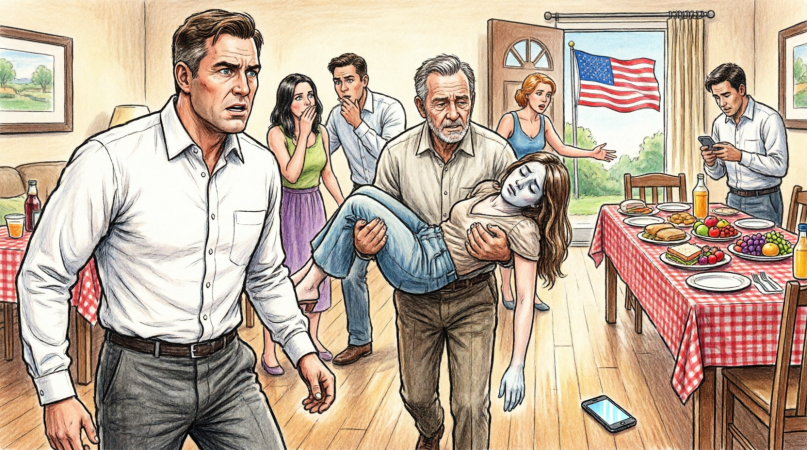
More Details
My Son Stole Everything and Disappeared for 25 Years Until His Daughter Arrived With a Key and a Message
Jul 3, 2026

My Son Stole Everything and Disappeared for 25 Years Until His Daughter Arrived With a Key and a Message

The doorbell rang on a Thursday morning and I almost did not answer it.

At sixty-seven, I had learned that unexpected knocks rarely brought anything good. But the bell rang again. Not impatient. Just certain. I wiped my hands on a dish towel and looked through the narrow window beside the door.

A young woman stood on the walkway outside my apartment in San Diego, one strap of a worn backpack over her shoulder. She looked like she was in her early twenties, with dark hair pulled back and the tired posture of someone who had traveled farther than she expected. She was not dressed like a salesperson. No badge, no brochure, no practiced cheerfulness.

She looked nervous.

I opened the door halfway.

“Can I help you?”

She stared at me for a moment, then swallowed.

“Are you Rosa Delgado?”

Something about her face made my hand tighten on the knob. It was not recognition exactly. More like an old photograph trying to come into focus.

“Who’s asking?” I said.

She took a breath.

“My name is Sophia. Sophia Delgado.”

I felt the hallway go quiet around us.

“I’m Daniel’s daughter.”

My son’s name landed between us like something pulled from a grave.

I had not spoken it in years. Not to neighbors, not to the women at church, not to the pharmacy clerk who once asked whether I had children. I had buried the name because every time it surfaced it carried the same image: my husband on the floor, the safe hanging open behind him, twenty-five years of savings gone. Daniel gone with it.

Antonio had died three days later. Heart attack, the doctor said. Catastrophic damage. Clean, medical words that could not explain how a family breaks in one morning and never reassembles.

For over twenty years, my son had not called, not written, not come back. He had vanished as if he had never existed.

And now his daughter was at my door.

She had Antonio’s eyes.

That was the part that made me step back.

“Come inside,” I heard myself say.

Sophia followed me into my small apartment. One bedroom, neat but worn at the edges, the kind of place where nothing matched but everything had been cleaned and repaired until it could be cleaned and repaired no further. We ended up at the kitchen table without discussing it. I offered coffee because I needed something to do with my hands.

She wrapped both hands around her mug like she was cold, though the morning sun was already warming the window.

“He died last month,” she said.

I waited.

“Cancer. Pancreatic. He was sick almost a year.”

The news landed flat. I had already mourned Daniel. Done it in pieces for more than two decades. The first grief had been sharp, the kind that made me look toward every door when a bell rang. Then came the heavier grief, settled into my bones through the years. After that, anger moved in and made a home where sorrow used to live.

“What kind of things did he tell you?” I asked, when she said he had told her things before he died.

“About you. About San Diego. About what happened.”

“What happened,” I said flatly, “is that he emptied our safe and disappeared.”

She flinched but did not look away.

She reached into her backpack and set a small silver key on the table between my calculator and red pen. A storage-unit key. The number 247 stamped into the metal.

“He made me promise to find you,” she said. “He said everything is there. What he took. Why he left. All of it.”

I picked up the key. Cold in my palm, lighter than it should have been for carrying what it represented.

“I haven’t seen my son in over twenty years,” I said. “I didn’t know if he was alive or dead or if he ever thought about me at all.”

“He thought about you,” she said. “All the time.”

I almost laughed. Not because it was funny, but because the words reached a place I thought had gone numb.

The truth about why I had believed what I believed required going back to the restaurant. La Cocina de Antonio on University Avenue. Twenty tables, red vinyl booths, a bell above the front door, and framed photographs of Guadalajara on the walls. Antonio had done all the cooking. I managed the front of the house and kept the books. Daniel had started working there after high school and never left.

We were a family.

Antonio kept cash in a safe in the back office, an old habit from growing up poor in Guadalajara where his family had lost everything when a bank failed. Two hundred and fifty thousand dollars by the time it ended, organized in labeled envelopes, carefully added to each week. The building fund was the biggest one. Our landlord had promised to sell the property when we saved enough. Antonio dreamed of owning it outright. No one able to take it from us.

When Daniel turned twenty-one, Antonio taught him the combination.

“In case something happens to me,” he had said, “you need to be able to take care of your mother.”

Daniel memorized the numbers, tore the paper into pieces, and threw them away. Just as his father had instructed.

The morning the world changed had started like any other. Antonio went to the office early for cash before a supplier delivery. I was prepping onions and peppers in the kitchen, the radio playing norteño music low. Then I heard a heavy thud from the back.

I found Antonio on the floor. His face was gray, his hand at his chest. Behind him, the safe door hung open. Empty. Completely empty.

They kept him on machines for three days and used careful words. Catastrophic. Irreversible. I did not understand at first that those words were preparation for what came next. Antonio died without waking up. On the third day. The same day the police finished asking their questions about who knew the safe combination.

Only three people had known.

Daniel never answered his phone.

I went to his apartment on the second day. His landlord let me in. Everything was there, clothes in the closet, dishes in the sink, bed unmade. But Daniel was gone. His car was gone from the parking spot.

I went back to the kitchen table and looked at Sophia across from me.

“So whatever is in that storage unit,” I said, “you think it explains all of it.”

“I think it does,” she said quietly. “I just know there’s more to the story.”

We drove to the facility off Marina Boulevard in my aging Honda. A chain-link fence, rows of orange roll-up doors, a small office with faded blinds. Unit 247 was at the far end, tucked into the corner.

I stopped in front of it.

My palm was sweating around the key.

I fitted it into the lock. It clicked. I pulled the door up and the metal screamed on its rails.

Against the back wall sat a dark green safe.

Medium-sized. The exact same kind as the one Antonio had kept in the restaurant office.

For a moment I could not breathe right.

He had stolen from a safe and spent decades keeping everything inside another one.

A piece of paper was taped to the top. Numbers in Daniel’s handwriting. His birthday. July 15, 1978. Numbers I would know anywhere.

My hands shook, but I needed to do it myself.

Right to 07. Left past zero to 15. Right to 78.

The handle gave. The door swung open with a familiar metallic groan I had not heard in decades.

Stacks of cash. Rubber-banded, organized by denomination, each stack wrapped with a paper band marked by year in black ink. The first stacks were from the early years after he left. Then the years marched forward through the 2000s and 2010s. The most recent stack was from only months before.

“Count with me,” I said.

Sophia opened the calculator on her phone.

Stack after stack. Year after year.

Finally she looked at the screen.

“Three hundred fifty-six thousand dollars.”

I sat down hard on the concrete.

More than he had taken. More than two hundred and fifty thousand. He had added to it. Saved more. Year after year, for over two decades.

I started crying before I understood I was going to. Not the managed grief I had practiced for years, the quiet kind that knew its place. Real crying, from somewhere deep and ugly and old. Hot tears that were angry and confused and something else I did not have a name for.

Sophia sat beside me on the concrete. She did not touch me. She just stayed.

When I could breathe again, I looked back at the safe. Three cardboard boxes sat behind where the money had been.

All three were labeled Sophia.

The first held photographs. Hundreds of them. Sophia as a newborn, as a toddler with a gap-toothed smile, in school pictures spanning every year. I picked up one showing her at about seven, standing in front of a birthday cake with Daniel behind her, his hands on her shoulders. Both of them smiling, but his eyes looked sad even then. I turned it over.

His handwriting on the back.

Her seventh birthday. She asked about you today. I didn’t know what to say.

Another photo. Sophia in a pink dress, Daniel in a suit.

Her quinceañera. She’s fifteen. She looks like you when she smiles.

Nearly every photograph had his handwriting on the back. First steps today. Lost her first tooth. Honor roll again. You would be proud.

Sophia was crying too, seeing herself through her father’s eyes.

The second box held folders labeled by year. The third contained something wrapped in a blanket. We lifted it together and found a small wooden box, old and worn at the corners. Inside was a men’s watch, silver and hand-wound, its face scratched, the band worn smooth, frozen at some long-ago time.

I turned it over.

An inscription on the back: To Daniel. Graduate 1996. Love, Dad.

Antonio had given that watch to Daniel the day he graduated high school. I remembered it. Antonio had saved for months.

Beneath the watch was a photograph of the three of us in front of the restaurant. I was younger. Antonio had his arm around my waist. Daniel stood between us, grinning at the camera.

We had looked happy.

A folded note lay at the bottom of the box.

The watch was mine. Dad gave it to me when I graduated. I wore it every day, even after it stopped working. The photo was in my wallet. It’s all I had left of you both.

He had carried it with him into exile. A broken watch and a family photograph. His only connection to the father who died and the mother he had left behind.

At the bottom of the safe, beneath all the stacked money, was a sealed envelope.

Thick with pages.

Rosa, written across the front.

Sophia watched me pick it up.

“He wrote it the week before he died,” she said. “He said everything you need to know is in there.”

We drove back separately. I dropped Sophia at her hostel and sat in my parked car for a while with Daniel’s watch in the wooden box on my lap and the letter on the passenger seat.

By the time I got home the sun was setting, painting my kitchen window orange. I made tea I did not want, sat down, and opened the envelope.

Six sheets of paper, written front and back. The handwriting was shaky in places, unsteady in a way I recognized as a body near its limit.

Mom, it began.

I don’t know how to start this. I’ve written it in my head a thousand times and never found the right words. I still haven’t. But I’m dying, and I’m running out of time to be a coward.

You think I stole from you and Dad. You’re right. I did. But not for the reason you think.

That spring, Carlos Ruiz came to me with a job. You remember Carlos. We’d been friends since high school. He said he had side work. Deliveries. Paid cash. Two thousand dollars for one night. I wanted a car. I wanted to buy it myself, not ask you both for help, because you had already worked so hard for everything.

Carlos said it was easy. Just packages from San Diego to Tijuana. I should have asked what was in the packages. I should have asked why anyone would pay two thousand dollars for one night of driving.

But I was twenty-two, and stupid, and proud.

We picked up the package on a Wednesday night. A heavy box, taped shut. We stopped at a gas station off the 805 and I went inside for water. When I came back, Carlos was panicking. The car window was smashed. The package was gone.

That was when he told me what was inside.

Cocaine. Five kilos. Worth two hundred and fifty thousand dollars.

Less than two hours later, they found us. Three men pulled up while we were still at the gas station. Carlos knew them. They were not police. They took us to a house in Chula Vista and explained that we owed two hundred and fifty thousand dollars. We had forty-eight hours to bring it to Tijuana in cash.

If we didn’t, they would kill us both. Then they would visit our families.

They said your name, Mom. They knew the restaurant address. They described Dad. They told us not to go to the police and said they would know if we did.

I believed them.

I told myself I was protecting you. I told myself if I didn’t pay them, they would kill all of us. I told myself I would pay it back somehow, even if it took the rest of my life.

That night I went to the restaurant. I let myself in through the back. I opened the safe. All those envelopes were there. Years of saving. Dad’s careful handwriting on each one. I took all of it. I tried to close the safe, but my hands were shaking so badly I couldn’t. I left it hanging open.

The next day, Carlos and I drove to Tijuana. We met them at a warehouse. We handed over the cash.

Then they told us we were staying in Mexico.

They said if we crossed back, they would assume we had talked to police. That our families would become problems.

We were trapped.

That afternoon I tried calling the restaurant to explain. The line was busy. I tried again. Busy. The third time, a stranger answered and said there was an emergency and the restaurant was closed.

I found out two days later that Dad had found the empty safe.

Heart attack.

I killed him, Mom.

I emptied that safe and his heart couldn’t take it. He died thinking I had betrayed him. He died thinking I stole from my own family and ran.

How do you come back from that? How do you call your mother and say I’m sorry I killed Dad, but I had a reason?

I couldn’t. I was a coward. I stayed in Tijuana. Got construction work. Lived cheap. Saved everything. I opened a safe of my own and started filling it every week.

I labeled each stack with the year.

Then I met Sophia’s mother. We had Sophia. She left when Sophia was three and I raised her alone.

Every time I had a chance to save, I saved. Every time I thought about buying something nice or making my life easier, I saw Dad on that floor.

Sometimes I crossed the border and came to San Diego. I watched from a distance, making sure you were okay. When I saw you needed help, I helped the only way I could. Anonymously. So you would never know it was me.

The safe filled up. Years passed. Sophia grew.

I kept thinking I would come back one day. Face you. But every year that passed made it harder.

Then I got sick.

The money in the safe is yours. All of it. It was always yours. I know it doesn’t fix anything. It doesn’t bring Dad back. It doesn’t give you back all those years.

But it is all I have.

I spent my whole life trying to pay back one terrible night.

I am sorry, Mom.

Sorry I took the money. Sorry I ran. Sorry I was too afraid to face you. Sorry you had to lose your husband and your son in the same week.

I love you. I always did.

I wish I could have told Dad.

I’m sorry.

Daniel.

I set the pages down with my hands still shaking.

The tea sat untouched beside me. The streetlight came through the kitchen window, making everything look cold. I had been sitting in that kitchen for over twenty years telling myself one story about my son.

Now I had another one.

Understanding did not erase the pain. It changed it. Made it heavier in some places and softer in others.

I remembered the eviction notice three days after I lost my job at the retail store, when the hours had been cut and I could not make rent. The landlord had called, confused, and said someone had paid the balance plus late fees. He would not say who. I had thought it was an accounting error. A miracle.

It was Daniel.

The appendectomy I had one February with no insurance, the bill more than eight thousand dollars. I had cried looking at it. Then a nurse told me it had been covered by an anonymous donation to the hospital’s charity account, specifically designated for my bill.

It was Daniel.

The transmission repair one winter when my car died. The mechanic called and said someone had already paid. I had cried in that parking lot, thinking I had finally gotten lucky.

It was Daniel.

Anonymous envelopes in my mailbox over the years with no return address, just enough to cover small emergencies.

All of it, Daniel.

He had been crossing the border and watching my life from a distance and seeing when I struggled and sending what he could. All the times I had survived alone through my own determination, he had been there beside me in secret, trying to fix what he had broken.

He had stolen everything.

But he paid it back.

He disappeared.

But he never really left.

Both things were true at the same time. There was no clean way to resolve that. Some truths do not resolve into something comfortable. They only become true in a more complete way.

The next morning, Sophia and I met at a small café near downtown. She was already there when I arrived. Two coffees on the table. Outside, ordinary traffic moved in the ordinary way of a city that has nothing invested in your interior weather.

We sat in a booth and neither of us knew how to start.

“Do you believe him?” she asked eventually.

I thought about it, actually thought.

“I believe it happened the way he said,” I answered. “I believe he was terrified. I believe he thought he was protecting us.”

“But?”

“But I am still angry he didn’t trust us enough to tell the truth. We could have run together. Faced it together. He made the decision for all of us and we paid for it.”

Sophia nodded slowly.

“He said the same thing in the hospital. That his biggest mistake was thinking he had to handle it alone.”

“What were his last days like?” I asked.

The question came out softer than I intended.

She told me. The hospice room, the morphine. Most of the time he had not been fully present. Then one night at two in the morning he had woken up completely lucid and grabbed her hand so hard it hurt. He had started talking about San Diego, about the restaurant, about Antonio and about me. He had cried while he talked, she said. He kept saying I killed him. I killed my own father. Then his machines alarmed and the nurses rushed in and she was pushed into the hallway. Two hours later a doctor came out and said his heart had given out.

Heart attack, she said.

Like Antonio.

The parallel sat between us, cruel and precise.

Father and son dying with the same wound at the center of the story. One from discovering the betrayal. One from finally confessing it.

Sophia asked the question I had known was coming.

“Can you forgive him?”

I looked out the window.

“I don’t know if forgiveness is the right word,” I said after a while. “What I can say is that I understand why he did it. And I accept that he tried to make it right.”

“Is that enough?”

I looked at her face. Antonio’s eyes looking back at me across three generations.

“It has to be,” I said. “He’s gone. I can’t forgive him to his face. I can’t yell at him or hug him or tell him what those years cost me. All I can do is decide how I move forward.”

She asked if she could still visit.

“You’re not him,” I said. “You’re you.” I touched her hand briefly across the table. “Yes. You can visit.”

Over the weeks that followed, we met regularly. Sometimes at my apartment, sometimes at coffee shops, once at a park where we walked for an hour without saying much but found it sufficient. We traded stories. She told me about Daniel teaching her to ride a bike, the Sunday breakfasts he cooked using recipes he had learned from Antonio, the way he came to every parent-teacher meeting even when he came home from work covered in construction dust. I told her about Daniel as a boy, how he loved standing on a stool beside Antonio to watch him cook, how his laugh used to fill the restaurant, how he was always gentle with the stray cats that gathered near the back door.

We were building something. Not what had been lost, but something new.

I moved the money from the safe into a bank account. For the first time in my life, those numbers appeared after my name on an official statement. I quit one bookkeeping client, then another. I stopped doing math in my head at the grocery store. I fixed the broken faucet, the cabinet door, the window screen I had been patching with tape for two years. I bought a reliable used car. I bought good coffee.

Then I used most of the rest for a down payment on a small house. Two bedrooms. A yard. A neighborhood where people waved from porches in the evenings.

Nothing fancy.

But mine.

One bedroom for me. One for when Sophia visited.

I set up an account for her as well. She was in nursing school and working part-time. The money would help her build a life without carrying every burden alone, without having to be as stubborn and exhausted as I had been. I wanted her to have the option of not surviving on the edge of things.

One weekend, Sophia drove us to Tijuana. We crossed the border together, something I had not done in decades. She drove through streets I did not recognize, past shops and food carts and apartment buildings with laundry on the balconies. Daniel was buried in a small cemetery at the edge of the city.

His headstone was simple.

Daniel Delgado. Beloved father.

Sophia stayed back and gave me space.

I stood at the grave alone. I had not prepared what to say. But the words came anyway, quietly, with no one else to hear.

“I read your letter,” I said. “I know what happened now.”

A bird sang somewhere in the trees beyond the wall.

“I understand you were scared,” I said. “But you should have told us. We could have faced it together. You didn’t have to carry it alone.”

The stone gave no answer.

“You carried it alone your whole life,” I continued. “That was your choice. I spent just as long being angry. That was mine.”

I knelt and brushed dirt from the base of the stone.

“You raised a good daughter,” I said. “She is smart and kind and strong. You did that right.”

My voice broke slightly on the last sentence.

“Antonio would have loved her. He would have been proud.”

I paused.

“Maybe he would have been proud of you too. For that part.”

I placed the flowers I had brought beside the grave. A simple bouquet in bright colors against the gray stone.

Sophia drove us home in the quiet.

Some things do not need words. Some understanding happens at a level below language, in the body rather than the mind, and you know it has occurred not by anything you say but by the way the weight redistributes itself afterward.

Back in my house, I hung photographs on the living room wall.

One of Daniel at around twenty, before everything fell apart, smiling in the restaurant with an apron and a tray.

Beside it, Sophia’s nursing school graduation photo. Cap and gown. Diploma in hand.

Same smile.

Family, continuing.

Different than before, but continuing.

Sophia started coming every few weeks. We cooked together. I taught her how to make tamales the way Antonio had taught me, showing her how to spread the masa, how to fold the corn husks just right, how to feel the texture instead of measuring by eye.

She took notes on her phone and asked questions and learned quickly.

One evening we were in the kitchen, music playing softly, the garden outside the window showing early green from the seeds I had planted in the spring. Sophia was working on her corn husks with the focused expression that reminded me of Daniel learning to chop vegetables beside his father.

I watched her and thought about Daniel at twenty-two, making a desperate decision in a moment of terror. About Antonio dying without knowing the truth. About myself, surviving alone for twenty-five years, not as alone as I had believed.

Daniel broke our family.

Then he spent the rest of his life trying to place something back into the space he had emptied.

He paid back every penny.

He watched over me when I did not know.

He raised his daughter to be kind, and then he sent her to find me.

That has to count for something.

Sophia looked up.

“Like this?” she asked, holding up a neatly folded tamale.

I checked it and smiled.

“Perfect,” I said. “You’re a natural.”

She smiled back.

Three generations of smiles moving through the same face.

Outside my window, the garden was coming up green and deliberate, reaching toward the light in the ordinary determined way that things grow when someone has finally decided to tend them.

We kept working side by side, hands moving together, making something from everything that had broken.

More Details