My family tried to tear my relationship apart when my fiancé stood by me. At the hospital, I made one decision that changed everything.
Jul 16, 2026

My family tried to tear my relationship apart when my fiancé stood by me. At the hospital, I made one decision that changed everything.

PART 1

I tried to open my left eye, but I saw absolutely nothing except deep darkness. With my right eye, I saw my mother, Brenda, standing by the old swing set in the yard.

She was not scared, she was not running to help me, and she was not calling for an ambulance. She just stood there and laughed at me.

My dad, Gregory Davis, dropped the broken half of the brick onto the grass. “I warned you,” he said calmly, acting as if he had just closed a door instead of smashing his daughter’s face.

Wyatt looked up at him with complete disbelief and horror. “What did you just do?” Wyatt asked, his voice shaking with anger.

Nobody answered him, but then my younger sister, Melanie, came out of the front door. She was wearing an expensive dress, had freshly done nails, and looked annoyed as if my blood had ruined her dinner plans.

“I told you he wasn’t going to change his mind,” Melanie said, crossing her arms tightly. My mom sighed and adjusted her clothes.

“We tried to talk to him nicely,” Brenda said. Wyatt carefully leaned my body against a column and stood up to face them.

“You people are sick,” Wyatt said with pure disgust. My dad smiled and pointed his finger at Melanie.

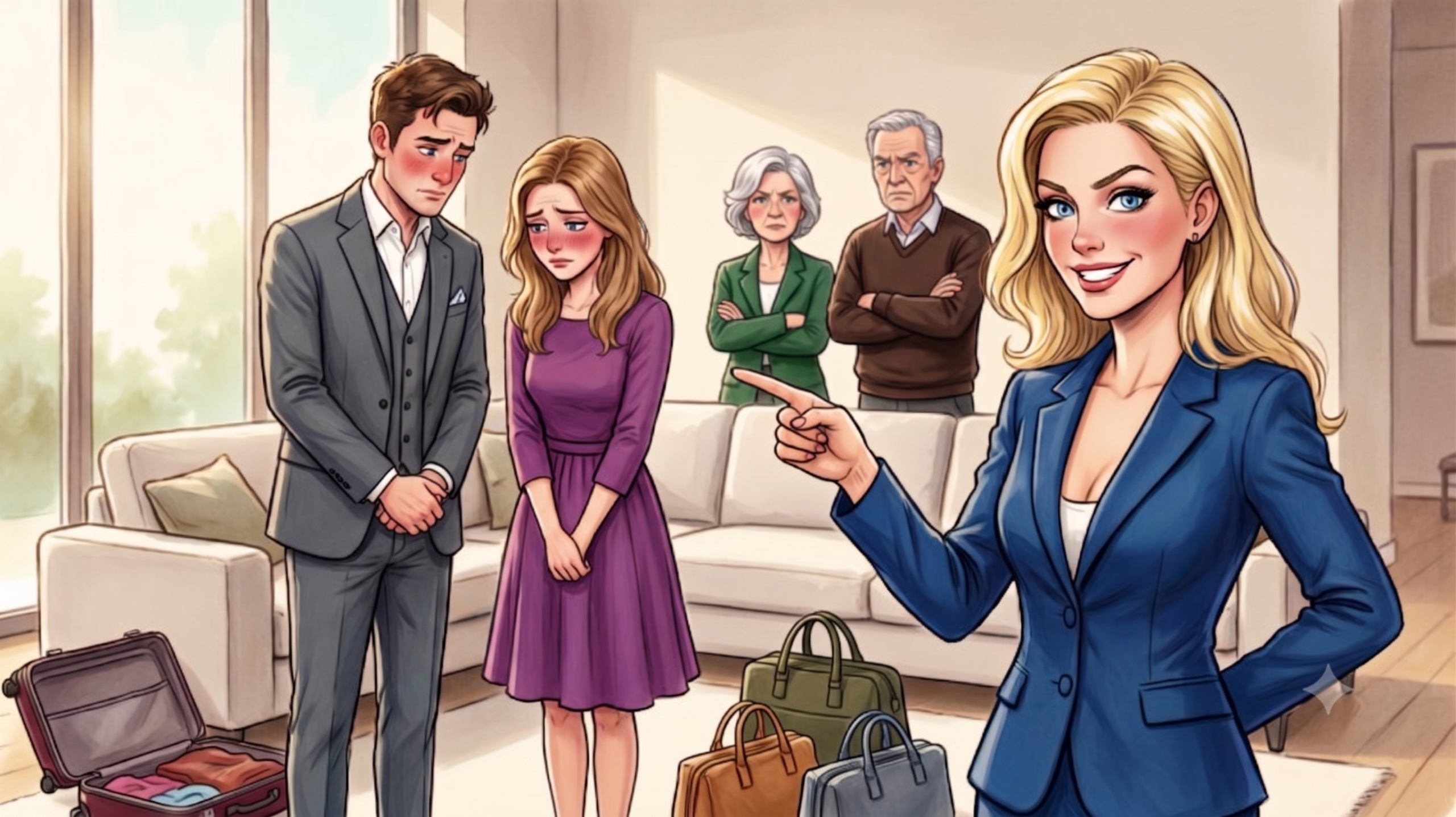
“No, you are just engaged to the wrong daughter,” Gregory said. The buzzing inside my head was terrible, but those words hurt me much more than the brick.

“What?” Wyatt asked. “Melanie should have always been in your place because Sadie is selfish and always has been,” my mother said coldly.

Melanie looked at me lying on the floor with a mean look. “And yet you still chose her,” Melanie told Wyatt.

Wyatt pulled out his cell phone to call 911, but my dad kicked it right out of his hand. The phone screen smashed into pieces against the doorway.

“Nobody here is going to call anybody,” Gregory growled. Wyatt pushed him hard, and my dad pounced on him like a crazy animal.

They fell into the rose bushes together. My mother and Melanie did not scream, they just watched as if it had all been planned.

In that moment, I understood something that chilled me to the bone. This was not a sudden impulse or a quick moment of madness.

Ever since Wyatt sold his construction company and became a millionaire, my family had started to hunt him. First with dinners, then with fake flattery, and later Melanie started showing up by chance at his gym, his office, his coffee shop, and outside our apartment.

Wyatt always rejected her and blocked her everywhere. Melanie told my parents that I was manipulating him to stay away from them.

“You either marry Melanie,” Gregory growled as he fought with Wyatt, “or you get out of this family.” “I love Sadie!” Wyatt yelled back.

“It will pass,” Melanie said casually. Suddenly, an electrician’s truck pulled up in front of the house, and the worker got out.

The man saw my bloody face and immediately took out his cell phone. “I am going to call an ambulance right now!” the man shouted.

My dad walked toward him aggressively, but the man pointed a finger at him. “Take another step and I will tell the police operator that you are attacking me too,” the worker said.

My dad stopped moving. The sirens arrived minutes later, and the paramedics helped me into the ambulance.

I took one last look at the living room window of the house. Behind the curtain stood an old man I had never seen before in my life.

His shaking hand was pressed against the glass, as if he wanted to warn me about something. Then the curtain closed, and nobody could guess what was about to happen next.

PART 2

I woke up to the smell of a hospital, full of disinfectant, clean sheets, and the metallic smell of my own blood. I opened my right eye, but my left eye was covered in thick medical bandages.

A doctor in a white coat leaned over me. “I am Dr. Alison Curtis, you are safe now, Sadie,” she said gently.

Safe was a word that felt completely strange to me. “Wyatt…” I whispered.

“He hasn’t left the hospital since you arrived,” Dr. Curtis  said. He appeared beside the bed right away, his shirt still stained with blood, his knuckles scraped, and his eyes red.

When he took my hand, he started to cry. “I promised you I wouldn’t leave you,” he whispered.

I had never seen him cry before, not even when he lost his grandfather or when his first business failed. Seeing me like this completely broke him.

The doctor explained that the bone around my left eye was fractured, so they had to reconstruct the area and stitch a deep wound. Then she said something that scared me.

“We believe you will get your vision back, but there is still too much swelling,” Dr. Curtis said. We believe meant they did not know for sure.

An hour later, a police investigator named Chief Donald Briggs came in. He did not raise his voice, he just asked a direct question.

“Did your father intentionally hit you with the brick?” Chief Briggs asked. “Yes,” I replied.

“Were there any threats before this?” the chief asked. I closed my good eye and remembered years of unfair treatment.

If Melanie wanted my things, they became hers. If she failed, I had to fix it.

When I won a scholarship, my dad said I was conceited. When Melanie dropped out of college, my mom said she was just finding herself.

When I bought my first car, they wanted me to give it to Melanie because she needed confidence. “Yes, many threats,” I said.

I told him about Wyatt, the sale of his company, the fake dinners, Melanie’s messages, the gifts Wyatt returned, the letters he burned, and the times my parents demanded I step aside. The chief closed his notebook.

“So the attack was meant to pressure him into leaving you for your sister,” Chief Briggs said. Wyatt clenched his jaw tightly.

“They thought that if they destroyed her face, I would stop loving her,” Wyatt said with rage. The investigator did not answer right away because he seemed completely furious.

Then a nurse poked her head in. “There are three people asking to see her: Gregory Davis, Brenda Davis, and Melanie Davis,” she said.

Wyatt stood up fast. “They don’t get in,” he said.

Before the nurse could leave, my father’s voice exploded in the hallway. “Sadie! You have embarrassed us enough already!” Gregory shouted.

My mother yelled next. “We came here to forgive you!” Brenda said.

Melanie added her voice too. “You owe us an apology for provoking Dad!” she screamed.

The chief left the room, leaving the door open a little bit. I heard his firm voice outside.

“Leave right now,” Chief Briggs ordered. “She is my daughter,” my father said.

“No, she is the victim,” the chief replied. There was silence, and then my dad burst out laughing.

“And you believe her lies?” Gregory asked. “I have six witness statements, a 911 call, and a neighborhood camera that recorded everything,” the chief said.

My mother was completely speechless. Then Melanie whispered something, and my father answered loudly enough for everyone to hear.

“Delete the footage,” Gregory said. The chief replied immediately.

“Thank you for saying that in front of three police officers,” Chief Briggs said. I heard handcuffs clicking shut, my mother screaming, and Melanie crying.

My father yelled that it was all just a big misunderstanding. As they were taking them away, an old voice spoke up in the hallway.

“I waited twenty-six years to see someone stop Gregory Davis,” the old man said. I looked toward the door and saw the same man from the window.

He had a cane and an old leather briefcase. He was looking right at me.

“I think it is time you knew who I really am,” he said.

PART 3

The hallway became completely quiet. My father, handcuffed, turned around before they put him in the elevator.

“Don’t go near her!” Gregory yelled. The old man did not move, he just replied with deep sadness.

“I have been gone too long,” he said. The elevator doors closed, and my family’s voices disappeared.

For the first time in my life, nobody was yelling at me or blaming me for existing. Chief Briggs came back inside.

“Do you know him?” the chief asked. I shook my head slowly.

“No,” I said. The old man took off his cap, showing white hair and hands deformed by arthritis.

“My name is Harvey Berry,” he said. That name meant nothing to me.

“I was your grandfather Walter’s best friend,” Harvey explained. My heart stopped because my grandfather died before I was born.

In my house, nobody spoke about him except to say he was stubborn. “He used to call me his brother,” Harvey said.

He took an old photograph out of his briefcase. Two young men covered in sawdust were laughing next to a half-built cabin.

One was my grandfather Walter, and the other was Harvey. “Your grandfather was not a harsh man, he was good, too good for his family,” Harvey said.

I swallowed hard. “My parents never told me about you,” I murmured.

“They couldn’t because Gregory made sure I was out of your lives,” Harvey said. Wyatt stood by my bed, keeping his hand on the rail.

Harvey looked at him. “Stay, young man, you need to hear this too,” Harvey told him.

He sat down with difficulty and opened his briefcase again. “When your mother got pregnant with you, Walter built a maple wood crib with his own hands,” Harvey said.

“He sanded it and carved stars on the sides because he said his first granddaughter would bring light to the house,” the old man shared. My eyes burned with tears.

“What happened to that crib?” I asked. Harvey looked down at the floor.

“Gregory burned it,” Harvey said softly. Wyatt squeezed my hand.

“Why?” Wyatt asked. “Because Gregory said a baby girl did not deserve that much effort,” Harvey answered.

The silence in the room felt very heavy. “When you were born, Walter held you for an hour and cried tears of joy,” Harvey said.

“He said you would change the history of the family, but Gregory wanted a son,” Harvey explained. “And when Melanie was born three years later, he decided she was the daughter he would be proud of,” he added.

“But Melanie was not a son either,” I said. “It didn’t matter because Gregory always believed Melanie should have been born first, and he blamed you for taking her place,” Harvey clarified.

I felt like I could not breathe properly. For years I thought I did something wrong, that I was just a difficult and selfish child.

But my only mistake was arriving first. Harvey took out a package of old envelopes tied with a blue ribbon.

“Your grandfather wrote these for you,” Harvey said. My name was on each envelope in nice handwriting: Sadie Davis.

“He asked me to give you a letter on every birthday, but I couldn’t because Gregory threatened to ruin my life if I came near you,” Harvey confessed. I touched the first envelope with shaking fingers.

My grandfather had loved me before I even knew what rejection felt like. “I kept them all safe for twenty-six years,” Harvey said.

I could not stop crying, and Wyatt wept quietly beside me too. Chief Briggs looked down to give us some privacy.

“There is something else,” Harvey said. He pulled out a small brass key with a leather tag.

“What does it open?” I asked. “A safety deposit box that Walter rented six months before he died, leaving instructions because he knew you would need the truth one day,” Harvey explained.

Before I could ask more, Chief Briggs stepped forward. “Sorry to interrupt, but we have big news,” the chief said.

His face looked completely shocked. “The Prosecutor’s Office searched your parents’ house, and we found files inside your father’s desk,” Chief Briggs revealed.

Wyatt frowned. “Files of what?” Wyatt asked.

“Files about you, Wyatt,” the chief confirmed. My stomach turned with a sick feeling.

The chief checked his notes to read the details. “Photographs, schedules, addresses, articles about the sale of your company, and notes tracking your movements,” Chief Briggs listed.

“They were stalking us,” Wyatt realized. “Yes, for months,” the chief said, then he paused.

“We also found handwritten notes,” the chief added. “What did they say?” I asked.

The chief read the notes aloud. “One says, ‘If Sadie is no longer an option, Wyatt will end up seeing Melanie,’” Chief Briggs read.

“Another says, ‘Appearance matters, so if Sadie’s face changes, he will understand which sister is worth more,’” he finished. The whole room went completely cold.

It was never an accident or a quick argument. They sat down together and planned it.

My mother, my sister, and my father talked about my face like it was just a problem they could fix with a brick. Suddenly, a nurse came in with a phone.

“Miss Davis, there is a call for you from the detention center, but it is not from your parents,” she said. I took the phone with a shaking hand.

“Hello?” I whispered. I heard heavy breathing and crying on the line.

“Sadie, you don’t know me, but I am Janice Foster, your father’s younger sister,” the woman said. I froze in my bed.

“I didn’t know I had an aunt,” I said. “I know because Gregory erased me from your life, and I have lived under my married name for twenty years so he couldn’t find me,” Janice explained.

Chief Briggs sat down to listen, and Harvey closed his eyes. “When I heard Gregory was arrested, I called right away because for the first time, I felt safe,” Janice wept.

“What do you need to tell me?” I asked. There was a long pause on the line.

“Harvey only knows half the story about the money,” Janice said. Harvey raised his head in surprise.

“What story?” Harvey asked. “Gregory was not always this cruel, but he became crazy after our father changed his will,” Janice explained.

Chief Briggs listened closely. “Explain what happened with the will, ma’am,” the chief requested.

“Our father caught Gregory stealing money from the family hardware store twice, so he changed everything,” Janice said. “What did he change?” I asked.

“He left Gregory the business but with a strict rule,” Janice explained. “If Gregory was ever convicted of a violent crime or intentionally hurt a family member, he would lose all the assets,” she revealed.

I felt the blood leave my face. “What assets?” I asked.

“The hardware store, the other shops, a cabin by the lake, investment accounts, and a trust fund worth over eleven million dollars,” Janice listed. Nobody in the room said a word.

“Our father knew Gregory loved money more than family, so he added a final clause,” Janice continued. “If Gregory committed serious violence against his own daughter, everything would pass directly to that daughter,” she explained.

The phone almost fell from my hand. “To me?” I asked.

“Yes, to you, Sadie,” Janice confirmed. For twenty-six years, my father thought controlling me was the way to keep his money.

But the moment he threw that brick at my face, he destroyed the exact future he wanted to save. I felt no joy, just a deep sadness.

It felt like someone finally turned on a light in a dark room where I had been lost all my life. Janice sent the original papers to the police that morning.

My grandfather’s key opened the box, revealing the real will, letters, and an old voice recording. On the tape, Walter Davis explained in a firm voice exactly why he feared his son would harm his own family.

Two days later, Dr. Curtis came back with new test results. “I have great news,” the doctor said with a smile.

Wyatt stood up fast. “The optic nerve is healthy, the swelling is down, and we expect Sadie will regain her vision completely,” Dr. Curtis revealed.

I started to cry like a little child. Wyatt hugged me gently, and for the first time, crying did not feel like pain, it felt like air returning to my lungs.

The next few weeks were slow, filled with legal statements, photos, minor surgeries, and meetings with lawyers. The electrician testified that my father tried to stop the 911 call.

The neighbor across the street told the police she saw the exact moment Gregory lifted the brick. The security camera footage showed the whole attack, and the notes proved it was planned.

My parents and Melanie tried to tell the judge it was just a family misunderstanding, but when they saw the evidence, they gave up. They accepted plea bargains to avoid a long trial and longer prison sentences.

The judge looked at the premeditation, the bad injuries, and the witness intimidation. They received long prison sentences, permanent restraining orders, and had to pay all my medical bills.

Melanie, who wanted to steal my man and the fortune, ended up losing her basic freedom. A month after leaving the hospital, I asked Wyatt to drive me to the cemetery.

Harvey Berry was waiting for us by my grandfather Walter’s grave, holding a small package wrapped in a blanket. “Walter wanted this to survive,” Harvey said as he uncovered it.

Inside was a thick wooden board, burnt at the edges from the fire. It was the only piece left of the cradle my father had destroyed.

In the center, hand-carved by my grandfather, were five words: “For my beautiful first granddaughter.” I ran my fingers over the carved wood.

For the first time in my life, I felt truly chosen, not just tolerated or compared to someone else. We left wildflowers on the grave.

“I received your letters, Grandfather,” I whispered into the wind. The leaves moved gently as if he heard me.

Months later, the scars on my face faded, though they never disappeared completely. At first, I tried to cover the marks with a lot of makeup.

Then one day, I stopped hiding them. I looked in the mirror and ran a finger along the line under my left eye.

For years, I thought beauty meant having an untouched face. Now I knew better because that scar proved I survived people who tried to destroy me.

All the legal stuff was settled according to my grandfather’s trust. The eleven million dollars in assets were transferred directly to my name.

I did not throw big parties or buy expensive cars. I sold some properties to start a foundation that helps young people learn trades like carpentry, plumbing, and construction.

I kept the cabin by the lake and fixed up the old hardware store, placing a bronze plaque by the door. The plaque read: “Walter Davis, an honest man, a deeply loving grandfather.”

Harvey cried when he saw it, and Janice did too. I didn’t cry, I just smiled.

Sometimes justice is quiet, and it just puts a good man’s name back where it belongs. That night, Wyatt and I drove out to the cabin by the lake.

There were no cameras or big speeches. It was just the two of us sitting on the wooden dock, watching the sun go down over the water.

Wyatt reached into his pocket and pulled out a small cloth bag. “If that is another ring, Wyatt, you have the worst timing ever,” I joked.

His face became very serious. “It is not a ring, Sadie,” he said.

He handed me my grandfather’s very first letter. “I think you should read this one today,” he suggested.

I opened the yellowed envelope carefully and read the old handwriting. The last part said: “If you ever feel unloved, remember this: those who do not know how to love you are revealing something about themselves, not about you. Build a life where kindness is inherited instead of cruelty.”

I folded the paper and looked at the water. For years, I thought my family defined my worth, but they never did.

They had only revealed their own complete lack of worth. Wyatt took my hand.

“So… do you still want to marry me?” he asked. I looked at the reflection of my scar in the dark water.

Then I looked at him, the man who stayed by my side when everyone else tried to destroy me. “I never doubted that you would love me, Wyatt,” I said.

“So what were you doubting?” he asked with a smile. I smiled back, feeling no fear at all.

“I was just doubting whether you were still going to make terrible jokes at our wedding,” I laughed. Wyatt burst into a loud laugh that echoed across the quiet lake, almost dropping the box into the water.

That sound was completely free, clean, and full of hope. And for the first time since the day my father tried to ruin my life, the laughter did not hurt.

It sounded exactly like the beginning of my new life.

THE END.

More Details
Part1: “The Waiter Whispered: ‘Don’t Drink That’
Jul 16, 2026

Part1: “The Waiter Whispered: ‘Don’t Drink That’

PART 3

“My daughter and her husband tried to poison me.”

The power-of-attorney papers from that morning.

Lena listened without interrupting.

When I finished, she looked at the sealed container.

“You did everything right.”

I gave a humorless smile.

“I spent thirty-two years teaching people how evidence disappears.”

“And now?”

“Now I know exactly how quickly someone can destroy the truth if they believe nobody will question them.”

Lena nodded.

“Did you drink any of it?”

“No.”

“Did anyone else touch the glass?”

“Daniel handled it after I moved it away.”

She looked toward the young waiter.

“He’s the one who warned you?”

“Yes.”

Lena watched him carefully.

“Good man.”

“He may have saved my life.”

The restaurant manager brought over security footage from the dining area.

Lena and I watched from a private office.

The first camera showed Claire and Evan entering.

They looked like the perfect couple.

Elegant.

Successful.

Happy.

The kind of people strangers admired.

Then the footage showed something else.

Evan leaving the table several times.

One trip toward the service station.

Another toward the kitchen entrance.

Another where he stood near the bar.

Lena paused the video.

“Can you zoom in?”

The manager enlarged the image.

There.

Evan’s hand.

Passing something small to another employee.

The employee immediately shook his head.

Then Evan took the item back.

My stomach tightened.

“That server.”

The manager nodded.

“His name is Tyler.”

“Where is he now?”

“He left his shift early.”

Lena looked at me.

“Interesting.”

Very few things surprised me anymore.

But this did.

Because it meant Evan hadn’t acted alone.

At 11:47 p.m., Lena received a phone call.

Her expression changed.

“What?”

She listened.

“Are you sure?”

Another pause.

Then:

“Send the report to me.”

She ended the call.

“What is it?”

She looked at me carefully.

“Your son-in-law has been researching something.”

“What?”

“Prescription medication.”

I felt a cold wave move through me.

“How long?”

“Three months.”

I stared at the table.

Three months.

Not an impulse.

Not a mistake.

A plan.

Lena continued.

“He searched for medications that could cause confusion, memory problems, and fatigue in older adults.”

My hands tightened.

The morning conversation returned to my mind.

Evan sitting across from me.

His calm voice.

“Margaret, maybe it’s time you let someone help manage things.”

Claire beside him.

“Mom, you forget appointments sometimes.”

I had thought they were concerned.

They weren’t.

They were building a story.

A story where I became unreliable.

A story where they became my protectors.

A story where nobody would question them taking control.

The next morning, I woke up in my own bed.

But I did not feel safe.

That was the hardest realization.

Home had always been the one place where I believed I could lower my guard.

The house my husband and I bought thirty years earlier.

The walls where Claire took her first steps.

The kitchen where I made birthday cakes.

The garden where my husband planted roses before cancer took him away.

Now, standing there alone, I wondered how long my own daughter had looked at this house and seen only its value.

Not memories.

Not love.

Value.

My phone rang.

Claire.

I stared at the screen.

For years, I answered every call immediately.

Even if I was busy.

Even if I was tired.

Because she was my daughter.

This time, I waited.

The phone rang until it stopped.

Seconds later, a message appeared.

CLAIRE:
Mom, why didn’t you answer? I was worried.

I almost laughed.

Worried.

That word felt different now.

I replied:

I was sleeping.

Her response came quickly.

CLAIRE:
Good. You should rest more. You sounded tired yesterday.

I looked at the message.

Then another appeared.

CLAIRE:
Evan and I think we should come over today. We need to talk about the documents.

The documents.

The power of attorney.

The papers she thought I would sign.

I placed my phone down.

Then I opened the locked drawer in my office.

Inside were the things Claire never knew existed.

My old work files.

My retirement records.

My legal documents.

And one folder marked:

EMERGENCY FAMILY TRUST.

Claire and Evan believed my age made me vulnerable.

They believed my career was over.

They believed the quiet woman drinking tea in the garden was all I had become.

They forgot something.

I spent decades studying deception.

I knew how people lied.

I knew how they prepared.

And most importantly…

I knew how to wait.

At noon, Claire and Evan arrived.

Claire entered first.

She hugged me.

Too tightly.

“Mom, you scared us last night.”

I looked at her.

“Did I?”

She smiled.

“Of course.”

Evan stepped inside carrying a folder.

“We just want to make sure you’re protected.”

Protected.

Another word that sounded different now.

I invited them to sit.

They relaxed immediately.

That was their mistake.

They thought the battle had already been won.

Evan opened the folder.

“These documents will simply allow us to help with your finances.”

I looked down.

Power of attorney.

Medical authority.

Estate management.

Exactly what I expected.

Claire reached over and touched my hand.

“Mom, you know we love you.”

I looked at my daughter.

The little girl I once held.

The little girl whose fever I stayed awake through.

The little girl I thought would hold my hand when I became old.

Then I looked at the woman sitting across from me.

And I finally understood.

Sometimes the hardest betrayal is not when someone hates you.

It’s when someone knows exactly how much you love them…

and uses it against you.

I picked up the pen.

Evan smiled.

Claire relaxed.

Then I placed the pen back on the table.

“I have one condition.”

They exchanged a quick glance.

“What condition?” Evan asked.

I smiled.

“Before I sign anything…”

“I want to show you something.”

I stood and walked toward my office.

Behind me, I heard Claire whisper:

“She finally agreed.”

They thought I was going to surrender.

They didn’t know I was about to show them the evidence that would destroy everything they had planned.

I opened the folder.

And removed the first document.

Evan’s smile disappeared the moment he saw the title.

Because written across the top were the words:

CONFIDENTIAL FORENSIC INVESTIGATION REPORT.

And beneath it…

was his name.

PART 4

Evan stared at the document.

For the first time since I had known him, I saw something I had never seen before.

Fear.

Not concern.

Not surprise.

Fear.

Claire noticed it too.

“What is that?” she asked.

Her voice was softer now.

Careful.

I walked back to the table and placed the folder between us.

“Something I prepared long before today.”

Evan forced a laugh.

“Margaret, I think you’re misunderstanding something.”

I looked at him.

“No.”

“I think you misunderstood me.”

He leaned back.

“What does that mean?”

“It means you thought retirement made me less observant.”

I opened the folder.

“You thought because I stopped working in a laboratory, I stopped knowing how evidence works.”

His expression tightened.

Claire looked between us.

“Mom, what are you talking about?”

I turned toward her.

“Ask your husband.”

Evan immediately shook his head.

“Don’t do this.”

“Do what?”

“Make accusations.”

I almost smiled.

Because that was exactly what people did when they knew the truth was approaching.

They attacked the person bringing it.

“I haven’t accused you of anything.”

I tapped the folder.

“I have documented.”

I removed the first page.

“Three months ago, you began researching medications that can mimic natural aging symptoms.”

Claire frowned.

“What?”

Evan’s face changed.

Only slightly.

But I noticed.

A tiny tightening around his eyes.

A small movement of his jaw.

A trained observer would see it.

I was trained.

“That is impossible,” he said.

“Is it?”

I placed another document on the table.

Printed search records.

Dates.

Times.

Locations.

“Your personal laptop was connected to your home network.”

Evan stared.

“You had no right—”

I interrupted.

“I didn’t access your computer.”

“You left information behind.”

I pointed to the paper.

“People who believe they are smarter than everyone else often become careless.”

Claire looked at him.

“Evan?”

He didn’t answer.

That silence hurt her more than any words could have.

Because for the first time…

she was seeing him without the mask.

I placed the restaurant report down.

“The drink from last night was collected.”

Evan went completely still.

“What drink?”

The question came too quickly.

I looked at him.

“You already know.”

“No, I don’t.”

“You just answered a question nobody asked.”

Claire’s face changed.

“Evan…”

He looked at her.

“Don’t listen to this.”

But she was no longer looking at him.

She was looking at me.

“Mom…”

Her voice broke.

“Are you saying he tried to hurt you?”

I wanted to say no.

I wanted to protect the little girl inside the woman sitting across from me.

But protecting someone from the truth does not always save them.

Sometimes it only delays the pain.

“Yes.”

Claire covered her mouth.

“No.”

“Claire…”

“No.”

She shook her head.

“He wouldn’t.”

I looked at her.

“You said the same thing about the power-of-attorney papers.”

She froze.

Evan suddenly stood.

“This is ridiculous.”

He grabbed his jacket.

“We’re leaving.”

“No.”

My voice stopped him.

He turned.

“What?”

“You don’t get to leave this conversation.”

His expression hardened.

“I don’t have to stay here while you attack me.”

I calmly reached for my phone.

“Good.”

His eyes narrowed.

“Good?”

“Because Detective Ortiz will be here in five minutes.”

The color disappeared from his face.

Claire looked at me.

“You called the police?”

“No.”

I looked at Evan.

“I called someone who understands evidence.”

The doorbell rang.

Exactly five minutes later.

Lena entered.

Behind her was another officer.

Evan immediately became defensive.

“This is harassment.”

Lena ignored him.

“Mr. Vale, we need to ask you some questions regarding an investigation.”

Claire looked at me.

“Mom…”

I saw tears forming in her eyes.

Not because she had lost.

Because she was finally realizing what she had helped create.

“I didn’t know.”

The words came quietly.

“I swear I didn’t know.”

I looked at her.

“Did you know about the documents?”

She looked down.

A long silence.

Then:

“Yes.”

That hurt more than I expected.

I nodded slowly.

“I see.”

“I didn’t think he would do anything like this.”

“But you were willing to take my house.”

Her tears fell.

“I was scared.”

“Of what?”

She couldn’t answer.

Because the truth was simple.

She wasn’t scared of losing me.

She was scared of losing comfort.

Lena took Evan’s statement in the living room.

Claire sat beside me in silence.

For almost an hour, neither of us spoke.

Finally she whispered:

“I was a terrible daughter.”

I looked at her.

“I was a terrible mother.”

She immediately shook her head.

“No.”

“You were not.”

I swallowed.

“I spent so much time trying to give you everything that I never taught you that love has limits.”

She cried.

“I thought you would always forgive me.”

“I probably always would have.”

“Then why didn’t you?”

I looked toward the window.

“Because forgiveness does not mean allowing someone to destroy you.”

The investigation lasted months.

The drink from the restaurant contained a substance that could cause extreme drowsiness and confusion.

Not enough to immediately kill.

But enough to make someone appear unstable.

Especially someone older.

The plan became clear.

Evan wanted me declared incapable of managing my own affairs.

He wanted control over my accounts.

My property.

My estate.

The drink was only one part.

The real goal was my signature.

My life reduced to paperwork.

The most painful part was discovering how long it had been planned.

Evan had convinced Claire that they were “helping” me.

He told her I was struggling.

He told her I was becoming forgetful.

He told her he was protecting our family.

And because Claire wanted to believe him…

she ignored the signs.

Evan was eventually charged.

He accepted a plea agreement after the evidence became impossible to deny.

He lost his medical license.

He lost his reputation.

But the greatest consequence was something he never expected.

Claire stopped defending him.

Not because she hated him.

Because she finally saw him clearly.


Six months later, Claire came to my house.

Not the old house.

My new home.

A smaller place.

A peaceful place.

A place where I chose who entered.

She stood at the door holding flowers.

“I don’t know if I deserve to be here.”

I looked at her.

“You’re right.”

She nodded.

“I know.”

“But you’re here.”

“Yes.”

“Why?”

She looked down.

“Because I want to earn back what I broke.”

I didn’t answer immediately.

Because some things cannot be repaired with one apology.

Some things require time.

Actions.

Patience.

“I can’t forget what happened.”

“I know.”

“I can’t pretend it didn’t hurt.”

“I know.”

“But…”

I opened the door wider.

“…I am willing to see who you become after this.”

She cried.

And for the first time in years…

I hugged my daughter.

Not because everything was fixed.

But because something new had finally begun.


A year later, I returned to the restaurant where everything started.

Daniel, the waiter who saved my life, still worked there.

When he saw me, he smiled.

“Ma’am.”

I laughed.

“You don’t have to call me ma’am.”

He smiled.

“I think I do.”

I thanked him again.

He shook his head.

“I only did what was right.”

I looked around the restaurant.

The same tables.

The same lights.

The same place where my life almost changed forever.

But I was different.

I wasn’t the woman who trusted blindly anymore.

I wasn’t the woman who believed love required silence.

I was Margaret Carter.

A mother.

A grandmother.

A survivor.

And a woman who finally understood:

The people who love you should never need you to become smaller so they can feel bigger.


That evening, I sat at home looking through old photographs.

There was one of Claire as a little girl.

Her hand in mine.

Both of us laughing.

I kept that picture.

Not because I forgot what happened.

But because I remembered who she was before she lost her way.

People can make terrible choices.

Families can break.

Trust can shatter.

But sometimes…

when the truth finally comes out…

it gives everyone a chance to become someone better.

And this time…

I wasn’t saving my daughter.

I was giving her the chance to save herself.

Part2: “The Waiter Whispered: ‘Don’t Drink That’

PART 5

Three years passed after the night at the restaurant.

You may like 

815
204
272
232
58
77

People often asked me if I regretted what happened.

They asked if I wished I had never discovered the truth.

If I wished Claire had never betrayed me.

If I wished I could go back to the day before everything changed.

My answer was always the same.

“No.”

Not because it didn’t hurt.

It did.

A mother doesn’t simply stop loving her child because that child makes a terrible choice.

The heart does not work like a courtroom.

There is no instant verdict.

There is only grief.

Love.

And the slow process of accepting reality.

But if that night had never happened…

I might have spent the rest of my life believing that being needed was the same as being loved.

And I would have been wrong.


Claire changed.

Not overnight.

Real change rarely happens that way.

There were no dramatic speeches.

No perfect apology that erased years of mistakes.

Instead, there were small things.

The first time she visited, she asked:

“Mom, do you need anything?”

Not:

“What can I take?”

Not:

“What can you give me?”

But:

“What do you need?”

It was a simple question.

But I knew how much it cost her to ask.

Because for years, she had looked at me as a source of solutions.

Now she was learning to see me as a person.


She started volunteering at a senior support center.

At first, I didn’t understand why.

Then one afternoon, she told me.

“I met women there who remind me of you.”

I smiled.

“What do you mean?”

“They worked their whole lives.”

“They raised families.”

“They gave everyone everything.”

She looked down.

“And then everyone forgot they were people too.”

My heart tightened.

Because she finally understood.

Not because I explained it.

Because she felt it.


One Sunday afternoon, Claire brought my granddaughter, Emily, to my house.

Emily was eight years old now.

She loved sitting beside my sewing machine and watching me create quilts.

“Grandma,” she asked one day, “why do you sew so much?”

I smiled.

“Because every stitch tells a story.”

She looked at the quilt in my hands.

“What story does this one tell?”

I looked down.

It was made from small pieces of fabric.

Different colors.

Different patterns.

But together they became something beautiful.

“This one tells a story about broken things becoming something new.”

Emily thought about that.

“Like fixing things?”

“Yes.”

“Like people?”

I looked at Claire standing in the kitchen.

She heard the question.

And she smiled sadly.

“Yes, sweetheart.”

“Like people.”


Evan eventually wrote me a letter from prison.

I almost didn’t read it.

Lena warned me.

“You don’t owe him anything.”

I knew that.

For the first time in my life…

I knew I didn’t owe anyone my forgiveness.

But I opened it anyway.

The letter was short.

There were no excuses.

No blaming.

No explanations.

Only regret.

He wrote:

“Mrs. Carter,

I spent my entire life believing intelligence meant knowing how to manipulate situations.

I was wrong.

The smartest person in that restaurant was the woman who stayed calm while everyone else revealed themselves.

I lost everything because I thought your kindness was weakness.

It was actually your strength.

I am sorry.”

I folded the letter and placed it away.

Did I forgive him?

Eventually.

But forgiveness was not a gift I gave him.

It was a gift I gave myself.

Because I refused to let anger occupy a room in my heart forever.


Five years after that night, something unexpected happened.

I received a package.

Inside was a framed photograph.

It was from Daniel.

The waiter.

The young man who had risked his job to warn me.

The photograph showed the restaurant.

But underneath it was a note.

“Mrs. Carter,

You once told me that doing the right thing matters even when nobody notices.

I remembered that.

I went back to school.

I became a lawyer.

I now help elderly people protect themselves from financial abuse.

Your courage changed my life.

Thank you.”

I sat there holding that note for a long time.

Because sometimes we think we are only surviving a moment.

But sometimes…

we are inspiring someone else.


On my eightieth birthday, my family gathered in my garden.

My garden.

That phrase still made me smile.

Not Claire’s garden.

Not someone’s house where I was allowed to stay.

Mine.

There were flowers everywhere.

Children laughing.

Music playing.

And for the first time in many years…

I looked around and felt completely at peace.

Claire came to me holding a small box.

“Another gift?”

I laughed.

“You know I don’t need anything.”

“I know.”

She handed it to me.

Inside was a necklace.

Attached was a small silver charm.

A tiny key.

I looked at her.

“What is this?”

She smiled.

“A reminder.”

“Of what?”

“That you opened doors for everyone your whole life.”

She paused.

“But you finally learned you were allowed to close one.”

Tears filled my eyes.

Because that was the lesson I had spent decades learning.

Love does not mean unlimited access.

Kindness does not mean surrender.

Family does not mean someone gets to hurt you and call it love.


That night, after everyone left, I sat alone on my porch.

The same place where I had once waited for my daughter to arrive.

The same place where I had wondered if I had lost my family forever.

But now I knew something.

I had not lost my family.

I had lost an illusion.

The illusion that love meant accepting everything.

The illusion that mothers had no limits.

The illusion that age made someone powerless.

I was not powerless.

I never was.

I was simply waiting to remember who I had always been.

A scientist.

A mother.

A woman.

A survivor.


Years later, when people asked me about the most difficult moment of my life, they expected me to say:

“The night someone tried to poison me.”

But that wasn’t the hardest moment.

The hardest moment was realizing that the person sitting across from me wasn’t seeing my love.

They were seeing my vulnerability.

And the greatest moment of my life?

It wasn’t catching them.

It wasn’t proving the truth.

It wasn’t watching justice happen.

It was the morning I woke up and realized:

I no longer needed anyone else to understand my worth.

I already knew it.


The world teaches women like me to become invisible.

To give quietly.

To forgive endlessly.

To make everyone comfortable.

But I learned something important:

A life spent loving others should never require you to abandon yourself.

Your kindness is valuable.

Your memories matter.

Your voice matters.

And no matter your age…

you are never too old to choose yourself.

I lifted my cup of tea that evening and watched the sunset over my garden.

A peaceful home.

A healed family.

A life that belonged to me.

And I smiled.

Because the woman who walked into that restaurant years ago was not the same woman who walked out.

She went in as someone who trusted everyone.

She came out as someone who finally trusted herself.

And that…

was the greatest victory of all.

More Details
MOST EMOTIONAL Auditions | Britain’s Got Talent😍
Jul 16, 2026

MOST EMOTIONAL Auditions | Britain’s Got Talent😍


Backstage, even the most hardened critics were visibly shaken. Among them was Simon Cowell, known for his cutting remarks and uncompromising honesty. But as she reached the heart of the performance, his usually steely composure melted into complete awe and disbelief. With his eyes wide and his jaw slack, Simon, a man known to rarely be at a loss for words, was left entirely speechless. His silence spoke volumes, instantly setting social media abuzz with excited chatter and fervent praise.

In that singular performance, she not only captured the essence of Whitney Houston’s iconic style but also imprinted her own identity upon the piece, transforming it into something new yet achingly familiar. Every note resonated with so much passion and depth that the audience felt as if they were witnessing a rebirth of a legend, a celebration of timeless talent that transcended generations.

After the final note had faded into a thunderous standing ovation, her eyes sparkled with relief and joy. Tears of elation streamed down faces all around, as viewers and critics alike began to share their thoughts on the overwhelming performance. Social media platforms exploded with praise, comparisons, and a flurry of hashtags celebrating the unforgettable moment. Interviews followed, with former doubters now questioning how someone so young could embody the spirit of such an iconic voice.

In the days that followed, her performance became the talk of the town. TV shows, blogs, and magazine features dissected every nuance of her act—every subtle inflection, every deliberate pause, and every electrifying high note. People marveled at the flawless mimicry of Whitney Houston’s style, yet no two reviews were exactly alike; some saw echoes of a bygone era, while others heralded the emergence of a new superstar in her own right.

That night, in a modest dressing room backstage, she sat quietly, still in disbelief at what she had just achieved. The memory of seeing Simon Cowell, one of the most discerning voices in the industry, rendered speechless was a humbling reminder that talent, when fused with passion and dedication, transcends all boundaries. As she prepared to leave the stage, an overwhelming feeling of gratitude washed over her—a gratitude for the opportunity to share her gift and for the support of an audience that recognized true artistry when they heard it.

Her journey was just beginning, and while she knew that there would be challenges ahead, that transformative performance had redefined her destiny. It was a night of magic, where every chord struck a chord in the hearts of those present, and where a single performance created ripples that would echo throughout the music industry for years to come. This was more than an act; it was an awakening, a powerful reminder that sometimes, under the bright lights of fame, legends are reborn.

More Details
😍MOST EMOTIONAL Auditions | Britain’s Got Talent😍
Jul 16, 2026

😍MOST EMOTIONAL Auditions | Britain’s Got Talent😍


Backstage, even the most hardened critics were visibly shaken. Among them was Simon Cowell, known for his cutting remarks and uncompromising honesty. But as she reached the heart of the performance, his usually steely composure melted into complete awe and disbelief. With his eyes wide and his jaw slack, Simon, a man known to rarely be at a loss for words, was left entirely speechless. His silence spoke volumes, instantly setting social media abuzz with excited chatter and fervent praise.

In that singular performance, she not only captured the essence of Whitney Houston’s iconic style but also imprinted her own identity upon the piece, transforming it into something new yet achingly familiar. Every note resonated with so much passion and depth that the audience felt as if they were witnessing a rebirth of a legend, a celebration of timeless talent that transcended generations.

After the final note had faded into a thunderous standing ovation, her eyes sparkled with relief and joy. Tears of elation streamed down faces all around, as viewers and critics alike began to share their thoughts on the overwhelming performance. Social media platforms exploded with praise, comparisons, and a flurry of hashtags celebrating the unforgettable moment. Interviews followed, with former doubters now questioning how someone so young could embody the spirit of such an iconic voice.

In the days that followed, her performance became the talk of the town. TV shows, blogs, and magazine features dissected every nuance of her act—every subtle inflection, every deliberate pause, and every electrifying high note. People marveled at the flawless mimicry of Whitney Houston’s style, yet no two reviews were exactly alike; some saw echoes of a bygone era, while others heralded the emergence of a new superstar in her own right.

That night, in a modest dressing room backstage, she sat quietly, still in disbelief at what she had just achieved. The memory of seeing Simon Cowell, one of the most discerning voices in the industry, rendered speechless was a humbling reminder that talent, when fused with passion and dedication, transcends all boundaries. As she prepared to leave the stage, an overwhelming feeling of gratitude washed over her—a gratitude for the opportunity to share her gift and for the support of an audience that recognized true artistry when they heard it.

Her journey was just beginning, and while she knew that there would be challenges ahead, that transformative performance had redefined her destiny. It was a night of magic, where every chord struck a chord in the hearts of those present, and where a single performance created ripples that would echo throughout the music industry for years to come. This was more than an act; it was an awakening, a powerful reminder that sometimes, under the bright lights of fame, legends are reborn.

More Details
My Daughter Sent Me Our Secret Code—I Knew Something Was Wrong
Jul 16, 2026

My Daughter Sent Me Our Secret Code—I Knew Something Was Wrong

PART 1

“If you take one more step towards my daughter, tomorrow this entire private community will know who you really are.”

My daughter had not used those specific words since she was fourteen years old, which was when her father died suddenly of a heart attack during a family meal. Ever since that tragic day, she had been terrified that something terrible would happen to her without anyone noticing.

We invented that code for a severe emergency, meaning that if she could not explain the situation, she would just send the phrase to signify that I must come immediately without asking questions. I called her phone three times in a row, but she did not answer.

I grabbed my car keys and immediately called Poppy, an old friend of mine who was a retired police officer. “I am going there right now,” he replied over the phone line.

When I arrived at the house, I saw Zoe’s pink bicycle lying uselessly next to the wet bushes. I could easily hear aggressive shouting coming all the way from the street.

It was not the normal shouting of a regular couple arguing, but rather the shouting of someone who felt entitled to exploit other people’s deepest fears. Then I heard young Zoe crying inside.

I opened the front door without knocking first. The house smelled strongly of tequila, burnt food, and absolute panic.

Hannah was standing by the dining room table, bent over to one side with her lip split open and her hair plastered to her wet face. Eight-year-old Zoe was hiding tightly behind her while wearing her favorite dolphin pajamas.

Gavin was standing in the kitchen with his white shirt completely immaculate and a glass in his hand, looking as if it were all just an elegant misunderstanding. “Taylor,” he said smoothly, “this is really not what it looks like.”

Liars always seem to believe that this particular phrase still works to clear their name. Poppy came in right behind me to secure the room.

Zoe immediately ran into my arms and trembled violently against my chest. “It was just a small fight,” Gavin insisted while gesturing with his hands. “Hannah gets incredibly intense, and you already know how she behaves.”

My daughter would not look up from the floor, and that deep shame scared me much more than the blood on her face. “Did he hit you?” I asked her directly.

Hannah swallowed hard as she tried to compose herself. Before answering my question, she looked at Gavin to see his reaction.

That single second of hesitation completely broke my heart. Gavin took a threatening step towards her. “Don’t start with your drama,” he muttered.

Poppy spoke firmly from the living room to stop him. “The police patrol is already on its way here.”

Gavin’s face changed instantly upon hearing those words. It was not a look of guilt, but rather a look of pure fear because he was terrified that someone would finally stop believing his perfect lies.

When the police arrived, a young officer pulled Hannah aside into the hallway. I heard the officer ask from the nearby hallway if her husband had hit her tonight.

Hannah looked back towards the living room where Gavin shook his head almost without moving. “We both just got very upset,” she whispered softly.

Zoe clung to her mother’s waist as if she had to hold her up so she would not break completely. Then I understood something absolutely horrible, realizing that my granddaughter was not just reacting to a single terrible night, but was acting like a child who already knew the exact procedure.

At midnight I took Hannah and Zoe back to my house. Gavin stayed behind at their place because Hannah firmly refused to file an official police report.

In my quiet kitchen, holding cups of cold coffee in our hands, my daughter finally began to cry silently. “Do you think I am weak, Mom?” she asked me.

I looked closely at the dark bruise that was beginning to mark her jawline. “Surviving this for so long is definitely not a weakness,” I replied.

Then she said the words that completely destroyed me inside. “The first time he pushed me down was when Zoe was only three years old.”

Five long years she had spent living in constant fear while the rest of us simply admired their beautiful family photos. But the absolute worst part of the truth came later.

Hannah lowered her voice to a fragile whisper. “He also took all the money from Zoe’s college fund account.”

“How much did he take?” I asked. She did not answer me, and that heavy silence spoke volumes for her.

I could not believe the dark secrets I was about to discover regarding the man she married.

PART 2

At nine o’clock in the morning, Poppy arrived at my house with fresh coffee, a yellow folder, and the face of someone who had seen far too much misery in his career. Zoe was still asleep in the guest room, while Hannah sat at my kitchen table wearing one of my old sweatshirts, her lip swollen and her heart filled with shame.

“I checked all the public records,” Poppy said as he sat down. “There is nothing explicitly illegal on the surface, but this is what comes up when you know exactly where to look.”

He placed several detailed sheets of paper right in front of us, showing records of hotels, bank transfers, luxury purchases, flights to the Bahamas, and a rented apartment in Beacon Hill. Gavin had been claiming for months that they were drowning in debt, that Hannah did not know how to manage money, and that even Zoe’s basic expenses were mere whims.

But the official charges showed expensive restaurants, high-end watches, and luxury jewelry. Then Lawrence swiped a clear photograph across the table.

Gavin appeared in the photo embracing an elegant, dark-haired woman in front of a beautiful terrace. She was laughing happily as if she had already taken my daughter’s rightful place in his life.

“Her name is Camille Welch,” Poppy said carefully. “She is the commercial director of a prominent real estate agency, and she is currently married.”

Hannah covered her mouth in shock. “I thought I was just being crazy and paranoid,” she whispered.

She was not crazy at all, but she had simply been trained by him to doubt her own eyes. Later that afternoon, a family law attorney named Maureen arrived at the house.

She thoroughly reviewed the contracts, bank statements, signed authorizations, and text messages from Gavin. Each document seemed to tear another heavy piece of guilt away from Hannah’s shoulders.

“There is clear financial abuse, possible fraud, and severe coercive control here,” Maureen stated firmly. “Your husband was not just planning to leave you, but he was actively planning to leave you without any resources and make you look completely unstable.”

Hannah lowered her head toward the table. “I signed some of those things,” she admitted.

“You signed them after long arguments, when you were exhausted, late at night, right?” Maureen asked. My daughter looked up, completely surprised by the accuracy of the question because Maureen knew the exact pattern of abusers.

During the following days, Gavin transformed into many different types of men. In the morning he would cry via text message, saying that he lost control and begging for her forgiveness.

At midday his tone would turn aggressive as he accused me of brainwashing her. In the afternoon he would suddenly beg to see Zoe, but at night he would threaten that everyone would find out she was the crazy one.

Zoe completely stopped asking about her father. That absolute silence hurt me even more than Gavin’s direct insults.

A young girl does not stop asking about her father because she suddenly stops loving him. She stops asking when the act of asking becomes terrifying to her.

One sunny afternoon, Hannah showed me a new message on her phone. “If you don’t come back immediately, I will legally ask for full custody because you don’t have a job, you are nervous, and you are being manipulated by your mother,” the text read.

Maureen requested full screenshots of every single message. Poppy brought in a forensic accountant to dig deeper into the finances.

The wall of lies began to crumble completely as they discovered that Gavin had used falsified receipts at his company, mixed tax documents with personal loan information, and dipped into almost all of Zoe’s savings. He also had a secret dossier prepared to present Hannah as an emotionally unfit mother to the courts.

The final blow came with a specific luxury hotel bill. The date coincided perfectly with the night Gavin claimed he was traveling to Atlanta for an urgent business meeting.

But the official record clearly showed his name alongside Camille’s name. In the comments section of the reservation, it explicitly said anniversary celebration.

Hannah let out a dry, bitter laugh. “While I was apologizing to him for being suspicious, he was celebrating with her,” she said.

Maureen closed the yellow folder with finality. “Tomorrow is the Children’s Hope Foundation gala, and Gavin will be there with all his business partners, donors, and directors,” the lawyer explained. “I have already sent all of this evidence directly to his company’s legal department.”

Hannah paled at the thought of a public confrontation. “I really don’t want to make a spectacle,” she murmured.

“You won’t be making a scene,” Maureen replied gently. “You will just stop protecting his reputation.”

That night, Gavin sent one final threatening message saying that if she showed up tomorrow, she would regret it. Hannah read the words on her screen and, for the first time in many years, she did not tremble at all.

“Then I will go,” she said firmly. And absolutely nobody imagined what would be revealed in front of everyone at that prestigious gala.

PART 3

Gavin Pearson arrived at the gala fully convinced that he could still salvage his reputation. That is exactly what happens with men who are accustomed to controlling every room they enter, believing that a smile, an expensive suit, and a strong drink can put the world back in order even when the truth is already on its way.

The high-profile event was held at an elegant hotel in Newport, featuring massive windows overlooking the garden, beautiful white flowers, and soft music playing in the background. There were prominent businesspeople, doctors, local officials, wealthy individuals, and young people recording videos for social media.

Everything glittered far too brightly, as is often the case in places where no one wants to talk about what is really going on beneath the surface. Hannah left my house wearing a simple navy blue dress, her hair pulled back neatly, and her eyes completely calm.

She did not look happy, but she seemed incredibly determined. Before we walked out the front door, she took off her wedding ring and placed it quietly on a small clay plate on my nightstand.

Nobody said a single word about it. Sometimes a small, quiet gesture makes much more noise than a long speech.

Inside the grand ballroom, Gavin was standing confidently with Camille Welch. She wore a stunning silver dress and exuded a borrowed confidence that did not belong to her.

Gavin greeted everyone with friendly pats on the back, talking loudly about corporate growth, upcoming projects, and new opportunities. But tiny cracks were already appearing in his perfect facade.

Two top executives completely avoided looking at him, a woman quickly put her cell phone away when he approached, and several private conversations were abruptly interrupted as he walked by. The truth had arrived long before we did.

That morning, Maureen had sent altered invoices, duplicate reimbursements, hotel charges disguised as meetings, and personal expenses paid with company funds to the board. A full copy of the documents also went to Camille’s husband, Simon Luján, who was a very discreet man who never raised his voice even when he had every reason to do so.

At exactly eight twenty, Simon entered the ballroom. He walked straight towards Camille without hesitation.

He did not shout at her, but simply stood in front of her with a chilling calmness that cut through the air. “We will go talk outside right now,” he said.

Camille turned completely white upon seeing him. Gavin tried to flash his usual charming smile to diffuse the tension.

“Simon, this is really not the right time or place,” he said smoothly. Simon looked at him with a mixture of deep disgust and profound sadness.

“You used company money to sleep with my wife for eight months, so any time will do perfectly,” Simon replied. The silence spread rapidly across the ballroom.

Even a nearby waiter stood completely motionless with his drink tray. Then two men in dark professional suits entered the room.

They were from the internal audit department. “Mr. Pearson, we need to talk in private immediately,” one of them said.

Gavin laughed far too loudly to hide his panic. “Right now?” he asked.

“Regarding unauthorized refunds, false billing, and extensive misuse of corporate accounts,” the auditor replied firmly. Elegant people have a very quick instinct to distance themselves from disgrace when it starts to tarnish their own reputation.

No one stepped forward to defend him. Gavin saw us standing there, looking first at me with pure hatred, and then his eyes moved to Hannah.

That was the exact moment he turned completely pale because my daughter was not crying, begging, or hiding away. She was standing perfectly calm with her hands still.

“Hannah,” he said as he approached her quickly, “tell them that this is completely ridiculous.” She did not answer him at all.

“Your mother filled your head with absolute nonsense,” he sneered. I felt like answering him, but I remained completely silent since this time it was not my turn to speak for her.

Gavin raised his voice, attracting more attention to the scene. “You always do the same thing when you get upset, you cry, and then you regret it later,” he shouted. “Tell them right now that we just had normal problems like any other married couple.”

Hannah looked at him like someone who has finally put a heavy burden down on the ground forever. “I protected you for years,” she said clearly.

“Lower your voice,” he ordered sharply. That aggressive order, delivered in front of everyone, revealed more about his true character than any legal folder ever could.

Hannah took a deep breath to steady herself. “No,” she said. “Not anymore.”

Those words were small, but they felt absolutely enormous. Maureen handed the certified documents directly to one of the corporate auditors.

Gavin tried to snatch them out of her hand, but hotel security intervened immediately. “You really don’t know what you are doing,” he told Hannah angrily.

“Yes, I know exactly what I am doing,” she replied. “I am finally stopping lying for you.”

Then he made his final, desperate mistake. He pointed aggressively at my daughter and shouted for everyone to hear. “She is sick,” he yelled. “She has always been completely unstable.”

Nobody moved, and absolutely nobody defended him. At that exact moment, Zoe appeared by the entrance of the ballroom.

The neighbor who looked after her had taken her to the lobby because the girl insisted on giving her mother a drawing she made. The loud noise drew them into the room, and Zoe heard the last part of his shouting.

Gavin saw her standing there. “Zoe, my love,” he called out.

The girl did not run towards him at all. She hid tightly behind the neighbor and spoke in a small but incredibly clear voice. “My mom is not crazy,” she said. “You are the one who makes her cry.”

That statement was far worse for him than any corporate audit. Hannah knelt down on the floor and hugged her daughter tightly without justifying anyone’s actions.

She did not say that her dad did not mean it, and she did not apologize for the truth. She just hugged her.

Security escorted Gavin to a private back room. As he passed by me, he murmured bitterly. “You destroyed my family,” he said.

I looked at him without raising my voice at all. “No, Gavin,” I replied. “You just mistook your family for a piece of property.”

The event did not end with loud applause. It ended with Hannah trembling silently in the car, Zoe asleep on her lap, and me driving carefully through the wet streets.

It ended with a little girl asking half-asleep if her dad was going to yell again. It ended with my daughter answering her. “Not here, my love,” she whispered. “Not here anymore.”

The following months were incredibly tough for us. There was no perfect justice and no movie-like ending.

There were endless lawyers, therapy sessions, awkward phone calls, bank statements, custody agreements, and nights when Hannah woke up sweating because she dreamt Gavin was breaking in. There were also difficult mornings when she did not want to get out of bed, and I stayed up making coffee until she came out barefoot with her face puffy from exhaustion.

No one heals from trauma in a perfectly straight line. One day she would be laughing happily with Zoe over a funny cartoon, and the next day she would be crying uncontrollably when she found one of Gavin’s old shirts in a storage bag.

We quickly learned not to rush her healing process. There were also many difficult conversations between Hannah and me.

One night she sincerely apologized for not telling me about the abuse sooner. I apologized to her for not asking about it more forcefully.

Neither of us had a perfect answer to give. We only understood that silence protects the abuser, but it also stems from deep fear rather than a lack of love.

The company fired him immediately when they confirmed the fraudulent refunds. Simon filed for a swift divorce from Camille.

Maureen obtained a strict protective order and started a legal investigation to recover some of Zoe’s money. Not all of the money came back to us.

Money mixed with fear and signatures obtained under duress returns very slowly, and sometimes it returns incompletely. But Hannah completely stopped asking for permission to live her life.

She opened her own independent bank account. She changed all of her personal passwords.

She started talking again to the friends Gavin used to call a bad influence. She even got a part-time job at a local children’s art workshop.

The first day she came home, she arrived with green paint on her wrist and a tired but genuine smile. I locked myself in the garage and cried tears of relief for ten minutes.

It was not complete, perfect happiness. It was simply movement.

And sometimes moving just a single inch away from fear is a massive victory. Zoe also gradually returned to her normal self.

First, she started singing happily again while taking her evening bath. Then she stopped hiding her colorful drawings from us.

After that, she began sleeping peacefully with her bedroom door wide open. “I like to listen to the sounds of the house,” she told me one bright morning.

I nodded my head as if that sentence had not completely broken my heart. The house now had reliable, safe sounds.

There was boiling coffee, Rusty snoring softly, Hannah laughing, Zoe taking out cereal, and the rain touching the windows without anyone mistaking it for threatening footsteps.

One Saturday afternoon in July, Hannah found an old family Christmas photograph. Gavin was smiling brightly, hugging them both tightly.

At first glance, it truly seemed like a perfectly happy family. But now I could clearly see my daughter’s tense shoulders, Zoe’s hand clutching her dress, and the polite smile that did not quite reach her eyes.

“I absolutely hate this photo,” Hannah said. “Then don’t keep it,” I replied.

She looked at me as if she had never even considered that simple possibility before. Then she walked out to the patio and threw the heavy picture frame straight into the trash can.

There was no grand speech. There was just the sharp, sudden thud of glass breaking against plastic.

Healing sometimes comes exactly like that, without any music, without an audience, and almost entirely in silence.

One afternoon in August, Gavin called from a completely unknown number. I answered the phone without thinking about it. “Taylor,” he said.

His voice sounded much smaller and worn out compared to before. “I really need to talk to Hannah,” he pleaded.

I looked out the window at the sunny patio. Zoe was learning how to ride a bicycle without training wheels.

Hannah was sitting on the steps, pretending to read a book, but in reality, she was watching her daughter’s every attempt with a watchful smile. “She does not want to talk to you,” I told him firmly.

There was a long silence on the line. “I lost absolutely everything,” he muttered.

“You lost what you were using,” I replied. “It is not the same thing at all.” “I really loved her,” he said.

Perhaps that statement was true in his own twisted way. That is the uncomfortable part that traditional revenge stories never tell you, because there are people who love in a deeply selfish, hungry, and harmful way.

But calling your own need love does not turn harm into actual care. “Maybe you did,” I said. “But your love did not bring back the terrible nights Zoe heard her mother cry.”

He took a very deep breath. “Tell her that I am truly sorry,” he whispered.

“No,” I replied. “If one day you can apologize without using messengers, you will do it face to face and accept that perhaps no one will want to listen to you.”

Hannah looked up from the patio steps because she knew exactly who I was talking to on the phone. I approached her and asked her with my eyes if she wanted the phone, but she glanced at Zoe and firmly shook her head.

I hung up the call. “What did he say?” she asked me calmly.

I told her almost everything he said. I did not tell her everything, because not every single sentence deserves to become a heavy burden for someone who is currently learning to let go of the past.

She listened to my words calmly. “I don’t hate him anymore,” she finally said.

Her response honestly surprised me. “I don’t forgive him either,” she added. “I just don’t want to keep carrying him around with me every single day.”

Then I understood that my daughter was further away from Gavin than she had ever been before. It was not because she was shouting louder, but simply because she no longer needed to convince him of anything at all.

That night, Zoe and I ate delicious mango popsicles on the sidewalk as the summer sky turned a beautiful shade of orange. My old knees were scraped from riding the bicycle with her, but I was smiling like I had conquered the entire world.

“Grandma, were you a real hero when you were in the Army?” she asked me out of nowhere.

I smiled warmly at her question. Thirty years in a military uniform teaches you many valuable things, but it does not teach you how to explain to a little girl that rescuing someone does not always look like it does in the movies.

“Not in the way that you think, my love,” I replied. “But my mom told me that you saved us,” she insisted.

I looked back at the beautifully lit house. Hannah was on the phone with Maureen, her voice no longer filled with paralyzing fear, but with genuine hope for the future.

Rusty barked playfully at nothing in the yard. “Sometimes heroes are just regular people who arrive when someone who is scared asks for help,” I told her gently.

Later that night, when everyone was fast asleep, I sat alone with a cup of lukewarm coffee. The house was completely quiet, but it was no longer a suffocating silence that masked deep wounds.

It was a peaceful silence that I had truly earned. I thought about all the warning signs I had not wanted to see clearly enough in the past.

I thought about the canceled family dinners, the constant apologies for everything, and how Zoe would freeze completely whenever Gavin walked into the room. I thought about how many families call what is really just fear, administered in small daily doses, simple relationship problems.

If this story reaches anyone who recognizes that heavy silence, let it serve some real purpose. Ask the hard questions, call them, and reach out to them.

Don’t wait until someone you love has to invent a secret code just to ask for help.

Because sometimes the difference between a real home and a prison is not found in the strength of the walls, but in who is afraid to speak within them. And sometimes, to save someone you love, you don’t actually have to be brave all the time; you just have to believe them completely when they finally say the word: come.

THE END.

More Details
Part1: A Year After My Wife Passed Away a Renovation Crew Found Something That Changed Everything
Jul 16, 2026

Part1: A Year After My Wife Passed Away a Renovation Crew Found Something That Changed Everything

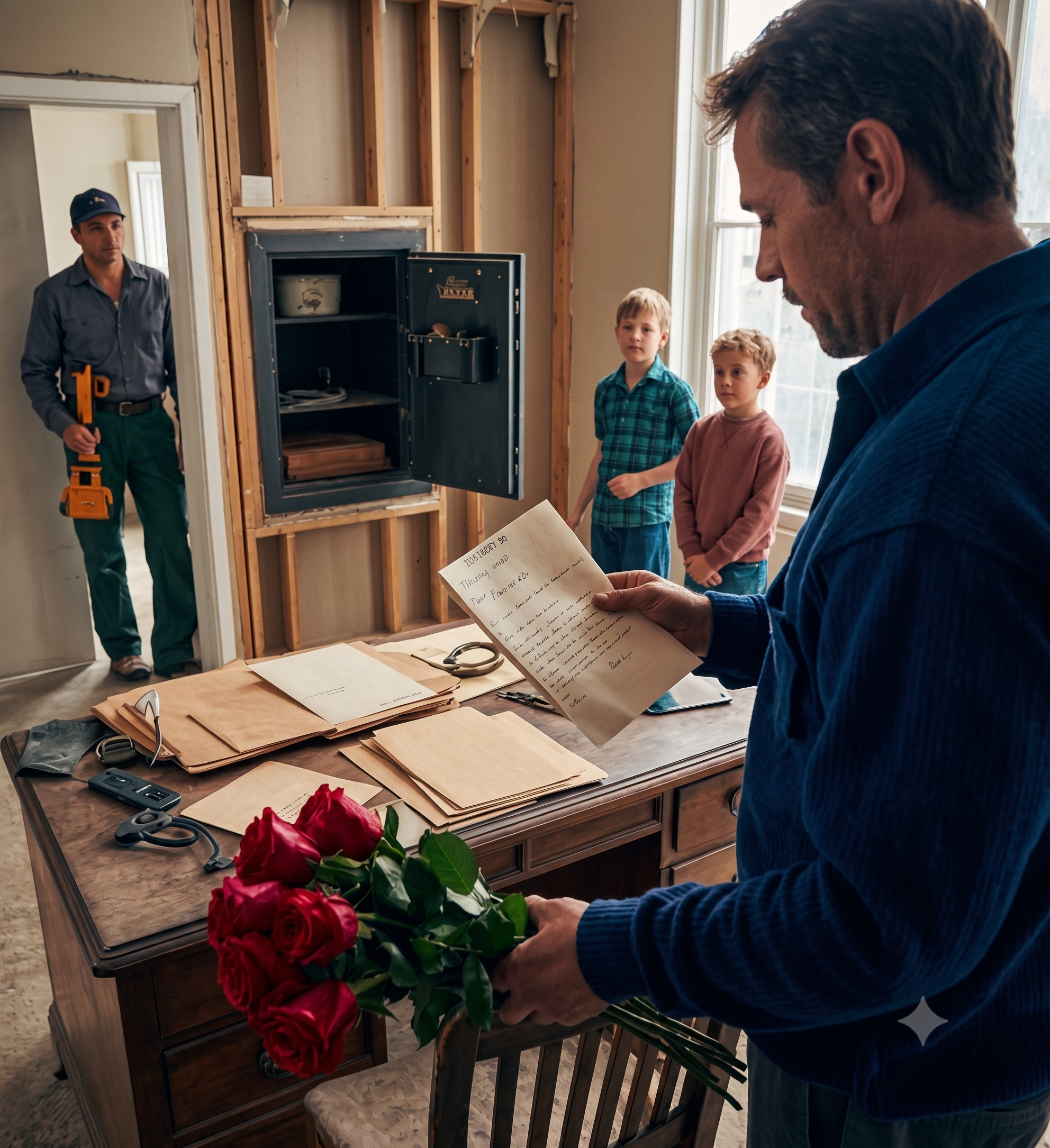
On the first anniversary of Victoria’s death, I bought twelve white roses.

There are sentences no parent should ever have to hear. I sat down on the floor of his room, because it felt wrong to be above him for that conversation, and Leo came in a minute later and sat on the bed without being asked, and I told them the truth as carefully as I knew how. Their mother had died because Marcus Vance was a criminal and a coward who had made a choice. She had protected them because she loved them, because that was who she was, because she believed the record she was building would eventually reach the right hands and put things right. The blame belonged exactly where the law was now placing it, on a man who was already in a cell. Not on two boys who had only ever been loved.

Two days later Emma brought me another envelope recovered from the safe inventory. It was addressed simply: For the boys. Inside, Victoria told Leo and Sam that none of what had happened was their burden to carry. She told Leo that being observant was not the same as being responsible for the failures of adults. She told Sam that his kindness was not a weakness, that it was the most precise and difficult thing a person could practice in a world that keeps trying to make it inconvenient. She told both of them to choose honesty, even when it was expensive, because secrets grow teeth in the dark. I read that letter aloud in the living room while both of them cried and pretended not to. I pretended not to notice. We sat there in the pretending together, and it was one of the most honest moments we had shared in months.

The financial case kept widening. Investigators eventually tied Marcus to more than two million dollars in fraudulent transfers over five years. Some had gone to gambling debts accumulated at card rooms up and down the coast. Some funded a condo no one knew he owned, listed under a holding company that shared initials with one of the shell vendors. Some simply padded a life he had constructed under layers of fake invoices and borrowed reputations, a life that looked like success and was entirely hollow underneath.

His executive assistant, Jillian Price, turned state’s evidence after investigators found emails she had been instructed to backdate to cover transaction timelines. She testified that Marcus had rehearsed lines before Victoria’s funeral about Victoria being overworked and forgetful. He had been shaping the story of her character before anyone had even thought to question the story of her death.

The trial began nine months after the safe was found. I testified for three hours. So did Thomas, and Emma, and Detective Ortiz, and Eugene Bell, and Jillian Price, and two forensic accountants who walked the jury through the shell companies one transfer at a time with the unhurried precision of people who understood they were telling a story that needed to be told slowly. The audio recordings were played in open court. Marcus sat in a gray suit, taking notes in a yellow legal pad as if he were attending a professional seminar rather than listening to his own recorded voice threaten two children through their mother’s telephone.

When the prosecutor played the recording in which he made that threat, Leo squeezed my hand so hard my fingers went numb. Marcus did not look at us. I watched him not look at us and understood that even then, even in that room with everything lost, he was still calculating, still managing the story, still trying to control whatever small portion of the narrative he had left.

The defense tried exactly what Victoria had predicted. They argued she was overwhelmed, confused, guilty of her own accounting errors, emotionally fragile under years of professional pressure. The implication was that she had fabricated or misread what she found, that her documentation was the product of a troubled mind rather than a careful one. But the records were too clean. Her notes were too methodical. Her timelines were too precise. Cross-referencing her handwritten binders against the digital records and the shell company registrations, there was not a single discrepancy. Victoria had done what accountants do best: she had left a trail that made lies expensive.

The jury convicted Marcus on the murder charge and a stack of fraud-related counts so long that the clerk needed extra time to read them all into the record. Eugene Bell took a plea on reduced charges for his cooperation. Jillian kept her agreement. Marcus received what remained of his life behind bars, in a room smaller than the office where he had spent years stealing from people who trusted him with their futures.

I thought the conviction would feel triumphant. It did not. It felt final. Triumph is for games. What I felt in the courtroom when the verdicts were read was the terrible calm that arrives when a long question is finally answered and the answer changes nothing about the loss. Victoria was still gone. The roses I bought each year were still only roses. But the story of her death was no longer a lie. It was no longer an accident chalked up to rain and a curve in the road. It was the truth, the whole complicated and horrible truth, and it was now part of the public record. That mattered in a way I could not fully explain then and still cannot fully explain now, but it did. It mattered enormously.

In the months after sentencing, Emma helped me do the thing Victoria would have done first. We made the clients whole. Insurance recovery, asset seizures, restitution orders, and the sale of Marcus’s hidden property and condo created a recovery fund large enough to restore the nonprofit losses he had caused. It was not instant and it was not simple and it required more legal hours than I want to think about, but the shelter kept its beds, the church completed its planned repairs, the youth league survived and kept its scholarships, and the fund Marcus had raided was rebuilt to where it had been before he ever touched it.

Then, with the boys’ blessing, I reopened the office.

Not as Sterling and Vance. That name belonged to a wound. We reopened as Victoria Reynolds Community Accounting, a small firm offering low-cost bookkeeping and audit support to local nonprofits that cannot afford to be exploited, the exact organizations she had spent her career protecting. Leo helped design the website, picking fonts and layout with the same careful attention he had started applying to everything since the trial. Sam chose the paint color for the front office because Victoria had always let him choose from the fan decks when we repainted rooms at home, and that was the kind of continuity worth keeping.

On opening day I carried in twelve white roses. The same number I had been holding in the kitchen when Thomas called.

The renovated office looked nothing like the gutted space where we had found the safe. Clean walls, warm lights, new shelving, fresh carpet, and Victoria’s old desk refinished and placed near the back window where it could catch the afternoon light the way she had always preferred. But one thing stayed exactly where it had been found. The safe. We did not drywall over it again. We left it visible inside a recessed frame, locked and empty now, not as a shrine to fear but as a reminder that truth sometimes survives because one careful person refused to let the record disappear. Visitors asked about it occasionally. I always told them exactly what it was.

That afternoon, Leo stood beside me in the new reception area while Sam arranged the roses in a glass vase at the front counter. The phones had not even been connected yet. The office still smelled faintly of new paint and sawdust and something that might have been hope, or at least its practical equivalent. Leo looked at the safe for a long moment and then looked at me.

“Do you still hate him?” he asked.

I thought about it before I answered, the way Victoria would have wanted me to, the way she used to pause before saying anything important, gathering the words like she was gathering a document, making sure each one earned its place.

“Hate takes up too much room,” I said. “Your mom already gave us something better to do.”

Sam looked up from the vase. “Good work?” he asked.

I laughed for what felt like the first time in years. A real laugh, the kind that comes from the chest and surprises you. “Yeah,” I said. “Good work.”

The boys went off to argue over where to hang a framed photograph of Victoria that Sam had chosen, the one from the firm’s first anniversary dinner where she was laughing at something just off camera. The office phones had not been connected yet, but the place felt alive. Not haunted. Not frozen in the particular amber of a space where something terrible once happened. Alive, in the way that the best things we build in the aftermath of loss feel alive, because they are built in full knowledge of what they cost.

Grief still lives in my house. It probably always will. I still reach for a second coffee mug some mornings before I remember. I still turn at certain sounds, a particular laugh on a television, a specific note in a song, expecting to find her there at the end of it. But now when my sons ask about their mother, and they still ask, I can tell them the whole truth and all of it is worth telling. She was brave in a way that did not announce itself. She was methodical in a way that most people never appreciated because they only saw the warmth on top of it. She was terrified for months and she kept going anyway, kept building her record, kept protecting her clients, kept protecting her boys, kept leaving a trail that could be followed even without her at the front of it.

She protected them. And in the end, she won.

Not because the ending was fair. It was not, and nothing will make it so. Not because justice returned what Marcus took. It cannot. There is no court ruling that restores twelve years cut short on a rain-slick road. She won because the record survived him. Because she built something too careful to be buried, too precise to be dismissed, too deeply rooted in the truth to be undone by a man who had spent years mistaking her decency for weakness.

And because one year after we thought her voice had been buried for good, we pulled open a wall and heard her speak again. This time, in a courtroom, in front of everyone, with the full weight of everything she had built behind her words.

This time, everyone listened.

More Details
PART1: “My husband admitted to cheating and told me to leave right after I paid off his $300,000 debt.
Jul 16, 2026

PART1: “My husband admitted to cheating and told me to leave right after I paid off his $300,000 debt.

Right after I cleared my husband’s $300,000 debt, he admitted he’d been unfaithful and told me to leave our home. His parents sided with the other woman, and I couldn’t help but laugh as I met his eyes and asked whether he had completely lost his mind and forgotten something crucial.


Patricia sighed as if she had been waiting for this moment. “Lauren, Jonathan deserves someone younger and someone who truly understands his ambitions,” she said coldly.

William nodded in agreement, adding that we had never been a good match. The weight of their words pressed down on my chest.

Three years of sacrifice and loyalty meant nothing to them. Jonathan pointed toward the stairs and told me I could pack my things that night because Vanessa would be moving in the next day.

The room went completely still for a few seconds as everything settled.

Then I started laughing.

Not softly. Not politely. But with a force that surprised even me.

I laughed so hard that everyone stared at me like I had lost control. Jonathan frowned and asked what could possibly be funny.

I wiped a tear from my eye and looked straight at him with calm clarity. “My husband, have you completely lost your mind,” I asked slowly.

He looked irritated and demanded to know what I meant. I tilted my head slightly and told him he had forgotten something extremely important.

The room fell silent as they waited. Jonathan crossed his arms and told me to explain.

I stepped further into the living room and set the champagne bottle carefully on the table. “For three years, I have been the one paying off your business loan,” I said evenly.

Vanessa smirked and said they already knew because Jonathan had told her everything. I smiled politely and shook my head.

“Oh no, he definitely did not tell you everything,” I replied calmly.

Jonathan frowned and told me to stop being dramatic, clearly thinking I was creating unnecessary tension. I reached into my bag, pulled out a folder, and placed it on the coffee table.

Inside were the official loan documents he had signed when his company was on the verge of collapse. Patricia leaned forward slightly and asked what they were supposed to be looking at.

I opened the folder to the final page and pointed to a specific section. Jonathan glanced down with disinterest at first, but confusion quickly replaced it.

“What is it,” Vanessa asked, leaning over his shoulder.

I folded my arms and looked at him carefully. “Do you remember when the bank rejected your loan application back then,” I asked.

He said nothing, which told me everything. “So I stepped in and convinced them to approve it under certain conditions,” I continued.

William interrupted impatiently, saying they already knew I helped repay it. I nodded and tapped the page again.

“That is correct, but what none of you bothered to read was the ownership clause included in this agreement,” I said clearly.

Jonathan’s face turned pale as he stared at the document again. “Lauren, what are you saying,” he whispered.

Vanessa looked annoyed and demanded clarification. I remained calm as I explained.

“The clause states that whoever guarantees and fully repays the loan using their own funds becomes the primary owner of all company assets,” I said.

Silence filled the room as the meaning settled in. Jonathan’s hands trembled as he reread the page.

“That cannot be true,” he said weakly.

“It is completely true, and your attorney explained it the day you signed,” I replied.

Patricia stood abruptly, demanding to know what kind of nonsense this was. I pulled out another document and placed it beside the first.

“This is the official confirmation from the bank that the loan was fully repaid this morning using my funds,” I said.

Vanessa’s confidence faded as reality set in. Jonathan looked like he had been struck by something irreversible.

“You are lying,” he said, though without conviction.

I met his eyes. “As of 9:42 this morning, I became the majority owner of Brooks Logistics,” I said clearly.

William slammed his hand on the table, insisting it was Jonathan’s company. I tilted my head slightly.

“Not anymore,” I said.

PART2: “My husband admitted to cheating and told me to leave right after I paid off his $300,000 debt.

Jonathan rushed toward me, accusing me of deceiving him. I raised an eyebrow and asked whether I had tricked him or if he had simply failed to read what he signed.

You may like 

626
157
209
249
62
83

Vanessa looked at him, confused, asking why he told her he owned everything. He had no answer.

I leaned slightly closer and reminded him of what he said earlier about this being my last day in the house. He swallowed and confirmed it quietly.

“Well, there is another thing you forgot,” I said, glancing around the room.

His voice barely came out when he asked what I meant. I smiled.

“This house was purchased using company funds,” I said calmly.

Patricia gasped as Jonathan’s eyes widened in horror. For the first time, they all understood where the power truly lay.

The silence grew heavy as Jonathan stared at me, his world unraveling. He insisted it was impossible, but I calmly sat down across from him.

“It is very possible,” I said.

Vanessa stood nervously, demanding an explanation. Jonathan ignored her, flipping through the documents as if hoping they would change.

William finally asked what I intended to do next. I answered without hesitation.

“As the majority owner of Brooks Logistics, I legally control all company assets,” I explained.

Then I gestured slowly around the room. “That includes this property.”

Patricia’s voice trembled as she asked if that meant what she thought. I nodded.

Jonathan sank into the couch while Vanessa looked completely lost. She asked if I was saying I owned the house.

“Technically, yes,” I replied.

Jonathan grabbed my arm, begging me to talk. I gently removed his hand and reminded him of his own words.

“I thought today was my last day here,” I said.

He tried to take it back, but it was too late. I reminded him that he had introduced his mistress and told me to leave.

Vanessa grew angry, demanding to know why he said we were already separated. Jonathan snapped at her to stop, making everything worse.

I leaned back and spoke quietly. “For three years, I believed I was building a future with my husband,” I said.

Jonathan lowered his head.

“But apparently I was just funding his new life with someone else,” I continued.

Vanessa crossed her arms and said maybe I should have been a better wife. Jonathan looked horrified, but I told him to let her speak.

She insisted he deserved someone more exciting. I nodded slowly.

“That is fair,” I said, standing up.

“Now he is free to pursue that exciting life,” I added calmly.

Jonathan looked hopeful for a brief moment until I finished. “Just not in my company,” I said.

His face froze as confusion returned. I slid one final envelope toward him.

“This is a notice from the board,” I explained.

He insisted there was no board, but I corrected him. “There is now.”

Inside was an official termination letter. “As majority owner, I held an emergency meeting this afternoon,” I said.

Jonathan read it with shaking hands. “You fired me,” he whispered.

I nodded.

Patricia accused me of destroying my own husband. I looked at her calmly.

“He destroyed himself,” I said.

Vanessa stepped back from him as if she no longer recognized him. She reminded him he had told her he was the CEO.

He said nothing, because he was no longer anything.

I picked up the champagne bottle I had brought to celebrate. I walked toward the door and paused.

“Jonathan,” I said quietly.

He looked up, completely broken.

“Congratulations,” I added.

“For what,” he asked weakly.

I gave him a small, knowing smile. “Today really is the beginning of a new life,” I said.

Then I opened the door.

“But unfortunately, it is not yours,” I finished, stepping outside.

I walked out of the house that now legally belonged to me, leaving behind everything that no longer mattered.

PART3: “My husband admitted to cheating and told me to leave right after I paid off his $300,000 debt.

💭 What This Story Teaches Us

Some betrayals are loud.
But the most dangerous ones… are quiet.
They don’t come from enemies. They come from the people you’ve sacrificed for. From the life you’ve financed with your own hands.
This story reminds us of something uncomfortable—but real:
👉 Not every promise is a foundation. Some are just placeholders.
Sometimes, the biggest risk is not what you don’t know…
…but what you assume could never happen to you.
💔 Key Lessons Trust should be verified, not assumed. Years of shared history don’t guarantee loyalty. People don’t always change. Sometimes, they just stop hiding. Paperwork isn’t paranoia. It’s protection. Contracts, clauses, and clear records aren’t signs of distrust. They’re the quiet safeguards that keep you standing when everything else collapses. Calmness shifts the entire room. Panic hands control to the person who wronged you. A steady voice and documented truth cut through the noise faster than anger ever could. Kindness without boundaries becomes self-sabotage. You can be fiercely loyal and still read the fine print. Protecting yourself isn’t betrayal. It’s self-respect. Awareness is control. The moment you stop assuming and start observing… you stop being a passenger in your own life and become the driver.
🧠 A Reality Most People Avoid
You can pay off someone’s debt…
and still be replaced the day the balance hits zero.
That doesn’t make you foolish.
It makes you human.
💬 What Would You Do?
If you were in this situation…
👉 Would you have handed over the documents immediately, or let them sit with their own assumptions first? 👉 Would you have tried to salvage the marriage, or recognized the moment it was already over? 👉 Or would you have quietly secured your own leverage long before the conversation even started?
There’s no perfect answer.
But there is one important question:
👉 Are you paying attention… or just trusting without protecting yourself?
🔥 Final Thought
In the end, this story is not just about betrayal.
It’s about awakening.
Because sometimes…
the moment everything feels like it’s falling apart…
is the moment you finally realize what you’ve actually been building all along.
More Details
At Family Dinner, My Sister Raised My Rent—And Everyone Laughed
Jul 15, 2026

At Family Dinner, My Sister Raised My Rent—And Everyone Laughed

Toddlers cannot wait until meal time. They have to be fed before everyone else at a big family reunion. Selective focus on distracted middle baby boy. Family members busy in background. A lot of action is happening in this real life caption! Horizontal day light shot. This was taken in Quebec, Canada.

The Basement

The fork in my hand felt like it weighed a pound.

Madison sat at the head like she owned the air. She always had. Three years older, three inches taller in heels, and a lifetime of acting like her success was a favor she performed for the family.

My mother dabbed at the corners of her mouth, careful not to smear her lipstick. My father carved his prime rib the way he did everything: quietly, precisely, like it was beneath him to struggle with anything. My brother Tyler was half-present, thumb scrolling on his phone. Madison’s husband Marcus poured himself another glass of red wine and didn’t bother pretending it was for “pairing.”

Madison set her fork down with a little click.

“So,” she said, voice syrupy. “Emma.”

My name sounded like she was about to scold a dog.

“Marcus and I have been talking. We need to discuss your living arrangement.”

There it was. That tone. Same tone she used when we were kids and she wanted Mom to know I’d stepped on her territory. Same tone at my college graduation when she announced her engagement during dessert. Same tone at my wedding reception when she leaned in and whispered, congratulations, you finally caught up.

The basement apartment had been my parachute after Derek. After the divorce. After the debt I didn’t even know existed until it was strangling me. Madison had offered it with a saintly smile: eight hundred a month, furnished, separate entrance. “No pressure,” she’d said, like she was giving me a spa weekend instead of a place to keep my life from spilling into the street.

I’d taken it because pride doesn’t pay for shelter. I kept it spotless. Paid on time. Lived small. Made myself easy to ignore.

Madison folded her hands. Her diamond bracelet flashed, as if the chandelier respected it.

“We’ve realized that the rent you’ve been paying is significantly below market value.” Marcus nodded along like this was a quarterly report. “So, starting immediately, your rent will be six thousand eight hundred dollars a month.”

For a second, I thought I’d misheard her. Then I saw the little twitch at the corner of her mouth. The satisfaction.

My mother made a strangled sound. Marcus swirled his wine. “We’re losing money, honestly. We’ve been subsidizing Emma for two years.”

Subsidizing. Like I was a charity case they’d sponsored for the holidays.

Madison tipped her head, studying me like she was waiting for tears. “You’re thirty-four, Emma. You can’t depend on us forever.”

My father chuckled behind his napkin. My mother’s laugh came out nervous and thin. Even Tyler’s mouth twitched, then he caught himself and looked away.

I let it happen. I let the laughter land and settle and warm Madison’s skin like sunlight.

Because here’s the thing nobody tells you about rock bottom: once you hit it, you stop fearing the fall. There’s nothing left to lose. And that’s where power hides—quietly, patiently—waiting for you to notice.

Madison leaned forward, voice dropping like she was being kind. “So what do you say? Can you handle it? Or should we find a real tenant?”

I looked around the table. My mother, hoping I’d apologize for existing. My father, amused, as if my humiliation was proof the universe still made sense. Marcus, interested, like he was watching a financial documentary. Tyler, trapped between loyalty and decency. Madison, glowing.

And something in me unclenched.

I smiled. Not a polite smile. Not a “please don’t hurt me” smile. A real one.

Madison’s eyebrows lifted. “What’s funny?”

I picked up my water glass, took a slow sip, and set it down.

“That’s actually perfect timing,” I said.

“Perfect timing,” Madison repeated, like she tasted something sour. “You can’t afford sixty-eight hundred dollars a month.”

“Oh, I could. But I won’t need to.”

Silence rolled across the table. My mother blinked. Marcus paused with his fork halfway to his mouth. Tyler’s phone lowered completely. My father’s knife stopped.

Madison’s smile faltered. “What does that mean?”

“It means I’m moving out. My closing is next Thursday.”

“Closing?” my father echoed.

“On my house. Three-bedroom. Old Victorian. Riverside district.”

That got her. Riverside was the neighborhood Madison always talked about like it was a private club. “If we ever move,” she’d say at parties, “it would have to be Riverside. But the prices are insane.”

Now she stared at me like I’d claimed I was buying the moon.

“With what money?” she snapped, composure cracking. “You’re a paralegal.”

“I was,” I said. “I passed the bar earlier this year.”

My mother’s hand flew to her chest. “Emma—what?”

“I work as an associate attorney now. Same firm that hired me as a paralegal. They sponsored my prep. I studied. I passed. They promoted me.”

Marcus swallowed. “How much does that pay?”

“Starting salary is one-forty. Plus bonus.”

My father’s eyes sharpened, like he’d just realized he’d been wrong and didn’t like it. His knife rested against the plate, forgotten. My mother’s hand was still on her chest, fingers spread like she was trying to hold something in.

Madison’s face flushed. “You’ve been living in my basement while making that?”

“For six months,” I corrected. “Before that, I saved. Aggressively. Lived cheap. Did the boring stuff that works.”

I glanced at Tyler. “Remember last Thanksgiving when you laughed because I brought my own Tupperware instead of eating out with everyone?”

Tyler winced. “Yeah.”

“That was strategy,” I said. “Not poverty.”

Madison’s voice tightened. “So you’re just rubbing it in?”

“No. I’m answering your question.”

Then I reached into my purse and pulled out my phone.

“Also, Madison, do you remember signing those papers I brought you last year? The ones you witnessed?”

Her eyes narrowed. “What papers?”

“You were hosting your book club. You didn’t look at them. You just signed.”

Madison’s lips parted, confused and suddenly wary.

“Those were formation documents for an LLC. My LLC.” I tapped the screen. “The LLC bought a four-unit apartment building downtown. Six months ago.”

For a heartbeat, nobody breathed.

My mother whispered, “You own an apartment building?”

“The company does. I’m the sole member.”

Marcus stared at me with a hungry kind of respect now, the way people look at money when it’s finally in the room. Madison’s chair creaked as she shifted, like her body was trying to find an exit without standing up.

“I’ve been thinking about expanding,” I went on, tone casual. “There’s a commercial property coming up for auction. Former restaurant space in the arts district.”

I turned to Marcus. “Didn’t you say you’ve been looking for a location for your farm-to-table concept?”

Marcus blinked. “I… yeah.”

“This one’s estimated around eight hundred. Needs work, but the traffic is incredible.”

Madison finally found her voice, sharp and high. “This is ridiculous. You expect us to believe you’re suddenly some kind of real estate investor?”

“I’m not sudden,” I said. “I’m quiet.”

I looked directly at her. “And I’m done being your punchline.”

I stood up, placed my napkin neatly beside my plate, and picked up my purse.

“I’ll be out by Wednesday. You can list the basement for whatever price you want.”

Madison’s jaw clenched. “You’re doing this to embarrass me.”

“No,” I said. “You did that all by yourself. I’m just not helping anymore.”

When I reached the entryway, Tyler followed. “That was insane,” he whispered. “In a good way.”

I opened the door, cool air brushing my face. “It wasn’t about revenge. It was about boundaries. And about me remembering who I am.”

Behind us, the dining room erupted into muffled voices. Madison, furious. My mother, panicked. My father, low and gruff. Marcus, quiet and calculating.

I stepped into the night and smiled to myself, because the part they didn’t understand was simple: I wasn’t escaping. I was arriving.


The next morning, my phone was a war zone. Seven missed calls from Madison. Two from my mother. A text from Tyler: Proud of you. Also, please don’t let her murder you.

I made coffee in the little kitchen that had been my world and let the quiet settle.

At the firm, nobody called me “the divorced one.” Nobody talked to me like I was a lesson. My boss, Catherine Morrison, cared if I was sharp.

Catherine was the one who’d looked at me during my divorce—eyes red, hands shaking as I slid bank statements across her desk—and said, “You’re not stupid, Emma. You were betrayed. There’s a difference. And you don’t have to stay broken.”

She didn’t say it like comfort. She said it like instruction.

That evening, I drove back to Madison’s. My father was waiting on the front step, hands shoved in his pockets. We weren’t a hugging family. But he nodded, which in our language was an entire paragraph.

“I laughed,” he said finally. “Last night. That wasn’t right.”

I waited.

“I thought Madison was helping you. And maybe she was, but I didn’t see the other part.”

“The part where she got to feel taller,” I said.

He nodded like it hurt to admit. “I didn’t see you rebuilding. I assumed you were stuck.”

I almost laughed at the word. Like all those early mornings, all those nights studying until my eyes burned, were just me idling.

“I didn’t broadcast it,” I said. “I didn’t want opinions. I didn’t want Madison turning it into a competition.”

My father looked down at the steps. “You passed the bar.”

“Yes.”

“You bought a house.”

“I’m closing next Thursday.”

He was quiet for a moment. Then: “I’m proud of you.”

The words landed like something heavy and warm. My father didn’t hand out pride casually. It was a currency he guarded like it mattered.

My throat tightened. “Thanks, Dad.”

Inside, Madison was pacing in the entryway like a storm trapped in designer clothes. Marcus stood near the kitchen, arms folded, looking tired in a way money couldn’t fix.

Madison spun toward me. “So you’re just going to waltz in here like you didn’t blow up my life?”

“I didn’t blow up your life. I answered your performance.”

“You embarrassed me.”

“You tried to embarrass me,” I corrected. “I just didn’t play my part.”

Madison’s breath came fast. “You could’ve told us.”

“Why? So you could make it about you? So you could ‘help’ me again and remind me every holiday?”

Marcus cleared his throat. “Emma, about the property auction—”

Madison whipped toward him. “Not now!”

I held up a hand. “Marcus, email me the details.”

Madison snapped back to me. “You think you’re better than us now?”

I studied her. She wasn’t angry because I’d lied. She was angry because the story she’d been telling herself—successful Madison, broken Emma—had cracked.

“I don’t think I’m better,” I said. “I think I’m free.”

“Free. From what?”

“From needing you to approve of me. From being grateful for scraps. From being the family’s cautionary tale.”

Madison’s chin lifted. “We charged you below market.”

“You charged me what you wanted,” I said. “And I accepted because it was better than sleeping in my car.”

The room went still. Marcus looked away. Madison’s eyes widened, just a fraction. For the first time, I saw something besides smugness. Something like shame, caught off guard.

My mother’s voice drifted from the dining room. “Madison, please—”

Madison ignored her. “You lived here because you needed us.”

“I lived here because I needed shelter,” I said. “And I paid for it. On time. Every month. I kept the place spotless. I made myself invisible. And you still found a way to make it a performance piece for the family.”

“I never—”

“Subsidizing,” I said. “That’s the word Marcus used last night. Like I was a tax write-off.”

Marcus flinched.

“I’m not here to punish you,” I said. “I’m here to tell you I’m leaving Wednesday, and I want it clean.”

Madison’s voice dropped, quieter now, but still barbed. “And the LLC papers. You had me sign those like an idiot.”

“You witnessed them. That’s what witnesses do.”

“Did you do that on purpose? So I’d be part of your little scheme?”

“No,” I said honestly. “I did it because you were there, and I needed a signature, and I didn’t want to ask you for anything else.”

I turned to her. “If you ever want a relationship that isn’t built on you standing on my neck, you’ll have to change how you talk to me.”

“So you’re giving me an ultimatum.”

“I’m giving you a boundary. You can accept it or not. But I’m not negotiating my dignity at the family table anymore.”

For a second, she looked like she might cry. Then she straightened, armor snapping back into place. “Fine. Leave. See if your little house makes you happy.”

I smiled, small and genuine. “It already does.”

I walked out before she could say anything else. In my car, I sat for a moment with my hands on the steering wheel, breathing.

The old me would’ve shaken. Would’ve replayed every word. Would’ve wondered if I’d gone too far.

The new me just felt clear.

Because Madison couldn’t raise my rent anymore. Not because I had money now, though I did. But because she didn’t own my safety anymore.


Wednesday came fast. I packed in quiet bursts between work and sleep. Boxes stacked like proof. My basement apartment emptied room by room, the walls revealing faint scuffs where my desk had sat, where I’d taped up schedules for bar prep, where I’d written myself small reminders on sticky notes: Keep going. Don’t quit. Future you is watching.

On my last morning, I swept the floor twice, wiped down the counters until they shined, and left the key on Madison’s counter with a note: Thank you for the roof. I’m taking it from here.

I didn’t wait to see her reaction. By Monday, Madison had stopped calling. Not because she’d calmed down—because she’d switched tactics. Silence was her way of reclaiming control, as if she could punish me by withholding attention. It would’ve worked on the version of me that still chased approval. Instead, I put my head down and moved forward.

Closing day felt almost anticlimactic, like the climax had already happened at that dinner table. I sat in a conference room with a stack of documents thick enough to qualify as furniture. My realtor slid papers toward me. My attorney—someone I’d hired even though I could technically do it myself, because I’d learned the value of having a team—watched for details.

I signed my name again and again until my hand cramped. Then the seller’s agent handed me a ring of keys.

My keys. My house.

I walked through the front door alone first.

The Victorian smelled like dust and old wood and second chances. Sunlight poured through tall windows, catching the worn edges of the floorboards. The place needed work. The kitchen was stubbornly stuck in the 1980s. The paint colors were choices someone had made during a fight. But the bones were solid. The house felt like something that had survived its own story—and was ready for another.

An hour later, Catherine arrived with cheap champagne and plastic cups because she believed in celebrations that didn’t wait for perfect.

“You did it,” she said, grinning.

“I did.”

We clinked cups in the empty living room.

“Your sister thought she was humiliating you,” Catherine said, leaning back against a doorway.

“She was.”

“And you smiled.”

“Because I knew,” I said.

Catherine’s eyes gleamed. “Because you knew.”

The weeks after were busy in the best way. I painted walls. Scheduled contractors. Pulled up carpet to reveal hardwood worth saving. I learned my neighbors’ names. I ran miles along the riverwalk early in the morning, feeling like I was moving forward on purpose.

I slept on an air mattress in the living room because the bedroom furniture hadn’t arrived. Every morning I woke up to sunlight coming through tall windows and the quiet creak of an old house settling into itself. It felt like breathing room. Like proof.

Work got heavier too. My caseload grew. I started specializing in divorces with complicated finances—hidden assets, secret accounts, spouses who smiled while lying. I could spot the patterns. I knew the language of manipulation, the way it tried to make you doubt your own memory.

When a client cried and said, “I feel stupid,” I didn’t comfort her with clichés. I said, “You’re not stupid. You’re being played. Let’s end the game.”


Marcus emailed me his restaurant plan. It wasn’t bad. It was just unfinished—like him.

I marked it up in red and sent it back: show your numbers, not your dreams. Identify risks. Build contingencies. Stop assuming passion is a business model.

He called that night, voice a mix of defensive and grateful. “You’re brutal.”

“I’m honest.”

“Can you help me do it right?”

“If you’re willing to work.”

He did work. And when the commercial property auction came, I won it—not by throwing money at it, but by preparing, knowing my ceiling, and refusing to get emotional.

Meanwhile, Catherine slid a new file across my desk. “High conflict. Possible hidden assets. Emotional manipulation. You’re up.”

Patricia Hughes. Married fourteen years. Two kids. Husband owned a construction company, controlled the money, used it like a leash. When she asked for transparency, he laughed. When she asked for access, he called her ungrateful. When she threatened divorce, he said, “Go ahead. You’ll get nothing. I made everything.”

It was a story I’d heard before. Not from a client. From my own life.

I met Patricia in a small conference room. She was polished but tired—the kind of tired that comes from years of being told you’re crazy until you start to wonder if you are. She sat across from me, hands folded so tightly her knuckles were pale.

“I don’t want to destroy him,” she said quickly. “I just want what’s fair. And I want to stop feeling afraid.”

“You don’t have to destroy him,” I told her. “You just have to stop letting him write the story.”

Her eyes filled. “He keeps saying there’s nothing.”

“There’s always something,” I said. “People who have nothing don’t spend this much energy convincing you.”

I slid a legal pad toward her. “We start by building a timeline. Every account you know about. Every property. Every time money moved and he had an explanation that didn’t make sense. And we do not argue with him about reality. We prove it.”

Her shoulders lowered, just a fraction.

I spent weeks doing forensic work that made my brain hum. Public records. Business filings. Secretary of State databases. Property tax records. Contractor permits. Social media photos where the background revealed more than the caption intended.

Patricia’s husband—Grant—had a talent for hiding money in plain sight. The construction company was paid by clients, but the money didn’t show up in business accounts. It appeared as “loans” to shell companies that owned “equipment” that was never purchased. It appeared as “consulting fees” to a cousin who couldn’t spell consulting. It appeared as a second mortgage on a property Patricia didn’t know existed—an investment condo he’d put under a company name she’d never heard.

One night at my kitchen table, laptop open, paperwork spread like a map, something clicked. A pattern. A series of transfers, small enough to avoid attention, always on Fridays, always to the same processor.

I followed the trail. Crypto exchange.

I leaned back and laughed once, sharp and humorless. Of course. It was 2026. When men like Grant wanted to hide money, they didn’t use offshore accounts anymore. They used the myth of complexity. They used buzzwords. They used the assumption that “crypto” was unknowable.

But I wasn’t most people. And I wasn’t afraid of paperwork.

We filed motions. Requested records. Subpoenaed the exchange. Grant’s attorney tried to stall, tried to paint Patricia as irrational. During mediation, Grant leaned toward Patricia and said, smiling like a threat, “You’ll spend everything on lawyers and still end up broke.”

Patricia’s hands shook. I placed my palm flat on the table. “Mr. Hughes, if you continue to speak to my client like that, we can take this to trial. And you can explain to a judge why you thought hiding marital assets in cryptocurrency was a clever idea.”

Grant’s smile faltered. Patricia looked at me, startled. I leaned closer to her, voice low. “Breathe. He’s doing this because intimidation used to work. It doesn’t anymore.”

At the hearing, Grant took the stand and said, with a straight face, that he had “no meaningful investments.”

I stood. “Your Honor, we have evidence of ongoing weekly transfers from Mr. Hughes’s corporate entities to a cryptocurrency exchange dating back four years. We are requesting an order compelling full disclosure and preventing dissipation of assets.”

Grant’s face shifted. Just a small flicker. Fear. The judge compelled disclosure.

The settlement we secured was strong—structured support, asset division accounting for hidden funds, clear orders preventing him from dragging her back into court out of spite. When Patricia signed, she cried quietly. Like someone letting go of a weight they’d worn so long they forgot it wasn’t part of their body.

“How did you see that?” she asked in the hallway. “How did you know?”

I thought about the basement. About Derek. About the dinner table.

“I learned what it looks like when someone is lying with numbers,” I said. “And I learned I don’t have to accept it.”

That night, I drove home and pulled into my own driveway—the one nobody could threaten—and felt something quiet and fierce inside me. This wasn’t just about winning. It was about turning what happened to me into something useful. Something that built instead of broke.


Construction on the restaurant started in late spring. The space was uglier in person than on paper—it smelled like old grease and stubborn failure, the kitchen gutted, the dining room sporting stained carpet and a ceiling that had survived a small war. But the location was gold: corner lot, heavy foot traffic, three office buildings within walking distance.

Marcus was there every morning in work boots, meeting contractors, checking deliveries, learning how quickly money bleeds through small delays. For the first time, I saw him alive in his own life. He called me regularly—not to ask permission, but to check assumptions. “If we switch the flooring, does it change the timeline?” “If labor runs high, what’s our runway?” He was learning the language of reality.

Madison hovered at the edges, struggling with the fact that this wasn’t something she could win by being shiny. Nobody cared about her tennis bracelet in a room full of exposed wiring.

At a family brunch my mother hosted, Madison smiled brightly and said, “It’s so nice that Emma has time for these little side projects now.”

Little side projects.

My mother laughed nervously. My father stared at his plate. Tyler’s eyes widened like he was watching a car drift toward a cliff.

I sipped my coffee. “It’s not a side project. It’s an asset with risk exposure. But I understand why that might sound like a hobby if you’ve never built something from scratch.”

Madison’s smile froze.

Tyler choked on his orange juice, half laugh, half cough.

Madison leaned closer, voice low. “You love humiliating me now.”

“I don’t love it,” I said quietly. “I just won’t absorb it anymore.”

After brunch, my mother followed me to the door. “Honey, you don’t have to jab.”

“I’m not jabbing. I’m correcting the record.”

My mother’s eyes were damp. “I didn’t realize how much you carried.”

“I carried it because nobody else would,” I said gently.

One afternoon, I walked into the restaurant space and found Madison arguing with the contractor about lighting fixtures.

“I don’t care what you ordered. These aren’t what I want.”

Marcus looked exhausted. The contractor looked ready to quit.

I stepped between them. “Madison, you do not get to derail timelines because you saw something prettier online.”

Her cheeks flushed. “It’s my husband’s restaurant.”

“It’s his,” I agreed. “Not yours.”

Marcus let out a breath like I’d cut a rope off his chest. “We’re keeping the original order.”

Madison stared at him, shocked. For the first time, she was the one being outvoted. I watched her swallow that reality, and I didn’t gloat. I didn’t need to.

That night, Marcus texted: Thanks. I didn’t realize how much she steamrolls until someone stopped it.

I typed back: Keep practicing. It gets easier.

A week later, Madison called. Her voice was controlled, careful, like she was negotiating.

“Marcus told me you’re structuring the investment.”

“Yes.”

“And you’ll own part of it.”

“If the deal makes sense.”

Another pause. “We’re going to need help with the build-out costs.”

“I already said I’d consider investing. What’s the issue?”

Madison inhaled sharply. “The issue is—this is family.”

There it was. Family, the word they used when they wanted a discount, when they wanted access, when they wanted me to bend.

“Family is emotional,” I said. “Business is math.”

“So you’re going to treat us like strangers.”

“No. I’m going to treat you like adults.”

Then Madison said, quieter, “We can’t afford to fail.”

I almost laughed at the irony. She’d tried to crush me at dinner, and now she was admitting fear.

I softened, but I didn’t fold. “Then don’t treat this like a vanity project. Let Marcus lead. Let me protect the downside. And stop trying to make it about who looks impressive at family gatherings.”

Madison’s voice wavered. “You think that’s what I do.”

“I know,” I said.

She didn’t deny it. That was progress, in its own uncomfortable way.

Madison didn’t come to my housewarming party until she was almost an hour late. She wore her perfect smile like a mask and walked through my renovated living room as if touring a property she might buy.

“It’s… nice,” she said, like the word cost her.

My parents showed up early. My mother brought a casserole. My father walked through the house quietly, touching the crown molding, studying the woodwork. “This is solid,” he said, which in Dad-language meant you did good.

Tyler showed up with his girlfriend and announced, loudly, “I always knew Emma was secretly Batman.”

Late in the evening, after the last guest left, Madison lingered on my porch.

“Can we talk?”

I didn’t owe her conversation. But I wanted to know who she was when she wasn’t performing.

We sat side by side, the street quiet, the porch light warm.

Madison stared at her hands for a long time. “I was jealous,” she said finally, voice flat with the honesty she usually avoided.

I didn’t speak.

“I built my whole identity on being first. First marriage. First house. First promotion. And when you crashed, it made me feel safe.”

That landed in my chest like a stone.

“And then you stood up at that dinner and showed me you were never less. You were just rebuilding. And I hated that I didn’t know.”

“You didn’t ask,” I said quietly.

“I know,” she whispered.

Silence stretched between us—not uncomfortable, exactly, but raw, like a wound being aired for the first time.

Then she said, “I’m sorry.”

It wasn’t dramatic. It wasn’t cinematic. It didn’t erase the last two years, or the way she’d used my low point as a stage. But it was real—the first thing she’d said to me in years that didn’t have a second meaning hiding behind it.

“I’m not looking for you to grovel,” I said.

“Then what do you want?”

I looked out at the street, at my house behind me, at the life I’d built with my own hands.

“I want you to treat me like an equal. Not a rival. Not a charity case. Not a cautionary tale.”

Her throat bobbed. “I can try.”

“Don’t try,” I said gently. “Do.”

She sat with that. Then nodded—smaller this time. “Okay.”

“One more thing,” I said. “Therapy. Real therapy. Not the kind you brag about. The kind that hurts.”

Madison didn’t answer for a long moment. Then, softer: “Okay.”

When she left, I stayed on the porch, letting the quiet wrap around me. The old me would’ve shaken. Would’ve replayed every word. Would’ve wondered if I’d gone too far. The new me just felt clear.

My phone buzzed. Catherine: Auction went well. Proud of you. Also, you’re buying more property than some people buy shoes. Don’t get cocky.

I smiled. Because the ending I’d needed wasn’t Madison apologizing. It wasn’t my family finally clapping for me.

It was this: I had a roof nobody could threaten. A future nobody could hold hostage. A life built on decisions instead of desperation.

And somewhere in the middle of new houses, old family patterns, business contracts, and court orders, I’d built something I didn’t even know I was building at first: a life where nobody else got to decide my value. A life where I could help people like Patricia escape. A life where even Madison, if she chose it, could change.

And if she didn’t—if she went back to being who she’d always been—I’d still be fine.

Because the point was never to make Madison suffer. The point was to make sure I never did again.

My peace wasn’t rented.

It was owned.

THE END.

More Details
They thought my recovery had left me powerless. They never expected what was inside my medical file.
Jul 15, 2026

They thought my recovery had left me powerless. They never expected what was inside my medical file.

The Silence in the Living Room

“You cannot expect him to spend the rest of his life taking care of you.”

“Don’t talk to my mom like that.”

Patricia blinked at him, almost amused.

“This is an adult conversation.”

“Then act like an adult,” he replied.

Under different circumstances, I might have corrected him for speaking sharply to his grandmother. That afternoon, I could only look at my son and wonder how an eleven-year-old had found the courage his father could not.

Before the highway collision, people often told me how fortunate I was. We lived in a two-story home outside Boise, Idaho, in a neighborhood with trimmed lawns, quiet streets, and school buses that arrived at the same time every morning. Colin worked as a regional construction estimator, and I had spent nearly a decade managing our home while raising Aiden, Owen, Lily, and four-year-old Maisie.

From the outside, our life looked dependable.

Inside, I had always understood that Patricia considered me temporary.

She came from a family that measured people by property, college names, and the size of their holiday gatherings. I had grown up above my father’s hardware store in a small town near Twin Falls. My parents had been gone for years, and the only relative I still spoke to was my older brother, Trevor, though we had never been especially close.

Patricia never missed an opportunity to remind me that the house had been purchased with Colin’s salary.

“My son built this life,” she would say during Sunday dinners. “Not everyone gets invited into a family like ours.”

I had swallowed those remarks for years because keeping peace seemed easier than confronting them. I cooked the meals, remembered birthdays, packed lunches, washed uniforms, sat through school concerts, and stayed awake beside sick children. Colin earned the paycheck, but I had built the rhythm of our home so quietly that everyone eventually mistook my work for something that happened by itself.

Then, on a rainy Tuesday in November, everything changed.

I had picked up Owen and Lily from an after-school music program when another driver crossed an intersection too quickly and struck the driver’s side of our car. The children escaped with minor injuries, but damage to my spine left me unable to stand without help.

I spent weeks in the hospital and several more in a rehabilitation center. My doctors were honest: with time and therapy, I might regain much of my mobility, but no one could promise how far the recovery would go.

At first, Colin visited every evening. He brought coffee, held my hand, and told me we would handle whatever came next.

“You’re still you,” he said. “Nothing important has changed.”

Yet by the time I returned home in a wheelchair, something important had changed. His visits to therapy became less frequent. He complained about folding laundry, preparing meals, and driving the children to school. When I asked him to help me transfer from the chair to the bed, he sighed before reaching for me.

He no longer looked at me as his wife.

He looked at me as an obligation added to an already crowded schedule.

Patricia began visiting almost daily. She would sit near the window, watching me practice standing with the physical therapist, then turn to Colin and speak as though I were not present.

“You look exhausted, sweetheart. This is far too much for one person.”

I wanted him to say that I was the exhausted one. I wanted him to remind her that I had spent years caring for everyone in that house without calling them burdens.

Instead, he accepted her sympathy.

Four months after the collision, I overheard them in the kitchen.

“You’re still young,” Patricia said. “You cannot spend the next thirty years arranging your entire life around her limitations.”

There was a long pause.

Then Colin answered quietly.

“I know.”

That was the moment our marriage ended for me—not when Patricia ordered me to leave a week later, but when my husband agreed that my value had disappeared with my ability to walk easily.

When Patricia finished speaking in the living room, I looked at Colin one final time.

“Do you want us to go?”

He rubbed the back of his neck.

“Maybe some space would help everyone think.”

Even then, he could not say the words plainly.

I nodded, asked the children to pack what they could carry, and opened the blue medical folder I kept beside my chair. Inside were treatment records, insurance statements, account information, and copies of every message Colin had sent since my injury. I slipped the folder into a canvas bag and fastened it carefully.

We left with two bags, four frightened children, and less than three hundred dollars.

No one offered us a ride.

The Door That Closed Twice

Aiden held my document bag while we waited for a rideshare car at the corner. The November wind moved through his thin jacket, but he refused to go back for a heavier one.

“I’m not going inside that house again,” he said.

We went to my brother Trevor’s apartment in Nampa. He lived with his girlfriend, Kelsey, in a cramped two-bedroom unit above an auto-parts store. When I called, he hesitated before agreeing.

“A few nights,” he said. “That’s all I can promise.”

I told myself that a few nights would be enough. I would find work, contact social services, and make a plan. I still believed that when circumstances became difficult, family members made room for one another.

The first night, Aiden and Owen slept on the floor. Lily shared the couch with Maisie, while I remained upright in a dining chair because lowering myself onto the mattress hurt too much.

By the third day, Kelsey complained about the children leaving shoes near the door. By the fifth, she said the apartment felt like a daycare center. Trevor never corrected her.

On the eighth morning, he asked me to join him in the kitchen.

“This isn’t working, Nora.”

“I know it’s crowded. I’m trying to find somewhere else.”

He crossed his arms.

“Kelsey can’t relax in her own home. I have responsibilities too.”

“Trevor, I can barely walk, and I have four children. I need a little more time.”

He looked past me toward the window.

“You’ve always figured things out. You’ll figure this out too.”

There was nothing left to argue. A person who wants to help searches for possibilities. A person who wants you gone searches for excuses.

That afternoon, Trevor drove us to Harbor House, a transitional shelter for mothers and children. He carried our bags to the entrance, hugged the children quickly, and left before Maisie woke from her nap.

The shelter was clean and orderly, though privacy was scarce. We shared a room with another mother and her two daughters. Meals were served at fixed hours, showers had time limits, and lights went out at ten.

I applied for jobs at reception desks, insurance offices, retail stores, and dental clinics. At every interview, the manager’s eyes dropped to my crutches before returning to my face.

They needed someone who could move quickly. Someone who could stand all day. Someone whose circumstances were less complicated.

No one said I was incapable, but the message arrived clearly enough.

At night, after the children were asleep, I used an old laptop from the shelter’s resource room. I began writing product descriptions for online sellers—lamp shades, kitchen organizers, gardening gloves, anything a client would assign. The pay was small, but the work could be done while seated.

I taught myself basic design, email marketing, and website editing through free online lessons. Most nights, I worked until two or three in the morning, pausing whenever pain traveled through my lower back.

Aiden became watchful in a way no child should have to be. He helped Owen with homework, brushed Maisie’s hair, and checked that Lily had packed her school bag.

One night, I found him sitting beside the bedroom door long after everyone else had fallen asleep.

“What are you doing out here?”

“Making sure nobody tells us to leave.”

I lowered myself beside him, though the movement sent pain through my side.

“No one is sending us away tonight.”

“But they could.”

I wanted to promise him that it would never happen again. Instead, I gave him the only honest promise I had.

“I’m building something that belongs to us. It may take time, but I’m not stopping.”

The shelter director, Rebecca Hale, often saw me working after midnight. One evening, she placed a cup of tea beside my computer.

“What exactly are you trying to create?”

“A life no one else can take apart.”

She pulled out the chair across from me.

“Then keep going. Eventually, you’ll become too skilled for people to overlook.”

Ten months later, a small outdoor-equipment company hired me to manage its website copy. Four months after that, I saved enough to rent a worn two-bedroom apartment.

The paint was chipped, the kitchen cabinets leaned slightly, and the carpet had been cleaned so many times that its original color was impossible to guess. None of that mattered.

When I closed the front door with all four children safely inside, Aiden checked the lock twice.

I placed my hand over his.

“This door is ours.”

For the first time, he smiled.

The Story They Told Without Me

Nearly two years after we left Colin’s house, I attended a parent conference at Lily’s elementary school. By then, I had moved from crutches to a cane and could stand for several minutes at a time.

Another mother approached me in the hallway.

“It’s nice to see you doing better,” she said. “I always wondered what really happened between you and Colin.”

I studied her face.

“What were you told?”

She lowered her voice.

“Patricia said you refused everyone’s help, took the children, and kept Colin from seeing them. She said he tried everything.”

For two years, I had avoided criticizing Colin in front of the children. I never told them about the unpaid expenses or the messages he ignored. I thought silence would protect them.

Instead, Colin and Patricia had filled that silence with a story in which they were generous and I was ungrateful.

That evening, I opened the blue folder.

It contained medical records, shelter forms, rental receipts, childcare expenses, employment applications, messages about delayed support payments, and Colin’s written complaints about having to reorganize his life around me.

I had not saved those papers to punish anyone. I had saved them because once you have been pushed out of a home, documentation begins to feel like another kind of shelter.

Rebecca referred me to an attorney named Margaret Sloan, who specialized in family financial disputes. Margaret reviewed the folder page by page.

“This is not about revenge,” she said. “It is about creating stability for your children and correcting a false account of what happened.”

The legal process moved slowly. Colin first called it unnecessary. Then he became angry. When he realized how thoroughly I had documented the missed payments and our months in transitional housing, he wanted to negotiate privately.

Patricia continued telling relatives that I was only interested in money.

At the hearing, I wore a simple green dress and carried my cane openly. For months, I had tried to hide it in photographs or leave it behind during short errands. That morning, I understood that it was not evidence of weakness. It was evidence of work—hundreds of therapy sessions, painful steps, and mornings when I stood up despite knowing how difficult the next movement would be.

Margaret presented the facts without exaggeration. She described the forced separation, the financial gaps, the shelter, and the work I had done to support four children.

Colin called the entire situation a family misunderstanding.

Then Margaret produced his messages.

In one, written shortly before we were told to leave, Colin had said that his mother was right and that caring for me no longer felt like a marriage.

In another, written after we entered the shelter, he complained that the children prevented him from beginning a new life.

The judge ordered him to correct the unpaid support, established clear parenting arrangements, and entered the history of abandonment into the official record.

There was no dramatic outburst. No raised voices. Justice arrived in the plain language of signed documents.

For me, that was enough.

The record confirmed that I had not left because of pride. We had been guided toward the door and expected to disappear quietly.

We had not disappeared.

A Home With My Name on It

My writing business grew one client at a time. Product descriptions became website projects, and website projects became full marketing campaigns for local contractors, medical offices, family restaurants, and real estate firms.

Three years after leaving the shelter, I hired my first employee, a designer who worked remotely from Montana. Later, I added an editor and a social media coordinator. What began on a donated laptop became a small creative agency employing six people.

The children recovered in their own ways.

Aiden checked every lock before going to bed for years. I never teased him or told him to stop. I simply walked with him through the apartment.

“We’re secure,” I would say. “You can rest.”

Owen became fascinated with repairing things. He fixed loose chair legs, cabinet hinges, and broken toys.

“I don’t like leaving things damaged,” he once explained.

I knew he was talking about more than furniture.

Lily developed an extraordinary talent for mathematics, while Maisie grew up believing a strong mother was simply a mother who used a cane some days, worked at a computer, and still made pancakes on Sunday mornings.

Seven years after Colin’s silence in the living room, I purchased a modest three-bedroom house on a quiet street outside Spokane, Washington.

When the closing agent placed the papers in front of me, I stared at my name printed on the deed.

Mine.

Not Colin’s. Not Patricia’s. Mine.

On moving day, Aiden carried boxes, Owen arrived with a toolbox, Lily measured the rooms for furniture, and Maisie ran into the backyard announcing where she would plant sunflowers.

I stood alone in the empty living room for a moment and let the tears come.

For years, some part of me had expected another person to appear with authority over my home and tell me I had overstayed my welcome.

No one could do that now.

Colin eventually remarried, though the relationship lasted only a few years. Later, he developed a serious health condition that required ongoing appointments and daily assistance. Patricia, older and less energetic, became his primary caregiver.

I did not celebrate their difficulty. Colin was still the father of my children, and once, long ago, I had loved him.

But life had placed him in the position he once believed made a person less worthy. The family that had treated physical dependence as a personal failure was forced to learn that nearly anyone may someday need patience, dignity, and help.

When the children were older, Colin asked to see them. Each made an individual choice. Aiden declined. Owen agreed to a short visit. Lily went because she had questions. Maisie, who remembered very little about him, asked me what she should do.

“You don’t have to dislike anyone for my sake,” I told her. “But you also don’t owe closeness to someone simply because you are related.”

Several weeks later, Colin sent me a handwritten letter. He admitted that he had been afraid to stand up to his mother. He wrote that he had watched me leave on crutches and had considered stopping me, but remaining silent had seemed easier.

He said that image had stayed with him for years.

I read the letter once and placed it inside the blue folder.

I never replied.

Some forgiveness is quiet. It is not permission to return, nor does it erase what happened. It is simply the moment when you decide the past will no longer occupy every room in your life.

Today, when I watch my children talking around the kitchen table, I sometimes remember that cold afternoon on the curb: four children, two bags, a pair of crutches, and no clear place to go.

At the time, I believed we had lost everything.

I understand now that we had only lost the people who were never truly supporting us.

A home is not owned by the person who boasts about paying for it or uses the keys to make someone feel small. A home is the place where children sleep without wondering whether they will be asked to leave in the morning.

A family is not defined by a shared last name. It is defined by who remains when health changes, money grows tight, plans fail, and life becomes inconvenient.

Patricia called me a burden.

Colin answered with silence.

Trevor left us outside a shelter.

Yet I am still here—not because someone arrived to rescue me, but because when every familiar hand released mine, I discovered that my own hands were still strong enough to build a new life.

More Details
At 4:30 A.M., my husband came home, saw me holding our 2-month-old baby while I cooked breakfast for his whole family-tete
Jul 15, 2026

At 4:30 A.M., my husband came home, saw me holding our 2-month-old baby while I cooked breakfast for his whole family-tete

I knew the sound before I knew what it meant. The kitchen tile was cold under my bare feet, and bacon grease hung in the air with burnt coffee and the sour little smell of a baby bottle that had been warming too long in a mug of water. His cheek was damp against my T-shirt, his little fist twisted into the stretched-out collar, and his breath came in those tiny uneven pulls that only a newborn can make. I had been awake since midnight. Mark’s parents were coming at eight. His sister had texted at 1:17 a.m. to remind me that their mother liked her eggs soft and her toast dry. She had written it like a work order. Just instructions, delivered to a woman who had given birth eight weeks earlier and still moved through the house like her bones had not been fully put back in place. The refrigerator hummed. The pan hissed.

Interesting For You 

The pressure was wrong.

The little hook at the end of the last letter was something I had not done since college.

Even sleep-deprived and bruised from the inside out, I could see it.

Mrs. Henderson’s face changed.

Not anger.

Worse.

Professional focus.

She picked up the document by the corner and said, “Do not touch this again.”

At 10:03 a.m., Mark called.

This time, Mrs. Henderson nodded for me to answer.

I put it on speaker.

His voice came through sharp and low.

“Where are you?”

I looked at the forged initials.

Then at the account name.

Then at my sleeping son.

Before I could say anything, Mark’s mother’s voice came through behind him.

“Did she find it?”

The room went silent.

Even the refrigerator seemed to stop humming.

Mark hissed something away from the phone.

His mother said, “I told you she was always too quiet.”

Mrs. Henderson took the legal pad and wrote three words in block letters.

Do not react.

So I did not.

I breathed in.

I breathed out.

Then I said, “Find what?”

There was a pause.

A tiny one.

But I had spent years listening for tiny pauses in conference rooms, depositions, and audit calls.

People think lies sound like words.

They sound like timing.

Mark came back on the line.

“You need to come home.”

“No.”

“My parents are here.”

“I know.”

“You are making this worse.”

“No, Mark. I am documenting it.”

Mrs. Henderson’s pen stopped moving.

On the other end of the phone, nobody spoke.

That was the first moment he understood I was not standing in some motel bathroom with a crying baby and an empty checking account.

I was sitting across from the woman who had taught me how to dismantle a ledger without raising my voice.

Mrs. Henderson turned over the last page of the acknowledgment and pointed to one more signature.

Not Mark’s.

Not mine.

His mother’s.

Witness.

I looked at the word until it blurred.

Then I understood why she had treated me like staff.

Staff can be dismissed.

A wife with proof cannot.

Mark said, quieter now, “What do you want?”

That question should have made me feel powerful.

It did not.

Power, I learned that morning, does not always arrive like fire.

Sometimes it arrives as a tired woman in yesterday’s T-shirt, holding a baby bottle and refusing to be hurried.

“I want every communication in writing,” I said.

Mrs. Henderson nodded once.

“I want you to stop contacting me except about the baby.”

He scoffed, but there was no strength in it.

“And I want you to tell your mother that the next time she says my name, she should remember hers is already on the paperwork.”

His mother made a sound then.

Small.

Cracked.

Not guilt.

Fear.

Then the line went dead.

For a few seconds, nobody moved.

The baby slept on.

The coffee cooled.

The little American flag by the window barely stirred in the heat from the vent.

Mrs. Henderson gathered the papers into neat piles.

“Now,” she said, “we do this correctly.”

Correctly meant copies.

Correctly meant dates.

Correctly meant a timeline that began before my son was born and ended with the phone call where Mark’s mother had asked whether I had found it.

Correctly meant no dramatic posts, no angry voicemail, no late-night texts that could be twisted later.

By noon, the forensic accountant had confirmed the first account trail.

By 2:15 p.m., Mrs. Henderson had marked the forged initials on the acknowledgment and placed the original in a clear sleeve.

By 4:40 p.m., I had fed my son, changed him on a folded towel in her guest room, and finally sat down on the edge of the bed long enough to realize my whole life had split open.

That was when I cried.

Not in the kitchen.

Not in the driveway.

Not when Mark said divorce like he was ordering me out of his way.

I cried in a quiet guest room because my baby grabbed my finger in his sleep and held on like I was still the whole world.

Mrs. Henderson found me there.

She did not ask me to be strong.

She put a sandwich on the nightstand and said, “Eat half. Then we keep going.”

That was the kind of kindness I could survive.

The next morning, Mark sent an email.

It was formal in the way cowards become formal when they realize casual cruelty has been recorded.

He wrote that we had both been emotional.

He wrote that decisions made at 4:30 a.m. should not define a marriage.

He wrote that he hoped we could handle things privately for the sake of our son.

Mrs. Henderson read it once and said, “He is not asking for peace. He is asking for privacy.”

There was a difference.

There had always been a difference.

Over the next week, the story Mark had planned for me began to fall apart.

His family had expected me to be embarrassed.

They had expected me to come back because the baby needed diapers and I needed money.

They had expected me to trade silence for temporary comfort.

Instead, there were records.

There were transfers.

There were signatures.

There was the county clerk filing.

There was the spousal acknowledgment with my copied initials.

There was the account opened three weeks before my son was born.

And there was the 10:03 a.m. call, where his mother’s first instinct had not been confusion or concern.

It had been, “Did she find it?”

That sentence did more than expose her.

It exposed the family habit.

They did not panic because Mark had ended his marriage.

They panicked because I had taken the folder.

Weeks later, when Mark finally sat across from me in a plain conference room with his lawyer beside him, he looked smaller than he had in our kitchen.

His suit was still expensive.

His hair was still perfect.

But his confidence had thinned.

Mrs. Henderson sat on my side of the table.

My son was with a sitter she trusted.

For the first time in months, my arms were empty.

They felt strange that way.

Mark’s lawyer opened with the kind of polite language people use when they hope documents will behave like feelings.

Mrs. Henderson let him talk.

Then she opened the file.

She placed the wire transfer ledger on the table.

She placed the county clerk filing beside it.

She placed the spousal acknowledgment last.

Mark stared at it.

His lawyer stared longer.

Then his lawyer looked at him in a way I had seen only once before, during an audit where a CFO realized his own counsel had not been told the truth.

I did not smile.

I did not need to.

My silence, once mistaken for weakness, had become the room’s most expensive fact.

Mark asked for a private minute.

Mrs. Henderson said no.

He looked at me then.

Really looked.

Not at the wife who made coffee.

Not at the tired woman with a baby on her chest.

Not at the person he thought would fold under shame.

At the senior corporate auditor he had forgotten existed.

“I didn’t think you’d go this far,” he said.

That was the closest he came to telling the truth.

I looked back at him and thought of the cold kitchen tile, the bacon grease, the bottle warming too long, the one word he had dropped on me while our son slept against my chest.

Divorce.

He had thought it was a weapon.

It turned out to be a door.

I walked through it with one suitcase, one baby, and a folder he should have feared more than my tears.

He thought I had nothing.

He forgot what I did before I became his wife.

And by the time he remembered, the proof was already on the table.

THE END.

More Details