Part1: My Son Skipped His Mother’s Funeral for a Trip to Europe—Then Her Will Changed Everything
Jul 9, 2026

Part1: My Son Skipped His Mother’s Funeral for a Trip to Europe—Then Her Will Changed Everything

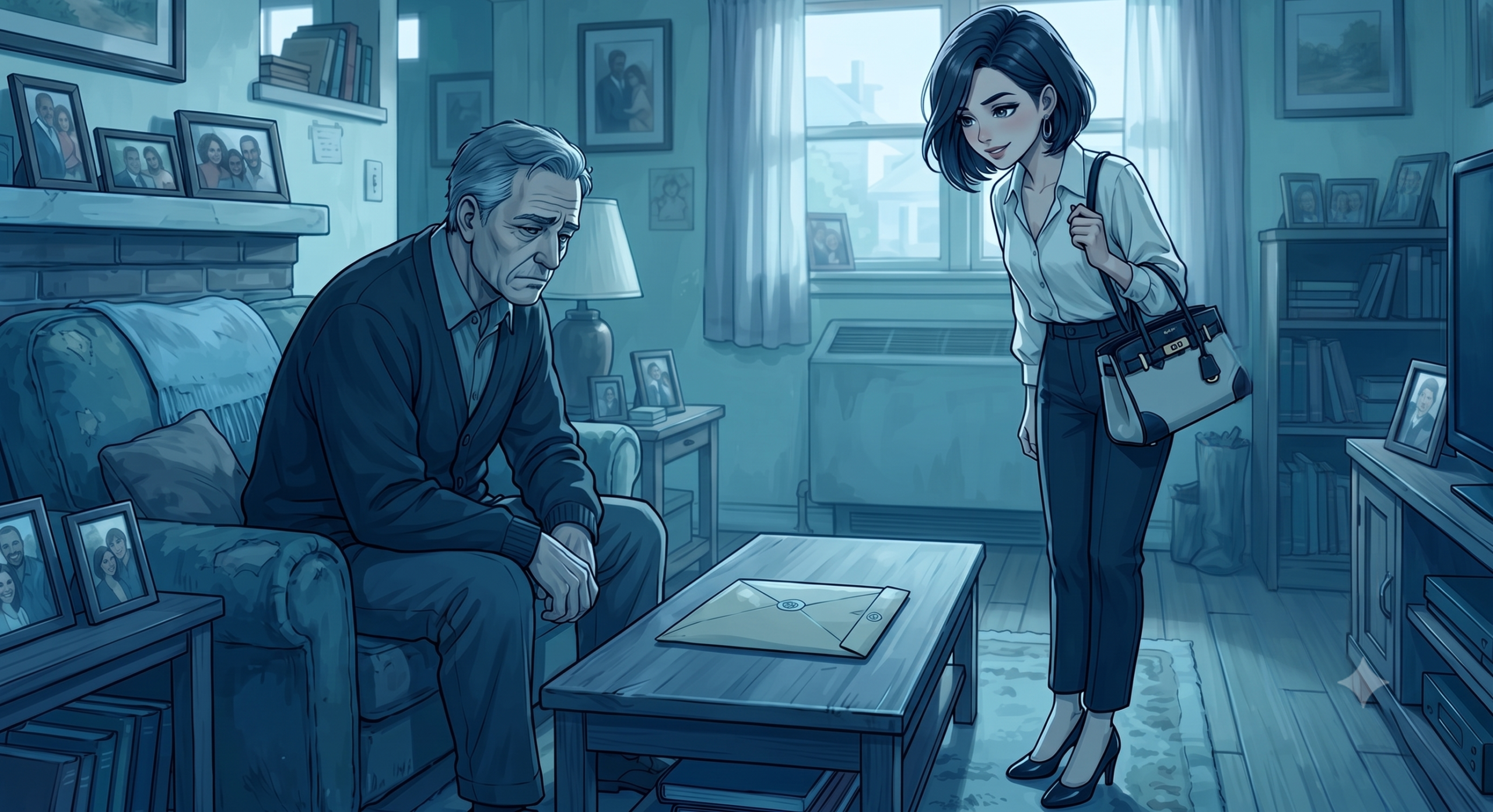
My fingers didn’t touch it yet.

“You’re early,” I said.

She blinked. “Early?”

“For people who couldn’t make a funeral.”

A flicker passed through her face—confusion first, then something more careful. She adjusted her grip on the handbag.

“We… we didn’t think it was necessary for both of us to cancel our travel,” she said. “Darnell was really close with his mother, you know that. He just handles grief differently.”

Handles grief differently.

I almost laughed. It came out as air instead.

Before I could answer, the front door opened again.

Footsteps.

Darnell walked in.

He looked exactly like I remembered and completely unfamiliar at the same time. Expensive jacket. Phone already in his hand. Eyes tired, but not from sorrow—from travel planning, from decisions that had nothing to do with death.

“Hey, Dad,” he said quickly, like he was checking in on a routine task. “We don’t have long. The Uber’s waiting.”

His gaze shifted to his wife, then to the folder.

“What’s that?”

I didn’t answer immediately. I just looked at him.

At my son.

The boy I once carried on my shoulders through Detroit summers, who used to fall asleep listening to Diane read recipes out loud as if they were bedtime stories.

Now he stood in my living room like a man measuring time in flight departures.

“That,” I said finally, “is from your mother.”

That stopped him for half a second.

Not grief.

Curiosity.

His wife stepped forward first. “Is it the will?”

I didn’t answer her either.

I picked up the folder.

The seal was already broken on one edge, like Harold had opened it once, checked it, then resealed it carefully.

Diane’s signature was on the bottom.

Firm. Certain. Undeniably hers.

“I didn’t know she had anything to leave,” Darnell said, trying to sound casual.

That was when something inside me shifted—not anger yet. Something colder.

“Your mother,” I said quietly, “did not spend fifty years of her life leaving behind nothing.”

I placed the folder back down.

Neither of them moved closer.

So I opened it.


Inside was not what they expected.

No simple will dividing furniture or bank accounts.

There were documents. Multiple pages. Stamped. Signed. Verified.

And then a letter.

Written in Diane’s handwriting.

My hands hesitated before unfolding it.

I read the first line silently.

Then the second.

And by the third, I felt the room change temperature.


Darnell shifted. “Dad… what does it say?”

I didn’t answer right away.

Because suddenly I understood the timing.

The attorney’s repeated calls.

The quiet weeks before her death.

The way Diane had insisted on handling “paperwork” alone.

She hadn’t been preparing to leave things behind.

She had been preparing for what came after she was gone.


I finally spoke.

“She didn’t just leave an inheritance,” I said.

I looked at my son.

“And she made decisions about who it belongs to.”

His wife laughed lightly, uncomfortable. “Well, of course it goes to her only child.”

I turned the letter slightly toward them.

Darnell leaned in.

His expression changed the moment his eyes moved across the page.

Confusion first.

Then disbelief.

Then something that looked like anger trying to disguise itself as shock.

“What… is this?” he whispered.

Because Diane hadn’t left everything to him.

Not even close.

And the part that changed everything… was still unread.

PART 4

Darnell took a step closer, as if distance would change what the paper said.

“That doesn’t make sense,” he said sharply. “Mom would never—just leave everything split up like this.”

His wife leaned over his shoulder, eyes scanning the page faster than he was willing to read it out loud. I watched her expression change first. Not confusion this time.

Concern.

Then calculation.

“What is she talking about?” she asked quietly.

I didn’t answer immediately. I let the silence stretch until it became uncomfortable enough to feel real.

Diane had always said silence tells the truth better than people do.

Finally, I spoke.

“She’s not talking,” I said. “Your mother is.”

Darnell scoffed. “Dad, she’s gone.”

I nodded once. “Yes.”

Then I tapped the letter.

“But she prepared for what would happen after.”

His eyes dropped back down.

This time he read slower.

And I watched it happen again—the shift.

The tightening in his jaw. The small flicker in his eyes when words stop being abstract and start becoming consequences.

His voice lowered. “This is impossible…”

His wife grabbed the paper from his hands.

“Wait—no, no, this can’t be right,” she said quickly, scanning it. “This says… this says the house—”

She stopped.

Because she had finally found the line that mattered.

The house was not left to Darnell.

Neither were the savings.

Neither were the accounts they clearly assumed were waiting for them like a closed suitcase.

Darnell’s voice sharpened. “Where did she put it then?”

I looked at him for a long moment.

“She didn’t put it anywhere,” I said.

His confusion deepened. “What does that even mean?”

I picked up the second document from the folder.

This one was heavier. More formal. Multiple signatures. Witness stamps. Attorney notes in the margins.

Diane had not simply divided her assets.

She had reorganized them.

And then she had moved something far more important than money.

“She transferred control,” I said quietly, “three weeks before she died.”

His wife frowned. “Control of what?”

I turned the page around.

And that’s when Darnell finally saw it.

Not just inheritance distribution.

Not just property.

But ownership.

Of everything.

The house. The accounts. The insurance policies.

And one final line at the bottom that made the room go completely still:

“Conditional inheritance pending acknowledgment of prior abandonment and legal forfeiture of filial responsibility.”

Darnell looked up at me.

His face had changed now.

The annoyance was gone.

The confidence was gone.

“What is this supposed to mean?” he asked again, but his voice wasn’t demanding anymore.

It was uncertain.

I felt something in my chest tighten—not satisfaction. Not revenge.

Something heavier.

Truth finally being spoken in a language people can’t interrupt.

“It means,” I said slowly, “your mother didn’t die without thinking about what she was leaving behind.”

I stepped closer to the table.

“And it means she remembered everything you forgot.”

The room went quiet.

Even the house outside seemed quieter, like it was listening now.

Darnell’s wife finally broke the silence.

“This isn’t legal,” she said quickly. “People can’t just—just write emotional conditions into estates like this.”

A small voice. Not confident anymore.

Behind her, Darnell was still staring at the page like it might change if he blinked.

That’s when I saw it.

The final document.

Smaller than the rest.

Folded separately.

No signature at the front.

Only Diane’s handwriting on the top line:

“If they come looking for what I left, give them this last page.”

My hand paused above it.

Darnell noticed immediately. “What is that?”

I didn’t answer.

Because I suddenly understood something I hadn’t understood at the funeral.

Diane hadn’t just prepared a will.

She had prepared a final message.

Not for lawyers.

Not for me.

For them.

And whatever was written on that page…

was not about money anymore.

Part2: My Son Skipped His Mother’s Funeral for a Trip to Europe—Then Her Will Changed Everything

PART 5

I unfolded the last page slowly.

The paper felt different from the others—softer at the edges, as if it had been handled more than once before it ever reached me.

Darnell took a half step forward. “Dad… just read it.”

His voice wasn’t demanding anymore. It was cautious. Like he was afraid of what silence might say first.

I lowered my eyes.

And I read.


“If you are reading this, then I am already gone.

I am not surprised you did not come.

I am not even angry anymore.

I stopped being angry the first time I sat alone at a hospital waiting room and realized I had raised a son who learned how to leave before he learned how to stay.”


The room went still.

Even Darnell’s wife stopped moving.

I continued.


“Raymond will not tell you this part. He never knows how to speak when it matters most.

So I will.”

“Everything I built was never meant to reward silence.”


My throat tightened slightly, but I kept reading.


“Darnell, you will think this is about money.

It is not.

It is about memory.

I remembered every time you said ‘I’m busy’ when I needed five minutes.

I remembered every birthday you missed but still posted about online.

I remembered how quickly you learned to turn love into inconvenience.”


A sound escaped Darnell—small, involuntary. Not words. Not denial. Something caught between breath and shock.

His wife reached for his arm.

He didn’t move.


“So I made my decision early.”

“The house is not yours because you stopped living in it long before I stopped breathing in it.”

“The accounts are not yours because you only return when there is something to take.”

“And the life insurance… is not yours because I did not want my death to fund your comfort.”


Silence.

Heavy. Absolute.

Even the clock on the wall sounded too loud.

I looked up briefly.

Darnell’s face had gone pale in a way I had never seen before.

Not grief.

Recognition.


I continued reading the final lines.


“Everything has been placed in a trust.”

“Not for punishment.”

“For observation.”

“If my son learns what it means to come back without being called, to give without being asked, and to stay without being rewarded—then what I have left will be released to him.”

“If not… then let it go where it belongs.”

“Where effort has always been present, even when love was not.”


I lowered the paper slowly.

The room didn’t move.

Darnell stared at me, then at the letter, then at nothing.

His voice finally broke the silence.

“Is this… real?”

I didn’t answer immediately.

Because that wasn’t the question.

The real question was different now.

And I think he knew it too.

His wife let out a small laugh—uncertain, nervous. “A trust that depends on behavior? That’s… that’s not how inheritance works.”

I looked at her.

“It is when someone spends fifty years watching how people behave.”

Darnell finally sat down.

Not dramatically.

Just… as if his legs had stopped agreeing with him.

“I didn’t think she would actually…” he started.

He stopped.

Couldn’t finish it.

Couldn’t say die, or notice, or care.

I folded the letter carefully and placed it back into the envelope.

“She did,” I said quietly.

The word landed heavier than anything else in the room.

Outside, a car door shut.

An Uber, maybe.

A reminder that life keeps moving even when people stop understanding it.

Darnell looked up at me, eyes red now, but not fully broken.

“What do I do now?” he asked.

It was the first honest question he had asked since the beginning of this entire story.

I held his gaze for a long moment.

And for the first time since Diane died, I didn’t feel alone in the house.

“You start,” I said slowly, “by deciding whether you came back too late… or just in time.”

And somewhere in that silence…

the real ending had not been written yet.

PART 6

Darnell didn’t speak for a while.

The house felt different now—not because anything had changed physically, but because something invisible had shifted inside it. Like the walls had finally stopped pretending nothing had ever happened.

His wife was the first to break.

“So what,” she said carefully, “we just… prove we’re good people now? And everything goes back to us?”

I looked at her.

“That’s not what it says.”

She frowned. “Then what is it supposed to mean?”

I glanced at the envelope in my hand.

“It means your mother didn’t want apologies written after she was gone,” I said. “She wanted behavior that existed while she was still alive.”

Darnell let out a short breath. “So what, I’m just disqualified? That’s it?”

His voice cracked slightly on the last word, like he hated that it did.

I didn’t rush my answer.

Because Diane hadn’t raised him to be punished. She had raised him to notice.

“She didn’t say you were disqualified,” I said finally. “She said you were… not proven.”

That word hung in the air longer than the others.

Not proven.

Not condemned. Not erased.

Just unearned.

Darnell stood up again, slower this time. He walked to the window, staring out at the quiet street like it might explain something better than I could.

“I didn’t hate her,” he said suddenly.

I believed him.

That was the problem.

“I just… didn’t have time,” he added.

I nodded once. “That’s what you told her.”

Silence again.

But this time it was different.

Less sharp. More honest.

His wife shifted uncomfortably. “This is insane,” she whispered, but without conviction now. “People don’t leave emotional conditions like this. This is… manipulation.”

I turned to her.

“No,” I said quietly. “It’s observation.”

Darnell looked back at me. “So what happens now?”

That question again.

But now it sounded heavier. Less like escape. More like responsibility.

I walked over to the table and placed the folder back where it had been.

“What happens now,” I said, “is what always should have happened.”

He waited.

I continued.

“You decide what kind of son you are without an audience.”

That seemed to land somewhere deep, because he didn’t answer immediately.

For the first time since he walked into the house, he wasn’t performing anything. No confidence. No impatience. No excuses ready on standby.

Just a man standing in a space that used to belong to his mother.

His phone buzzed.

He looked at it.

A notification. Flight reminder.

Europe.

His old life waiting for him like nothing had changed.

He stared at it for a long time… then turned the screen off.

His wife noticed. “Darnell?”

He didn’t answer her.

Instead, he sat down again slowly.

“I don’t know how to fix this,” he said.

And this time, I didn’t hear avoidance in it.

I heard something closer to truth.

“I know,” I said.

He looked at me. “Did she… did she ever think I would come back?”

I hesitated.

Then I told him the only honest thing left.

“Yes,” I said. “But not because she expected you to. Because she hoped you might still learn how.”

That was when the silence finally changed.

Not heavy anymore.

Not sharp.

Just open.

His wife looked between us, suddenly unsure of where she stood in a conversation she could no longer control.

Darnell reached into his pocket and pulled out his phone again.

This time, he didn’t check flights.

He looked at a photo.

I saw it from across the room.

Diane.

Smiling in an old kitchen.

Probably years ago.

Before silence got too comfortable.

He stared at it for a long time.

Then he spoke, quietly.

“I don’t want the house.”

I didn’t react.

He continued.

“I don’t want the money if it means this is what I become.”

His wife looked stunned. “Darnell—”

He raised a hand slightly. Not harsh. Just final.

“I can’t undo what I did,” he said. “But I also can’t keep pretending it didn’t matter.”

He looked at me.

“I think… she knew that too.”

I felt something inside me loosen, just slightly.

Not joy.

Not relief.

Something quieter.

Understanding.

The house creaked softly, like it was settling.

And for the first time since Diane’s funeral, it didn’t feel empty in a way that hurt.

It felt empty in a way that made room.

Darnell stood up.

He didn’t reach for the folder again.

Didn’t argue.

Didn’t ask for clarification.

Instead, he said something I never expected to hear from him.

“Dad… can I stay tonight?”

I looked at him for a long moment.

Not the version of him that left.

Not the version of him that came back too late.

But the version of him still deciding.

Then I nodded once.

“Yes,” I said. “You can.”

His wife hesitated in the doorway, watching him like she wasn’t sure where she fit anymore.

“Are you coming?” she asked.

Darnell didn’t answer immediately.

Then he said, “Not tonight.”

And she left.

Quietly.

No argument.

Just the sound of heels fading down a hallway that had heard too many endings.

When the door closed, the house changed again.

Not louder.

Not happier.

Just… real.

Darnell sat back down.

I sat across from him.

For a long time, neither of us spoke.

Then he finally said, almost in a whisper:

“Do you think she would forgive me?”

I looked at the empty space where Diane used to sit.

The chair near the window.

The one slightly pulled out, like she was always halfway between staying and leaving.

“I think,” I said slowly, “she already made room for that question.”

Outside, Detroit kept moving.

Cars. Lights. Distance.

But inside the house, for the first time in a long time…

nothing was being taken.

Only understood.

And that was how it ended.
THE END

More Details
Jul 9, 2026

Part1: My Son Skipped His Mother’s Funeral for a Trip to Europe—Then Her Will Changed Everything

My fingers didn’t touch it yet.

“You’re early,” I said.

She blinked. “Early?”

“For people who couldn’t make a funeral.”

A flicker passed through her face—confusion first, then something more careful. She adjusted her grip on the handbag.

“We… we didn’t think it was necessary for both of us to cancel our travel,” she said. “Darnell was really close with his mother, you know that. He just handles grief differently.”

Handles grief differently.

I almost laughed. It came out as air instead.

Before I could answer, the front door opened again.

Footsteps.

Darnell walked in.

He looked exactly like I remembered and completely unfamiliar at the same time. Expensive jacket. Phone already in his hand. Eyes tired, but not from sorrow—from travel planning, from decisions that had nothing to do with death.

“Hey, Dad,” he said quickly, like he was checking in on a routine task. “We don’t have long. The Uber’s waiting.”

His gaze shifted to his wife, then to the folder.

“What’s that?”

I didn’t answer immediately. I just looked at him.

At my son.

The boy I once carried on my shoulders through Detroit summers, who used to fall asleep listening to Diane read recipes out loud as if they were bedtime stories.

Now he stood in my living room like a man measuring time in flight departures.

“That,” I said finally, “is from your mother.”

That stopped him for half a second.

Not grief.

Curiosity.

His wife stepped forward first. “Is it the will?”

I didn’t answer her either.

I picked up the folder.

The seal was already broken on one edge, like Harold had opened it once, checked it, then resealed it carefully.

Diane’s signature was on the bottom.

Firm. Certain. Undeniably hers.

“I didn’t know she had anything to leave,” Darnell said, trying to sound casual.

That was when something inside me shifted—not anger yet. Something colder.

“Your mother,” I said quietly, “did not spend fifty years of her life leaving behind nothing.”

I placed the folder back down.

Neither of them moved closer.

So I opened it.


Inside was not what they expected.

No simple will dividing furniture or bank accounts.

There were documents. Multiple pages. Stamped. Signed. Verified.

And then a letter.

Written in Diane’s handwriting.

My hands hesitated before unfolding it.

I read the first line silently.

Then the second.

And by the third, I felt the room change temperature.


Darnell shifted. “Dad… what does it say?”

I didn’t answer right away.

Because suddenly I understood the timing.

The attorney’s repeated calls.

The quiet weeks before her death.

The way Diane had insisted on handling “paperwork” alone.

She hadn’t been preparing to leave things behind.

She had been preparing for what came after she was gone.


I finally spoke.

“She didn’t just leave an inheritance,” I said.

I looked at my son.

“And she made decisions about who it belongs to.”

His wife laughed lightly, uncomfortable. “Well, of course it goes to her only child.”

I turned the letter slightly toward them.

Darnell leaned in.

His expression changed the moment his eyes moved across the page.

Confusion first.

Then disbelief.

Then something that looked like anger trying to disguise itself as shock.

“What… is this?” he whispered.

Because Diane hadn’t left everything to him.

Not even close.

And the part that changed everything… was still unread.

PART 4

Darnell took a step closer, as if distance would change what the paper said.

“That doesn’t make sense,” he said sharply. “Mom would never—just leave everything split up like this.”

His wife leaned over his shoulder, eyes scanning the page faster than he was willing to read it out loud. I watched her expression change first. Not confusion this time.

Concern.

Then calculation.

“What is she talking about?” she asked quietly.

I didn’t answer immediately. I let the silence stretch until it became uncomfortable enough to feel real.

Diane had always said silence tells the truth better than people do.

Finally, I spoke.

“She’s not talking,” I said. “Your mother is.”

Darnell scoffed. “Dad, she’s gone.”

I nodded once. “Yes.”

Then I tapped the letter.

“But she prepared for what would happen after.”

His eyes dropped back down.

This time he read slower.

And I watched it happen again—the shift.

The tightening in his jaw. The small flicker in his eyes when words stop being abstract and start becoming consequences.

His voice lowered. “This is impossible…”

His wife grabbed the paper from his hands.

“Wait—no, no, this can’t be right,” she said quickly, scanning it. “This says… this says the house—”

She stopped.

Because she had finally found the line that mattered.

The house was not left to Darnell.

Neither were the savings.

Neither were the accounts they clearly assumed were waiting for them like a closed suitcase.

Darnell’s voice sharpened. “Where did she put it then?”

I looked at him for a long moment.

“She didn’t put it anywhere,” I said.

His confusion deepened. “What does that even mean?”

I picked up the second document from the folder.

This one was heavier. More formal. Multiple signatures. Witness stamps. Attorney notes in the margins.

Diane had not simply divided her assets.

She had reorganized them.

And then she had moved something far more important than money.

“She transferred control,” I said quietly, “three weeks before she died.”

His wife frowned. “Control of what?”

I turned the page around.

And that’s when Darnell finally saw it.

Not just inheritance distribution.

Not just property.

But ownership.

Of everything.

The house. The accounts. The insurance policies.

And one final line at the bottom that made the room go completely still:

“Conditional inheritance pending acknowledgment of prior abandonment and legal forfeiture of filial responsibility.”

Darnell looked up at me.

His face had changed now.

The annoyance was gone.

The confidence was gone.

“What is this supposed to mean?” he asked again, but his voice wasn’t demanding anymore.

It was uncertain.

I felt something in my chest tighten—not satisfaction. Not revenge.

Something heavier.

Truth finally being spoken in a language people can’t interrupt.

“It means,” I said slowly, “your mother didn’t die without thinking about what she was leaving behind.”

I stepped closer to the table.

“And it means she remembered everything you forgot.”

The room went quiet.

Even the house outside seemed quieter, like it was listening now.

Darnell’s wife finally broke the silence.

“This isn’t legal,” she said quickly. “People can’t just—just write emotional conditions into estates like this.”

A small voice. Not confident anymore.

Behind her, Darnell was still staring at the page like it might change if he blinked.

That’s when I saw it.

The final document.

Smaller than the rest.

Folded separately.

No signature at the front.

Only Diane’s handwriting on the top line:

“If they come looking for what I left, give them this last page.”

My hand paused above it.

Darnell noticed immediately. “What is that?”

I didn’t answer.

Because I suddenly understood something I hadn’t understood at the funeral.

Diane hadn’t just prepared a will.

She had prepared a final message.

Not for lawyers.

Not for me.

For them.

And whatever was written on that page…

was not about money anymore.

Part2: My Son Skipped His Mother’s Funeral for a Trip to Europe—Then Her Will Changed Everything

PART 5

I unfolded the last page slowly.

The paper felt different from the others—softer at the edges, as if it had been handled more than once before it ever reached me.

Darnell took a half step forward. “Dad… just read it.”

His voice wasn’t demanding anymore. It was cautious. Like he was afraid of what silence might say first.

I lowered my eyes.

And I read.


“If you are reading this, then I am already gone.

I am not surprised you did not come.

I am not even angry anymore.

I stopped being angry the first time I sat alone at a hospital waiting room and realized I had raised a son who learned how to leave before he learned how to stay.”


The room went still.

Even Darnell’s wife stopped moving.

I continued.


“Raymond will not tell you this part. He never knows how to speak when it matters most.

So I will.”

“Everything I built was never meant to reward silence.”


My throat tightened slightly, but I kept reading.


“Darnell, you will think this is about money.

It is not.

It is about memory.

I remembered every time you said ‘I’m busy’ when I needed five minutes.

I remembered every birthday you missed but still posted about online.

I remembered how quickly you learned to turn love into inconvenience.”


A sound escaped Darnell—small, involuntary. Not words. Not denial. Something caught between breath and shock.

His wife reached for his arm.

He didn’t move.


“So I made my decision early.”

“The house is not yours because you stopped living in it long before I stopped breathing in it.”

“The accounts are not yours because you only return when there is something to take.”

“And the life insurance… is not yours because I did not want my death to fund your comfort.”


Silence.

Heavy. Absolute.

Even the clock on the wall sounded too loud.

I looked up briefly.

Darnell’s face had gone pale in a way I had never seen before.

Not grief.

Recognition.


I continued reading the final lines.


“Everything has been placed in a trust.”

“Not for punishment.”

“For observation.”

“If my son learns what it means to come back without being called, to give without being asked, and to stay without being rewarded—then what I have left will be released to him.”

“If not… then let it go where it belongs.”

“Where effort has always been present, even when love was not.”


I lowered the paper slowly.

The room didn’t move.

Darnell stared at me, then at the letter, then at nothing.

His voice finally broke the silence.

“Is this… real?”

I didn’t answer immediately.

Because that wasn’t the question.

The real question was different now.

And I think he knew it too.

His wife let out a small laugh—uncertain, nervous. “A trust that depends on behavior? That’s… that’s not how inheritance works.”

I looked at her.

“It is when someone spends fifty years watching how people behave.”

Darnell finally sat down.

Not dramatically.

Just… as if his legs had stopped agreeing with him.

“I didn’t think she would actually…” he started.

He stopped.

Couldn’t finish it.

Couldn’t say die, or notice, or care.

I folded the letter carefully and placed it back into the envelope.

“She did,” I said quietly.

The word landed heavier than anything else in the room.

Outside, a car door shut.

An Uber, maybe.

A reminder that life keeps moving even when people stop understanding it.

Darnell looked up at me, eyes red now, but not fully broken.

“What do I do now?” he asked.

It was the first honest question he had asked since the beginning of this entire story.

I held his gaze for a long moment.

And for the first time since Diane died, I didn’t feel alone in the house.

“You start,” I said slowly, “by deciding whether you came back too late… or just in time.”

And somewhere in that silence…

the real ending had not been written yet.

PART 6

Darnell didn’t speak for a while.

The house felt different now—not because anything had changed physically, but because something invisible had shifted inside it. Like the walls had finally stopped pretending nothing had ever happened.

His wife was the first to break.

“So what,” she said carefully, “we just… prove we’re good people now? And everything goes back to us?”

I looked at her.

“That’s not what it says.”

She frowned. “Then what is it supposed to mean?”

I glanced at the envelope in my hand.

“It means your mother didn’t want apologies written after she was gone,” I said. “She wanted behavior that existed while she was still alive.”

Darnell let out a short breath. “So what, I’m just disqualified? That’s it?”

His voice cracked slightly on the last word, like he hated that it did.

I didn’t rush my answer.

Because Diane hadn’t raised him to be punished. She had raised him to notice.

“She didn’t say you were disqualified,” I said finally. “She said you were… not proven.”

That word hung in the air longer than the others.

Not proven.

Not condemned. Not erased.

Just unearned.

Darnell stood up again, slower this time. He walked to the window, staring out at the quiet street like it might explain something better than I could.

“I didn’t hate her,” he said suddenly.

I believed him.

That was the problem.

“I just… didn’t have time,” he added.

I nodded once. “That’s what you told her.”

Silence again.

But this time it was different.

Less sharp. More honest.

His wife shifted uncomfortably. “This is insane,” she whispered, but without conviction now. “People don’t leave emotional conditions like this. This is… manipulation.”

I turned to her.

“No,” I said quietly. “It’s observation.”

Darnell looked back at me. “So what happens now?”

That question again.

But now it sounded heavier. Less like escape. More like responsibility.

I walked over to the table and placed the folder back where it had been.

“What happens now,” I said, “is what always should have happened.”

He waited.

I continued.

“You decide what kind of son you are without an audience.”

That seemed to land somewhere deep, because he didn’t answer immediately.

For the first time since he walked into the house, he wasn’t performing anything. No confidence. No impatience. No excuses ready on standby.

Just a man standing in a space that used to belong to his mother.

His phone buzzed.

He looked at it.

A notification. Flight reminder.

Europe.

His old life waiting for him like nothing had changed.

He stared at it for a long time… then turned the screen off.

His wife noticed. “Darnell?”

He didn’t answer her.

Instead, he sat down again slowly.

“I don’t know how to fix this,” he said.

And this time, I didn’t hear avoidance in it.

I heard something closer to truth.

“I know,” I said.

He looked at me. “Did she… did she ever think I would come back?”

I hesitated.

Then I told him the only honest thing left.

“Yes,” I said. “But not because she expected you to. Because she hoped you might still learn how.”

That was when the silence finally changed.

Not heavy anymore.

Not sharp.

Just open.

His wife looked between us, suddenly unsure of where she stood in a conversation she could no longer control.

Darnell reached into his pocket and pulled out his phone again.

This time, he didn’t check flights.

He looked at a photo.

I saw it from across the room.

Diane.

Smiling in an old kitchen.

Probably years ago.

Before silence got too comfortable.

He stared at it for a long time.

Then he spoke, quietly.

“I don’t want the house.”

I didn’t react.

He continued.

“I don’t want the money if it means this is what I become.”

His wife looked stunned. “Darnell—”

He raised a hand slightly. Not harsh. Just final.

“I can’t undo what I did,” he said. “But I also can’t keep pretending it didn’t matter.”

He looked at me.

“I think… she knew that too.”

I felt something inside me loosen, just slightly.

Not joy.

Not relief.

Something quieter.

Understanding.

The house creaked softly, like it was settling.

And for the first time since Diane’s funeral, it didn’t feel empty in a way that hurt.

It felt empty in a way that made room.

Darnell stood up.

He didn’t reach for the folder again.

Didn’t argue.

Didn’t ask for clarification.

Instead, he said something I never expected to hear from him.

“Dad… can I stay tonight?”

I looked at him for a long moment.

Not the version of him that left.

Not the version of him that came back too late.

But the version of him still deciding.

Then I nodded once.

“Yes,” I said. “You can.”

His wife hesitated in the doorway, watching him like she wasn’t sure where she fit anymore.

“Are you coming?” she asked.

Darnell didn’t answer immediately.

Then he said, “Not tonight.”

And she left.

Quietly.

No argument.

Just the sound of heels fading down a hallway that had heard too many endings.

When the door closed, the house changed again.

Not louder.

Not happier.

Just… real.

Darnell sat back down.

I sat across from him.

For a long time, neither of us spoke.

Then he finally said, almost in a whisper:

“Do you think she would forgive me?”

I looked at the empty space where Diane used to sit.

The chair near the window.

The one slightly pulled out, like she was always halfway between staying and leaving.

“I think,” I said slowly, “she already made room for that question.”

Outside, Detroit kept moving.

Cars. Lights. Distance.

But inside the house, for the first time in a long time…

nothing was being taken.

Only understood.

And that was how it ended.

THE END

More Details
My in-laws thought I was only a broke widow when they locked me and my children out of our house just after my husband’s funeral. Then my father-in-law s:truck my teenage son, my mother-in-law slipped my wedding ring off my hand, and I finally opened the folder Jasper had left behind for me.
Jul 9, 2026

My in-laws thought I was only a broke widow when they locked me and my children out of our house just after my husband’s funeral. Then my father-in-law s:truck my teenage son, my mother-in-law slipped my wedding ring off my hand, and I finally opened the folder Jasper had left behind for me.

Chapter One: The Unwelcome Gatekeepers
My husband, Jasper Thorne, rested in his final place that morning while I stood in a haze, encased in a black suit I had agonized over selecting through a blur of tears. By late afternoon, I found myself standing on the damp pavement outside our modest home in a quiet corner of rural Vermont, accompanied by my two children, fifteen-year-old Toby and eight-year-old Rose.

To my horror, the front door remained locked, and my father-in-law, Frederick, stood firm, gripping the brass handle as if he held the deed to my very soul. Beside him hovered my mother-in-law, Avery, her dark coat buttoned to the chin, her expression as cold and dry as a winter morning in the mountains.

“This house is the rightful property of the Beaumont legacy,” Frederick declared, his voice echoing with a sharp, metallic finality that sent a shiver down my spine. “You and those children need to pack up your essentials and go stay with your sister until we have had the time to sort through everything.”

I stared at him, my mind far too exhausted to process the sheer audacity and cruelty dripping from his words, especially on this of all days.

“This is our home, Frederick,” I whispered, my voice cracking under the weight of the grief I had been holding back since the church service concluded.

Avery cast a disparaging glance at my simple, store-bought black dress and then let her eyes linger on the worn-out soles of young Rose’s shoes.

“Jasper supported you for many years, Hazel,” she sighed, checking her watch as if she had a dinner reservation to attend. “He is gone now, and we are certainly not going to take on the burden of continuing that responsibility.”

Toby, my teenage son, stepped forward, his small frame shaking with a mixture of terror and white-hot indignation.

“You have no right to talk to my mother like that, so stop it right now!”

Frederick turned his gaze toward my son, his face hardening into a mask of pure, unadulterated disdain.

“You need to watch your tone when you speak to your elders, boy, because you are currently standing on ground that no longer belongs to you.”

I felt the fire of a thousand suns burning in my chest as I stepped between them, my voice surprisingly steady despite my shaking hands.

“He just buried his father today, Frederick, so please, have some shred of human decency.”

Before the sentence had fully escaped my lips, Frederick swung his arm with sudden, violent force, his hand connecting with Toby’s cheek. The sound of the slap was sharp, and the impact sent my son reeling backward until he hit the porch railing with a dull, sickening thud.

Rose let out a sharp, piercing scream, diving into the folds of my coat as if she could hide from the world entirely.

In that exact moment, something within my spirit went deathly quiet, a freezing stillness that felt like the deepest part of an ocean.

I reached out to scoop Toby up, but Avery, moving with surprising speed, grabbed my left hand and yanked the gold band from my finger. The diamond edge scraped against my skin, drawing a tiny bead of blood, but I barely felt the sting compared to the insult of her touch.

“This heirloom belonged to my own mother,” she stated with a icy, detached precision, tucking the ring into her pocket. “It was never yours, and it was certainly never intended for someone like you.”

For twelve long years, I had worn that ring with pride, standing by their son through endless nights of overtime, mounting medical debt, and the persistent, gnawing fear that his illness would eventually claim him. We had shared Sunday dinners, laughed at the table, and they had called me a daughter, yet here they stood, looking at me as if I were a discarded piece of trash.

Without uttering another word, I quickly checked Toby’s red, swollen cheek, took Rose’s trembling hand, and walked back to our rusted sedan.

Deep inside the glove compartment, hidden beneath a stack of expired insurance papers, was a heavy, brown envelope that Jasper had tucked into my hands just weeks before he drew his final breath. He had made me swear on our life together that I would never open it unless I was faced with an impossible situation.

With hands that felt like they belonged to a stranger, I tore the seal and pulled out a stack of crisp, white papers.

The first page was a letter written in Jasper’s unmistakable, looping handwriting, and as I read it, the rain outside began to fall in heavy, rhythmic sheets.

My dearest Hazel, if my parents ever attempt to turn against you or try to seize what is rightfully yours, please do not bother arguing with them for even a second. Call Attorney Miles Abernathy immediately, as the house belongs to you, the cabin by the lake belongs to you, and my business shares are held in a secure trust for you and our children. Mom and Dad know absolutely nothing about the legal protections I have put in place, so do not let them intimidate you.

I looked through the weeping windshield at Frederick and Avery, who were still standing on my porch, looking smug and victorious.

Then, I pulled out my phone and dialed the number at the bottom of the letter.

Miles Abernathy answered on the third ring, his voice calm and professional, as though he had been sitting by his desk waiting for this exact phone call.

Once I had explained the scene playing out on my front lawn, his warm, polite tone shifted into something sharp, cold, and ready for battle.

“Hazel, stay in the vehicle with the children and do not under any circumstances step back onto that porch, as I am calling the local authorities and bringing certified copies of every single document right now.”

Frederick caught me talking into the phone through the rain and let out a low, condescending laugh.

“Calling your sister isn’t going to help you, so you might as well start the engine and drive away while you still have a shred of dignity left.”

I rolled the window down just enough to let my voice carry over the wind.

“I am currently on the phone with Jasper’s personal attorney.”

The smile vanished from Frederick’s face instantly, his confidence shattering like glass on a tile floor.

Avery tightened her hand over the pocket where she had hidden my wedding ring, and for the first time since the funeral began, a flicker of genuine fear crossed her pale, wrinkled features.

Chapter Two: The Tables Turned

Twenty minutes passed in agonizing silence, but then the bright, flashing lights of a patrol car sliced through the gloom, followed closely by a sleek, silver sedan pulling up behind us.

Miles Abernathy stepped out, clad in a charcoal overcoat, clutching a leather briefcase with an expression of such professional intensity that Frederick instinctively retreated two steps.

He ignored the older couple entirely, walking straight to my car to inspect Toby’s face and offer a nod of quiet comfort to Rose in the backseat.

“You did exactly what Jasper hoped you would do, and you have shown remarkable strength today,” he said, his voice low and reassuring.

Then, he turned to face Frederick and Avery, his posture radiating a calm authority that silenced the entire street.

“You are currently trespassing on private property that is legally owned by Hazel Beaumont, and I suggest you step off the porch immediately.”

Frederick let out a nervous, loud, and slightly hysterical laugh that didn’t reach his eyes.

“That is the most ridiculous thing I have ever heard, as my son bought this house long before he even met this woman.”

Miles opened his briefcase with a deliberate, slow motion, pulling out a thick folder filled with notarized documents.

“Following his diagnosis, Jasper transferred the deed and the property into an irrevocable marital trust, making Hazel the primary beneficiary and the sole trustee. Six months ago, you were both formally invited to attend the estate signing, yet you declined the invitation.”

Avery whispered, her voice barely audible over the sound of the rain, “Jasper would never leave us out of his life or his legacy.”

Miles never looked away, his gaze piercing and unyielding.

“He did not leave you out, as he bequeathed you the condo in Florida and arranged a generous annual allowance from a completely separate account. What he did not provide, however, was permission to force his grieving widow and children out of their sanctuary on the very day of his funeral.”

The police officer approached us, looking directly at Toby with a concerned expression.

“I need to ask, did this man strike you in the face?”

Toby looked at me for permission, and when I nodded, he gave a small, defeated affirmative.

Frederick raised both of his hands in the air, his face turning a deep, blotchy shade of red.

“I was merely disciplining a child who was being insolent and disrespectful!”

“He is a minor, and the law does not permit you to strike a child, especially not on property you do not own,” the officer replied, his hand resting near his belt.

Avery tried to sneakily move my wedding ring out of her pocket and into her bag, but Miles had eyes like a hawk.

“That ring is specifically listed in Jasper’s personal property instructions as Hazel’s separate, private possession,” Miles noted sharply.

“It belonged to my family long before she arrived!” Avery snapped, her composure completely disintegrating.

“It belonged to Jasper, and Jasper chose to give it to his wife,” Miles answered, his voice devoid of any room for argument.

The officer extended his hand, palm up, and Avery, pale and trembling with rage, dropped the ring into his palm.

When the officer handed it back to me, I held it tightly in my fist, feeling the weight of the metal, but I did not put it back on my finger just yet.

I watched as Frederick and Avery finally came to the realization that the woman they viewed as a weak, easily manipulated widow had been protected by the son they thought they controlled all along.

By the time the sun began to set, they were standing in the driveway next to two heavy, overstuffed suitcases that Miles had allowed them to collect under the watchful eyes of the police.

Our neighbors watched the entire scene from behind their curtains, but I didn’t care about the gossip or the shame of it all.

Frederick pointed a shaking finger at me as he prepared to leave.

“You are the one who turned our own son against us, aren’t you?”

I almost smiled, a bitter, sad sound that felt like the closing of a long, painful chapter.

“No, Jasper protected me because he understood exactly who you were, perhaps even better than I ever did.”

Avery’s voice trembled as she looked at the house one last time.

“We have truly lost our son now.”

“So have my children,” I replied, my voice steady and cold. “And before the flowers on his grave had even wilted, you tried to make them homeless in the middle of a storm.”

She had absolutely no response to that, only a hollow look of realization that hit her too late.

Miles stayed with us until every lock in the house had been replaced and the security system was updated to recognize only our fingerprints.

Together, we meticulously searched the house, going through every drawer, cabinet, and finally the hidden safe that Jasper had concealed behind a wall of old tax boxes in his office.

Inside the safe, we found insurance documents, bank records, birth certificates, passwords for everything we owned, and another sealed letter addressed directly to Toby and Rose.

I decided to leave it unopened for now, knowing that some words are meant to be heard by my children only when they are ready to process them.

The following morning, Miles sat me down in his office to explain the full extent of the planning Jasper had done.

Jasper had known for months that his parents were pressuring him to transfer his assets back into the family holding company during his illness.

Long before the treatments began to weaken him, he quietly placed the house, his ownership in the manufacturing company, and the vacation cabin into protected trusts.

“He wanted to leave you more than just a house or money,” Miles said softly, his eyes reflecting a deep respect for his former client. “He wanted to leave you with the absolute freedom to live without ever needing to answer to them again.”

For the first time since the funeral, I allowed myself to cry openly, letting the tears wash away the fear that had been gripping me for so long.

Three weeks later, Frederick filed a challenge to the trust in court, claiming that Jasper had been suffering from diminished mental capacity when he signed the documents.

Miles presented medical evaluations from three different specialists, high-definition video recordings of the signing process, and sworn testimony from the bank employees who had witnessed the event.

The judge dismissed the case in less than an hour, chiding the defense for wasting the court’s time with such baseless accusations.

Avery never once offered an apology, choosing instead to mail back a box of family photographs with my name intentionally misspelled on the label, as if acknowledging my true identity would somehow validate my existence.

Toby’s bruise healed within a few days, but the deep-seated anger he felt toward his grandparents took much longer to dissipate.

Rose spent months sleeping with one of Jasper’s old, oversized sweatshirts, clutching it for comfort as if it still held the scent of his cologne.

I learned that the process of grief never follows a straight line, and there is no right way to say goodbye to the love of your life.

Some mornings, the weight of it looks like nothing more than stacks of coffee and endless legal paperwork.

Some nights, it looks like a child crying quietly against your shoulder while the world continues to spin outside your window.

But one thing remained constant and unshakeable, and that was the fact that we were still standing in the home he gave us.

That spring, I took Toby and Rose to the cabin by the lake that Jasper had left for us in the hills of northern Maine.

We threw open every window to let in the scent of the pine trees, swept the porch of the winter debris, and planted bright, vibrant yellow flowers along the steps.

Only then, with the sun warming my back and the sound of the lake lapping at the shore, did I finally slide my wedding ring back onto my finger.

I didn’t do it because it proved I belonged to the Beaumont family, because that was a name I no longer cared to carry.

I did it because Jasper had chosen me, he had protected me, and he had left behind a legacy of truth when everyone else fully expected me to fall apart.

And I never did.

THE END.

More Details
After our car accident, I was still trapped inside when my dad shouted at the paramedics to save my sister first. Then he pointed at me and said, “The other one never meant much anyway. Don’t waste time on her.”
Jul 9, 2026

After our car accident, I was still trapped inside when my dad shouted at the paramedics to save my sister first. Then he pointed at me and said, “The other one never meant much anyway. Don’t waste time on her.”

After our car crash, I was still stuck inside when my father yelled at the paramedics to save my sister first. Then he pointed toward me and said, “The other one never meant much anyway. Don’t waste time on her.” I was still awake, and I heard every single word. After our car accident, my father told the paramedics, “Save my daughter first — the other one never meant much anyway. Don’t waste time on her!” I heard every word. I was trapped on the passenger side of my father’s black Lincoln, my left leg crushed beneath the bent door while firefighters tried to cut their way to me. Smoke drifted through the night as red and blue emergency lights flashed across Riverside Drive, turning everything into a blur of color and sirens. My younger sister, Olivia, sat a few feet away wrapped in a silver emergency blanket, crying out for Dad. She had a cut across her forehead and a broken wrist. I could see her moving. I could hear her sob. I could not feel my feet.

May be an image of text

“Sir, step back,” one paramedic snapped. “My Olivia first!” Dad shouted. His voice cracked, but not because he was worried about me. “She’s all I have. Grace is—” He stopped, then said it anyway. “Grace is not important.” The firefighter nearest me paused briefly. His eyes met mine through the smoke. I wanted to tell him that I mattered. I wanted to tell my father that I had packed Olivia’s lunch every school morning since Mom died, that I had worked double shifts at the diner to help cover the bills he forgot, that I had given up Boston University for community college because he said the family needed me. But I could barely speak. Everything had changed only minutes before. Dad had picked us up from Aunt Meredith’s house. Olivia wanted to stop for coffee. Dad said no. I noticed a strange smell in the car, but when I mentioned it, Dad told me to stop being dramatic.

Moments later, the engine sputtered.

Then everything went black.

A paramedic knelt beside me.

“Grace, can you hear me?”

I blinked once.

“We’re getting you out.”

Behind him, Dad held Olivia’s hand and kissed her knuckles.

“You’re safe, sweetheart. I’m here.”

Olivia looked past him at me.

For one brief second, her face changed.

Not fear.

Not sadness.

Guilt.

That was when I remembered what she had whispered before Dad started the car.

“Grace, don’t be mad. I only told him because I thought he already knew.”

Told him what?

The answer slowly returned.

The bank envelope in my backpack.

The acceptance letter.

The apartment deposit.

My plan to leave both of them.

The firefighters finally pulled me out.

Dad never even looked toward me.

That night, I stopped being his unwanted daughter.

I became his witness.

Part 2

I woke up three days later at St. Vincent Medical Center with tubes in my arms, stitches across my ribs, and a police officer sitting outside my hospital room.

At first, I thought he was there because of the crash.

Then Aunt Meredith leaned over my bed and whispered, “Grace, honey, don’t talk to your father alone.”

Her face was pale. She looked older than she had on Sunday. Her silver hair was tied back messily, and she held my hand as if she feared I might vanish if she let go.

“What happened?” I asked. My voice sounded rough and dry.

“You were badly hurt,” she said.

“I know that.”

Her eyes shifted toward the door. “The police found something.”

Before she could explain, Dad walked in carrying flowers from the hospital gift shop. Cheap daisies. The kind he used to buy Mom when he had forgotten an anniversary.

“Gracie,” he said softly.

I stared at him.

He tried to smile, but it trembled. “You scared us.”

Us.

The word almost made me laugh.

Aunt Meredith stood. “Daniel, the doctor said she needs rest.”

“I’m her father.”

“And I’m the person she asked for when she woke up.”

Dad’s face tightened. For one second, the mask slipped, just long enough for me to see the same coldness I had heard on the road.

Then he became gentle again.

“Grace,” he said, stepping closer, “you may have heard things that night that sounded wrong. I was panicking. Olivia was bleeding. I didn’t know what I was saying.”

I remembered every syllable.

“The other one never meant much anyway.”

My fingers curled against the blanket.

“I heard you,” I said.

His eyes sharpened.

Aunt Meredith moved beside my bed.

Dad lowered his voice. “You were confused. You had a concussion.”

“No,” I said. “I was awake.”

He glanced at the officer outside the door, then back at me. “This is family business.”

That was when Detective Maria Keller entered.

She was in her forties, composed, with dark hair pulled into a low bun and a notebook in her hand. She did not introduce herself like someone asking permission. She introduced herself like someone gathering facts.

“Grace Holloway,” she said, “I’m Detective Keller. When you feel ready, I need to ask you about the vehicle.”

Dad gave a short laugh. “My daughter just woke up.”

Detective Keller did not look at him. “Mr. Holloway, you can wait outside.”

“I’m not leaving.”

“Yes,” she said. “You are.”

The officer appeared in the doorway.

Dad’s mouth tightened again, but he left.

Detective Keller closed the door.

Then she said, “The explosion was not an accident.”

My heart monitor started beeping faster.

She opened her notebook. “Someone tampered with the fuel line. There was also evidence of an accelerant under the driver’s side. But here’s what doesn’t make sense. Your father had the car serviced two days earlier, and the mechanic says he warned him not to drive it until a full inspection was completed.”

Aunt Meredith covered her mouth.

I stared up at the ceiling.

Dad had known something was wrong.

Detective Keller continued. “Your sister says she doesn’t remember anything before the explosion.”

“She remembers,” I whispered.

Both women looked at me.

“She told him something,” I said. “Before we got in the car. She said, ‘Don’t be mad. I only told him because I thought he already knew.’”

“What did she mean?” Keller asked.

“My bank account. My apartment deposit. My college transfer.”

Aunt Meredith closed her eyes.

I swallowed through the pain. “I was leaving.”

Detective Keller’s expression changed, not dramatically, but enough.

“Grace,” she asked, “did your father benefit from you staying?”

I thought about the bills in my name. The diner paychecks he borrowed and never paid back. The life insurance policy Mom had left, controlled by Dad until I turned twenty-one in six months.

Then I thought about the explosion.

“Yes,” I said. “He did.”

PART 3

Detective Keller did not reveal everything to me that day. She only asked enough questions to know where she needed to look next.

Over the next week, while doctors changed my bandages and physical therapists taught me how to stand without collapsing, the truth arrived in fragments.

First came the mechanic.

His name was Peter Walsh, owner of Walsh Auto Repair in Newark, New Jersey. He told police that Dad had brought in the Lincoln after complaining about “a strange smell” and “rough starting.” Peter found a cracked fuel line and warned him the car was unsafe.

“I told Daniel not to drive it,” Peter said in his recorded statement. “I even wrote it on the invoice. Vehicle unsafe. Tow recommended.”

Dad had signed the invoice.

Then he drove the car anyway.

Second came the insurance.

Mom had left behind a structured settlement from a workplace accident years before. I had not known the details because Dad always said, “Your mother trusted me to handle it.”

That was a lie.

Mom had placed half of the remaining money into a protected account for me. It would be released when I turned twenty-one. Until then, Dad could request funds only for my education, medical care, or housing.

According to the records Detective Keller uncovered, he had tried three times in the past year to access the money.

All three requests had been rejected.

Third came Olivia.

At first, she avoided my room. Aunt Meredith said she was “traumatized,” but I knew my sister better than that. Olivia had never handled consequences well. She was sixteen, pretty, anxious, and used to being rescued from every mistake by our father’s gentle voice and my tired hands.

When she finally came to see me, she stood in the doorway with her wrist in a cast and her hair perfectly braided.

“Grace,” she said.

I did not respond.

She looked at the machines, the bruises on my arms, the brace around my leg. Tears filled her eyes.

“I didn’t know this would happen.”

That was the first honest thing she said.

Aunt Meredith stood from the chair beside me. “I’ll get coffee.”

After she left, Olivia came closer, but not too close.

“What did you tell him?” I asked.

Her lower lip trembled. “He found your Boston University folder.”

“No. You told him something before we got in the car.”

She looked down.

“What did you tell him, Olivia?”

Her voice became small. “That you had an apartment.”

My chest tightened, but I waited.

“And?” I asked.

“And that you were moving the week after graduation.”

I closed my eyes.

Dad had not exploded because I was leaving emotionally. He had exploded because I was leaving financially.

The bills. The settlement. The control. The free childcare. The daughter he did not love but still needed.

“He got quiet,” Olivia whispered. “Not angry at first. Just quiet. Then he asked where the paperwork was. I told him your backpack. I thought he was going to yell at you. That’s all.”

“You thought he was going to stop me.”

She nodded, crying now.

“You wanted him to stop me.”

She did not deny it.

The silence between us felt older than either of us.

I had raised Olivia after Mom died. I had taught her how to curl her hair, helped her study biology, driven her to sleepovers, protected her from Dad’s drinking, and made excuses when he forgot her birthdays. But love without boundaries had turned into something else. She had learned that my life was a resource.

Not a life.

“Grace,” she said, “I’m sorry.”

I looked at her bandaged wrist.

“Did you hear what he said after the explosion?”

Her crying stopped.

Then I knew she had.

She stared at the floor.

“He said to save you first,” I said. “And not to waste time on me.”

“He was scared.”

“No,” I said. “He was honest.”

Olivia wiped her face with her sleeve like a child.

I wanted to hate her. Part of me did. But another part of me saw exactly what Dad had created: one daughter trained to sacrifice, the other trained to receive. Neither of us had left that house intact.

Still, damage explained something. It did not erase it.

“When Detective Keller asks you what happened,” I said, “tell the truth.”

Olivia immediately shook her head. “Dad said if I talk, they’ll blame me.”

“Did you damage the car?”

“No!”

“Did you light anything?”

“No.”

“Then tell the truth.”

She stepped back. “You don’t understand. He’s all I have.”

I laughed then, a dry, painful sound that pulled at my stitches.

“No, Olivia. He’s all you chose.”

She left without hugging me.

Two days later, Detective Keller returned with a folder.

“Your sister made a statement,” she said.

I expected disappointment. I expected fear.

Instead, Keller opened the folder and placed a transcript on my blanket.

Olivia had told them everything.

She told them Dad had found my transfer acceptance letter. She told them he searched my backpack while I was in Aunt Meredith’s kitchen. She told them he took the bank envelope and sat alone in the car for nearly twenty minutes before calling us outside.

Most importantly, she told them what Dad said when she asked why the car smelled worse than before.Used

“Don’t worry,” he told her. “Grace always makes problems sound bigger than they are.”

That sentence did not prove murder.

But it proved knowledge.

The arrest happened on a rainy Thursday morning.

I watched it on the local news from my hospital bed. Daniel Holloway, fifty-two, was led out of our split-level house in handcuffs while reporters stood beneath umbrellas at the curb. He did not look afraid. He looked insulted.

The headline read: Newark Father Arrested After Car Explosion Injures Two Daughters.

Aunt Meredith muted the television.

“You don’t have to watch,” she said.

“Yes,” I said. “I do.”

At the first hearing, Dad’s attorney argued that the explosion had been a tragic accident and that my father had been “emotionally overwhelmed” when he spoke to the paramedics.

Detective Keller testified about the mechanic’s warning.

Peter Walsh testified about the signed invoice.

The fire investigator testified that the damage to the fuel line was consistent with deliberate tampering after the mechanic had inspected it.

Then the prosecutor played audio from a firefighter’s body camera.

The courtroom heard Dad’s voice clearly.

“Save my daughter first — the other one never meant much anyway. Don’t waste time on her!”

I sat in the front row beside Aunt Meredith, my cane resting across my knees.

Dad did not look at me while the recording played. He looked at the judge, as if expecting someone important to understand that I had always been inconvenient.

Olivia sat three rows behind me. She cried silently through most of the hearing.

When I was called to testify months later, my leg had healed enough for me to walk slowly. The scars remained, thick and pale along my thigh and ribs. My voice shook only once: when the prosecutor asked what I remembered after the explosion.

“I remember believing I was going to die,” I said. “And I remember my father deciding that was acceptable.”

The defense attorney tried to make me sound resentful.

“Ms. Holloway,” he said, “isn’t it true you planned to leave your family?”

“Yes.”

“Isn’t it true you hid money from your father?”

“Yes.”

“Isn’t it true there was tension in the household?”

I looked at the jury.

“There is always tension when one person is trying to escape and another person is trying to keep ownership of them.”

The courtroom became very quiet.

Dad was convicted of attempted murder, reckless endangerment, insurance fraud, and financial exploitation. The judge sentenced him to twenty-eight years in prison.

He shouted when the sentence was read.

Not that he was innocent.

Not that he loved us.

He shouted, “After everything I gave you!”

That was the last thing I ever heard him say in person.

Recovery moved more slowly than justice.

In stories, people leave the courtroom and are instantly free. In real life, freedom limps. It fills out medical forms. It wakes at three in the morning from dreams of fire. It learns that surviving is not the same as healing.

I stayed with Aunt Meredith for six months. Her house in Montclair smelled like lemon cleaner and old books. She did not ask me to forgive anyone. She did not tell me family was complicated. She simply put clean sheets on the guest bed and said, “You can stay as long as you need.”

I began physical therapy three times a week. I returned to classes online. Boston University deferred my transfer for one semester after Aunt Meredith called and explained what had happened. My protected account was finally placed under court supervision until my birthday, beyond Dad’s reach.

Olivia went to counseling because the court first required it. Then, surprisingly, she continued.

For a long time, I did not speak to her.

She sent letters. I did not open the first four.

The fifth arrived on my twenty-first birthday. It came in a plain white envelope, my name written carefully in blue ink.

I opened it at Aunt Meredith’s kitchen table.

Grace,

I used to think love meant someone would always choose me first. Dad taught me that. You paid the price for it.

I told him about your apartment because I was scared you would leave and I would have to live with him alone. That was selfish. I know saying sorry does not fix your leg or your scars or what you heard that night.

I am not asking you to forgive me.

I just want you to know I told the truth because you deserved at least one person in that family to finally do that.

Olivia

I read it twice.

Then I folded it and returned it to the envelope.

Aunt Meredith watched me from the stove. “Are you okay?”

“No,” I said. “But I’m better than I was.”

That summer, I moved to Boston.

My apartment was small, expensive, and perfect. The radiator clanked. The upstairs neighbor played jazz too loudly. The kitchen had one drawer that would not close unless I kicked it. I loved every inch of it because no one in that apartment needed me to disappear so they could be comfortable.

On my first night there, I sat on the floor because my furniture had not arrived yet. I ate takeout noodles from a cardboard container and watched headlights move across the ceiling.

For the first time since Mom died, silence did not feel dangerous.

It felt like mine.

A year later, Olivia came to visit.

She was eighteen by then, thinner and quieter, with less polish and more truth in her face. We met at a café near campus because I was not ready to let her into my home.

She sat across from me holding a paper cup in both hands.

“I got into Rutgers,” she said.

“That’s good.”

“I’m paying for part of it myself.”

“That’s also good.”

She nodded. “I’m trying not to be helpless anymore.”

I looked out the window at students crossing the street with backpacks and iced coffees and ordinary problems.

“I don’t know what we are,” I said.

Olivia swallowed. “Sisters?”

“Not the way we were.”

“No,” she said. “Not that way.”

That was the beginning. Not a reunion. Not a clean ending. Just a beginning with rules.

We talked once a month. Then twice. Sometimes we argued. Sometimes we sat silently on the phone. She learned not to ask me to save her. I learned that boundaries did not make me cruel.

Three years after the explosion, Detective Keller called me.

“I wanted you to hear it from me,” she said. “Your father’s appeal was denied.”

I was standing outside the university library, holding a stack of casebooks against my chest. After everything, I had changed my major to social work, then added legal studies because I wanted to understand the systems that had almost failed me and the people who had not.

“Thank you,” I said.

There was a pause.

“You built a life, Grace,” Keller said.

I looked at my reflection in the library glass. My scars were hidden beneath my jeans and sweater, but I knew exactly where they were.

“Yes,” I said. “I did.”

That night, I walked beside the Charles River. The water looked black beneath the city lights. Cars passed behind me, tires whispering across the bridge. For one second, the smell of exhaust tightened my throat.

I stopped walking.

I breathed in.

I breathed out.

The memory came back, sharp as broken glass: fire, metal, Dad’s voice, Olivia crying, the paramedic leaning over me.

“Grace, can you hear me?”

Yes.

I could hear then.

I could hear now.

But my father’s sentence no longer defined the story.

The other one never meant much anyway.

He had spoken it like a verdict.

He had been wrong.

I mattered enough to survive him.

I mattered enough to testify.

I mattered enough to leave.

And on a cold Boston night, with the river moving beside me and my future finally belonging to me, I understood something simple and permanent:

I had never been the other one.

I had always been Grace.

More Details
My Husband Put His Mother In Our Luxury SUV And Forced Me To Take The Bus 5 Days After A C-Section. “Don’t make a scene,” he told me. I stayed silent, looked at the 50 pesos in my hand, and dialed the number he should never have caused.
Jul 9, 2026

My Husband Put His Mother In Our Luxury SUV And Forced Me To Take The Bus 5 Days After A C-Section. “Don’t make a scene,” he told me. I stayed silent, looked at the 50 pesos in my hand, and dialed the number he should never have caused.

“This is enough for the bus. Hurry up, my mother is already waiting for us for lunch.” I stood frozen in front of the hospital’s exit plaza, my five-day-old baby pressed tightly against my chest. The raw ache from my C-section incised burned intensely, like a steady flame trapped beneath my skin. For a fractured second, I thought I had misheard him. Dominic Vance, my husband of two years, had just pressed a crumpled fifty-dollar bill and a few loose coins into my palm. He didn’t offer to carry the heavy diaper bag. He didn’t ask if I could manage the walk. He didn’t even glance down at Leo, our newborn son, who was wrapped securely in a soft white blanket.

“Dominic… what do you mean, the bus?” I asked, my voice cracking under the weight of the humid afternoon air. “I was just discharged. I can barely take a full step without agony.” He let out a sharp, irritated sigh, rolling his eyes as if my physical trauma were merely a theatrical performance. “Don’t start, Audrey. My sister was up and moving three days after giving birth, and she didn’t make half the drama you are. Besides, it’s not rush hour. You’ll easily find a seat.” Directly behind him, parked under the gleaming glass canopy of the private Upper East Side hospital, sat the sleek, black custom SUV that my father had gifted me before our wedding. Dominic drove it nearly every day, routinely claiming it “projected the correct executive image” to close rounds with venture capitalists. I had envisioned an entirely different homecoming. I thought Dominic would open the door for me, carefully help me adjust the seat, and offer a simple, decent sentence like, “You did incredibly well.” Something minimal. Something human. Instead, he turned his back and walked toward the curb. “And what about the SUV?” I asked, the chilling breeze cutting straight to my bones.

Dominic gestured toward the parking garage with a sharp flick of his chin. “I require the vehicle. My parents and Natalie are flying in this afternoon. I already secured a premium reservation at Carbone. I’m not going to cancel a critical family lunch just because you want to act fragile.”

I stared at him, completely stripped of my ability to draw oxygen.

Right then, the rest of the Vance family materialized from the lobby—my mother-in-law, Victoria, my father-in-law, Arthur, and his sister, Natalie. They arrived laughing loudly, impeccably dressed, heavily perfumed, acting as if they were simply embarking on a standard Sunday brunch. Natalie brushed right past me, caught a brief glimpse of the baby, and barely raised an eyebrow.

“Oh, brilliant, you’re finally out. Dominic, let’s move, or we’ll miss our seating block.”

Nobody inquired about my health. Nobody asked if little Leo required a single thing.

Dominic aggressively snatched the small diaper bag from the discharge nurse’s hands, tossed it carelessly into the rear passenger seat of the SUV, and turned back to issue his final directive to me.

“There’s leftover rice in the fridge from last night. Microwave that for yourself. And do not constantly call my terminal, because I will be completely checked out with my family.”

I felt the hard edges of the coins dig deep into my palm. A primal part of me wanted to shriek, to weep, to beg someone in that bustling plaza to defend my dignity. But Leo made a tiny, soft sound in his sleep, and I simply tightened my arms around him, protecting his peace.

The black SUV pulled away from the curb. Through the heavily tinted windows, I could see Dominic smiling widely while Natalie animatedly recounted a story from the front passenger seat. That relaxed, complicit smile was an expression I hadn’t received from him in months.

The city bus arrived with a sharp, heavy screech of its air brakes.

Climbing the high metal steps was absolute torture. Every single upward movement pulled violently at my stitches. The driver offered a brief, passing glance at my pale face and the newborn infant tucked beneath my cashmere shawl, but he said absolutely nothing. I took a seat by the window, shielding my son from the vibrations of the road.

As the bus rattled through Manhattan, the last two years of my silence replayed in my mind.

Dominic possessed absolutely no idea who I truly was. He genuinely believed my father was a retired contractor with “a few decent plots of land” upstate and a modest local construction firm. I had intentionally allowed him to believe that narrative, completely convinced it would ensure he loved me for who I was, rather than the heavy leverage of the Brooks surname.

In the beginning, Dominic had been incredibly attentive. Devoted. Ambitious, yes, but remarkably charming. But the exact moment his technology startup began securing substantial seed capital from major institutional funds, his nature inverted. He became insufferably arrogant. His mother began calling me a “dependent burden,” and Natalie routinely hinted that I had struck gold by marrying “a man destined for the tech elite.”

They never possessed the foresight to realize that those major institutional funds had opened their vault doors for one singular reason: they knew I was the sole heiress of Charles Brooks, the founder of Brooks Global Corp, one of the most powerful infrastructure conglomerates in the country.

The bus ground to a halt at a major intersection.

Beside our window, our black luxury SUV pulled up in the adjoining lane. Inside, the Vance family was laughing together on their way to the restaurant. Dominic didn’t even turn his head to look at the transit line beside him.

Something fundamental snapped completely inside my chest. It wasn’t a wave of sadness. It was an absolute, blinding clarity.

With a steady hand, I pulled my phone from my bag and dialed a priority line I had spent years avoiding for my personal affairs.

“Dad,” I said the moment the line cleared.

“Audrey?” My father’s deep voice answered on the very first ring.

I swallowed hard, looking down at my sleeping son, and spoke with a terrifying calmness. “Dad, I need you to dispatch a security detail to my apartment immediately. Dominic just sent me home on a city bus with Leo five days after my C-section. I am leaving him permanently.”

An immense, freezing silence deadened the line. When Charles Brooks spoke again, his voice was a low, terrifying growl.

“Give me your exact coordinate marker. And listen to me very carefully, Audrey: you are never crossing the threshold of that apartment again. Neither you nor my grandson will endure a single fraction of his disrespect for the rest of your lives.”

I closed my eyes tightly as the bus surged forward. My previous existence was officially left on the curb. And Dominic Vance had absolutely no idea what kind of leviathan he had just awakened.

PART 2

When I stepped down from the transit line in front of the high-rise structure where I lived with Dominic, my knees were trembling from pure physical exhaustion and white-hot rage. Leo remained fast asleep, completely insulated from the collapse of his father’s world.

I didn’t even have to reach for my access keys.

A sleek, black unmarked luxury transport pulled up smoothly to the curb with absolute mathematical precision. The rear door opened, and Mr. Vance—my father’s senior chief of staff for over two decades—stepped onto the pavement. He wore a dark, tailored suit and an expression that left zero room for administrative questions.

“Ms. Brooks,” he said, offering a respectful, low bow of his head. “Your father instructed me to bring you home immediately.”

Behind him stepped two women: a private neonatal nurse and a specialized postpartum medical officer. One took Leo with a practiced, feather-light gentleness; the other supported my frame, ensuring no pressure touched my incision.

I didn’t offer a single word of protest.

The moment I sank into the leather interior of the transport, the climate-controlled warmth, the pristine scent, and the orthopedic support were such a stark contrast to the city bus that tears finally threatened to breach my lashes. But I held them back. Not anymore.

We didn’t route to Dominic’s apartment. We drove straight to the Brooks estate in the Hamptons.

As the heavy security gates parted, I felt the immediate safety of the world I had willingly walked away from in the name of love, and to which I was now returning for absolute survival. The grand estate was fully illuminated, immaculate, and entirely quiet. Waiting at the grand entrance was my father.

Charles Brooks didn’t move to embrace me immediately. First, his sharp eyes scanned my pale complexion. Then, his gaze shifted to the infant resting in the nurse’s arms. His eyes, normally cold and unyielding in international boardrooms, filled with a terrifying, quiet fury.

“You are within the perimeter,” he said flatly. “That is the only data point that matters now.”

He immediately ordered a private medical suite prepared, hot broth, dedicated security details, and a total communications blackout on my personal line. I was treated with the exact medical luxury that should have been guaranteed from the beginning. They monitored my vitals, brought me food, and placed Leo in a pristine new bassinet directly beside my mattress.

Late that evening, when the medical staff left us alone, I gave my father the full audit of the marriage. The fifty dollars. The city bus. The family driving off to their high-end lunch. The leftover rice in the refrigerator. Dominic’s confident smile through the tinted glass.

My father didn’t interrupt the narrative once. He simply tightened his fists until his knuckles turned completely white.

Right then, the internal line chimed. Mr. Vance appeared at the door.

“Sir, we have Dominic Vance on the secondary line. He is demanding to speak with Ms. Brooks. He claims he returned to his apartment, found no dinner prepared, and wants to know her current location.”

I felt the last remaining shred of attachment turn to absolute ash. He wasn’t inquiring about the health of his newborn child. He wasn’t verifying if his recovering wife had survived the commute. He was demanding an update on his dinner.

My father stood up, his posture commanding. “Terminate the line. And block every single incoming frequency from that individual permanently.”

“Understood, sir.”

My father walked over to his executive desk and lifted a encrypted terminal. “Connect me to Corporate Legal. Then bring the Chief Financial Officer online. We are withdrawing all institutional underwriting from Vance Nexus effective immediately.”

I lifted my head from the pillows. Vance Nexus was Dominic’s entire architecture—his pride, his tech startup, his absolute validation.

“Dad…”

My father looked at me with a cold, absolute stillness. “The venture funds cleared his capital rounds because they operated under the assumption that Brooks Global stood behind the security. The commercial banks extended his lines of credit because they believed he was integrated into our family network. His contracts exist strictly because your surname was silently reinforcing his balance sheet, even if he lacked the basic intellect to carry his own son.”

My father spoke back into the terminal. “Revoke the corporate guarantees. Notify the institutional partners. Freeze the primary lines of credit. I want a complete forensic audit executed on his corporate structure by 8:00 a.m. tomorrow morning.”

Miles away in Manhattan, Dominic remained completely convinced that I was simply throwing a standard marital tantrum. He logged seventeen missed calls on my dark phone, followed by a series of frantic, demanding messages:

  • “Get back to the apartment now.”

  • “Stop playing the victim card.”

  • “My mother is highly stressed by this behavior.”

  • “Leo carries the Vance surname.”

I powered down the device completely.

The following morning, as I had breakfast in a perfectly sunlit room while Leo slept soundly under the care of the medical team, my father handed me a thick corporate dossier.

“You require the data on the man you married,” he said.

I flipped open the folder. It contained detailed forensic financial analyses, hidden short-term liabilities, escalating debt structures, and inflated project invoices sustained entirely by corporate smoke and mirrors. Dominic’s “booming tech empire” was riddled with catastrophic structural fractures. He was living entirely on borrowed capital, corporate favors, and manufactured prestige.

“His success was never independent capital,” my father remarked. “It was confidence lent by our infrastructure. And that confidence terminates today.”

I scanned the financial records slowly, the memory of the cold city bus steps and the deep ache in my abdomen grounding me completely. When I looked back up at my father, there wasn’t a single trace of hesitation left in my eyes.

“Execute it, Dad.”

My father watched me closely. “Once the legal machinery begins rolling, there is no option to halt the sequence.”

“I don’t want it halted,” I replied, my voice dead calm. “I want one specific condition. When his entire empire collapses to the bedrock, I want to personally inform him that it wasn’t a matter of bad luck. It was the exact price of a fifty-dollar bus ride.”

That exact afternoon, inside the sleek glass offices of Vance Nexus in the Financial District, Dominic received his first systemic shock. A major venture fund abruptly pulled its Series B capitalization.

Ten minutes later, the bank froze his commercial lines.

By 2:00 p.m., a primary enterprise client canceled their long-term infrastructure contract.

Dominic was shouting, slamming his fists against his mahogany desk, completely unable to comprehend the sudden failure of his network. Right then, his Chief Financial Officer walked into the executive suite, entirely translucent.

“Dominic… this isn’t a market shift. This is coming from the absolute top of the financial structure. Someone with massive institutional leverage just completely pulled our floor.”

Dominic felt a sudden, empty void open up in his chest. And for the very first time, though he still lacked the data to connect the lines, his mind flashed to me.

The moment his personal terminal began to vibrate, his mother’s name lit up the screen.

“Dominic!” Victoria wept over the speaker. “What on earth did you do to that girl?”

Before he could formulate a response, the heavy glass doors of his office swung open, and three senior forensic auditors from the banking cartel stepped directly into his space. The reality was about to hit him, but the true devastation hadn’t even arrived yet.

PART 3

Over the next few days, my existence within the Brooks estate became beautifully, perfectly still.

I slept whenever Leo slept. I ate hot meals, read books in the gardens, and let the private medical staff tend to my recovery. My mother, Eleanor, entered my room every afternoon, sitting silently beside my bed without flooding my mind with exhausting questions. She simply smoothed my hair back, just as she had when I was a child.

“I warned you repeatedly that I didn’t trust the calculations on that man,” she murmured softly one evening. “But I also know that sometimes a daughter has to break her own world apart to learn exactly how to rebuild it from the bedrock.”

I didn’t argue with her. She was entirely correct.

I had desperately wanted an ordinary, unpretentious life. I wanted someone to look at me without immediately calculating the net worth of Brooks Global behind my eyes. That was why I had intentionally allowed Dominic to believe a minimized version of my history—that my father was a regional independent businessman, that my family was comfortable but entirely detached from the elite tiers of capital.

What I had failed to factor into my equation was that Dominic didn’t even love that ordinary version of me. He merely tolerated my presence while I served his daily routines. He humiliated me whenever he required an ego boost to feel superior. And the exact moment I was at my most vulnerable—cut open from a C-section and holding his five-day-old son—he treated me worse than an expendable contract worker.

On my fourth morning at the estate, a cardboard box arrived via courier. It was cheap, poorly sealed with heavy tape, with my name scribbled across the side in his aggressive handwriting: “FOR AUDREY.”

Mr. Vance placed it in the reception hall. “This was dispatched from Mr. Vance’s address, ma’am.”

I instructed him to open it. Inside were my remaining personal items from the apartment: an old bathrobe, pharmacy cosmetics, prenatal magazines, worn slippers, and a single folded sheet of paper.

I opened the note:

Audrey, enough of your ridiculous silent games. Return to the high-rise with my son before noon. My mother and sister are completely exhausted by your dramatic behavior. You left the kitchen in absolute disarray. Do not forget that you are legally my wife, and Leo is the rightful heir to the Vance name. If you do not return by today’s deadline, I am instructing my legal counsel to take immediate emergency action.

I read the text down to the final character without a single flicker of emotion. Then I crumpled the paper and tossed it directly into the disposal bin.

“Donate the garments. Incinerate the rest,” I told Mr. Vance. “I want zero remnants of that existence inside my perimeter.”

“Right away, Ms. Brooks.”

That evening during our family dinner, one of my uncles casual remarked across the table, “Have you seen the trade tickers on Vance Nexus? The tech golden boy downtown is currently hovering on the absolute brink of total bankruptcy. A remarkably elegant liquidation.”

My cousin offered a cold smile. “The institutional funds completely vanished, the banks locked the doors on his lines, and compliance is currently picking apart his vendor invoices. To trigger a systemic freeze that absolute, you have to cross the path of someone incredibly powerful.”

Nobody looked directly at me. Until my father, sitting at the head of the table, set down his crystal glass and said evenly, “He is simply being instructed on how to respect the exact capital he lacked the capacity to value.”

The conversation smoothly moved to international markets. But the message was crystal clear. My family had re-established my perimeter. I was no longer Audrey Vance, the quiet wife who swallowed insults in a dark apartment. I was Audrey Brooks, daughter of Charles, mother of Leo, and I would never require permission to defend my sovereignty again.

The final counter-offensive occurred two days later.

Victoria and Natalie appeared at the main security gates of the Brooks estate without an appointment. They had applied an excessive layer of cosmetic armor, carried designer bags, and wore counterfeit, high-society smiles that failed to mask the sheer terror tracking behind their eyes.

I agreed to grant them an audience, but explicitly barred them from entering the main residence. I ordered staff to guide them to a private stone terrace deep within the gardens.

“Oh, Audrey, thank goodness,” Victoria opened, instantly moving to seize my hand as I stepped onto the stone. “We’ve been absolutely worried sick about your welfare, darling.”

I smoothly withdrew my hand, sliding it into my pocket.

Natalie was staring around the perimeter with a toxic mixture of intense envy and sheer awe—the sprawling acreage, the fountains, the immaculate uniformed staff, the discreet executive security details. Everything was shouting a financial reality she was only beginning to calculate.

“Honestly, Audrey, you completely crossed a line,” Natalie chimed in, trying to force a conversational tone. “Vanishing into thin air with the baby… do you have any idea what Dominic is enduring right now? His firm is completely collapsing, and you’re just sitting here in total luxury.”

I lifted a porcelain teacup, taking a slow, measured sip before setting it down against the saucer with a sharp, clean click.

“Luxury?” I asked.

Victoria let out a dramatic, heavy sigh. “Look, sweetheart, I willingly admit that Dominic made a minor tactical error that afternoon. But it was an absolute misunderstanding. He was under immense operational pressure from his venture rounds, the restaurant seating constraints, our arrival…”

“Operational pressure?” My voice was completely flat. “He possessed the mental capacity to operate my personal luxury vehicle and chauffeur you all to a premium lunch in Manhattan. But he lacked the capacity to ensure his newly operated wife and five-day-old son reached their home safely.”

Natalie rolled her eyes aggressively. “Oh, please, are we seriously still talking about a bus ride? Are you actually going to destroy your husband’s entire career over a single transit trip?”

I looked at her for the very first time, hitting her with a glacial stare that caused the words to die instantly in her throat.

“When you delivered your daughter, Natalie, didn’t your mother keep you cloistered for forty days without allowing you to lift a single finger? Didn’t this family bring you hot meals, fresh juices, and organic linens directly to your bedside? But when it came to my recovery, fifty dollars and yesterday’s cold rice were deemed sufficient parameters. Is that how you calculate the value of women in your dynasty? Some deserve premium care, and others are designated for public transit?”

Natalie’s complexion turned a deep, angry crimson.

Victoria’s eyes instantly welled with calculated tears. “Please, Audrey. Dominic is Leo’s father. A little boy requires his father’s presence.”

“A real father does not abandon his newborn infant at a public bus stop,” I replied, standing up from the iron chair. “A real father does not value a restaurant reservation infinitely more than the open surgical wound of his wife. A real father does not call a terminal to check on his dinner before verifying if his baby is alive.”

Victoria lowered her gaze, her confidence entirely broken. “So… you refuse to instruct your father to lift the financial freeze?”

I looked down at them. “Correct.”

“This is my home,” I continued, my voice echoing off the brick. “You are completely unauthorized within this perimeter. If you attempt to breach my security or approach my son again, you will be communicating strictly with senior litigation partners, not me.”

Mr. Vance materialized instantly from the garden path, flanked by two burly security guards. Victoria tried to formulate a dramatic protest, while Natalie muttered a bitter, low threat under her breath. “You’re going to regret this, Audrey.”

I offered a faint, chilling smile. “No, Natalie. I regretted my silence for two years. Now it’s your turn to manage the metrics.”

They were swiftly escorted down the gravel path.

But the Vance family lacked the intelligence to surrender gracefully. Cornered by mounting debt, public humiliation, and raw panic, Victoria and Natalie deployed the only tactical maneuver they understood: playing the victim. They contacted a high-society media outlet and leaked a completely fraudulent narrative.

“The High-Society Kidnapping: Tech Billionaire’s Wife Abandons Her Husband In Financial Ruin, Concealing The Newborn Heir With The Help Of Her Conglomerate Family.”

The piece heavily implied that I had systematically manipulated Dominic, utilized his company, and was now weaponizing his son to break his psychological health. It featured old, cropped wedding photographs, a staged image of Dominic holding Leo at the hospital, and anonymous quotes from “devastated family sources.”

But Charles Brooks wasn’t an executive who reacted with public shouting matches. He was a master of risk management who waited for the exact moment his opponent overextended their position.

“Let them run the copy,” he said calmly when Mr. Vance presented the press clippings. “Let them fully expose their tactics to the public.”

That very afternoon, Victoria, Natalie, and two hired hands arrived at the primary security gate of our private residential enclave, holding handwritten cardboard signs.

  • “RETURN OUR GRANDSON.”

  • *“WEALTH CANNOT MARGINALIZE FAMILY VALUES.”

  • “JUSTICE FOR DOMINIC.”

They shouted into the intercom for nearly forty minutes, hurling vitriol at the estate guards and blocking incoming residents. Natalie physically shoved a neighbor who was attempting to navigate past the gate, screaming, “I bet you’re completely complicit with that heartless woman too!”

Every single second of the display was immaculately preserved. High-definition perimeter cameras, neighbors’ personal devices, and a professional-grade camera operated by a private investigator my father had deployed.

The exact moment the spectacle reached its absolute peak of public degradation, law enforcement arrived on the scene. Victoria began shrieking that they were the victims of institutional suppression, while Natalie wept for the smartphone lenses. The two hired hands attempted to flee the perimeter immediately.

None of it worked.

By that evening, a tier-one media conglomerate published the unedited, master video feed. This time, the narrative was structured with pure, surgical precision: Dominic Vance, a tech founder facing imminent federal indictment for severe financial irregularities, was undergoing an intense corporate audit. His family had just instigated a chaotic, disorderly conduct scene outside one of the most exclusive enclaves in the state. And according to verified internal sources, the entire catalyst for the family’s collapse was the proven fact that Dominic had forced his wife, exactly five days after major abdominal surgery, to navigate public transit with a newborn infant so he could take his luxury SUV to a steakhouse lunch with his mother.

The digital space completely exploded.

  • “That isn’t a husband, that’s a warden.”

  • “Fifty dollars for a woman who just had a C-section? Liquidate his entire asset class.”

  • “Look at the mother faking tears at the gate. Absolutely grotesque.”

  • “Audrey, do not look back for a single second.”

Public opinion permanently inverted against the Vance name within a matter of business hours. Dominic, who had already lost his venture capital, his credit lines, his executive suite, and his institutional partners, had just lost the single asset he had left: his narrative.

The following morning, he appeared at the main gates of the Brooks estate. I monitored his arrival from a crisp monitor inside my private lounge.

He looked absolutely nothing like the confident executive who had stepped out of the hospital plaza wearing designer sunglasses and an expensive shirt. His jaw was covered in rough stubble, his clothing wrinkled, his eyes bloodshot and frantic. He was gripping the iron bars of our security gate like a cornered animal trapped in a enclosure.

“Audrey! I know you’re monitoring this feed! We need to audit this situation! Talk to me!”

I watched him in total silence. I felt no residual wave of affection. No nostalgia. Not even an active surge of hatred. There was only an immense, beautiful stillness inside my chest.

“Let him hold his position,” I instructed security.

Dominic shouted for a full hour. Then he begged. Finally, completely exhausted, he sank onto the curb.

At twilight, I dressed with absolute care. I slipped into a sharp, structured navy dress, pinned my hair back cleanly, and applied a minimal layer of makeup. It wasn’t an act of vanity; it was a formal ceremony. I was going to close a vault door permanently.

Mr. Vance opened the secure gate and guided Dominic not into the grand main residence, but into a stark, private security briefing room located right beside the gatehouse.

The moment Dominic saw me step through the door, he froze entirely. The woman standing before him wasn’t the pale, quiet wife he had abandoned on a concrete curb. This was a Crestwood—serene, striking, and entirely out of his financial reach.

“Audrey… please,” he stammered, his voice entirely broken. “You have to stop the liquidation. I’ve lost everything. The startup, the penthouse lease, the vehicles… My mother and Natalie are currently facing severe civil and criminal charges for that gate disruption. If you just speak to your father, if you give me a single chance, I can rebuild the infrastructure.”

I took a seat across from him, resting my hands flat on the table. “Speak to my father?”

Dominic swallowed hard, his eyes wide. “Yes. I finally realize your family possesses massive capitalization. I didn’t comprehend the true scope of his assets, but… you can easily persuade him to drop the compliance review. We are bound by law, Audrey. Leo requires his father.”

I tilted my head slightly, looking at him. “Did it ever once pique your curiosity to research who my father actually was, Dominic?”

He frowned, completely disoriented. “You explicitly stated he ran a regional family firm.”

“He does,” I replied evenly. “The firm is called Brooks Global Corp.”

Dominic blinked rapidly. Initially, his brain completely failed to process the data. Then, the realization hit his cortex like a physical blow.

Brooks Global. Charles Brooks.

The titan whose face regularly graced the covers of tier-one financial journals. The corporate predator who authorized major infrastructure investments, controlled bank syndicates, and cleared multi-billion dollar developments with a single signature. The surname that opened every closed door in the country without ever needing to ring the bell.

Dominic’s face went entirely, beautifully translucent. “No… no, that is mathematically impossible.”

I looked at him without a single drop of human compassion. “Your startup secured its initial funding rounds strictly because the institutional board believed my family was silently underwriting your risk. The banks extended your credit lines because they assumed you were being integrated into our capital circle. Your partners smiled at your pitches because they saw my surname tracking right behind your shadow, while you were far too busy humiliating me in dark rooms to ever audit the data.”

Dominic threw his hands over his face, his frame shaking. “Audrey, please… I beg of you…”

“Do you want to know the exact moment your entire empire collapsed to the bedrock?” I asked, leaning in slightly.

He didn’t dare answer.

“Because I made a single phone call from a city bus,” I said, the words falling like iron weights. “While holding Leo against my chest. While my C-section incision was bleeding through the gauze. With fifty dollars of your crumpled money sweating in my hand.”

Dominic let out a low, choked sound of pure horror. “All of this… over a single bus ride?”

I offered a soft smile that didn’t reach my eyes. “No, Dominic. All of this over what that bus ride forensically proved. It proved that you never once saw me as your wife. You saw me as a domestic asset. An ornament. A quiet servant who could wait, endure, and stay silent while you fed your own ego. But you completely miscalculated your margins.”

Dominic dropped straight to his knees on the concrete floor. “Forgive me. I swear to God I didn’t know who you were.”

My features hardened into solid stone. “That is the defining failure of your entire character, Dominic. You aren’t remorseful because you severely damaged a human being. You are remorseful because you accidentally damaged the sole heiress of Charles Brooks.”

Tears began to track down his face. “Just let me see my son.”

“My son will be completely insulated from your presence until a federal judge dictates otherwise,” I said, standing up from the chair. “And believe me, our litigation team already possesses an unassailable archive of data: spousal abandonment, gross medical negligence, written threats, and systematic emotional abuse. You are going to execute the uncontested divorce papers. You are going to sign a complete waiver on every single asset tied to my estate. And if you attempt to contest the permanent custody parameters, you will have to explain to a federal judge exactly why a five-day-old newborn required a transit bus commute so you wouldn’t miss a family steak reservation.”

Dominic buried his face in his hands, completely shattered.

I turned toward the exit. Before my hand touched the brass handle, I paused and looked back at him one final time.

“Goodbye, Dominic. That city bus was the absolute last location where you will ever see me weak.”

The heavy door clicked shut behind me. Dominic was left entirely alone, weeping in a steel security chair, while outside, the vast gardens of the Brooks estate shone brilliantly under the warm lights of the evening.

Months later, the final divorce decree was officially logged.

Dominic permanently lost his firm, his luxury vehicles, his residential leases, and every single commercial connection he had spent a lifetime manufacturing. The federal financial investigations into his startup’s irregular billing followed their complete course. Natalie and Victoria Vance were forced to issue a formal, written public retraction for their defamatory actions, facing a massive civil judgment that completely stripped them of the high-society circles they had spent decades trying to exploit.

I didn’t launch a single public celebration. I didn’t post a single indirect caption on social media. I didn’t grant a single interview to the press.

Instead, on a quiet afternoon while I was holding Leo in the sunlit gardens of our estate, I heard my son let out a genuine, bright laugh for the very first time. It was a tiny, clean, beautiful sound, like small crystal chimes in the wind.

Right then, I understood completely that true justice doesn’t always arrive with loud shouting matches or dramatic public entries. Sometimes, it unfolds in absolute silence. It arrives the exact moment a woman stops requesting affection from a place where she only receives degradation. It settles in when a mother decides that her child will never inherit a legacy of shackles, but a legacy of unyielding dignity.

I pressed a soft kiss against Leo’s forehead and looked out toward the secure, closed iron gates of our estate. On the other side lay the world that had once tried to make me feel entirely invisible. On this side rested my son, my name, and my absolute peace.

And for the very first time in a very long time, I smiled without a single trace of pain.

More Details
My stepfather beat me every day as a form of entertainment. One day, he broke my arm, and when we took me to the hospital, my mother said, “She accidentally slipped and fell while bathing.” As soon as the doctor saw the bruises on my face, he immediately called 911.
Jul 9, 2026

My stepfather beat me every day as a form of entertainment. One day, he broke my arm, and when we took me to the hospital, my mother said, “She accidentally slipped and fell while bathing.” As soon as the doctor saw the bruises on my face, he immediately called 911.

The day my stepfather broke my arm, my mother lied faster than I screamed. She held my good wrist in the hospital lobby and whispered, “Cry wrong, and you’ll never see sunlight again.” I was seventeen, small enough for them to call me weak, old enough to know the difference between a house and a cage. My stepfather, Thomas Vance, liked to beat me after dinner. Not because I talked back. Not because I failed school. He did it because he enjoyed watching fear change my face. “Dance, little orphan,” he would say, circling me with a beer in his hand while my mother sat on the couch, scrolling through her phone like I was a loud commercial.


My real father had died when I was nine. He left me two things: his last name and a locked cloud account full of old family videos. At least, that was what everyone thought. Thomas thought Dad had left me nothing useful. Mom thought I was too broken to remember passwords. They were both wrong. For years, I learned silence the way other girls learned makeup. I learned which floorboards creaked. I learned where Thomas hid his cash, where Mom kept her forged signatures, and how their voices changed when they were lying. I learned to record without looking like I was recording. An old phone, cracked at the corner, stayed hidden behind a loose vent in the living room. Another one lived inside a cereal box on top of the fridge. Every slap, every threat, every laugh after pain—saved, uploaded, backed up. I didn’t use it yet. I was waiting for someone outside that house to look at me and believe what they saw. That night, Thomas twisted my arm until something snapped. Mom’s face went white for one second, then hard again.

“Bathroom,” she said sharply. “You slipped.”

At the hospital, she smiled at the nurse. “She’s clumsy. Always has been.”

The doctor came in ten minutes later. Dr. Alexander Reed. Calm eyes. Careful hands. He looked at my arm, then at the yellowing bruises near my jaw, the finger marks fading on my neck.

He didn’t ask my mother anything. He looked straight at me and said softly, “Did you fall?”

My mother squeezed my wrist.

I raised my eyes. “No,” I said. “I survived.”

Dr. Reed stepped out. Thirty seconds later, he called 911.

PART 2

My mother’s smile cracked when two police officers entered the room. Thomas had gone outside to smoke, convinced the hospital visit was already under control. He always believed fear was a leash, and he had spent years tightening mine.

“Is this necessary?” Mom snapped. “My daughter is emotional. She makes things up when she wants attention.”

Dr. Reed stood between us. “She has injuries in different stages of healing.”

Mom laughed too quickly. “Teenagers are dramatic.”

I looked at her and said nothing. That scared her more than crying.

An officer named Brooks asked if I wanted to speak privately. Mom lunged forward. “She’s a minor. I’m her mother.”

Brooks didn’t blink. “And right now, you’re part of the investigation.”

They moved me to another room. For the first time in years, a door closed and Thomas was on the other side of it.

Brooks sat beside my bed. “Can you tell me what happened?”

I could have spilled everything like blood. Instead, I gave her the beginning, not the ending. “My stepfather hurts me,” I said. “My mother helps him hide it.”

Brooks’s expression hardened. “Do you have proof?”

I looked down at my broken arm. “More than he thinks.”

When Thomas stormed in twenty minutes later, he was smiling. That was his performance face—the one he used for neighbors, teachers, church volunteers, anyone with a clean shirt and easy trust.

“Sweetheart,” he said, spreading his arms. “You scared us.”

I stared at him. His eyes warned me to obey.

Mom stepped beside him, regaining confidence. “See? She’s confused. She hit puberty and became impossible. We’ve tried everything.”

Thomas sighed at the police like a tired saint. “Kids today. You discipline them, they call it abuse.”

Dr. Reed’s jaw tightened.

Then my phone rang. Not the cheap phone Mom allowed me to have. The old emergency phone hidden in my backpack. Mom’s eyes widened when she saw it.

I answered with my left hand.

A woman’s voice came through the speaker. “Lily? This is Attorney Sophia Sterling. I received the automatic evidence packet. Are you safe?”

Thomas froze. Mom whispered, “What evidence packet?”

I finally smiled.

My father had been a cybersecurity consultant. Before he died, he taught me that secrets needed backups and backups needed witnesses. When Thomas broke my arm, I used the emergency shortcut I had built from Dad’s old notes. Three taps sent years of videos, audio files, photos, dates, and medical notes to three places: a lawyer, a child advocacy center, and my father’s sister, Aunt Evelyn, who had been trying to get custody of me for six years.

Sophia’s voice turned cold. “Lily, do not speak to your mother or stepfather. Police should secure the residence immediately. There is also evidence of financial theft from your father’s estate.”

Mom grabbed the bed rail. “You little liar.”

Thomas’s face changed from charming to ugly. “Give me that phone.”

Officer Brooks stepped in front of him. “Sir,” she said, “take one more step and I’ll cuff you in front of everyone.”

For the first time in my life, Thomas stopped when someone told him to.

PART 3

They arrested Thomas in the hospital parking lot.

He shouted that I was unstable, ungrateful, poisoned by the internet. He called me a liar so many times the word began to sound like a prayer he hoped would save him. But Brooks had already watched the first video.

In it, Thomas stood in our living room laughing while I begged him to stop. In another, my mother said, “Hit where clothes cover it.”

After that, nobody asked if I had slipped.

The house was searched before sunrise. Police found the hidden phones exactly where I said they would. They found my journal sealed in plastic under a loose floorboard. They found forged documents in my mother’s desk and bank transfers from my college fund into Thomas’s gambling account.

Mom tried to cry when Aunt Evelyn arrived. “My baby,” she sobbed, reaching for me.

I stepped behind my aunt. “No,” I said. “You chose him every day.”

Her face collapsed, but not from guilt. From losing.

The courtroom three months later was bright, cold, and silent. Thomas wore a suit that didn’t fit. Mom wore pearls like innocence could be accessorized.

Their lawyer called me troubled. He called my recordings “teenage manipulation.” He suggested I injured myself for attention.

Then Attorney Sophia Sterling stood. She played one audio clip.

Thomas’s voice filled the courtroom: “Nobody will believe you. Your mother will swear you fell.”

Then Mom’s voice followed: “Make sure she says bathroom.”

The jury stopped looking at me like a damaged girl. They looked at Thomas and my mother like they were finally seeing the room I had lived in.

Thomas was convicted of aggravated assault, child abuse, witness intimidation, and evidence tampering. My mother was convicted of child endangerment, obstruction, and fraud. The judge ordered restitution from the stolen estate money. Their house was sold. Thomas’s friends disappeared. Mom’s perfect church circle became empty pews around her.

When the sentence was read, Thomas turned and hissed, “You ruined this family.”

I met his eyes. “No,” I said. “I documented what you built.”

Aunt Evelyn took me home that evening. Not to my old house. To hers, where the walls were pale blue, the locks worked, and nobody yelled after sunset.

Six months later, my cast was gone. My arm still ached when it rained, but I could hold a paintbrush again. I graduated with honors and accepted a scholarship to study digital forensics, because I had learned young that truth needed protection.

On my eighteenth birthday, Aunt Evelyn gave me a small silver key. “It’s for your father’s storage unit,” she said. “He saved everything for you.”

Inside were boxes of photos, his old camera, and a note in his handwriting.

Lily, if the world ever makes you feel small, remember: quiet people can still move mountains.

I sat on the floor and cried, not from fear this time, but because peace felt so new it almost hurt.

Thomas wrote letters from prison. I never opened them. My mother requested visitation. I declined every time.

Some people call revenge loud. Mine was quiet. It wore a hospital bracelet, carried a broken arm, pressed three buttons, and let the truth walk into the light.

More Details
Interesting For You  The Miley Cyrus Looks People Still Can’t Unsee After our car accident, I was still trapped inside when my dad shouted at the paramedics to save my sister first. Then he pointed at me and said, “The other one never meant much anyway. Don’t waste time on her.”
Jul 9, 2026

Interesting For You The Miley Cyrus Looks People Still Can’t Unsee After our car accident, I was still trapped inside when my dad shouted at the paramedics to save my sister first. Then he pointed at me and said, “The other one never meant much anyway. Don’t waste time on her.”

After our car crash, I was still stuck inside when my father yelled at the paramedics to save my sister first. Then he pointed toward me and said, “The other one never meant much anyway. Don’t waste time on her.” I was still awake, and I heard every single word. After our car accident, my father told the paramedics, “Save my daughter first — the other one never meant much anyway. Don’t waste time on her!” I heard every word. I was trapped on the passenger side of my father’s black Lincoln, my left leg crushed beneath the bent door while firefighters tried to cut their way to me. Smoke drifted through the night as red and blue emergency lights flashed across Riverside Drive, turning everything into a blur of color and sirens. My younger sister, Olivia, sat a few feet away wrapped in a silver emergency blanket, crying out for Dad. She had a cut across her forehead and a broken wrist. I could see her moving. I could hear her sob. I could not feel my feet.

May be an image of text

“Sir, step back,” one paramedic snapped. “My Olivia first!” Dad shouted. His voice cracked, but not because he was worried about me. “She’s all I have. Grace is—” He stopped, then said it anyway. “Grace is not important.” The firefighter nearest me paused briefly. His eyes met mine through the smoke. I wanted to tell him that I mattered. I wanted to tell my father that I had packed Olivia’s lunch every school morning since Mom died, that I had worked double shifts at the diner to help cover the bills he forgot, that I had given up Boston University for community college because he said the family needed me. But I could barely speak. Everything had changed only minutes before. Dad had picked us up from Aunt Meredith’s house. Olivia wanted to stop for coffee. Dad said no. I noticed a strange smell in the car, but when I mentioned it, Dad told me to stop being dramatic.

Moments later, the engine sputtered.

Then everything went black.

A paramedic knelt beside me.

“Grace, can you hear me?”

I blinked once.

“We’re getting you out.”

Behind him, Dad held Olivia’s hand and kissed her knuckles.

“You’re safe, sweetheart. I’m here.”

Olivia looked past him at me.

For one brief second, her face changed.

Not fear.

Not sadness.

Guilt.

That was when I remembered what she had whispered before Dad started the car.

“Grace, don’t be mad. I only told him because I thought he already knew.”

Told him what?

The answer slowly returned.

The bank envelope in my backpack.

The acceptance letter.

The apartment deposit.

My plan to leave both of them.

The firefighters finally pulled me out.

Dad never even looked toward me.

That night, I stopped being his unwanted daughter.

I became his witness.

Part 2

I woke up three days later at St. Vincent Medical Center with tubes in my arms, stitches across my ribs, and a police officer sitting outside my hospital room.

At first, I thought he was there because of the crash.

Then Aunt Meredith leaned over my bed and whispered, “Grace, honey, don’t talk to your father alone.”

Her face was pale. She looked older than she had on Sunday. Her silver hair was tied back messily, and she held my hand as if she feared I might vanish if she let go.

“What happened?” I asked. My voice sounded rough and dry.

“You were badly hurt,” she said.

“I know that.”

Her eyes shifted toward the door. “The police found something.”

Before she could explain, Dad walked in carrying flowers from the hospital gift shop. Cheap daisies. The kind he used to buy Mom when he had forgotten an anniversary.

“Gracie,” he said softly.

I stared at him.

He tried to smile, but it trembled. “You scared us.”

Us.

The word almost made me laugh.

Aunt Meredith stood. “Daniel, the doctor said she needs rest.”

“I’m her father.”

“And I’m the person she asked for when she woke up.”

Dad’s face tightened. For one second, the mask slipped, just long enough for me to see the same coldness I had heard on the road.

Then he became gentle again.

“Grace,” he said, stepping closer, “you may have heard things that night that sounded wrong. I was panicking. Olivia was bleeding. I didn’t know what I was saying.”

I remembered every syllable.

“The other one never meant much anyway.”

My fingers curled against the blanket.

“I heard you,” I said.

His eyes sharpened.

Aunt Meredith moved beside my bed.

Dad lowered his voice. “You were confused. You had a concussion.”

“No,” I said. “I was awake.”

He glanced at the officer outside the door, then back at me. “This is family business.”

That was when Detective Maria Keller entered.

She was in her forties, composed, with dark hair pulled into a low bun and a notebook in her hand. She did not introduce herself like someone asking permission. She introduced herself like someone gathering facts.

“Grace Holloway,” she said, “I’m Detective Keller. When you feel ready, I need to ask you about the vehicle.”

Dad gave a short laugh. “My daughter just woke up.”

Detective Keller did not look at him. “Mr. Holloway, you can wait outside.”

“I’m not leaving.”

“Yes,” she said. “You are.”

The officer appeared in the doorway.

Dad’s mouth tightened again, but he left.

Detective Keller closed the door.

Then she said, “The explosion was not an accident.”

My heart monitor started beeping faster.

She opened her notebook. “Someone tampered with the fuel line. There was also evidence of an accelerant under the driver’s side. But here’s what doesn’t make sense. Your father had the car serviced two days earlier, and the mechanic says he warned him not to drive it until a full inspection was completed.”

Aunt Meredith covered her mouth.

I stared up at the ceiling.

Dad had known something was wrong.

Detective Keller continued. “Your sister says she doesn’t remember anything before the explosion.”

“She remembers,” I whispered.

Both women looked at me.

“She told him something,” I said. “Before we got in the car. She said, ‘Don’t be mad. I only told him because I thought he already knew.’”

“What did she mean?” Keller asked.

“My bank account. My apartment deposit. My college transfer.”

Aunt Meredith closed her eyes.

I swallowed through the pain. “I was leaving.”

Detective Keller’s expression changed, not dramatically, but enough.

“Grace,” she asked, “did your father benefit from you staying?”

I thought about the bills in my name. The diner paychecks he borrowed and never paid back. The life insurance policy Mom had left, controlled by Dad until I turned twenty-one in six months.

Then I thought about the explosion.

“Yes,” I said. “He did.”

PART 3

Detective Keller did not reveal everything to me that day. She only asked enough questions to know where she needed to look next.

Over the next week, while doctors changed my bandages and physical therapists taught me how to stand without collapsing, the truth arrived in fragments.

First came the mechanic.

His name was Peter Walsh, owner of Walsh Auto Repair in Newark, New Jersey. He told police that Dad had brought in the Lincoln after complaining about “a strange smell” and “rough starting.” Peter found a cracked fuel line and warned him the car was unsafe.

“I told Daniel not to drive it,” Peter said in his recorded statement. “I even wrote it on the invoice. Vehicle unsafe. Tow recommended.”

Dad had signed the invoice.

Then he drove the car anyway.

Second came the insurance.

Mom had left behind a structured settlement from a workplace accident years before. I had not known the details because Dad always said, “Your mother trusted me to handle it.”

That was a lie.

Mom had placed half of the remaining money into a protected account for me. It would be released when I turned twenty-one. Until then, Dad could request funds only for my education, medical care, or housing.

According to the records Detective Keller uncovered, he had tried three times in the past year to access the money.

All three requests had been rejected.

Third came Olivia.

At first, she avoided my room. Aunt Meredith said she was “traumatized,” but I knew my sister better than that. Olivia had never handled consequences well. She was sixteen, pretty, anxious, and used to being rescued from every mistake by our father’s gentle voice and my tired hands.

When she finally came to see me, she stood in the doorway with her wrist in a cast and her hair perfectly braided.

“Grace,” she said.

I did not respond.

She looked at the machines, the bruises on my arms, the brace around my leg. Tears filled her eyes.

“I didn’t know this would happen.”

That was the first honest thing she said.

Aunt Meredith stood from the chair beside me. “I’ll get coffee.”

After she left, Olivia came closer, but not too close.

“What did you tell him?” I asked.

Her lower lip trembled. “He found your Boston University folder.”

“No. You told him something before we got in the car.”

She looked down.

“What did you tell him, Olivia?”

Her voice became small. “That you had an apartment.”

My chest tightened, but I waited.

“And?” I asked.

“And that you were moving the week after graduation.”

I closed my eyes.

Dad had not exploded because I was leaving emotionally. He had exploded because I was leaving financially.

The bills. The settlement. The control. The free childcare. The daughter he did not love but still needed.

“He got quiet,” Olivia whispered. “Not angry at first. Just quiet. Then he asked where the paperwork was. I told him your backpack. I thought he was going to yell at you. That’s all.”

“You thought he was going to stop me.”

She nodded, crying now.

“You wanted him to stop me.”

She did not deny it.

The silence between us felt older than either of us.

I had raised Olivia after Mom died. I had taught her how to curl her hair, helped her study biology, driven her to sleepovers, protected her from Dad’s drinking, and made excuses when he forgot her birthdays. But love without boundaries had turned into something else. She had learned that my life was a resource.

Not a life.

“Grace,” she said, “I’m sorry.”

I looked at her bandaged wrist.

“Did you hear what he said after the explosion?”

Her crying stopped.

Then I knew she had.

She stared at the floor.

“He said to save you first,” I said. “And not to waste time on me.”

“He was scared.”

“No,” I said. “He was honest.”

Olivia wiped her face with her sleeve like a child.

I wanted to hate her. Part of me did. But another part of me saw exactly what Dad had created: one daughter trained to sacrifice, the other trained to receive. Neither of us had left that house intact.

Still, damage explained something. It did not erase it.

“When Detective Keller asks you what happened,” I said, “tell the truth.”

Olivia immediately shook her head. “Dad said if I talk, they’ll blame me.”

“Did you damage the car?”

“No!”

“Did you light anything?”

“No.”

“Then tell the truth.”

She stepped back. “You don’t understand. He’s all I have.”

I laughed then, a dry, painful sound that pulled at my stitches.

“No, Olivia. He’s all you chose.”

She left without hugging me.

Two days later, Detective Keller returned with a folder.

“Your sister made a statement,” she said.

I expected disappointment. I expected fear.

Instead, Keller opened the folder and placed a transcript on my blanket.

Olivia had told them everything.

She told them Dad had found my transfer acceptance letter. She told them he searched my backpack while I was in Aunt Meredith’s kitchen. She told them he took the bank envelope and sat alone in the car for nearly twenty minutes before calling us outside.

Most importantly, she told them what Dad said when she asked why the car smelled worse than before.Used

“Don’t worry,” he told her. “Grace always makes problems sound bigger than they are.”

That sentence did not prove murder.

But it proved knowledge.

The arrest happened on a rainy Thursday morning.

I watched it on the local news from my hospital bed. Daniel Holloway, fifty-two, was led out of our split-level house in handcuffs while reporters stood beneath umbrellas at the curb. He did not look afraid. He looked insulted.

The headline read: Newark Father Arrested After Car Explosion Injures Two Daughters.

Aunt Meredith muted the television.

“You don’t have to watch,” she said.

“Yes,” I said. “I do.”

At the first hearing, Dad’s attorney argued that the explosion had been a tragic accident and that my father had been “emotionally overwhelmed” when he spoke to the paramedics.

Detective Keller testified about the mechanic’s warning.

Peter Walsh testified about the signed invoice.

The fire investigator testified that the damage to the fuel line was consistent with deliberate tampering after the mechanic had inspected it.

Then the prosecutor played audio from a firefighter’s body camera.

The courtroom heard Dad’s voice clearly.

“Save my daughter first — the other one never meant much anyway. Don’t waste time on her!”

I sat in the front row beside Aunt Meredith, my cane resting across my knees.

Dad did not look at me while the recording played. He looked at the judge, as if expecting someone important to understand that I had always been inconvenient.

Olivia sat three rows behind me. She cried silently through most of the hearing.

When I was called to testify months later, my leg had healed enough for me to walk slowly. The scars remained, thick and pale along my thigh and ribs. My voice shook only once: when the prosecutor asked what I remembered after the explosion.

“I remember believing I was going to die,” I said. “And I remember my father deciding that was acceptable.”

The defense attorney tried to make me sound resentful.

“Ms. Holloway,” he said, “isn’t it true you planned to leave your family?”

“Yes.”

“Isn’t it true you hid money from your father?”

“Yes.”

“Isn’t it true there was tension in the household?”

I looked at the jury.

“There is always tension when one person is trying to escape and another person is trying to keep ownership of them.”

The courtroom became very quiet.

Dad was convicted of attempted murder, reckless endangerment, insurance fraud, and financial exploitation. The judge sentenced him to twenty-eight years in prison.

He shouted when the sentence was read.

Not that he was innocent.

Not that he loved us.

He shouted, “After everything I gave you!”

That was the last thing I ever heard him say in person.

Recovery moved more slowly than justice.

In stories, people leave the courtroom and are instantly free. In real life, freedom limps. It fills out medical forms. It wakes at three in the morning from dreams of fire. It learns that surviving is not the same as healing.

I stayed with Aunt Meredith for six months. Her house in Montclair smelled like lemon cleaner and old books. She did not ask me to forgive anyone. She did not tell me family was complicated. She simply put clean sheets on the guest bed and said, “You can stay as long as you need.”

I began physical therapy three times a week. I returned to classes online. Boston University deferred my transfer for one semester after Aunt Meredith called and explained what had happened. My protected account was finally placed under court supervision until my birthday, beyond Dad’s reach.

Olivia went to counseling because the court first required it. Then, surprisingly, she continued.

For a long time, I did not speak to her.

She sent letters. I did not open the first four.

The fifth arrived on my twenty-first birthday. It came in a plain white envelope, my name written carefully in blue ink.

I opened it at Aunt Meredith’s kitchen table.

Grace,

I used to think love meant someone would always choose me first. Dad taught me that. You paid the price for it.

I told him about your apartment because I was scared you would leave and I would have to live with him alone. That was selfish. I know saying sorry does not fix your leg or your scars or what you heard that night.

I am not asking you to forgive me.

I just want you to know I told the truth because you deserved at least one person in that family to finally do that.

Olivia

I read it twice.

Then I folded it and returned it to the envelope.

Aunt Meredith watched me from the stove. “Are you okay?”

“No,” I said. “But I’m better than I was.”

That summer, I moved to Boston.

My apartment was small, expensive, and perfect. The radiator clanked. The upstairs neighbor played jazz too loudly. The kitchen had one drawer that would not close unless I kicked it. I loved every inch of it because no one in that apartment needed me to disappear so they could be comfortable.

On my first night there, I sat on the floor because my furniture had not arrived yet. I ate takeout noodles from a cardboard container and watched headlights move across the ceiling.

For the first time since Mom died, silence did not feel dangerous.

It felt like mine.

A year later, Olivia came to visit.

She was eighteen by then, thinner and quieter, with less polish and more truth in her face. We met at a café near campus because I was not ready to let her into my home.

She sat across from me holding a paper cup in both hands.

“I got into Rutgers,” she said.

“That’s good.”

“I’m paying for part of it myself.”

“That’s also good.”

She nodded. “I’m trying not to be helpless anymore.”

I looked out the window at students crossing the street with backpacks and iced coffees and ordinary problems.

“I don’t know what we are,” I said.

Olivia swallowed. “Sisters?”

“Not the way we were.”

“No,” she said. “Not that way.”

That was the beginning. Not a reunion. Not a clean ending. Just a beginning with rules.

We talked once a month. Then twice. Sometimes we argued. Sometimes we sat silently on the phone. She learned not to ask me to save her. I learned that boundaries did not make me cruel.

Three years after the explosion, Detective Keller called me.

“I wanted you to hear it from me,” she said. “Your father’s appeal was denied.”

I was standing outside the university library, holding a stack of casebooks against my chest. After everything, I had changed my major to social work, then added legal studies because I wanted to understand the systems that had almost failed me and the people who had not.

“Thank you,” I said.

There was a pause.

“You built a life, Grace,” Keller said.

I looked at my reflection in the library glass. My scars were hidden beneath my jeans and sweater, but I knew exactly where they were.

“Yes,” I said. “I did.”

That night, I walked beside the Charles River. The water looked black beneath the city lights. Cars passed behind me, tires whispering across the bridge. For one second, the smell of exhaust tightened my throat.

I stopped walking.

I breathed in.

I breathed out.

The memory came back, sharp as broken glass: fire, metal, Dad’s voice, Olivia crying, the paramedic leaning over me.

“Grace, can you hear me?”

Yes.

I could hear then.

I could hear now.

But my father’s sentence no longer defined the story.

The other one never meant much anyway.

He had spoken it like a verdict.

He had been wrong.

I mattered enough to survive him.

I mattered enough to testify.

I mattered enough to leave.

And on a cold Boston night, with the river moving beside me and my future finally belonging to me, I understood something simple and permanent:

I had never been the other one.

I had always been Grace.

More Details
I went to my quiet Malibu beach house at 70, hoping to rest, but found my daughter-in-law already inside with her entire family as if it were a vacation rental. When she looked at me with pure contempt and said, “What is this old parasite doing here—there’s no room for you,” I only smiled… because she had no idea she had just started a war she could never win.
Jul 8, 2026

I went to my quiet Malibu beach house at 70, hoping to rest, but found my daughter-in-law already inside with her entire family as if it were a vacation rental. When she looked at me with pure contempt and said, “What is this old parasite doing here—there’s no room for you,” I only smiled… because she had no idea she had just started a war she could never win.

The day my daughter-in-law called me an old parasite while standing in the doorway of the beach house I had paid for with forty years of bent fingers and aching shoulders, I did not scream.

That was what frightened her most, I think.

Not at first. At first, Jessica believed my silence was weakness. She believed my thin gray hair, my careful shoes, and my old leather handbag meant I was the kind of woman who could be pushed to the edge of her own life and told to make room for younger, louder people. She believed the house behind her belonged to her because she had slept there a few weekends, because she had learned where I kept the good plates, because she had married my son and assumed that marriage was a set of keys to everything his mother had ever built.

She was wrong.

My name is Eleanor Vance. I was seventy years old when this happened, though I did not feel seventy until that morning. Before then, age had simply been a number attached to my driver’s license, a list of vitamins in my kitchen cabinet, and the small stiffness in my knees when I climbed stairs too quickly. I still drove myself from Chicago to California twice a year when I wanted the long road and flew when I wanted to be sensible. I still gardened. I still hemmed my own dresses. I still kept receipts in labeled envelopes because a woman who grows up poor learns that paper can protect her when people will not.

The Malibu house was never meant to impress anyone.

That was what Jessica never understood.

To her, it was a view, a location, a weekend destination, a place to take pictures on the terrace with the Pacific behind her and tell her friends she was “escaping to the coast.” To me, it was proof. Proof that I had survived widowhood. Proof that a woman could lose the man she loved and still build something beautiful with hands that shook from grief. Proof that every late night at a sewing machine, every skipped vacation, every repaired coat, every wedding dress altered for another woman’s daughter had not disappeared into thin air.

I had not bought that house because I had money.

I bought it because my grief needed somewhere to breathe.

When my husband, Thomas, died, I was fifty years old. Too young, people said, though grief does not care whether the age sounds fair. He had spent thirty years promising me we would retire somewhere near the ocean. “Not Florida,” he used to say, because Thomas had opinions about humidity. “Somewhere with cliffs. Somewhere where the water looks dramatic.”

We lived in Chicago then, in a narrow house with a small yard and radiators that hissed through winter. I sewed for a living, first in a bridal shop, then for private clients after my hands became known among women who cared about seams and patience. I could take in a gown without changing its soul. I could rebuild a bodice overnight. I could turn a thrifted suit into something elegant if the woman wearing it stood still long enough.

Thomas worked for the city. He fixed things. Pipes, meters, budgets, neighbors’ lawn mowers when they asked nicely. He was a good man in the quiet ways that never make headlines. He loved our son, Robert, with a gentleness Robert did not fully appreciate until he was a man himself.

Then Thomas’s heart failed one Wednesday morning while he was trimming the hedge.

He was gone before the ambulance arrived.

For months afterward, I existed in the house like a ghost who still paid bills. Robert was twenty-five then, newly working, newly proud, still calling me when his check engine light came on. He came by often at first, standing in the kitchen awkwardly because neither of us knew how to speak around Thomas’s absence.

One night, while sorting through a drawer, I found a folder Thomas had labeled “Ocean Someday.” Inside were magazine clippings, handwritten notes, and an old listing for a small, neglected beach property above Malibu. It had been far beyond our reach when he saved it. The house was in poor condition, the lot overgrown, the roof questionable, the retaining wall needing work.

I should have thrown it away.

Instead, I flew to California.

I stood on that overgrown lot with weeds scratching my ankles and the Pacific rolling below like a living thing, and for the first time since Thomas died, I felt something inside me move toward tomorrow.

The realtor warned me it needed too much work. The inspector listed problems with a kind of professional pity. Robert told me gently that maybe grief was making me romantic.

Maybe it was.

But grief is not always foolish. Sometimes it sees the thing your ordinary life was too practical to imagine.

I bought the house.

Not easily. Not dramatically. With savings, insurance money, the sale of a small parcel Thomas and I had inherited, and a modest loan I attacked with the same discipline I brought to every seam I ever stitched. I did not renovate it all at once. I could not afford that. I did what I could, one project at a time. New roof first. Electrical next. Plumbing after that. Tiles for the kitchen bought on sale and carried home in the trunk of a rental car. Plants from nurseries, tucked into the soil by my own hands. Wicker chairs for the terrace after the first summer I could sit outside without looking at unfinished walls.

Every piece mattered because every piece had cost me something.

Robert understood that once.

The first summer the porch was finished, he helped me carry two wicker chairs out to face the ocean. He was thirty by then, broad-shouldered like his father, with the same habit of rubbing the back of his neck when emotions came too close.

He set the second chair down and looked at the house glowing in late sunlight.

“Mom,” he said softly, “this place is a miracle.”

“No,” I told him. “It’s a mortgage.”

He laughed, then kissed my cheek. “It’s your miracle.”

For years, that was what he called it.

Mom’s miracle.

When Robert married Jessica, I tried to welcome her into it.

I truly did.

Jessica was pretty in a sharp, polished way, with blond hair always arranged as if she expected a camera and a smile that appeared quickly but rarely reached her eyes. She came from a family that valued appearances the way some people value honesty. Her mother, Celeste, wore pearls to breakfast and corrected waiters with a sweetness more insulting than anger. Her sister, Veronica, moved through life as if every inconvenience were a personal attack.

Still, Jessica made Robert happy at first. Or he looked happy beside her, which I mistook for the same thing.

I invited them to Malibu for birthdays. I cooked dinners. I showed Jessica where I kept fresh towels, sunscreen, extra blankets, and the good white plates with the blue edge. I let her use my kitchen. I let her borrow my sunhat. I let her stay in the guest room and wake to the ocean because I wanted her to feel she had gained a mother, not an opponent.

That was my first mistake.

Entitlement rarely enters through a broken window.

It walks in through a door opened with love, compliments the view, and begins deciding what belongs to it.

Over time, little things shifted. Jessica stopped asking if she could open wine from the cabinet and simply opened it. She invited friends for “just the afternoon,” then stayed overnight. She rearranged my pantry because my system “made no sense.” She posted photos from my terrace with captions like “Our little coastal escape,” and when I gently corrected her, she laughed.

“Oh, Eleanor, it’s just social media.”

Robert heard these things and looked uncomfortable, which is to say he did nothing.

I should have changed the locks earlier. I know that now. But mothers are slow to protect themselves from their children because we remember them small. We remember fevered foreheads, lost teeth, first heartbreaks. We remember the boy who called a beach house a miracle, and we hesitate to treat the man like someone who might let that miracle be used against us.

I had given Robert a spare key years earlier for emergencies. The agreement was written because I have always believed love and paperwork can live under the same roof. He teased me about it when he signed.

“Mom, you make everything official.”

“And you will thank me one day,” I said.

The agreement was simple. The key was for emergency access, repairs, and visits I approved in advance. No overnight guests without permission. No parties. No transferring the key. No removal of my personal belongings.

Robert kissed my forehead. “You think I’m going to rob you?”

“No,” I said. “I think people forget boundaries when they are not written down.”

He laughed.

Years later, nobody was laughing.

That Friday morning, I drove up the coastal road expecting quiet.

It was late October, one of those California mornings that feels almost indecently beautiful. The sky was clear and blue, the ocean polished by sunlight, the air scented with salt, eucalyptus, and the faint dry sweetness of chaparral. I had come to Malibu for a long weekend to review tax papers, prune the geraniums, and sit with coffee on the terrace where Thomas should have sat beside me.

Robert had texted the night before.

Mom, Jessica may stop by tomorrow afternoon to pick up a few things we left last time. Is that okay?

I had replied: She may stop by between noon and three. No overnight guests. I will arrive Friday afternoon.

He sent back: Understood. Thanks, Mom.

Understood.

A useful word when people mean it.

I turned into my driveway just after ten and saw six unfamiliar cars.

Not one.

Six.

Two crowded into the garage. One parked across the front walkway. A black SUV half on my lawn. Another car near the side gate. Music thudded from inside the house, bass rattling through the walls I had paid to restore. Beer cans lay scattered across the grass. A beach ball rolled lazily across the path. My red geraniums—the ones I had trimmed by hand every visit—had been knocked over, soil spilled across the terrace.

For several seconds, I sat in the car with my keys in my hand.

The mind is merciful at first. It searches for innocent explanations. Maybe Robert was there. Maybe there had been an emergency. Maybe Jessica had misunderstood. Maybe the cars belonged to workers, though workers rarely arrived with coolers, towels, and children shrieking across a patio.

Then I saw a teenage boy run past the window carrying one of my decorative pillows under his arm.

Something inside me went still.

I got out of the car.

The closer I came, the worse it became. Wet towels lay over my wicker chairs. Cigarette ash dotted the porch rail. Someone had dragged a cooler across the mosaic tiles and left a scratch behind. A toddler held one of my seashell bookends in both hands. Through the open door, I could see strangers moving through my kitchen.

Then Jessica appeared in the doorway wearing my apron.

Not just any apron.

My embroidered linen apron, the one I had made ten years earlier during the winter after Robert moved into his first apartment. Cream fabric, blue stitching, tiny flowers along the pocket. It was not valuable to anyone else. It was valuable to me because I had sewn it while teaching myself how to live alone without collapsing.

Jessica had tied it carelessly at her waist, a glass of white wine in one hand.

She looked at me, and annoyance crossed her face before surprise did.

“Eleanor,” she said. “What are you doing here?”

I looked past her into my own house. Celeste sat in my living room with her feet on the coffee table. Veronica stood near the fireplace scrolling on her phone. Two teenage boys hovered by the destroyed geraniums, suddenly aware they had been caught. A man in a Hawaiian shirt held a cooler against his hip. A young woman bounced a baby near the hallway.

“This is my house,” I said.

Jessica laughed.

Not loudly. Not nervously. Dismissively.

“What is this old parasite doing here?” she called over her shoulder. “There’s no place for you.”

The terrace went quiet.

That was the moment I learned exactly what kind of people she had brought into my home.

Because no one corrected her.

No one said, Jessica, stop.

No one said, This is Eleanor’s house.

No one looked ashamed except Veronica, and even she looked more afraid of inconvenience than injustice.

Celeste gave me a slow look from inside, her eyes traveling over my linen pants, my sensible shoes, my old handbag. “Perhaps Eleanor forgot there was a family gathering this weekend.”

Family gathering.

In my house.

Without me.

The teenage boys snickered softly.

Quiet cruelty can cut deeper than shouting because it assumes you will help by shrinking.

I did not shrink.

“Jessica,” I said, “where is Robert?”

“Working,” she said. “As usual. Some people have responsibilities.”

The insult was lazy, but the confidence behind it was not. She believed she had power here. Not legal power. Social power. The kind younger women sometimes think they have over older women because they are married to someone’s son and everyone is too uncomfortable to challenge them.

“I gave permission for you to stop by this afternoon,” I said. “Not to move your family into my house.”

She rolled her eyes. “Oh, don’t be dramatic. It’s the weekend. The house is empty most of the time anyway.”

“It is not empty. It is mine.”

“Robert is your son.”

“Yes.”

“So what’s yours is his. And what’s his is mine. That’s how normal families work.”

I felt my key bite into my palm.

A younger version of me might have shouted. A grieving version of me might have cried. A lonely version of me might have tried to reason with her.

But I was seventy years old, and I had spent enough years sewing silk for wealthy women to know that bad seams must be cut cleanly. Pull gently and the whole garment warps.

“I need to go to my bedroom,” I said.

Jessica stepped slightly to block the doorway.

“The bedrooms are occupied.”

I stared at her.

She lifted her chin. “Look, Eleanor, there’s no room for you here. The kitchen is being used. The kids are settled. Your presence is only going to create tension.”

“My presence,” I repeated.

“In the nicest possible way, yes.”

One teenage boy, emboldened by her tone, muttered, “She could just get a hotel.”

Jessica smiled.

And that was when I smiled too.

Not warmly.

Not kindly.

“All right, dear,” I said. “I understand the situation perfectly.”

Jessica mistook that smile for surrender.

That was her first mistake.

I drove to the Pacific View Inn and paid $285 for a room I never should have needed. The woman at the desk asked if I was in town for the weekend. I nearly told her the truth just to see what her face would do.

Yes, I am visiting because strangers are sleeping in the bed I bought.

Instead, I said, “Something like that.”

The room was clean and beige, with a balcony facing the water. From there, I could see the warm glow of my house in the distance. It looked peaceful. Welcoming. As if it had not just watched me be turned away.

That offended me more than Jessica’s insult.

At 9:17 p.m., I opened the notebook I kept in my travel bag.

I wrote everything down.

Six cars. Broken geranium pots. Beer cans on lawn. Cigarette ash on porch rail. Wet towels on wicker chairs. Jessica wearing embroidered apron. Exact words: “old parasite,” “no place for you,” “your presence will create tension.” Approximate number of guests: sixteen. Possible minors present: four.

Then I opened the property folder I always carried during tax season. Deed. Mortgage payoff papers. Utility bills. Insurance policy. Los Angeles County property tax records. Emergency access agreement signed by Robert. Recent text message exchange printed from my phone at the hotel business center.

Paper remembers what people try to bully out of existence.

I slept little.

At eight the next morning, I returned.

The front door was locked.

My own front door.

I rang the bell.

Veronica opened it in pajamas, hair tangled, face already irritated.

“What do you want now?”

I looked at her for a long moment. “Good morning. I need to gather personal belongings and speak with Jessica.”

“She’s asleep.”

“Wake her.”

Veronica crossed her arms. “Your stuff’s in the garage.”

“My stuff?”

“Jessica had us move it so it wouldn’t be in the way.”

In the way.

My clothes. My photographs. My linens. My records. The life that had paid for the roof over her head.

I walked past her.

She protested, but weakly. People are often bold only when they think you will obey.

The garage door was open. Inside, near the storage shelves, I found black garbage bags.

One had split. My cardigan sleeve hung out. Another held framed photographs wrapped in a damp towel. My wedding picture leaned crookedly against a plastic bin. My old sewing ledger from Chicago—the one where I had recorded years of clients, payments, fabric costs, and dreams—had one corner bent. The embroidered pillowcases I made after Thomas died were crushed beneath beach toys.

For a moment, I could not move.

Then I took out my phone and began photographing everything.

The garbage bags.

The split seam.

The bent ledger.

The wedding photo.

The broken pots outside.

The cigarette burn on the wicker chair.

The ash on the railing.

The beer cans under the bougainvillea.

Jessica entered while I was photographing the apron still hanging from her neck.

“What are you doing?” she snapped.

“Documenting.”

Her eyes went to the folder in my hand. “What are those papers?”

Before I answered, my phone rang.

Robert.

I put him on speaker.

“Mom?” His voice sounded tense. “Jessica said you showed up and upset everyone.”

I looked directly at Jessica. “Did she?”

Jessica’s face tightened.

“Mom, what’s going on?”

“Your wife moved her family into my Malibu house without permission, packed my belongings into garbage bags, damaged my garden and furniture, wore my personal things, and told me there was no place for me in my own home.”

Silence.

Then Robert said, “What?”

Jessica stepped forward. “Eleanor is exaggerating. We came for one weekend. She’s being territorial.”

I held up the printed text message even though Robert could not see it. “You asked if Jessica could stop by for an afternoon. I replied no overnight guests and told you I would be arriving Friday. Do you remember that?”

A pause.

“Yes,” he said.

Veronica, standing near the door now, went pale. “Jess, you said she knew.”

Jessica’s eyes flashed. “Stay out of it.”

Celeste appeared behind her, wrapped in one of my guest towels as if this were a resort. “This is absurd. Eleanor, you are creating a spectacle over a family weekend.”

“No,” I said. “Jessica created the weekend. I am creating the record.”

Robert’s voice cut through the speaker. “Jessica, tell me you didn’t throw my mother out of her own house.”

Jessica looked around. The audience she had gathered for my humiliation was now watching her carefully.

“She had somewhere else to go,” Jessica said.

The silence after that was colder than any answer.

I heard Robert inhale sharply.

“Mom,” he said, voice low, “I’m coming.”

He arrived in less than an hour.

I know because I timed it.

He came into the garage without his work jacket, hair still damp from a rushed shower, face pale in a way I had not seen since Thomas’s funeral. For one second, I saw my son as a little boy again, looking at something broken and hoping I could fix it.

Then he saw the garbage bags.

His face changed.

“Mom,” he whispered.

I did not comfort him.

Mothers spend too much of their lives absorbing the consequences of their children’s cowardice. I had no intention of absorbing this.

Jessica began speaking quickly. “Robert, before you overreact, your mother is making this sound horrible. We moved a few things carefully. The house was empty. My family needed a place for the weekend. You said we could use it.”

“I said you could stop by.”

“You always say your mother won’t mind.”

Robert looked at her. “I never said you could throw her things in the garage.”

“They were in the way!”

The words rang out.

There it was again.

In the way.

Robert looked at me. Then at the bags. Then at the apron tied around Jessica’s waist.

His voice changed.

“Take it off.”

Jessica blinked. “What?”

“My mother’s apron. Take it off.”

She laughed nervously. “Are you serious?”

“Now.”

That was the first time Jessica looked frightened.

Not because of the apron, but because she finally realized Robert was not automatically standing between her and the consequences.

Slowly, angrily, she untied it and tossed it onto a storage box.

I picked it up, folded it once, and laid it beside my folder.

Then I opened the emergency access agreement and placed it on top of the bin.

“Robert,” I said, “do you remember signing this?”

He looked at it and swallowed. “Yes.”

“It says your key is for emergencies, repairs, and approved visits only. It does not permit overnight guests, parties, transfer of access, or removal of my belongings.”

Celeste made a scoffing sound. “Good heavens. You made your own son sign a contract?”

I looked at her. “And today I am grateful I did.”

Nobody had anything clever to say to that.

I gave them until noon to leave.

Jessica exploded.

She accused me of humiliating her. She said I was selfish. She said I was ruining the children’s weekend. She said I was punishing Robert because I could not handle sharing. She said old people became possessive when their lives got small.

I let her speak.

Then I said, “If everyone is not gone by noon, I will call the sheriff and my attorney. I will file a trespass report, submit a damage claim, and provide photographs, signed agreements, and text messages. I will also formally revoke all access to this property.”

Jessica’s mother stepped forward. “You would do that to family?”

“No,” I said. “I would do that to trespassers.”

The packing began at once.

It was not graceful. Children cried. Veronica muttered that she had told Jessica this was a bad idea. Celeste snapped at everyone while carrying designer luggage she had apparently unpacked in my guest room. The man in the Hawaiian shirt took three trips to load the cooler and avoided looking at me entirely. The teenage boys were assigned to pick up beer cans under Robert’s supervision.

By noon, the cars were gone.

All of them.

The silence left behind felt bruised.

The house smelled of spilled beer, sunscreen, smoke, and entitlement. Sand covered the hallway. The kitchen counter was sticky. Someone had cracked one of the blue-edged plates. My white quilt was bunched on the floor of the guest room. A damp swimsuit had been left in the sink.

Robert stood in the living room with a trash bag in his hand, looking devastated.

“I’m sorry,” he said.

“I know.”

“I should have stopped this before.”

“Yes.”

“I didn’t think she would—”

“Do not finish that sentence,” I said.

He looked at me.

“Do not tell me you didn’t think your wife would mistreat me when she has been testing how far she could go for years. You saw it. You excused it. That is why she thought she could do this.”

His eyes filled.

“I didn’t want to choose sides.”

“She counted on that.”

He sat down slowly on the edge of the couch.

“I’ve been a coward,” he said.

That was the first useful thing he had said all day.

I let the words sit between us.

Then I handed him a broom.

“Start with the terrace.”

He swept dirt from the tile while I called a locksmith. Then my attorney. Then my insurance agent. I sent photographs. I sent copies of the agreement. I sent the hotel receipt. I sent the printed text exchange. I changed the alarm code while Robert stood beside me and watched his access disappear from the system.

That hurt him.

Good.

Some pain is corrective.

By evening, the locks were changed. Robert had loaded my garbage-bagged belongings back into the proper rooms. When he found the bent sewing ledger, he cried. Not loudly. Just one hand over his eyes, shoulders shaking once.

I wanted to go to him.

I did not.

Love without consequence becomes permission.

Within one week, Robert reimbursed me for the hotel, the cleaning, the locksmith, the broken pots, the damaged wicker chair, and the cracked plate. I did not ask whether the money came from him or Jessica. I deposited the check after it cleared.

Jessica called once.

I let it go to voicemail.

At first, she was angry. She said I had embarrassed her, damaged her marriage, and made her family feel unwelcome. Then her tone changed. She said things had gotten out of hand. She said maybe she had been stressed. She said she hoped “we could all move forward.”

She never said, “I called you a parasite in your own home.”

She never said, “I packed your life into garbage bags.”

She never said, “I was wrong.”

I saved the voicemail.

People who rewrite history should never be left alone with the only copy.

Two weeks later, Robert came to Chicago.

He brought my repaired wedding frame wrapped carefully in brown paper. We sat at my small kitchen table, the same table where he had once done homework while Thomas read the newspaper.

“I’m not asking you to forgive Jessica,” he said.

“That is wise.”

He gave a sad smile. “We’re in counseling.”

“I hope it helps.”

“I don’t know if it will.”

I did not answer.

He looked down at his hands. “She thought I would always smooth things over. She thought if she pushed far enough, I’d make you accept it.”

“And would you have?”

His face twisted.

“Before that weekend,” he said quietly, “maybe.”

That honesty hurt more than a lie.

I looked out the kitchen window at the alley behind my building, at the brick walls and gray sky and laundry line strung between neighbors’ porches. Chicago was not Malibu. It did not pretend to be soft. I had always liked that about it.

“I love you, Robert,” I said. “You are my son. Nothing changes that.”

His shoulders loosened slightly.

“But love is not a spare key.”

He closed his eyes.

“The Malibu house remains mine. There will be no unsupervised access. No spare key. No casual weekends. Any visit will be requested in advance and confirmed by me in writing. If Jessica comes, she comes as a guest who understands she is a guest. If she cannot do that, she does not come.”

He nodded.

“I understand.”

“Do you?”

“Yes.”

I believed he wanted to.

That was not the same as trusting him yet.

The next month, I returned to Malibu alone.

I did not invite Robert. I did not tell Jessica. I did not announce anything to anyone.

I simply went home.

The house felt different at first, not ruined, but handled. Every room held traces I did not want. I cleaned slowly. I washed the apron twice and folded it into a drawer. I replanted the geraniums in heavier pots. I replaced the cracked plate, then changed my mind and kept the broken one wrapped in paper at the back of a cabinet as a reminder that beautiful things can survive damage without pretending it never happened.

The terrace took longest.

I scrubbed the cigarette burn. I sanded and refinished the arm of the wicker chair. I swept the tiles at sunrise and again at dusk. Each task steadied me. Women of my generation were taught to tidy away pain before guests saw it. This time, cleaning was not hiding. It was reclamation.

On the fourth evening, I sat on the terrace with coffee and opened my old sewing ledger.

Inside the front cover, written years earlier in Robert’s blue ink, were the words: Mom’s miracle.

I traced them with my thumb.

I thought about Thomas. About Chicago winters. About the first roof repair. About Robert carrying chairs. About Jessica in my apron. About my own voice saying, “I understand the situation perfectly,” while something fierce and ancient woke up inside me.

A gull cried overhead. The waves struck the rocks below. The wind moved through the curtains as if the house were exhaling.

For the first time since that Friday morning, the house sounded like itself again.

Six months later, Robert and Jessica separated.

He told me over the phone. His voice was tired but clear.

“She still thinks the problem was that you embarrassed her,” he said. “Not what she did.”

“And what do you think?”

“I think I almost let my wife steal my mother’s peace because I was afraid of conflict.”

I sat quietly.

“I’m sorry,” he said. “Not because I want the key back. Not because I want anything. I’m just sorry.”

That apology reached me because it did not ask to be rewarded.

“I hear you,” I said.

Sometimes that is all forgiveness can honestly begin as.

I did not celebrate their separation. Marriage is complicated, and other people’s broken vows are not a party. But I did feel relief. Not because Jessica was gone from Robert’s life completely—I had learned not to assume anything—but because he had finally noticed the difference between keeping peace and enabling disrespect.

The following summer, he visited Malibu with written permission, though I teased him for sending the request like a nervous tenant.

He arrived alone.

We sat on the terrace in the two wicker chairs he had carried out years before. The geraniums bloomed red between us. The sun dropped toward the Pacific. For a long time, neither of us spoke.

Then Robert said, “Dad would have hated what happened.”

“Yes.”

“He would have told me I was being weak.”

“Yes.”

“I miss him.”

“So do I.”

His eyes filled, but he did not look away.

“I forgot what this place was,” he said.

I looked at the ocean.

“No,” I said gently. “You forgot whose it was.”

He nodded.

That was enough for the day.

Age teaches you that not every wound needs a speech. Some truths do their work quietly if people are finally willing to sit still with them.

I am seventy-one now.

The house is still mine.

The spare key hangs on a hook inside my Chicago apartment, labeled Emergency Only, which makes me smile because there is no one left who receives it without understanding what those words mean. The Malibu property is in my trust now, with clear instructions, legal protections, and conditions that would make any entitled daughter-in-law break out in hives. Robert knows this. He helped drive me to the attorney’s office.

He did not complain.

That was progress.

Sometimes, when I sit on the terrace at dusk, I think about that morning in the driveway. The cars. The music. The wet towels. Jessica’s voice calling me a parasite while standing under my roof. I used to wonder whether I should have shouted. Whether I should have defended myself more dramatically. Whether a louder woman would have seemed stronger.

Now I know better.

Strength is not always loud.

Sometimes strength is a notebook opened in a cheap hotel room.

Sometimes it is a deed laid flat on a storage bin.

Sometimes it is a mother telling her grown son, “Love does not unlock the door again.”

And sometimes it is an older woman sitting peacefully in the house she built, listening to the waves, knowing nobody will ever again mistake her kindness for permission.

A home is not protected by blood.

It is protected by boundaries.

It is protected by memory, evidence, courage, and the woman who finally understands that everything she built with her own hands belongs first to her.

THE END.

More Details
ART 2: MY HUSBAND WAS LIVING TWO LIVES
Jul 8, 2026

ART 2: MY HUSBAND WAS LIVING TWO LIVES

For a moment, I forgot where I was.

The office around me kept moving in its clean, expensive rhythm: keyboards clicking behind frosted glass, phones vibrating on walnut desks, the soft hiss of the espresso machine in the break area, someone laughing near the elevators about a client call that had gone too long. Outside the floor-to-ceiling windows, Midtown Manhattan looked washed in late-morning light, all steel, taxis, and ambition. It should have been the beginning of something good. A new title. A new team. A new office badge still warm from the printer and clipped to the lapel of my charcoal blazer.

Instead, I was standing beside a young woman’s desk, staring at a silver picture frame that had quietly opened the floor beneath my life.

The man in the photograph wore a navy polo shirt, one shoulder angled toward the camera, his smile caught halfway between confidence and tenderness. I knew the dimple on his left cheek. I knew the slight lift of his right eyebrow when he was trying not to laugh. I knew that shirt because I had bought it for him on our third wedding anniversary after he complained that most polos made him look like a country club dad. I knew the background too: blue water, palm trees, bright Maui sky. I had taken that photo myself.

Michael Davis.

My husband of seven years.

The same man who had stood behind me in our Upper West Side kitchen the night before, his arms around my waist, saying, “Tomorrow’s your big day, sweetheart. They’re lucky to have you.”

Now his face sat on another woman’s desk, polished under glass, placed beside a tiny potted succulent and a blush-colored planner.

I kept my smile on because it was all I had.

Maya Jenkins smiled back at me, warm and eager, completely unaware that she had just handed me a front-row seat to my own humiliation.

“That’s my boyfriend,” she said, touching the frame lightly with one finger. “Well, technically my fiancé now. His name is Michael. We’ve been together three years. He proposed last month.”

Three years.

The number did not hit like thunder. It entered quietly, clinically, and began rearranging everything I thought I knew. Three years meant Dallas. It meant late client dinners. It meant the weekends he had called “quick finance conferences.” It meant the birthday I spent alone because his flight had supposedly been delayed. It meant the quiet season when he grew less affectionate and I blamed stress, the market, his clients, our schedules, anything but the possibility that my husband had built another life so close to mine that I could walk into it on my first day at work.

“That’s wonderful,” I said.

My voice sounded normal. Almost too normal.

Maya lifted her left hand, and the diamond on her finger caught the office light. Radiant cut. Large, bright, confident. The kind of ring that announced itself before the woman wearing it entered a room.

My own wedding band was thin gold, plain by choice, or so I had believed. Michael used to say love did not need spectacle. “We’re not those people,” he told me when we got married at City Hall with a dinner afterward at a little Italian place in the West Village. I had loved him more for that. I had thought our simplicity was intimacy.

Looking at Maya’s ring, I understood something with the sharp clarity of injury.

He had never disliked spectacle.

He had simply reserved it for someone else.

Maya laughed softly, a little embarrassed by her own happiness. “He says he wants to give me the wedding I deserve. We’re looking at hotels in Midtown. I’m trying not to become one of those brides, but honestly, I already have three dress appointments.”

The office seemed to tilt.

I set my bag on my new chair slowly and sat down before my knees could reveal me. My desk was separated from hers by a frosted glass divider that blurred shapes without hiding sound. I opened my laptop, entered my password, and stared at the blank screen as if it held instructions for breathing.

Maya leaned slightly toward me.

“Sorry, I’m talking too much. First-day nerves, right? You must be overwhelmed.”

“You have no idea,” I said, still smiling.

She laughed because she thought it was a joke.

My name is Allison Davis. I was thirty-two then, senior marketing manager at TechSphere, a fast-growing tech firm on Madison Avenue with exposed brick walls, glass conference rooms, and a CEO who wore sneakers with Italian suits. I had spent a decade building a reputation for being calm under pressure. I could handle hostile clients, collapsing budgets, product delays, and executives who changed strategy twenty minutes before a presentation. I knew how to turn panic into a spreadsheet and chaos into a launch plan.

But nothing in my career had prepared me to sit three feet away from a woman who believed my husband was her future.

Maya was not cruel. That was the hardest part. She was twenty-six, maybe twenty-seven, with soft brown hair, careful makeup, and the kind of openness people either protect or exploit. She had welcomed me like a friend before she knew I had a reason to become anything else. Her desk was neat but personal: pastel sticky notes, a ceramic mug with lipstick on the rim, a framed quote about ambition, a bottle of perfume tucked near her monitor, and Michael’s photograph shining like evidence.

I wanted to hate her.

It would have been easier.

Instead, when she asked whether I wanted coffee from the break room, I heard myself say, “Black, if they have it.”

She came back with two cups and a story about how Michael preferred pour-over coffee but pretended to drink office coffee when he was “being humble.” I nodded at the right places. I asked questions because silence would have looked strange. I learned he had met her at a finance conference in Dallas. He had been a guest speaker. She had gone up afterward to ask for his contact information because she thought his panel comments were brilliant. He had been, according to her, “guarded but sweet.”

“He told me later he wasn’t looking for anything serious,” she said, smiling at the memory. “But I changed his mind.”

I felt my fingernails press into my palm beneath the desk.

Michael had been married four years when Maya met him.

Married to me.

He had worn his ring through that conference. I knew because I remembered helping him pack. He could never fold dress shirts correctly, so I did it while he stood in the doorway with his phone, answering emails. I put his charcoal suit in the garment bag. I placed his watch in the small leather case. I told him to bring a sweater because hotel conference rooms were always freezing. He kissed my forehead and said, “You take care of me too well.”

Apparently, I did.

By noon, I had learned enough to understand this was not confusion. Maya knew Michael as Michael Davis, investment consultant, bachelor, future husband. She had met some of his business contacts. She had traveled with him. She had been to Dallas, Miami, Napa, and Maui.

Maui.

I asked about the photo because I could not stop myself.

“That picture,” I said, keeping my voice light. “Where was it taken?”

Her whole face brightened.

“Maui. Last year. He surprised me with the trip after I helped him with a presentation. Isn’t it beautiful?”

I looked at the frame.

Last year, Michael told me he had a partners’ retreat in San Francisco. He came home tan and tired, carrying a box of chocolates from the airport for me. He said the hotel had a heated pool but he barely had time to use it. I teased him for getting sunburned during “strategy sessions.” He kissed my hand and told me I was suspicious by nature.

I had laughed.

The memory folded over itself, turning from sweet to humiliating in an instant.

“It is beautiful,” I said.

At lunch, the team took me to a small bistro two blocks away, the kind of place with exposed brick, hanging plants, and twelve-dollar iced tea. Everyone asked safe first-day questions. Where had I worked before? How did I like New York after Chicago? Was I ready for TechSphere’s pace? I answered smoothly. I even made Bob Sterling, my new department head, laugh when I compared onboarding decks to airport security lines: necessary, exhausting, and somehow always missing one important sign.

Across the table, Maya talked about her wedding.

Not constantly. Just enough.

A venue in Midtown. A white sheath dress she was considering. A possible fall date. Michael’s insistence that they find a place with skyline views because “a woman should remember the room where her life changes.”

I lifted my water glass and swallowed slowly.

My life was changing in a room with Edison bulbs and roasted garlic.

The team designer, Jordan, grinned at her. “Sounds like your guy is serious.”

“He is,” Maya said. “He’s been under so much pressure lately. He’s launching something big with investors, but he still makes me feel like I’m the center of his world.”

I nearly laughed.

Not because it was funny.

Because I had been the center too, apparently. Or one of them. A man like Michael did not divide love clumsily. He portioned it with precision, giving each woman the version she was most likely to believe.

That afternoon, in a conference room overlooking Park Avenue, I sat through a project briefing with my notebook open and my mind elsewhere. Bob walked me through campaign objectives, client expectations, media spend, and internal politics. I asked the right questions. I offered two immediate improvements to the launch schedule. Bob looked impressed.

“Good instincts,” he said when the meeting ended. “You’re going to be great here.”

I thanked him and returned to my desk.

Maya was typing with one hand and texting with the other. Her phone lit up, and though I did not try to read it, I saw enough to recognize the name.

Michael.

She smiled at the screen the way I used to.

The first rule of surviving a betrayal is simple: do not alert the person who thinks you are still blind.

I learned that rule in the elevator going down to the lobby that evening. My reflection stared back from polished steel. Tailored gray suit. Neat low bun. Burgundy lipstick. Calm face. No one would have known I had just spent eight hours sitting beside the woman my husband planned to marry.

My phone buzzed before I reached the sidewalk.

Michael.

How was the first day, beautiful?

I stared at the message until the letters blurred.

Yesterday, I would have sent him a paragraph. I would have told him about Maya, Bob, the office coffee, the campaign plan, the doorman who called me Ms. Davis instead of Mrs. Davis because my badge confused him. I would have complained about my heels. I would have asked if he wanted pasta or takeout.

Instead, I typed: Good. Busy.

His reply came quickly.

Proud of you. Dinner meeting tonight. Don’t wait up.

Dinner meeting.

I stood in front of the building while yellow cabs rolled by and pedestrians moved around me like water around stone.

Okay, I wrote. Good luck.

Then I turned off my notifications and took the subway home.

Our apartment looked exactly the way it had that morning and nothing like home. The gray velvet sofa. The oak dining table. The framed Sedona landscape we bought on our fifth anniversary. The expensive espresso machine Michael insisted was “a long-term investment.” The wedding photo in the hallway, both of us smiling outside City Hall, my hair windblown, his hand around mine.

PART 3: MY HUSBAND WAS LIVING TWO LIVES

I stood beneath that photo for a long time.

Then I walked into the bedroom and opened his closet.

I did not tear through it. I did not throw clothes to the floor. I moved carefully, methodically. Suits arranged by color. Polos folded in drawers. Travel bags on the top shelf. Shoe trees tucked into Italian loafers. Michael believed in order. That had always comforted me. Now I understood order could be another kind of disguise.

In the inner pocket of the charcoal suit he had worn to Dallas, I found a receipt.

Omakase dinner. Manhattan. Three weeks earlier. Five hundred fifty dollars.

That night he had told me he was taking potential investors out and might be home late.

I sat on the edge of the bed with the receipt in my hand.

A lesser pain might have made me cry.

This one made me precise.

I took a photo of the receipt and saved it to a new folder on my phone. Then I opened my laptop and created a spreadsheet. Date. Claim. Evidence. Amount. Related Person. Notes.

The first line was Dallas conference.

The second was Maui photo.

The third was dinner receipt.

By the time Michael came home at 10:43, I had ten entries and a face calm enough to fool him.

He walked in smelling faintly of expensive sushi and winter air. He loosened his tie and smiled when he saw me reading on the sofa.

“You’re still awake.”

“Couldn’t sleep.”

He bent to kiss my forehead. “Big day.”

“Yours too?”

“Brutal dinner,” he said, walking toward the kitchen. “Singapore investors. They like to talk in circles.”

I watched him pour water, roll his shoulders, check his phone discreetly near the island.

“Did it go well?”

“Productive,” he said.

That word.

I almost admired him. Truly. He lied with the ease of a man who had practiced in mirrors for years.

He sat beside me, draped an arm across the back of the sofa, and asked about TechSphere. I told him the team seemed sharp. I mentioned Bob Sterling, the campaign, the office layout, the bistro. I did not mention Maya.

Not yet.

When he touched my shoulder, I did not pull away. I let his hand rest there because evidence requires patience, and patience sometimes requires sitting beside the person who has already left you in every meaningful way.

The next morning, he left his phone face up on the kitchen island for twelve seconds while he rinsed his coffee mug.

That was all it took.

A message lit the screen.

Maya: Can’t wait for tonight.

I looked away before he turned back.

He slipped the phone into his pocket and kissed me goodbye.

“Late again?”

“Probably,” he said. “Back-to-back pitches.”

“Of course.”

At work, Maya arrived glowing.

She wore cream trousers, a silk blouse, and the engagement ring that flashed every time she moved her hand. Around ten, she leaned over the divider.

“Allison, you have to hear this.”

I looked up.

“Michael took me to the most amazing omakase place last night. He said we hadn’t had a proper date in weeks.”

My hand stilled over the keyboard.

“That’s sweet.”

“He works too hard, but he always finds a way to make me feel special.”

There it was.

The receipt, given a voice.

By noon, I had stopped wondering whether I was wrong. By five, I followed Maya from the lobby at a careful distance, standing behind the glass doors while she waited at the curb. A black Audi pulled up. Michael stepped out, sleeves rolled, face bright with the charm he used when he wanted the world to forgive him before knowing why.

Maya threw her arms around his neck.

He kissed her hair.

Then he opened the passenger door for her like a gentleman.

I stood less than fifty feet away.

The doorman beside me asked if I needed help getting a cab.

“No,” I said. “I found what I needed.”

That evening, I went to Washington Square and met Sarah Levin in our usual corner booth at a quiet coffee shop. Sarah had been my best friend since college and one of the most feared family law attorneys in Manhattan. She had the rare gift of listening without making sympathy feel like pity.

I told her everything.

When I finished, she put both hands flat on the table.

“Do not

More Details
Part 1: He brought divorce papers to the hospital, as if he knew everything about my situation…
Jul 8, 2026

Part 1: He brought divorce papers to the hospital, as if he knew everything about my situation…

I’d been admitted for complications that started as “just dizziness” and turned into hushed conversations between doctors outside my curtain. I was exhausted, scared, and trying to hold my life together with trembling hands. He walked in smiling like it was a business meeting. No flowers. No concern. Just a phone in his hand and that smug expression he wore when he thought he’d won. “I filed for divorce,” he announced, loud enough for the nurse to look over. “I’m taking the house and the car, lol.” He actually laughed. Then he dropped a manila envelope onto my lap. His signature was already in place. He’d highlighted where I needed to sign, as if I were just another document waiting to be processed. I scanned the pages while my heart pounded. House. Car. Accounts. He’d checked boxes like he was shopping. The wildest part wasn’t that he wanted everything. It was how sure he was that I couldn’t stop him. Because he had no idea I earned $130,000 a year. For years, he treated my career like a side hobby. He preferred the quiet version of me — the one who paid bills, didn’t argue, and never made him feel insecure. I never corrected his assumptions about my income. I didn’t need to. I kept my salary separate. Built savings quietly. Watched him spend recklessly as if consequences didn’t apply to him. He leaned closer. “You can’t afford to fight this. Just sign it.” I didn’t cry. I didn’t beg. I asked one thing: “You’re leaving me here?” He shrugged. “You’ll be fine. Hospitals fix people.” Then he walked out. By the time I was discharged, he had already moved out. Weeks later, mutual friends told me he’d remarried — quickly, extravagantly, like he needed a public celebration to prove he’d upgraded. People assumed I was heartbroken. I wasn’t. I was clear. Three days after his wedding, at exactly 11:23 p.m., my phone lit up with his name. I almost ignored it. Almost. But I answered. There was no laughter this time. Only panic. “Please,” he said, voice cracking. “Tell me what you did.” In the background, I could hear a woman crying. He spiraled fast. The bank had frozen accounts. His cards weren’t working. The mortgage payment failed. The dealership had called. The house title was flagged. “You’re mad, I get it,” he rushed. “But my wife’s freaking out. Her kids are here. We can’t be homeless.” Homeless. The exact outcome he’d casually planned for me. I sat in my new apartment — quiet, peaceful, mine — and let him unravel. “You left me in a hospital bed,” I reminded him. He brushed it off. “You weren’t dying.” “But you didn’t know that.

The Phone Call

“But you didn’t know that.”

The silence on the other end lasted several seconds.

For the first time in our entire marriage, Ethan had no immediate answer.

His breathing became uneven.

“I…”

“You left because you believed I wasn’t worth waiting for.”

“No.”

“You left because you thought I’d become inconvenient.”

“That’s not true.”

“You handed me divorce papers while doctors were still trying to figure out why I kept passing out.”

“I didn’t think—”

“I know.”

Another silence.

This one hurt him.

Not me.

Behind him, I could hear drawers opening and slamming.

Someone was crying louder now.

A woman.

His new wife.

“Ethan!” she shouted.

“Tell them!”

“I am trying!”

The phone muffled as he covered the microphone.

Then another voice entered.

A man’s voice.

Professional.

Firm.


“Sir, unless this issue is resolved tonight, we will continue with the legal process tomorrow morning.”

My ex whispered something I couldn’t understand.

The man answered only one sentence.

“Ownership matters.”

Then the line became clear again.

“Evelyn…”

He hadn’t said my name like that in years.

Softly.

Like it actually belonged to a person instead of an obligation.

“What did you do?”

“I signed nothing.”

He blinked audibly.

“What?”

“I never signed your divorce settlement.”

“…”

“The papers you left in my hospital room?”

“…”

“They’re still sitting inside the envelope.”

His breathing stopped.

“No…”

“You filed assuming I’d cooperate.”

“…”

“You transferred property assuming I’d waive my rights.”

“…”

“You remarried assuming everything had already been finalized.”

Another long silence.

Then came the sentence that explained every ounce of panic.

“Oh my God…”

His voice cracked.

“The marriage…”

“Exactly.”

He understood.

Not everything.

Just enough.

The divorce had eventually been granted.


But because he had attempted to conceal marital assets and filed inaccurate financial disclosures, the court had placed temporary restrictions on several transactions while the case was being reviewed.

The home sale.

The refinancing.

The vehicle title.

Joint investment accounts.

Everything connected to those filings.

Nothing moved.

Nothing finalized.

Everything froze.

Not because I had attacked him.

Because the truth had finally caught up.

“You reported my annual income as twenty-two thousand dollars.”

“…”

“You reported your own as one hundred seventy.”

“…”

“You claimed I contributed almost nothing to the household.”

“…”

“You forgot payroll records exist.”

He said nothing.

“You forgot tax returns exist.”

Silence.

“You forgot electronic transfers leave permanent records.”

Silence.

“You forgot every mortgage payment came from an account that carried both our names.”

His breathing sounded weaker now.

“I made mistakes.”

“You built them.”

“I wasn’t trying to hurt you.”

I almost laughed.

“You served me in a hospital.”

“I know.”

“You walked away.”

“I know.”


“You remarried before the paperwork was completely settled.”

“I didn’t know—”

“But you were certain enough to spend money celebrating.”

Nothing.

Absolutely nothing.

Sometimes silence is louder than screaming.

After another minute he whispered,

“My lawyer quit.”

I raised an eyebrow.

“Why?”

“He said…”

His voice became embarrassingly quiet.

“He said I lied to him.”

That surprised me.

Not because Ethan lied.

Because apparently he’d finally met someone unwilling to lie with him.

“So now what?”

“I don’t know.”

The honesty sounded unfamiliar.

For years, Ethan always knew everything.

Every opinion.

Every decision.

Every criticism.

Now he knew nothing.

I ended the call.

Not angrily.

Simply because there was nothing left to discuss.

…

The following morning I made coffee.

Opened my balcony door.

Watched sunlight spill across the courtyard below.

My apartment wasn’t enormous.

It wasn’t luxurious.

But every object inside belonged to peace.

No shouting.

No criticism.

No eggshells.

No calculating someone’s mood before speaking.

For the first time in eleven years…

Home felt safe.

My phone buzzed again.

This time it was Rebecca.

My attorney.

“You slept?”

“Better than I have in years.”

“I have good news.”

“I’ve had enough surprises.”

“You’ll like this one.”

I smiled.

“I’m listening.”

“The forensic accountant finished.”

“And?”

“There was more.”

I frowned.

“What do you mean?”

“He wasn’t only hiding spending.”

Rebecca paused.

“He was hiding debt.”

My stomach tightened.

“How much?”

“More than we originally estimated.”

“Twenty thousand?”

“No.”

“Forty?”

“No.”

She took a slow breath.

“Almost four hundred thousand dollars.”

Everything around me became quiet.

Four hundred thousand.

I replayed every argument we’d ever had.

Every time he insisted we couldn’t afford vacations.

Every birthday he claimed money was tight.

Every anniversary gift he skipped.

Every lecture about my spending.

Every accusation that I wasn’t financially responsible.

Meanwhile…

He had secretly buried himself beneath mountains of debt.

“How?”

“Luxury watches.”

“Cars.”

“Sports betting.”

“Private investment schemes.”

“Personal loans.”

“Credit cards.”

“He even borrowed against future commissions.”

I closed my eyes.

“So that’s why he wanted everything.”

Rebecca answered immediately.

“He wasn’t trying to become rich.”

“He was trying to survive.”

That realization hit harder than any insult he’d ever thrown at me.

He hadn’t divorced me because I was worthless.

He divorced me because I was the only financially stable thing left in his collapsing life.

…

Three weeks later we met in mediation.

It wasn’t required anymore.

But his new attorney requested one final attempt at settlement.

When Ethan entered the conference room…

I barely recognized him.

The expensive suits were gone.

Designer shoes replaced with ordinary leather.

His shoulders slumped.

Dark circles beneath his eyes.

He looked older.

Not by years.

By consequences.

He stared at me for several seconds.

“You look…”

I waited.

“Healthy.”

“I am.”

“You lost weight.”

“I lost stress.”

That earned the smallest smile from Rebecca.

His attorney cleared his throat.

“My client wishes to resolve everything without further litigation.”

Rebecca folded her hands.

“So do we.”

The negotiations lasted nearly six hours.

For six hours Ethan discovered something he’d never experienced during our marriage.

Facts.

Not opinions.

Documents.

Not assumptions.

Numbers.

Not manipulation.

Every hidden account appeared.

Every unexplained withdrawal.

Every gambling transaction.

Every wire transfer.

Every false disclosure.

Piece by piece…

The version of himself he had carefully constructed fell apart.

Around four in the afternoon his attorney quietly whispered,

“I think you should accept.”

Ethan stared across the table.

At me.

“I don’t understand something.”

“What?”

“Why didn’t you destroy me?”

The room became still.

I answered honestly.

“Because I wanted freedom.”

He frowned.

“Not revenge?”

“No.”

“You could have asked for more.”

“I know.”

“You could have embarrassed me publicly.”

“I know.”

“You could have ruined everything.”

I looked directly into his eyes.

“You already did that yourself.”

His shoulders dropped.

For the first time…

He nodded.

Not because he agreed.

Because he finally couldn’t deny it.

…

Six months later the case officially ended.

The judge signed the final orders.

Assets divided fairly.

Hidden liabilities assigned appropriately.

My savings untouched.

My retirement protected.

My future finally belonged to me.

When I stepped outside the courthouse, Rebecca hugged me.

“You won.”

I shook my head.

“No.”

She looked confused.

“I got my life back.”

“That’s better.”

She was right.

Winning a lawsuit lasts a day.

Getting your life back lasts much longer.

…

Nearly a year passed.

I accepted a promotion.

Bought a small townhouse with a bright kitchen and a garden just big enough for flowers.

I painted every room exactly the colors I loved.

Nobody argued.

Nobody mocked my choices.

Nobody called them stupid.

Every morning I drank coffee by the window while reading in complete silence.

I discovered something surprising.

Peace has a sound.

It’s incredibly quiet.

…

One Saturday afternoon someone knocked on my front door.

I opened it.

Ethan stood there.

He looked thinner.

Calmer.

Almost humble.

“I won’t stay long.”

“I know.”

“I just…”

He handed me a small cardboard box.

Inside were photographs.

Old birthday cards.

The necklace my grandmother had given me.

Letters.

Small pieces of a life I’d thought were gone forever.

“I found these while moving.”

I looked through them carefully.

“You kept them.”

“I couldn’t throw them away.”

Neither of us spoke for a while.

Finally he said,

“I was angry at you.”

“I know.”

“But mostly…”

He swallowed hard.

“I was angry that you never needed me as much as I wanted you to.”

I smiled sadly.

“I did need you.”

He looked surprised.

“I just wanted a partner.”

His eyes filled.

“I wasn’t.”

“No.”

“I’m sorry.”

There it was.

The apology I’d imagined hearing a thousand different ways.

It wasn’t dramatic.

It wasn’t perfect.

It wasn’t enough to erase the past.

But it was real.

“I forgive you.”

His head lifted.

“But forgiveness doesn’t mean going back.”

“I know.”

“It means I’m done carrying it.”

He nodded.

“I hope you’re happy.”

“I am.”

“I believe you.”

He turned.

Walked down the path.

Never looked back.

Neither did I.

I closed the door.

Placed the photographs on my kitchen table.

Opened every curtain in the house.

The afternoon sunlight filled every room.

For years I thought surviving my marriage would be the hardest thing I’d ever do.

It wasn’t.

The hardest part was believing I deserved a peaceful life afterward.

Now I knew I did.

Some people think justice is watching the person who hurt you lose everything.

Sometimes it is.

But sometimes justice is much quieter.

It’s waking up without fear.

It’s spending money without asking permission.

It’s laughing without being judged.

It’s sleeping through the night.

It’s building a home where kindness is ordinary instead of exceptional.

The phone never rang again at 11:23 p.m.

It didn’t have to.

The last conversation had ended exactly the way it should have.

Not with revenge.

Not with victory.

With freedom.

And freedom, I finally learned, was worth far more than the house, the car, or every dollar either of us had ever earned

Part 2

One Year Later
One year passed more quickly than I expected. People always say time heals everything.
It doesn’t.
Time simply gives you enough distance to see the truth more clearly.
Some mornings I still reached for the other side of the bed before remembering no one slept there anymore.
Instead of sadness, I felt relief.
My home had become quiet in the best possible way.
Every room reflected choices I had made for myself.
Fresh flowers stood on the kitchen table every Sunday.
Books filled shelves that Ethan had once insisted were “a waste of space.”
Music played while I cooked dinner.
No one complained.
No one criticized.
No one demanded silence.
One Friday afternoon my assistant knocked on my office door.
“You have a visitor.”
“I wasn’t expecting anyone.”
“He says his name is Daniel.”
The name meant nothing to me.
When I walked into the reception area, I found a man in his early sixties holding a weathered leather folder.
“Mrs. Carter?”
I smiled politely.
“It’s Ms. Carter now.”
He smiled back.
“Good.”
He extended his hand.
“My name is Daniel Brooks.”
“I used to work with Ethan.”
My smile faded slightly.
“I’m retired now.”
“I hope you don’t mind me stopping by.”
“It depends.”
He nodded as if he expected that answer.
“I came because there are things you deserve to know.”
I invited him into a nearby conference room.
He carefully placed the old leather folder on the table.
“I spent twenty-two years working beside Ethan.”
“I watched your marriage from a distance.”
“I should have spoken sooner.”
I folded my hands.
“What is this about?”
Daniel sighed.
“The debts weren’t where everything started.”
He opened the folder.
Inside were copies of old business reports.
Emails.
Expense summaries.
Meeting notes.
“I managed compliance.”
“My job was making sure employees followed company policy.”
He slid one document toward me.
“I recognized your signature.”
I frowned.
“My signature?”
“It had been copied.”
I looked closer.
The signature resembled mine.
Almost perfectly.
But it wasn’t mine.
A chill ran through me.
“What is this?”
“A loan authorization.”
“I never signed this.”
“I know.”
He nodded slowly.
“I reported it.”
“What happened?”
“Nothing.”

“They said there wasn’t enough proof.”
I stared at the document.
The date was almost five years earlier.
Back when Ethan constantly insisted money was tight.
Back when he convinced me to postpone replacing my old car.
Back when he told me we couldn’t afford vacations.
Daniel quietly continued.
“There were three more.”
My heart sank.
Three more forged authorizations.
Each tied to loans Ethan had taken using falsified documentation.
“I wanted to tell you.”
“But I was afraid.”
“Afraid of what?”
“He knew people.”
“He intimidated employees.”
“He convinced everyone he was untouchable.”
I leaned back in my chair.
“So why now?”
Daniel looked tired.
“Because I retired.”
“And because I watched what happened during your divorce.”
“I realized I had stayed silent for far too long.”
He pushed the folder toward me.
“It belongs to you.”
I looked at him for a long moment.
“You didn’t owe me this.”
“No.”
He smiled sadly.
“But I owed myself.”
After he left, I sat alone for nearly an hour.
Not because I was angry.
Because another piece of my past had finally made sense.
For years I blamed myself for not noticing.
Now I understood.
Manipulation works because it is gradual.
It doesn’t arrive all at once.
It arrives one lie at a time.
One excuse.
One secret.
One compromise.
Until one day you wake up wondering when your confidence disappeared.
That evening I placed the folder in my attorney’s hands.
Rebecca reviewed every page carefully.
When she looked up, she said only one sentence.
“Some stories aren’t over just because the divorce is.”
I didn’t know what would come next.
For the first time, though, I wasn’t afraid of whatever truth remained.
Because I had already survived the hardest chapter of my life.
Everything after that was simply another page waiting to be written.


The Truth Buried in the Numbers

Rebecca called me just after eight the following morning.

“I didn’t sleep much,” she admitted.

“I take it the folder was worth reading.”

“It was.”

She paused for a moment.

“Daniel may have just handed us the missing piece.”

I stared out the window of my office.

“What missing piece?”

“The one that explains why Ethan became so desperate.”

I drove to Rebecca’s office instead of asking more questions over the phone.

When I arrived, the folder was spread across her conference table.

Every page had sticky notes.

Every transaction was highlighted.

Every signature had been compared.

Rebecca slid a thick report toward me.

“I had a handwriting expert review the signatures overnight.”

“So quickly?”

“I called in a favor.”

“And?”

“They’re not yours.”

I wasn’t surprised.

I was disappointed.

Not because Ethan had forged my signature.

Because he had looked at my name and decided it was simply another tool he could use.

Rebecca pointed to the first document.

“This loan paid off gambling debts.”

She pointed to the second.


“This one covered losses from a failed investment.”

The third.

“A luxury SUV.”

The fourth.

“A private line of credit.”

None of it had been for our family.

None of it had paid our mortgage.

None of it had gone toward medical bills.

Every dollar had gone toward maintaining an image.

An image I had unknowingly helped finance simply by believing him whenever he said we needed to tighten our budget.

“I kept wondering why he never wanted to take vacations,” I whispered.

Rebecca nodded.

“He couldn’t afford to stop pretending.”

For years, I had mistaken control for responsibility.

Now I understood.

Control had been the only thing he still possessed.

The money was already gone.

The confidence was borrowed.

The success existed mostly in photographs and expensive suits purchased with credit.

Rebecca opened another envelope.

“There was something else.”

Inside was a handwritten statement from Daniel.

He described years of watching Ethan pressure coworkers into approving expenses.

He described intimidating junior employees.

He described shouting behind closed doors.

He described threatening careers.

Then came one paragraph that made me stop reading.


“I once overheard Ethan say that if Evelyn ever learned how much money she actually had, she would realize she never needed him.”

I read the sentence again.

Then again.

It wasn’t just about money.

He had needed me to underestimate myself.

As long as I believed I couldn’t survive alone, I would stay.

Rebecca quietly asked, “How are you feeling?”

I answered honestly.

“Strangely relieved.”

She looked surprised.

“I spent years wondering what was wrong with me.”

I smiled sadly.

“It turns out the question was wrong.”

“The right question?”

“What was wrong with the life I accepted?”

Rebecca nodded.

“I think you’ve finally answered it.”

A week later, Daniel called again.

“I remembered something.”

“What?”

“There was a storage unit.”

“A storage unit?”

“Ethan rented it through the company years ago.”

“What was inside?”

“I don’t know.”

“It was always locked.”

“Why tell me now?”

“Because yesterday I received a letter.”

“What kind of letter?”


“The rental company is auctioning abandoned units.”

My heart skipped.

“You think it’s his?”

“I know it’s his.”

Rebecca wasted no time.

Within hours she had confirmed that the unit was listed under Ethan’s former business address.

Because the lease had expired months earlier, its contents were scheduled for public auction in three days.

“If there’s evidence inside,” Rebecca said, “it could disappear forever.”

“So what do we do?”

“We go.”

Three mornings later we stood outside a row of weathered storage buildings on the edge of town.

Dozens of bidders wandered between the units.

Some were collectors.

Others were resellers looking for furniture or antiques.

No one else knew what I hoped to find.

The auctioneer rolled open the metal door.

Dust floated through the morning sunlight.

At first glance it looked ordinary.

Cardboard boxes.

Plastic bins.

Old office furniture.

Then I noticed something.

Every box had a label.

Taxes.

Personal.

Insurance.

Bank.

Photos.

Rebecca whispered, “Those labels weren’t made for an auction.”

“They were made for someone trying to organize secrets.”

The bidding began.

Hands shot into the air.

The price climbed quickly.

Five hundred dollars.

Seven hundred.

One thousand.

Fifteen hundred.

I hesitated.

Rebecca leaned toward me.

“If those documents matter, this may be your only chance.”

I raised my paddle.

“Two thousand.”

Another bidder immediately answered.

“Twenty-two hundred.”

The auctioneer looked around.

“Do I hear twenty-four?”

I took a deep breath.

“Three thousand.”

The crowd turned toward me.

The other bidder hesitated.

Then slowly lowered his paddle.

“Sold.”

The metal door slammed shut again until payment was complete.

A few minutes later, I stood inside the storage unit.

The air smelled of old paper and dust.

Rebecca opened the nearest filing cabinet.

Her expression changed instantly.

“Evelyn…”

“What?”

“You need to see this.”

She lifted a thick envelope.

Across the front, written in Ethan’s unmistakable handwriting, were six words.

OPEN ONLY IF EVERYTHING FALLS APART.

Neither of us spoke.

For the first time since the divorce, I wasn’t looking at the man Ethan had pretended to be.

I was standing in front of the life he had hidden from everyone.

And somehow, I knew the envelope was about to answer questions I hadn’t even thought to ask.

FINAL PART — The Last Envelope

My hands hesitated over the envelope.

For months, every answer I uncovered had led to another question.

Every secret revealed another layer beneath it.

Rebecca looked at me.

“You don’t have to open it today.”

I took a slow breath.

“No.”

“I’ve spent too many years afraid of the truth.”

“It’s time.”

I carefully broke the seal.

Inside were several folders.

A handwritten letter rested on top.

It began with only three words.

If you’re reading…

I recognized Ethan’s handwriting immediately.

It was neat.

Steady.

Nothing like the frantic voice I had heard during that late-night phone call.

I started reading.

“If you’re reading this, then everything finally collapsed.”

“I always believed I could fix things before anyone found out.”

“I was wrong.”

“I blamed everyone except myself.”

“I blamed my job.”

“I blamed the economy.”

“I blamed you.”

“But none of this was your fault.”

I stopped.

Rebecca remained silent.

I continued.

“The first debt came from one stupid decision.”

“I won a large amount gambling.”

“I thought I had discovered an easy way to make money.”

“Then I lost it.”

“I kept trying to win it back.”

“Every loss became another loan.”

“Every loan became another lie.”

“I started buying expensive things because people believe successful people.”

“If everyone believed I was successful, maybe I would believe it too.”

“I couldn’t stand that you were becoming more successful every year.”

“You never bragged.”

“You never competed with me.”

“But your quiet confidence reminded me of everything I wasn’t.”

“So I convinced myself you needed me.”

“I criticized you.”

“I controlled you.”

“I made you doubt yourself.”

“Because if you ever realized your own worth…”

“…you would leave.”

A tear rolled down my cheek.

Not because I wanted him back.

Because the tragedy had finally become clear.

He had destroyed his own life trying to protect his pride.

The next page listed every hidden account.

Every unpaid loan.

Every creditor.

Every forged document.

Every lie.

He had documented everything.

Not for the courts.

Not for the police.

For himself.

As if writing it down somehow balanced the scales.

At the bottom of the final page was another note.

“I don’t expect forgiveness.”

“I don’t deserve another chance.”

“If you ever read this…”

“…please don’t spend another day wondering whether you were enough.”

“You always were.”

“I simply couldn’t accept that I wasn’t.”

I quietly folded the letter.

Rebecca asked softly, “How do you feel?”

I thought for a long moment.

“I think…”

“I finally understand.”

She nodded.

“Understanding isn’t the same as excusing.”

“I know.”

“And I don’t excuse him.”

“But I’m tired of carrying questions.”

Outside the storage unit, the afternoon sun felt warm.

For the first time in months, I wasn’t thinking about evidence.

Or courtrooms.

Or bank statements.

Or betrayal.

I was thinking about tomorrow.

Over the next several weeks, Rebecca turned every document over to the appropriate authorities.

The remaining legal matters were resolved.

Some creditors pursued Ethan.

Others wrote off losses that could never be recovered.

The forged documents became part of the official record.

Nothing remained hidden anymore.

A month later, my phone rang.

It was an unfamiliar number.

When I answered, a quiet voice spoke.

“Hello.”

I recognized it immediately.

Ethan.

“This is the last time I’ll call.”

“I know.”

“I heard the documents were found.”

“They were.”

“I figured they would be.”

There was no panic in his voice this time.

Only exhaustion.

“I wanted to apologize one last time.”

“I know saying sorry doesn’t repair anything.”

“It doesn’t.”

“I know.”

“I’ve started attending counseling.”

I said nothing.

“I finally admitted I had a gambling addiction.”

“I should have admitted it years ago.”

“Probably.”

“They say recovery starts when you stop blaming everyone else.”

I looked out my living room window.

“And have you?”

“Yes.”

“I lost my marriage.”

“My home.”

“My reputation.”

“My friends.”

“But I lost those because of my choices.”

“Not because of you.”

For a long moment, neither of us spoke.

Finally I answered.

“I hope you recover.”

He sounded surprised.

“Really?”

“Yes.”

“Not for us.”

“There is no us anymore.”

“But because becoming a better person is still worthwhile.”

His voice broke.

“Thank you.”

“Goodbye, Ethan.”

“Goodbye, Evelyn.”

The call ended.

This time, I knew it truly was the last one.

Nearly two years after the divorce, life looked completely different.

I accepted an executive position that challenged me in all the best ways.

I mentored young women entering the company.

Whenever someone apologized for speaking confidently, I stopped them.

“You never have to shrink yourself to make someone else comfortable.”

Those words became something of a personal motto.

My townhouse slowly transformed into the home I had always imagined.

The spare bedroom became a library.

The backyard filled with roses and lavender.

Friends gathered for dinners that lasted late into the evening.

Laughter echoed through rooms that had once known only tension.

One Saturday, while cleaning a closet, I found the old hospital bracelet.

The thin plastic band still carried my name.

The date.

The hospital identification number.

I held it for several minutes.

That bracelet reminded me of the day I thought my life was ending.

In reality…

It had been the day my new life quietly began.

I walked outside and placed it in the trash.

Not out of anger.

Out of gratitude.

Some memories belong in our hearts.

Others belong in the past.

Years later, people occasionally asked what happened after my divorce.

Most expected a dramatic story.

A revenge story.

They were always surprised by my answer.

“I didn’t win because he lost.”

“I won because I finally stopped measuring my life by someone else’s opinion.”

“The house was never the prize.”

“The car was never the prize.”

“The money was never the prize.”

“The real prize was discovering that peace is priceless.”

I learned that strength is often quiet.

It signs its own mortgage.

It pays its own bills.

It sleeps well at night.

It no longer argues with people determined to misunderstand it.

It simply keeps moving forward.

As I locked my front door one evening and watched the sunset paint the sky in shades of gold and crimson, I smiled to myself.

The woman sitting alone in that hospital room had believed she had lost everything.

She hadn’t.

She had only lost the person who was standing between her and the life she deserved.

And in the end, that made all the difference.

THE END

More Details