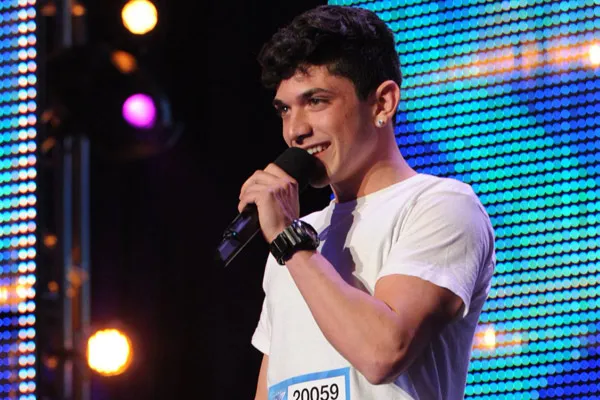
When 19-year-old Al Calderon stepped onto The X Factor USA stage, his charming smile and upbeat energy immediately captured the judges’ attention. Hailing from Long Island, New York, Al worked as a restaurant host whose primary duty was being the “designated Happy Birthday singer” whenever a table celebrated with a candle. Supported backstage by his proud dad—a city sanitation worker—Al made it clear that he was desperate to leave his restaurant job behind and pursue music full-time.
Taking a deep breath, Al stood in front of judges Simon Cowell, Demi Lovato, Kelly Rowland, and Paulina Rubio, ready to prove he was meant for much bigger stages than dining roomst Charmed the Room
Al took a risk with a soulful rendition of Hall & Oates’ classic hit, “Sara Smile.”
His natural smooth tone, combined with undeniable charisma and boy-next-door charm, had the crowd cheering and the judges smiling throughout his audition. Even as nerves crept in, his infectious energy resonated through every verse.
Why His Audition Caught Everyone’s Attention:
Slightly Edgy Smooth Vocals: A naturally soulful voice capable of taking on classic pop-rock hits.
Instant Charisma: Blushing on stage while charming the judges panel—even prompting Kelly Rowland to joke about wanting to go on a date with him!
Relatable Backstory: A hard-working teenager striving to trade his birthday-singing job for a professional music career.
“The Music Business Is Waiting For Someone Like You”
The judges praised Al’s star potential, noting that his natural talent far outweighed his initial audition jitters. Demi Lovato reassured him that his restaurant host days were officially over.
With four enthusiastic YES votes, Al walked off stage ecstatic, leaving his restaurant days behind and advancing straight to the next round!
When 9-year-old Immi Davis stepped onto the stage, no one could have predicted the powerhouse performance that was about to unfold. With her rendition of the iconic classic “I Put a Spell on You,” Immi not only captured the attention of the judges and audience but also left them spellbound by her mature voice, emotional depth, and magnetic stage presence.
Despite her young age, Immi sang with the confidence and control of a seasoned performer. Her ability to channel raw emotion into every note made the performance unforgettable, reminding everyone that true talent knows no age. The audience was on their feet, cheering her on as her voice soared with both intensity and precision.
The performance quickly became a viral sensation online, with viewers praising her astonishing vocal range and unique ability to interpret such a challenging, soulful song. Many described it as one of the most memorable performances by a child singer in recent years.
Immi Davis has proven herself to be far more than just a child prodigy—she’s an artist in the making. Her unforgettable take on “I Put a Spell on You” is a performance that fans and music lovers alike will be talking about for years to come.
When 14-year-old Darius Mabda walked onto the America’s Got Talent: All-Stars stage, the emotion in his eyes was instantly visible. Overwhelmed by the moment, the young performer was visibly shaking and fought back tears before he could even introduce himself.
Fresh off his victory as the winner of Romania’s Got Talent, Darius was making his very first trip to the United States. Taking on the biggest stage in global entertainment proved to be an overwhelming dream come true.
However, as soon as the music started, the nervous teen transformed into an unstoppable force of movement, grace, and athletic genius.
A Self-Taught Prodigy Who Amazed the World
What makes Darius’s story truly unbelievable is how he mastered his craft. Despite displaying elite-level technique, flexibility, and emotional storytelling, Darius revealed to the judges that he originally taught himself how to dance by watching YouTube videos of AGT when he was younger.
His routine blended intense contemporary dance with mind-bending contortion and gymnastics, leaving the audience cheering through every leap, spin, and back-bend.
What Made This Performance Extraordinary?
Borderline Contortionist Flexibility: He seamlessly integrated high-level acrobatics into a fluid, emotional narrative.
Self-Taught Brilliance: Learning complex choreography and technique purely through online videos before formal training.
Pure Emotional Depth: Turning his initial stage fright into raw, passionate energy that captivated the entire room.
“A Cross Between Nadia Comăneci and Baryshnikov!”
The judges were left completely floored by the sheer power and precision of his performance. Howie Mandel offered high praise, comparing the young prodigy to two legendary icons of gymnastics and ballet:
Simon Cowell admitted that while he initially thought it might be just another dance routine, Darius completely flipped expectations on their head, proving why he deserved a spot among the world’s elite talent.
Performance Quick Breakdown
Detail
Info
Performer
Darius Mabda
Age / Origin
14 / Romania
Claim to Fame
Winner of Romania’s Got Talent
Specialty
Contemporary Dance & Acrobatics (Self-taught via AGT videos)
Judge Reaction
Standing Ovation & High Praise from Howie Mandel & Simon Cowell
Watch the Breath-Taking Performance
Experience the incredible emotion and jaw-dropping choreography for yourself on YouTube:
From a taped enigma to a duo debating who rides the giraffe, a string of audacious acts proved you don’t need dialogue to crush a room. Here’s how they did it—and why the judges couldn’t stop laughing.
The night opened with a greeting that felt more like a handshake than an introduction: two visitors from Japan, new to America and to this stage, nodding, smiling, testing their English. “Nice to meet you. Hello.” They called themselves Liu and Yuya—“we are Sumaha”—and described the United States with the modest warmth of tourists who fell into the right postcard. “Very beautiful country,” they said, before looking out at the panel and adding, “Very beautiful humans.”
No one in the room could guess what would come next. A judge pressed them for details—was this their job in Japan? Ten years, they answered. The exchange grew loopy, like a warm-up sketch that doesn’t end. Someone cracked, “What is happening?” A beat later came the line that defined the mood: “They’re so cute.” And then, without a single premise set in neat words, they detonated the room.
What they delivered was sculpted silliness, the kind of physical comedy that winks at language and keeps going without it. The judges gushed in short bursts that perfectly matched the act: “That was genius.” “Genius.” “Really funny.” It was, as one of them put it, “Ten years in the making.” When asked whose idea it all was, the duo offered the kind of teamwork answer that sounds like a puzzle: “We our idea.” Their only creative debate? “Who’s gonna be on top when we do the giraffe.” Somehow, that choice—who rides the giraffe—became a thesis for their entire aesthetic: fearless, playful, and gloriously committed to the bit.
The laugh that needs no introduction
Later, a performer arrived without a name you could pin down. The host tried to figure it out: “You are… you are you.” The person’s face and body spoke more than their voice; when asked, “What do you have a name?” the best answer anyone got was a nod toward tape—“You’re taped.” What were they going to do? “You don’t know.” It shouldn’t have worked. It did.
Onstage, the silence didn’t hide anything; it revealed the craft. The audience saw a routine built on clean visual beats and punch lines that didn’t require translation. One judge summed it up: “Simple but clever, unique, funny, brilliant.” Another admitted, “At first, I thought you were so creepy, but then I really truly loved it.” The praise was so buoyant it swerved into self-parody: “By this time tomorrow,” a judge boomed, “everyone in America—no. No one in America is gonna know your name.” It was a perfect slip, a joke inside a joke about performance anonymity. The act’s mystery, it turned out, was a feature, not a bug.
Akira’s ‘never shown show’
The next quiet revolution came from a 51-year-old performer, Akira, who described his work with a phrase that was part riddle, part mission statement: “This is my full time job in Japan.” He asked to keep the plan a surprise, then hinted at the concept with a promise that felt like a wink: “Never shown show.” When the music cue finally came—“Music, start”—so did the point. We weren’t watching a spectacle; we were watching restraint turned into a punch line.
The rhythm was the joke. He said almost nothing, then said it at half-speed. “Slowly. More slowly. Okay. Okay.” The audience laughed because the stage dared them to—and because Akira knew exactly where to place the silence. Afterward, a judge teased, “You came all the way from Japan to show us that. Well, not show us that, actually. That was the whole point.” Akira answered, over the roar, “I gave everythi
The panel split for a moment. One judge warned, “I’m saying no. Absolutely no.” But the tide turned with a grin and a stamp of certainty: “A 100% yes.” If the night had a refrain, it was that simple: if it makes you laugh, it belongs.
The parody that wanted to be the original
Not every word-light act sailed through, and that made the triumphs feel earned. A performer who called herself Yuri Ann Retriever—“Yuriang Retriever is my stage name”—announced her hero list like a drumroll: “I only respect three people in the world, my mom and my dad. And? Julianne.” She had a cat, she explained. “His name is Retriever.”
Her routine was a pastiche of pop-dance poses and deliberate misses. One judge hit the buzzer anyway. Afterward, the conversation turned deliciously meta. “Julianne, you gave her a buzzer when every move you just watched was inspired by you.” The dancer pleaded her case directly: “Yes. I wanna be like you. But you buzz me. You buzz me.” The panel toyed with the line between flattery and craft. “You are so cute,” came the gentle verdict, followed by a surprising offer: “I am prepared to pay Julianne to give you dancing lessons.” Then the door closed softly: “It’s a no for now, so thank you.” Even here, the humor did its work. It made the sting feel like part of the show.
The science of a single plop
Then came a duo whose stage name landed with a thunk and a grin—“Yumbo. Dang.”—and a mission so microscopic it felt monumental: “Sound of a drop of water falling on the surface of water.” The demonstration hinged on a line that could have been written by a physics teacher with a sense of humor: “You have to get the right angle.”
The judges tried to keep it together. They failed, happily. “How many times are you sitting alone at home on the couch with your belly button going, what do I use this for?” one of them cracked, before conceding, “I’m gonna go home and I’m gonna try that.” The panel laughed at its own bafflement. “If you’re just tuning in now,” a judge said, “you’re gonna be going, what the hell am I watching?” And then the endorsement that every oddball artist wants to hear: “This is one of the funniest things and the most stupid things I’ve seen on this show.” When it came time to vote, two judges leapt in—“I wanna give you your first yes.” “We all need to laugh more in our lives, so I’m gonna give you a yes.”—and a third demurred. “I didn’t laugh, and I didn’t really get it, so I have to say no.” The act didn’t flinch. The laughter already had.
One comic who proved silence is a punch line
Amid the wordless wonders, one stand-up grabbed the mic and made a case for quiet of a different kind: the pause. He opened with a fastball, the kind of self-aware misdirection that kicks the door in: people ask me, “Is that genetic?” He answered himself: “Yes. Because you see, my mom was Irish, and my dad was a lobster.” Then he swiveled toward the invisible hum in all our living rooms—subtitles. “I wear hearing aids, so I watch all my movies and TV shows with the subtitles on. My favorite is when the subtitle says, ‘indistinct chatter.’”
He worked the crowd with mischief and care, admitting the daily obstacle course of a drive-thru—“you gotta say the order fast, and you’re talking through an intercom”—before popping the tension with a joke that only lands if the room trusts you. “Let’s talk about the elephant in the room,” he said. “Who ordered Stephen Hawking off of wish.com?” It drew a gasp, then a laugh, because he immediately reclaimed the line as his own story and capped it with a twist of pride: “He might be smarter than me, but I would beat him in a race.” Every beat was a reminder that even spoken comedy is sculpted with silence—that a pause, placed right, can be louder than a punch line.
Why the room cracked
Across the night, the through line was simple: when performers handled silence with purpose, everyone listened harder. Sumaha turned a “What is happening?” into a roar of recognition, turning a decade of craft into an instant classic. The anonymous, taped mystery figure let the audience fill in every blank, while a judge narrated the shape of the laugh with perfect honesty: “It was, like, simple but clever, unique, funny, brilliant.” Akira moved even the skeptics by engineering the world’s slowest reveal—“Slowly. More slowly. Okay.”—until the panel pushed its chairs back and said the quiet part out loud: “This is what AGT is all about.”
Even the outliers stitched into the theme. Yuri Ann Retriever showed how parody lives or dies on precision, turning “I wanna be like you” into a dialogue about taste and timing. Yumbo Dump proved that the most fragile sound effect can carry a whole room if the setup is brave enough. As one judge put it, “I think what your talent is is making people laugh with really weird things that you do.” In between, judges confessed their own bewilderment and joy. One stared into the lights and said, half-plea, half-promise: “I don’t know what it is, but I really, really think that you deserve this.” Another turned to a colleague after a big decision and announced, “You shocked the world.”
Maybe that’s the point. Comedy doesn’t always need a thesis statement. Sometimes it just needs a body, a rhythm, and the courage to say very little. The performers who triumphed didn’t chase translation; they trusted reaction. They didn’t explain. They showed. And the room—judges included—met them where they were, halfway between confusion and delight.
Want to see how far a joke can travel without a script? Watch the video and follow the beats that words can’t catch. The next time a crowd bursts into laughter before anyone speaks, you’ll know what’s happening: silence, stealing the show.
☆ABOUT AMERICA’S GOT TALENT☆ Creator and Executive Producer Simon Cowell returns to the judges’ panel along with Howie Mandel, Heidi Klum and Sofia Vergara. Terry Crews, who made a big splash as the host of the inaugural series “America’s Got Talent: The Champions”, joins as host for “America’s Got Talent.” With the show open to acts of all ages, AGT 2022 continues to celebrate the variety format like no other show on television. Year after year, “America’s Got Talent” features a colorful array of singers, dancers, comedians, contortionists, impressionists, magicians, ventriloquists and hopeful stars, all vying to win America’s hearts and a $1 million prize. ☆ABOUT TALENT RECAP☆ Talent Recap is the #1 independent website which is exclusively dedicated to the fans of the most popular talent shows around the world. As passionate fans of these shows, we provide news, analysis and fan engagement on America’s Got Talent, Britain’s Got Talent, The Voice, The X Factor, American Idol, The Four, The Masked Singer, The World’s Best and its contestants.
☆ABOUT AMERICA’S GOT TALENT☆ Creator and Executive Producer Simon Cowell returns to the judges’ panel along with Howie Mandel, Heidi Klum and Sofia Vergara. Terry Crews, who made a big splash as the host of the inaugural series “America’s Got Talent: The Champions”, joins as host for “America’s Got Talent.” With the show open to acts of all ages, AGT 2022 continues to celebrate the variety format like no other show on television. Year after year, “America’s Got Talent” features a colorful array of singers, dancers, comedians, contortionists, impressionists, magicians, ventriloquists and hopeful stars, all vying to win America’s hearts and a $1 million prize. ☆ABOUT TALENT RECAP☆ Talent Recap is the #1 independent website which is exclusively dedicated to the fans of the most popular talent shows around the world. As passionate fans of these shows, we provide news, analysis and fan engagement on America’s Got Talent, Britain’s Got Talent, The Voice, The X Factor, American Idol, The Four, The Masked Singer, The World’s Best and its contestants.
☆ABOUT AMERICA’S GOT TALENT☆ Creator and Executive Producer Simon Cowell returns to the judges’ panel along with Howie Mandel, Heidi Klum and Sofia Vergara. Terry Crews, who made a big splash as the host of the inaugural series “America’s Got Talent: The Champions”, joins as host for “America’s Got Talent.” With the show open to acts of all ages, AGT 2022 continues to celebrate the variety format like no other show on television. Year after year, “America’s Got Talent” features a colorful array of singers, dancers, comedians, contortionists, impressionists, magicians, ventriloquists and hopeful stars, all vying to win America’s hearts and a $1 million prize. ☆ABOUT TALENT RECAP☆ Talent Recap is the #1 independent website which is exclusively dedicated to the fans of the most popular talent shows around the world. As passionate fans of these shows, we provide news, analysis and fan engagement on America’s Got Talent, Britain’s Got Talent, The Voice, The X Factor, American Idol, The Four, The Masked Singer, The World’s Best and its contestants.
Backstage, even the most hardened critics were visibly shaken. Among them was Simon Cowell, known for his cutting remarks and uncompromising honesty. But as she reached the heart of the performance, his usually steely composure melted into complete awe and disbelief. With his eyes wide and his jaw slack, Simon, a man known to rarely be at a loss for words, was left entirely speechless. His silence spoke volumes, instantly setting social media abuzz with excited chatter and fervent praise.
In that singular performance, she not only captured the essence of Whitney Houston’s iconic style but also imprinted her own identity upon the piece, transforming it into something new yet achingly familiar. Every note resonated with so much passion and depth that the audience felt as if they were witnessing a rebirth of a legend, a celebration of timeless talent that transcended generations.
After the final note had faded into a thunderous standing ovation, her eyes sparkled with relief and joy. Tears of elation streamed down faces all around, as viewers and critics alike began to share their thoughts on the overwhelming performance. Social media platforms exploded with praise, comparisons, and a flurry of hashtags celebrating the unforgettable moment. Interviews followed, with former doubters now questioning how someone so young could embody the spirit of such an iconic voice.
In the days that followed, her performance became the talk of the town. TV shows, blogs, and magazine features dissected every nuance of her act—every subtle inflection, every deliberate pause, and every electrifying high note. People marveled at the flawless mimicry of Whitney Houston’s style, yet no two reviews were exactly alike; some saw echoes of a bygone era, while others heralded the emergence of a new superstar in her own right.
That night, in a modest dressing room backstage, she sat quietly, still in disbelief at what she had just achieved. The memory of seeing Simon Cowell, one of the most discerning voices in the industry, rendered speechless was a humbling reminder that talent, when fused with passion and dedication, transcends all boundaries. As she prepared to leave the stage, an overwhelming feeling of gratitude washed over her—a gratitude for the opportunity to share her gift and for the support of an audience that recognized true artistry when they heard it.
Her journey was just beginning, and while she knew that there would be challenges ahead, that transformative performance had redefined her destiny. It was a night of magic, where every chord struck a chord in the hearts of those present, and where a single performance created ripples that would echo throughout the music industry for years to come. This was more than an act; it was an awakening, a powerful reminder that sometimes, under the bright lights of fame, legends are reborn.


 Watch now: