The night opened with a greeting that felt more like a handshake than an introduction: two visitors from Japan, new to America and to this stage, nodding, smiling, testing their English. “Nice to meet you. Hello.” They called themselves Liu and Yuya—“we are Sumaha”—and described the United States with the modest warmth of tourists who fell into the right postcard. “Very beautiful country,” they said, before looking out at the panel and adding, “Very beautiful humans.”
No one in the room could guess what would come next. A judge pressed them for details—was this their job in Japan? Ten years, they answered. The exchange grew loopy, like a warm-up sketch that doesn’t end. Someone cracked, “What is happening?” A beat later came the line that defined the mood: “They’re so cute.” And then, without a single premise set in neat words, they detonated the room.
What they delivered was sculpted silliness, the kind of physical comedy that winks at language and keeps going without it. The judges gushed in short bursts that perfectly matched the act: “That was genius.” “Genius.” “Really funny.” It was, as one of them put it, “Ten years in the making.” When asked whose idea it all was, the duo offered the kind of teamwork answer that sounds like a puzzle: “We our idea.” Their only creative debate? “Who’s gonna be on top when we do the giraffe.” Somehow, that choice—who rides the giraffe—became a thesis for their entire aesthetic: fearless, playful, and gloriously committed to the bit.
The laugh that needs no introduction
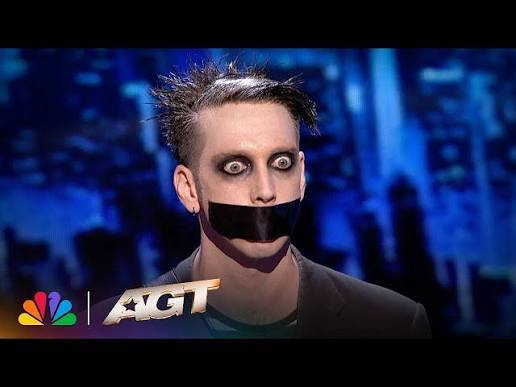
Later, a performer arrived without a name you could pin down. The host tried to figure it out: “You are… you are you.” The person’s face and body spoke more than their voice; when asked, “What do you have a name?” the best answer anyone got was a nod toward tape—“You’re taped.” What were they going to do? “You don’t know.” It shouldn’t have worked. It did.
Onstage, the silence didn’t hide anything; it revealed the craft. The audience saw a routine built on clean visual beats and punch lines that didn’t require translation. One judge summed it up: “Simple but clever, unique, funny, brilliant.” Another admitted, “At first, I thought you were so creepy, but then I really truly loved it.” The praise was so buoyant it swerved into self-parody: “By this time tomorrow,” a judge boomed, “everyone in America—no. No one in America is gonna know your name.” It was a perfect slip, a joke inside a joke about performance anonymity. The act’s mystery, it turned out, was a feature, not a bug.
Akira’s ‘never shown show’
The next quiet revolution came from a 51-year-old performer, Akira, who described his work with a phrase that was part riddle, part mission statement: “This is my full time job in Japan.” He asked to keep the plan a surprise, then hinted at the concept with a promise that felt like a wink: “Never shown show.” When the music cue finally came—“Music, start”—so did the point. We weren’t watching a spectacle; we were watching restraint turned into a punch line.
The rhythm was the joke. He said almost nothing, then said it at half-speed. “Slowly. More slowly. Okay. Okay.” The audience laughed because the stage dared them to—and because Akira knew exactly where to place the silence. Afterward, a judge teased, “You came all the way from Japan to show us that. Well, not show us that, actually. That was the whole point.” Akira answered, over the roar, “I gave everythi
The panel split for a moment. One judge warned, “I’m saying no. Absolutely no.” But the tide turned with a grin and a stamp of certainty: “A 100% yes.” If the night had a refrain, it was that simple: if it makes you laugh, it belongs.
The parody that wanted to be the original

Not every word-light act sailed through, and that made the triumphs feel earned. A performer who called herself Yuri Ann Retriever—“Yuriang Retriever is my stage name”—announced her hero list like a drumroll: “I only respect three people in the world, my mom and my dad. And? Julianne.” She had a cat, she explained. “His name is Retriever.”
Her routine was a pastiche of pop-dance poses and deliberate misses. One judge hit the buzzer anyway. Afterward, the conversation turned deliciously meta. “Julianne, you gave her a buzzer when every move you just watched was inspired by you.” The dancer pleaded her case directly: “Yes. I wanna be like you. But you buzz me. You buzz me.” The panel toyed with the line between flattery and craft. “You are so cute,” came the gentle verdict, followed by a surprising offer: “I am prepared to pay Julianne to give you dancing lessons.” Then the door closed softly: “It’s a no for now, so thank you.” Even here, the humor did its work. It made the sting feel like part of the show.
The science of a single plop
Then came a duo whose stage name landed with a thunk and a grin—“Yumbo. Dang.”—and a mission so microscopic it felt monumental: “Sound of a drop of water falling on the surface of water.” The demonstration hinged on a line that could have been written by a physics teacher with a sense of humor: “You have to get the right angle.”
The judges tried to keep it together. They failed, happily. “How many times are you sitting alone at home on the couch with your belly button going, what do I use this for?” one of them cracked, before conceding, “I’m gonna go home and I’m gonna try that.” The panel laughed at its own bafflement. “If you’re just tuning in now,” a judge said, “you’re gonna be going, what the hell am I watching?” And then the endorsement that every oddball artist wants to hear: “This is one of the funniest things and the most stupid things I’ve seen on this show.” When it came time to vote, two judges leapt in—“I wanna give you your first yes.” “We all need to laugh more in our lives, so I’m gonna give you a yes.”—and a third demurred. “I didn’t laugh, and I didn’t really get it, so I have to say no.” The act didn’t flinch. The laughter already had.
One comic who proved silence is a punch line
Amid the wordless wonders, one stand-up grabbed the mic and made a case for quiet of a different kind: the pause. He opened with a fastball, the kind of self-aware misdirection that kicks the door in: people ask me, “Is that genetic?” He answered himself: “Yes. Because you see, my mom was Irish, and my dad was a lobster.” Then he swiveled toward the invisible hum in all our living rooms—subtitles. “I wear hearing aids, so I watch all my movies and TV shows with the subtitles on. My favorite is when the subtitle says, ‘indistinct chatter.’”
He worked the crowd with mischief and care, admitting the daily obstacle course of a drive-thru—“you gotta say the order fast, and you’re talking through an intercom”—before popping the tension with a joke that only lands if the room trusts you. “Let’s talk about the elephant in the room,” he said. “Who ordered Stephen Hawking off of wish.com?” It drew a gasp, then a laugh, because he immediately reclaimed the line as his own story and capped it with a twist of pride: “He might be smarter than me, but I would beat him in a race.” Every beat was a reminder that even spoken comedy is sculpted with silence—that a pause, placed right, can be louder than a punch line.
Why the room cracked
Across the night, the through line was simple: when performers handled silence with purpose, everyone listened harder. Sumaha turned a “What is happening?” into a roar of recognition, turning a decade of craft into an instant classic. The anonymous, taped mystery figure let the audience fill in every blank, while a judge narrated the shape of the laugh with perfect honesty: “It was, like, simple but clever, unique, funny, brilliant.” Akira moved even the skeptics by engineering the world’s slowest reveal—“Slowly. More slowly. Okay.”—until the panel pushed its chairs back and said the quiet part out loud: “This is what AGT is all about.”
Even the outliers stitched into the theme. Yuri Ann Retriever showed how parody lives or dies on precision, turning “I wanna be like you” into a dialogue about taste and timing. Yumbo Dump proved that the most fragile sound effect can carry a whole room if the setup is brave enough. As one judge put it, “I think what your talent is is making people laugh with really weird things that you do.” In between, judges confessed their own bewilderment and joy. One stared into the lights and said, half-plea, half-promise: “I don’t know what it is, but I really, really think that you deserve this.” Another turned to a colleague after a big decision and announced, “You shocked the world.”
Maybe that’s the point. Comedy doesn’t always need a thesis statement. Sometimes it just needs a body, a rhythm, and the courage to say very little. The performers who triumphed didn’t chase translation; they trusted reaction. They didn’t explain. They showed. And the room—judges included—met them where they were, halfway between confusion and delight.
Want to see how far a joke can travel without a script? Watch the video and follow the beats that words can’t catch. The next time a crowd bursts into laughter before anyone speaks, you’ll know what’s happening: silence, stealing the show.